Pearson Edexcel · GCSE · English Language
Course version: 1EN0 · Version from Mar 2026
AO8: Listen and respond appropriately to spoken language, including to…
Full specification wording
Assessment Objectives: AO8: Listen and respond appropriately to spoken language, including to questions and feedback to presentations
AO8 requires you to listen actively to spoken language and respond appropriately, especially when answering questions or receiving feedback after a presentation.
Checked against the Pearson Edexcel 1EN0 specification (opens in a new tab) on .
- Point 8 of 9
- 4 key terms
Study notes
From the checked teaching notes for this specification point.
The idea
AO8 requires you to listen actively to spoken language and respond appropriately, especially when answering questions or receiving feedback after a presentation. You must show that you have understood the speaker's points, then reply in a way that is relevant, respectful and developed. For example, if an audience member asks why you chose a particular example, you might acknowledge the question, explain your reasoning and link back to your main argument. You should maintain eye contact, avoid interrupting, ask for clarification when needed, and build on what others say. Assessment focuses on the quality and appropriateness of your spoken responses in formal contexts, including how well you engage with questions and feedback.
What earns the marks
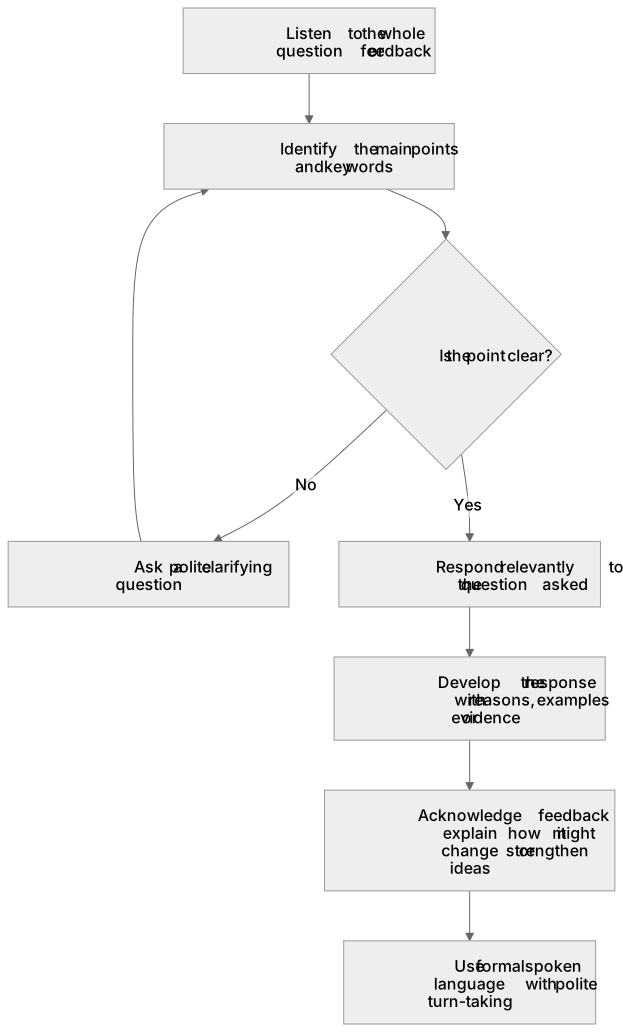
- Listening attentively to questions and feedback and identifying the main points being made.
- Responding relevantly to the question asked rather than repeating a prepared answer.
- Developing responses with reasons, examples or evidence that support your point of view.
- Using appropriate formal spoken language, including polite turn-taking and respectful disagreement.
- Seeking clarification or asking follow-up questions when a point is unclear.
- Building on feedback by acknowledging it and explaining how it might change or strengthen your ideas.
Common mistakes and how to put them right
Ignoring the question and repeating a rehearsed speech.
Put it right: Pause, identify the key words in the question and answer that specific point first.
Responding aggressively or dismissively to feedback.
Put it right: Thank the speaker, acknowledge the point and then explain your reasoning calmly.
Giving one-word or very brief answers.
Put it right: Extend each response with a reason, example or link back to your presentation.
Exam tips
- Listen to the whole question before planning your answer, and note one or two keywords mentally.
- Use phrases such as 'That's a fair point, however...' to acknowledge feedback while developing your response.
- If you are unsure, ask a polite clarifying question rather than guessing or staying silent.
Try the lesson
The start of the Assessment Objectives: AO8: Listen and respond appropriately to spoken language, including to questions and feedback to presentations lesson, made from checked teaching notes for this specification point.
Have a go first
During a formal presentation, an audience member asks a complex question that the speaker does not fully understand. Which is the most appropriate way for the speaker to respond?
Listen
AO8 requires you to listen actively to spoken language and respond appropriately, especially when answering questions or receiving feedback after a presentation. You must show that you have understood the speaker's points, then reply in a way that is relevant, respectful and developed. For example, if an audience member asks why you chose a particular example, you might acknowledge the question, explain your reasoning and link back to your main argument. You should maintain eye contact, avoid interrupting, ask for clarification when needed, and build on what others say. Assessment focuses on the quality and appropriateness of your spoken responses in formal contexts, including how well you engage with questions and feedback. A strong answer earns marks for these points. Listening attentively to questions and feedback and identifying the main points being made. Responding relevantly to the question asked rather than repeating a prepared answer. Developing responses with reasons, examples or evidence that support your point of view. Using appropriate formal spoken language, including polite turn-taking and respectful disagreement. A common slip: Ignoring the question and repeating a rehearsed speech: this shows poor listening. Instead, pause, identify the key words in the question and answer that specific point first. Exam tip: Listen to the whole question before planning your answer, and note one or two keywords mentally.
See it
Key words
Say what each word means before you turn the card.
Active listening
Try answering aloud or in your head before turning the card.
Relevant response
Try answering aloud or in your head before turning the card.
Formal spoken interaction
Try answering aloud or in your head before turning the card.
Feedback and clarification
Try answering aloud or in your head before turning the card.
See every definition
- Active listening
- Listening attentively to questions and feedback and identifying the main points being made.
- Relevant response
- Replying to the question asked rather than repeating a prepared answer.
- Formal spoken interaction
- Using appropriate formal spoken language, including polite turn-taking and respectful disagreement.
- Feedback and clarification
- Building on feedback by acknowledging it and explaining how it might change or strengthen your ideas, and seeking clarification or asking follow-up questions when a point is unclear.
Label the diagram
Some boxes have lost their names. Pick the right name for each number.
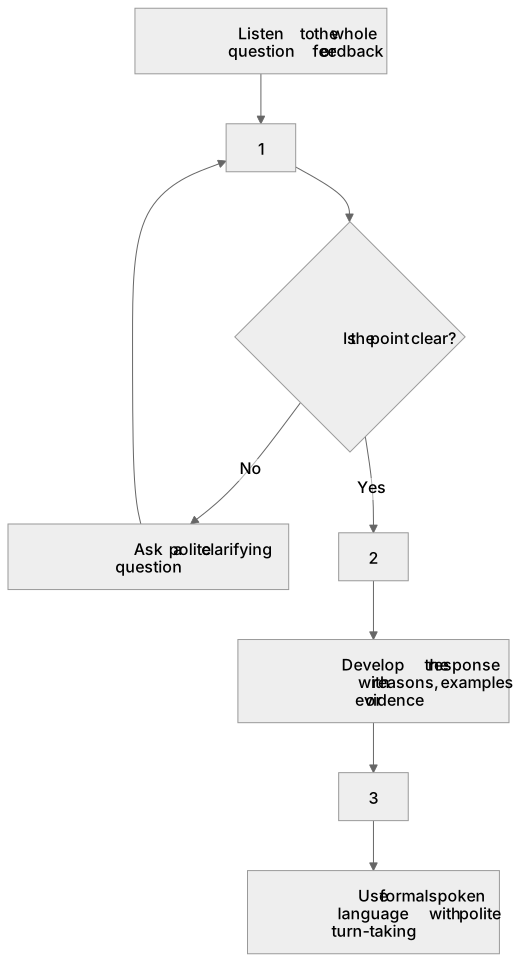
1Box 1
2Box 2
3Box 3
There is more to this lesson
The full lesson goes on to check your understanding and help you earn the marks. Create a free account to carry on, with your progress saved.
A week of Premium from your first lesson · Then the free plan continues · No card, no charge
Test your understanding of Assessment Objectives: AO8: Listen and respond appropriately to spoken language, including to questions and feedback to presentations
Active recall beats re-reading. Take an instant quiz now to test what you’ve learned and lock it into long-term memory.
A week of Premium from your first lesson · Then the free plan continues · No card, no charge