Pearson Edexcel · GCSE · English Language
Course version: 1EN0 · Version from Mar 2026
Fiction and Imaginative Writing - 1.1 Reading: 1.1.3 summary: identify the…
Full specification wording
Component 1: Fiction and Imaginative Writing - 1.1 Reading: 1.1.3 summary: identify the main theme or themes; summarise ideas and information from a single text
Summary is a reading skill in the 1.1.3 specification clause: identify the main theme or themes and condense ideas and information from a single text.
Checked against the Pearson Edexcel 1EN0 specification (opens in a new tab) on .
- Point 3 of 4
- 4 key terms
Study notes
From the checked teaching notes for this specification point.
The idea
Summary is a reading skill in the 1.1.3 specification clause: identify the main theme or themes and condense ideas and information from a single text. Read the question first, then re-read the relevant lines and select key points, translating them into your own vocabulary rather than copying the writer's phrasing. For example, if the extract describes a character's growing fear, a summary point might be 'the narrator becomes increasingly anxious as the journey continues', supported by a brief reference. Summarising also supports the longer analytical and evaluative questions: grasping central concerns, such as isolation or survival, helps you select relevant evidence and track how a theme develops. Note that Paper 1 Question 1 is a short retrieval question, not a summary task; Component 2 assesses synthesis and comparison across texts, not a standalone summary.
What earns the marks
- Identifies the main theme or themes of a single fiction text to establish a clear focus.
- Selects key ideas and information from the relevant part of the text, distinguishing major points from minor detail.
- Expresses ideas in own words rather than copying the writer's phrasing.
- Condenses the narrative into concise points that track how a theme or idea develops.
- Uses summary as a foundation for selecting relevant evidence in longer analytical and evaluative responses.
Common mistakes and how to put them right
Copying whole sentences from the extract instead of using own words.
Put it right: Read the line, cover it, then write the idea in your own vocabulary.
Treating summary as the final goal and writing a narrative recount instead of selecting key points.
Put it right: Use your summary of the text's themes as a starting point to select evidence for analysis and evaluation.
Focusing on a minor detail early in the text and incorrectly identifying it as the main theme.
Put it right: Read the entire extract first to ensure the identified theme is central to the whole passage.
Exam tips
- Paper 1 Question 1 is a short retrieval question, so practise locating explicit information quickly; summary skills are assessed in other questions and in Component 2.
- Jot down the main theme and three key bullet points summarising the narrative progression before you start writing your longer answers.
Try the lesson
The start of the Component 1: Fiction and Imaginative Writing - 1.1 Reading: 1.1.3 summary: identify the main theme or themes; summarise ideas and information from a single text lesson, made from checked teaching notes for this specification point.
Have a go first
Which of the following best describes the main theme of a text?
Listen
Summary is a reading skill in the 1.1.3 specification clause: identify the main theme or themes and condense ideas and information from a single text. Read the question first, then re-read the relevant lines and select key points, translating them into your own vocabulary rather than copying the writer's phrasing. For example, if the extract describes a character's growing fear, a summary point might be 'the narrator becomes increasingly anxious as the journey continues', supported by a brief reference. Summarising also supports the longer analytical and evaluative questions: grasping central concerns, such as isolation or survival, helps you select relevant evidence and track how a theme develops. Note that Paper 1 Question 1 is a short retrieval question, not a summary task; Component 2 assesses synthesis and comparison across texts, not a standalone summary. A strong answer earns marks for these points. Identifies the main theme or themes of a single fiction text to establish a clear focus. Selects key ideas and information from the relevant part of the text, distinguishing major points from minor detail. Expresses ideas in own words rather than copying the writer's phrasing. Condenses the narrative into concise points that track how a theme or idea develops. A common slip: Copying whole sentences from the extract instead of using own words. Instead, read the line, cover it, then write the idea in your own vocabulary. Exam tip: Paper 1 Question 1 is a short retrieval question, so practise locating explicit information quickly; summary skills are assessed in other questions and in Component 2.
See it
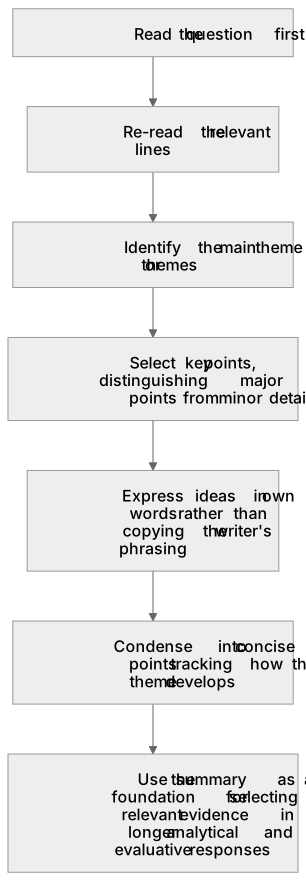
Put it in order
Put these steps in the order they happen.
- 1. Use the summary as a foundation for selecting relevant evidence in longer analytical and evaluative responses
- 2. Condense into concise points tracking how the theme develops
- 3. Identify the main theme or themes
- 4. Express ideas in own words rather than copying the writer's phrasing
- 5. Read the question first
- 6. Re-read the relevant lines
- 7. Select key points, distinguishing major points from minor detail
Key words
Say what each word means before you turn the card.
main theme
Try answering aloud or in your head before turning the card.
summarise
Try answering aloud or in your head before turning the card.
own words
Try answering aloud or in your head before turning the card.
relevant evidence
Try answering aloud or in your head before turning the card.
See every definition
- main theme
- The central concern of a single fiction text, which a reader identifies to establish a clear focus.
- summarise
- Condensing ideas and information from a single text into concise points, expressing them in your own words rather than copying the writer's phrasing.
- own words
- Expressing ideas in your own vocabulary rather than copying the writer's phrasing from the extract.
- relevant evidence
- Material selected from the text to support longer analytical and evaluative responses, chosen once the central concerns have been grasped.
Label the diagram
Some boxes have lost their names. Pick the right name for each number.
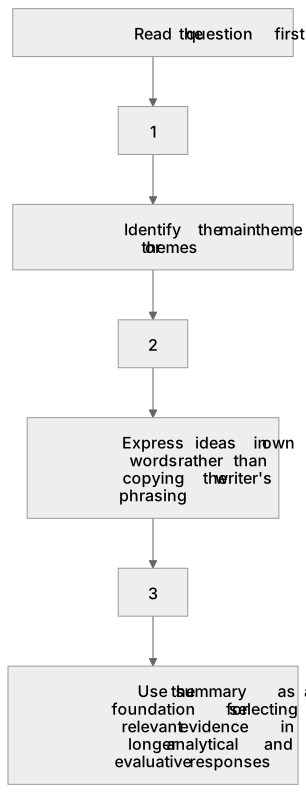
1Box 1
2Box 2
3Box 3
There is more to this lesson
The full lesson goes on to check your understanding and help you earn the marks. Create a free account to carry on, with your progress saved.
A week of Premium from your first lesson · Then the free plan continues · No card, no charge
Test your understanding of Component 1: Fiction and Imaginative Writing - 1.1 Reading: 1.1.3 summary: identify the main theme or themes; summarise ideas and information from a single text
Active recall beats re-reading. Take an instant quiz now to test what you’ve learned and lock it into long-term memory.
A week of Premium from your first lesson · Then the free plan continues · No card, no charge