Pearson Edexcel · GCSE · English Language
Course version: 1EN0 · Version from Mar 2026
Non-fiction and Transactional Writing - 2.1 Reading: 2.1.3 summary and…
Full specification wording
Component 2: Non-fiction and Transactional Writing - 2.1 Reading: 2.1.3 summary and synthesis: identify the main theme or themes; summarise ideas and information from a single text; synthesise from more than one text
This skill has three connected layers.
Checked against the Pearson Edexcel 1EN0 specification (opens in a new tab) on .
- Point 3 of 5
- 3 key terms
Study notes
From the checked teaching notes for this specification point.
The idea
This skill has three connected layers. First, identify the main theme or themes: decide what the text is centrally about, such as the pressures on young carers or the benefits of urban green space, and support that judgement with the text's dominant ideas rather than a single detail. Second, summarise ideas and information from a single text: select the most important points across the whole passage, including opening and closing sections, and condense them in your own words while keeping the writer's meaning. Third, synthesise from more than one text: combine points from two sources, showing where they agree, where they differ and how together they build a fuller picture. A useful method is to annotate each text for its big idea, then group related points across both texts before writing a concise response that moves between the sources.
What earns the marks
- Identifies a main theme or themes that genuinely govern the whole text, not a minor detail from one paragraph.
- Selects ideas and information from across a single text, including its beginning and ending, rather than only the most memorable section.
- Condenses single-text material into concise summary, using own words while preserving the writer's meaning and emphasis.
- Combines material from more than one text, making clear which source each point comes from.
- Shows relationships between texts, such as agreement, contrast or one text extending the other, rather than listing them separately.
- Uses textual detail selectively to anchor summary and synthesis without copying long quotations.
Common mistakes and how to put them right
Retelling the whole text in sequence instead of condensing it.
Put it right: Group points by idea and cut repetition so the summary is shorter than the original.
Treating synthesis as two separate summaries placed side by side.
Put it right: Link points explicitly, for example 'Both texts agree that... whereas Source 2 adds...'.
Choosing a theme that fits only one paragraph.
Put it right: Test a candidate theme against the whole text and adjust it until it covers the dominant ideas.
Exam tips
- Read the question first so you know whether it asks for theme, summary or synthesis, then read with that purpose.
- Annotate each source with a short label for its main idea before writing, so your response has a clear structure.
- Use comparative signposts such as 'similarly', 'in contrast' and 'both' to make synthesis visible to the reader.
- Keep quotations brief and embed them, since the skill is selection and combination rather than quotation hunting.
Try the lesson
The start of the Component 2: Non-fiction and Transactional Writing - 2.1 Reading: 2.1.3 summary and synthesis: identify the main theme or themes; summarise ideas and information from a single text; synthesise from more than one text lesson, made from checked teaching notes for this specification point.
Have a go first
Read the short passage: 'Every Saturday, Maya volunteers at the community garden. She plants seeds, waters the beds and shares the vegetables with neighbours who need them. She says the garden brings people together.' Which option best states the main theme of the passage?
Listen
This skill has three connected layers. First, identify the main theme or themes: decide what the text is centrally about, such as the pressures on young carers or the benefits of urban green space, and support that judgement with the text's dominant ideas rather than a single detail. Second, summarise ideas and information from a single text: select the most important points across the whole passage, including opening and closing sections, and condense them in your own words while keeping the writer's meaning. Third, synthesise from more than one text: combine points from two sources, showing where they agree, where they differ and how together they build a fuller picture. A useful method is to annotate each text for its big idea, then group related points across both texts before writing a concise response that moves between the sources. A strong answer earns marks for these points. Identifies a main theme or themes that genuinely govern the whole text, not a minor detail from one paragraph. Selects ideas and information from across a single text, including its beginning and ending, rather than only the most memorable section. Condenses single-text material into concise summary, using own words while preserving the writer's meaning and emphasis. Combines material from more than one text, making clear which source each point comes from. A common slip: Retelling the whole text in sequence instead of condensing it. Instead, group points by idea and cut repetition so the summary is shorter than the original. Exam tip: Read the question first so you know whether it asks for theme, summary or synthesis, then read with that purpose.
See it
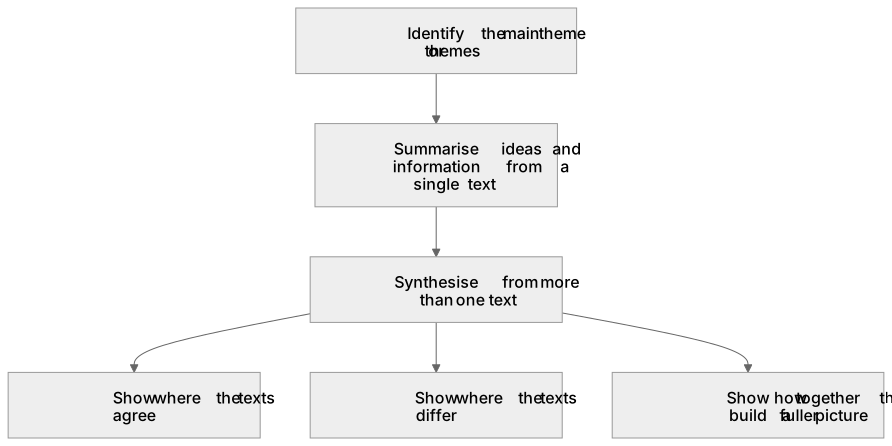
Key words
Say what each word means before you turn the card.
main theme
Try answering aloud or in your head before turning the card.
summary
Try answering aloud or in your head before turning the card.
synthesis
Try answering aloud or in your head before turning the card.
See every definition
- main theme
- The idea that is centrally what the text is about, supported by its dominant ideas rather than a single detail.
- summary
- Selecting the most important points across the whole passage, including opening and closing sections, and condensing them in your own words while keeping the writer's meaning.
- synthesis
- Combining points from two sources, showing where they agree, where they differ and how together they build a fuller picture.
Label the diagram
Some boxes have lost their names. Pick the right name for each number.
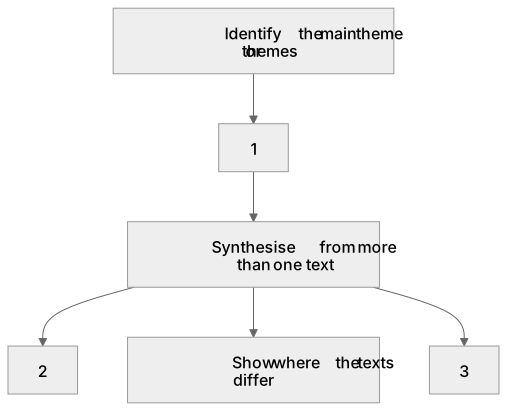
1Box 1
2Box 2
3Box 3
There is more to this lesson
The full lesson goes on to check your understanding and help you earn the marks. Create a free account to carry on, with your progress saved.
A week of Premium from your first lesson · Then the free plan continues · No card, no charge
Test your understanding of Component 2: Non-fiction and Transactional Writing - 2.1 Reading: 2.1.3 summary and synthesis: identify the main theme or themes; summarise ideas and information from a single text; synthesise from more than one text
Active recall beats re-reading. Take an instant quiz now to test what you’ve learned and lock it into long-term memory.
A week of Premium from your first lesson · Then the free plan continues · No card, no charge