Pearson Edexcel · GCSE · English Language
Course version: 1EN0 · Version from Mar 2026
Non-fiction and Transactional Writing - 2.1 Reading: 2.1.5 compare texts:…
Full specification wording
Component 2: Non-fiction and Transactional Writing - 2.1 Reading: 2.1.5 compare texts: compare two or more texts critically with respect to the above.
Comparing texts critically means going beyond spotting surface similarities.
Checked against the Pearson Edexcel 1EN0 specification (opens in a new tab) on .
- Point 5 of 5
- 4 key terms
Study notes
From the checked teaching notes for this specification point.
The idea
Comparing texts critically means going beyond spotting surface similarities. You read two non-fiction extracts, identify each writer's viewpoint, purpose and audience, then examine how language, structure and tone create those effects. This ties into earlier criteria: interpreting information, analysing language and structure, and evaluating viewpoints. A strong method is to select a shared idea, such as attitudes to technology, then track how Writer A uses statistics while Writer B uses anecdote. You weigh which approach is more persuasive and why, supporting every judgement with a short quotation. Comparison is assessed through your ability to move fluently between texts, rather than describing them separately.
What earns the marks
- Selects a genuine point of comparison, such as differing attitudes to the same issue, rather than listing features of each text in turn.
- Supports comparison with concise quotations or references from both texts, integrating them into the same sentence or paragraph.
- Analyses how language, form and structure shape meaning, for example contrasting a statistic with a rhetorical question.
- Evaluates the effectiveness of each writer's choices, judging which text is more convincing and justifying that view.
- Maintains a clear comparative thread using discourse markers such as 'whereas', 'similarly' and 'in contrast'.
- Connects comparison back to viewpoint, purpose and audience, showing why the differences matter.
Common mistakes and how to put them right
Writing two separate text descriptions joined by 'both texts are similar'.
Put it right: Organise each paragraph around one comparative point and discuss both texts within it.
Retelling what each text says without analysing how meaning is made.
Put it right: Attach a method to every quotation, naming the language or structural choice and its effect.
Asserting that one text is 'better' without evidence.
Put it right: State the criterion, such as clarity or emotional impact, and support the judgement with textual detail.
Exam tips
- Plan briefly by noting two or three shared ideas and the evidence for each before writing.
- Use comparative signposts deliberately so the examiner can track the argument across paragraphs.
- Keep quotations short and embed them, then spend more words on analysis than on copying the text.
Try the lesson
The start of the Component 2: Non-fiction and Transactional Writing - 2.1 Reading: 2.1.5 compare texts: compare two or more texts critically with respect to the above. lesson, made from checked teaching notes for this specification point.
Have a go first
A student is comparing two non-fiction texts about school uniforms. Which sentence best shows a direct comparison of the two texts?
Listen
Comparing texts critically means going beyond spotting surface similarities. You read two non-fiction extracts, identify each writer's viewpoint, purpose and audience, then examine how language, structure and tone create those effects. This ties into earlier criteria: interpreting information, analysing language and structure, and evaluating viewpoints. A strong method is to select a shared idea, such as attitudes to technology, then track how Writer A uses statistics while Writer B uses anecdote. You weigh which approach is more persuasive and why, supporting every judgement with a short quotation. Comparison is assessed through your ability to move fluently between texts, rather than describing them separately. A strong answer earns marks for these points. Selects a genuine point of comparison, such as differing attitudes to the same issue, rather than listing features of each text in turn. Supports comparison with concise quotations or references from both texts, integrating them into the same sentence or paragraph. Analyses how language, form and structure shape meaning, for example contrasting a statistic with a rhetorical question. Evaluates the effectiveness of each writer's choices, judging which text is more convincing and justifying that view. A common slip: Writing two separate text descriptions joined by 'both texts are similar'. Instead, organise each paragraph around one comparative point and discuss both texts within it. Exam tip: Plan briefly by noting two or three shared ideas and the evidence for each before writing.
See it
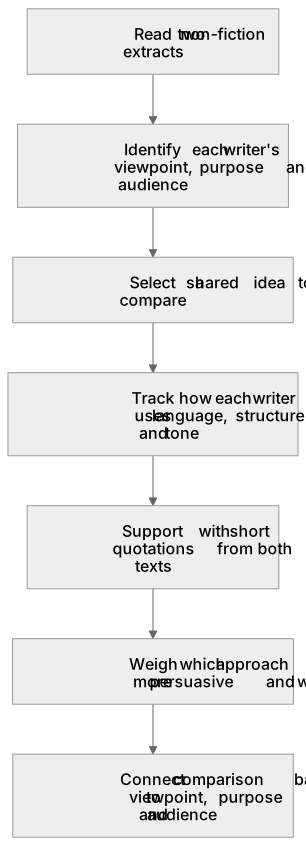
Put it in order
Put these steps in the order they happen.
- 1. Connect comparison back to viewpoint, purpose and audience
- 2. Weigh which approach is more persuasive and why
- 3. Select a shared idea to compare
- 4. Support with short quotations from both texts
- 5. Read two non-fiction extracts
- 6. Identify each writer's viewpoint, purpose and audience
- 7. Track how each writer uses language, structure and tone
Key words
Say what each word means before you turn the card.
Viewpoint and perspective
Try answering aloud or in your head before turning the card.
Language and structure analysis
Try answering aloud or in your head before turning the card.
Evaluation and judgement
Try answering aloud or in your head before turning the card.
Audience and purpose
Try answering aloud or in your head before turning the card.
See every definition
- Viewpoint and perspective
- Each writer's stance, which you identify in two non-fiction extracts alongside purpose and audience.
- Language and structure analysis
- Examining how language, structure and tone create effects, tying into interpreting information and analysing language and structure.
- Evaluation and judgement
- Weighing which approach is more persuasive and why, supporting every judgement with a short quotation.
- Audience and purpose
- What each writer aims to achieve and for whom, identified alongside viewpoint when reading the extracts.
Label the diagram
Some boxes have lost their names. Pick the right name for each number.
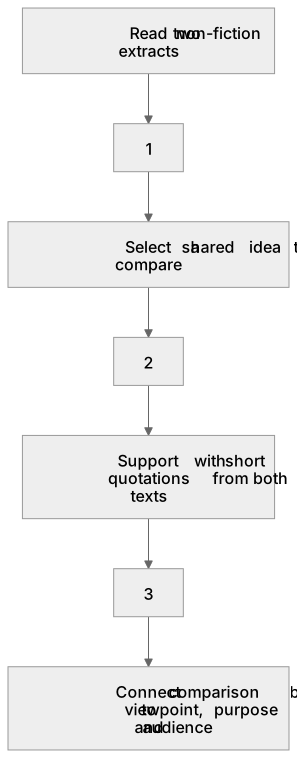
1Box 1
2Box 2
3Box 3
There is more to this lesson
The full lesson goes on to check your understanding and help you earn the marks. Create a free account to carry on, with your progress saved.
A week of Premium from your first lesson · Then the free plan continues · No card, no charge
Test your understanding of Component 2: Non-fiction and Transactional Writing - 2.1 Reading: 2.1.5 compare texts: compare two or more texts critically with respect to the above.
Active recall beats re-reading. Take an instant quiz now to test what you’ve learned and lock it into long-term memory.
A week of Premium from your first lesson · Then the free plan continues · No card, no charge