Pearson Edexcel · GCSE · English Language
Reading: Fiction and Imaginative Writing
This topic focuses on your ability to critically evaluate how writers use language and structure to create effects, and your own ability to write engagingly. It tests both analytical reading (AO1, AO2) and creative/transactional writing (AO5, AO6).
- 5 min read
- 3 worked examples
- 5 practice questions
- 8 key terms
Study Notes
Overview
GCSE English Language is fundamentally a skills-based exam. You are not being tested on your memory of a set text, but on your ability to read unseen fiction and non-fiction critically, and your ability to write effectively for different purposes and audiences. This guide covers the core skills required for the Reading and Imaginative Writing components.
Listen to the podcast overview below for a detailed walkthrough of how to evaluate texts effectively:

Reading Skills
Identifying Information & Ideas
The foundation of any reading paper is locating explicit (stated clearly) and implicit (suggested or implied) information. When reading an unseen text, track the who, what, where, and when. Pay attention to how the writer establishes the setting and introduces characters.
Analysing Language
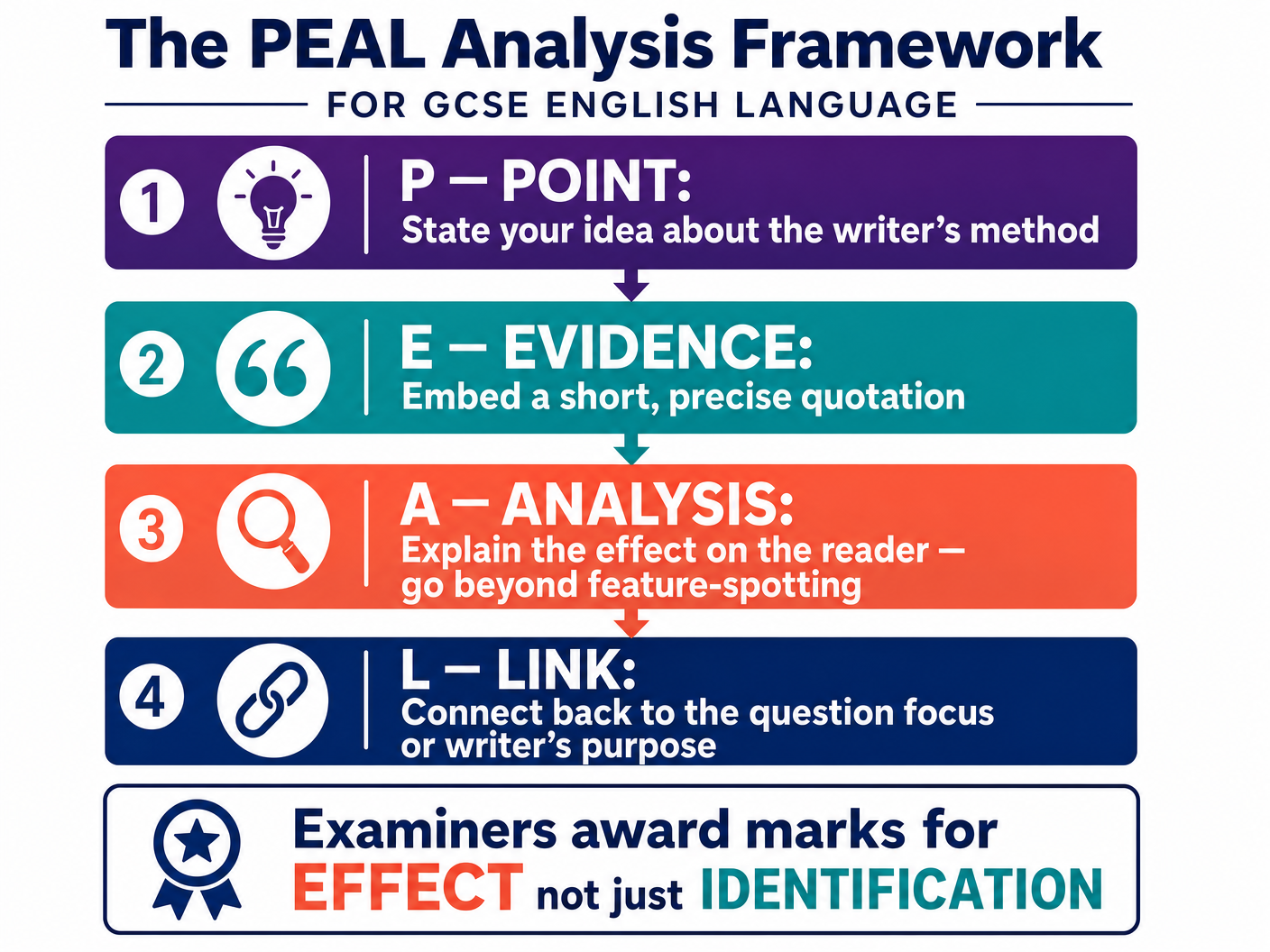
Examiners want to see you analyse the effect of language choices, not just spot features. Use the PEAL framework for this: Point, Evidence, Analysis, Link.
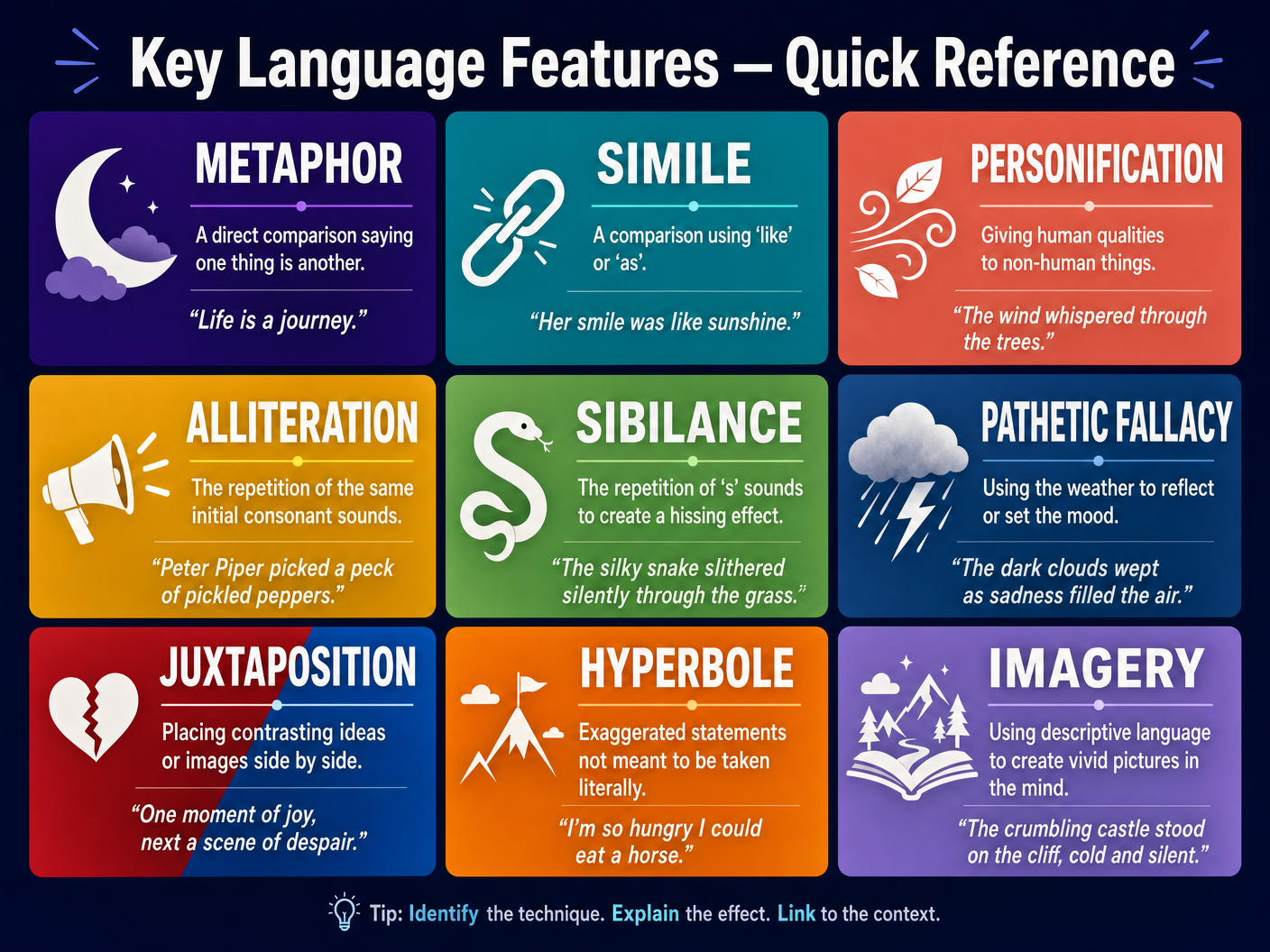
Key Language Features to Identify
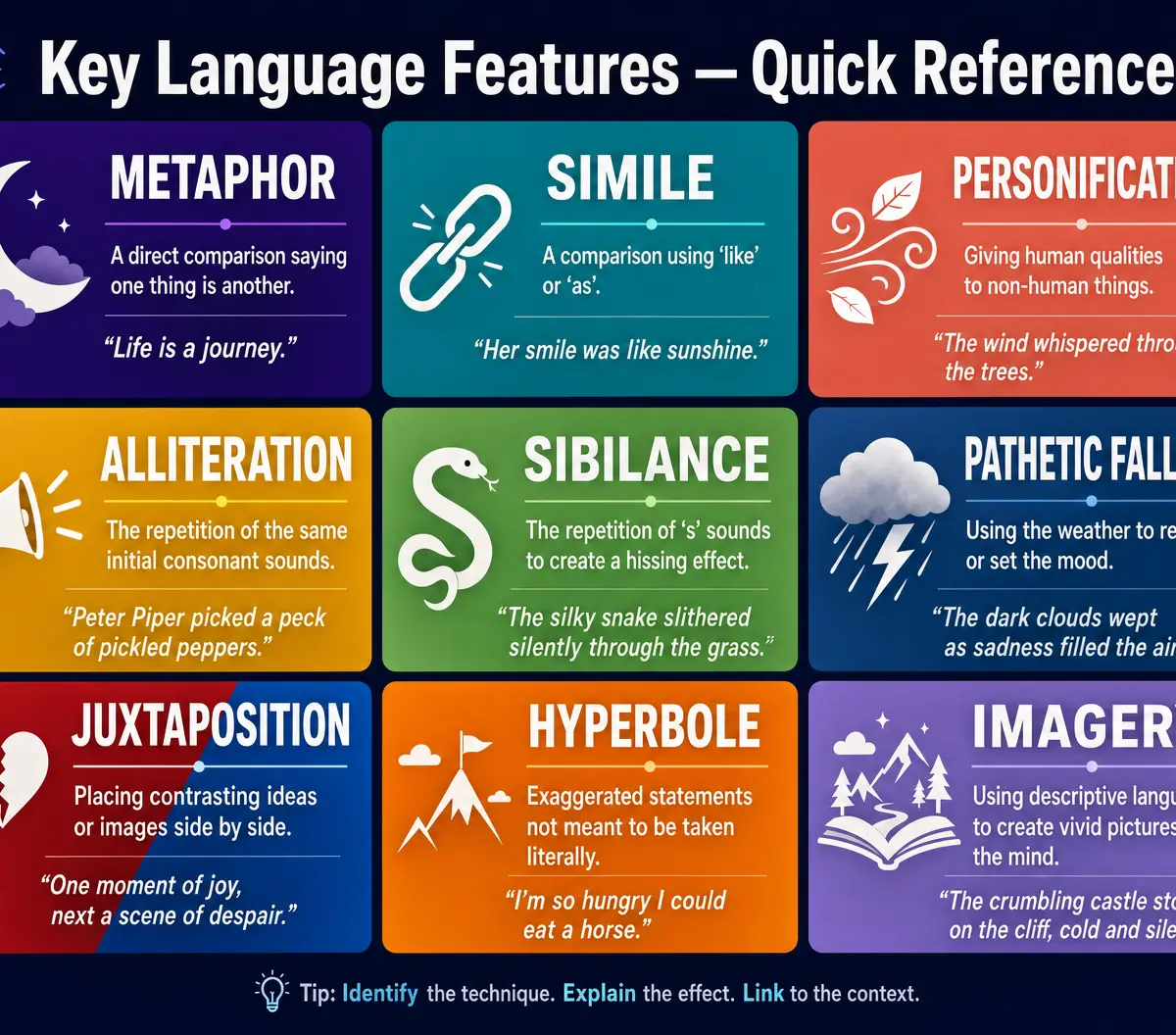
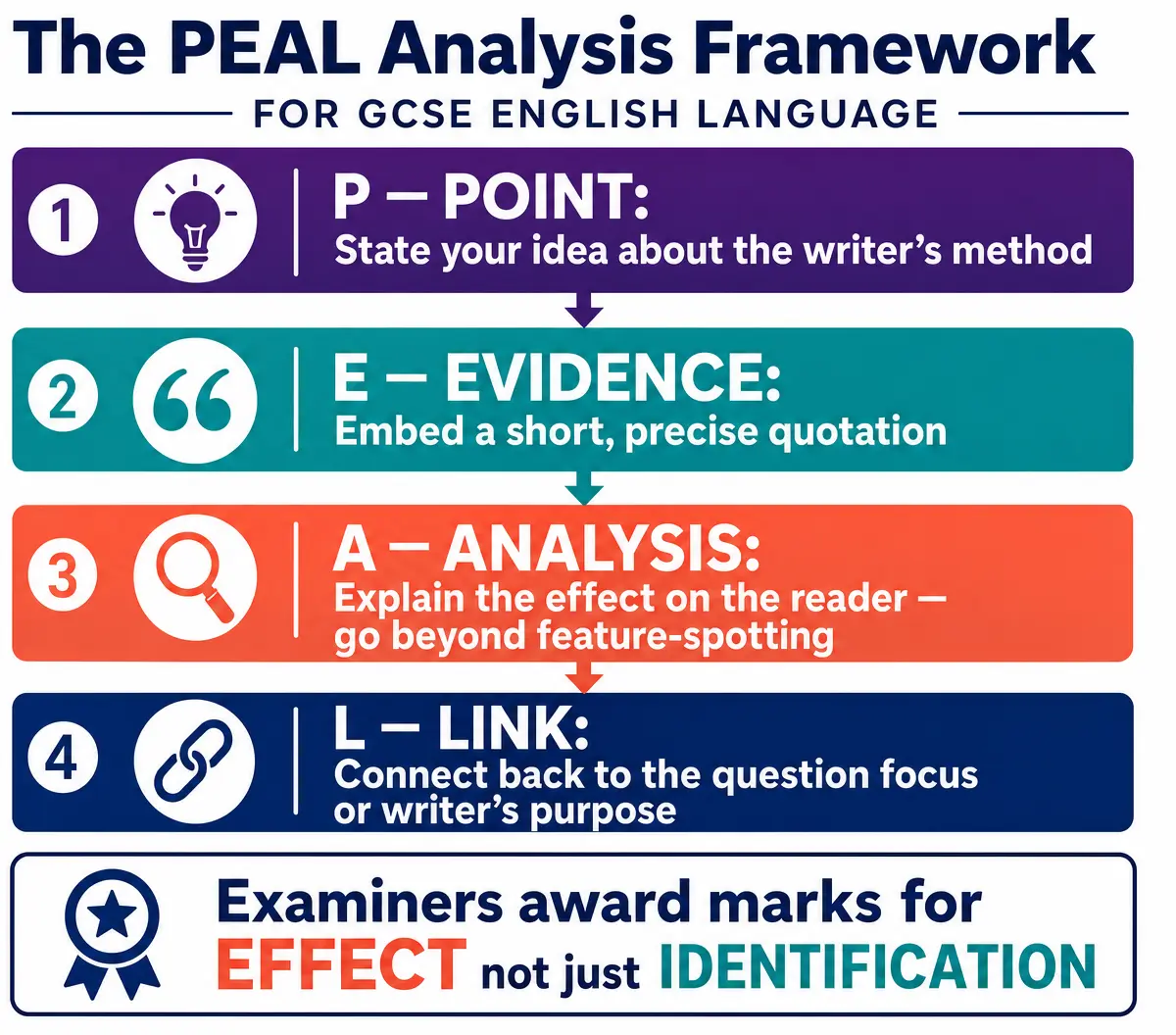
| Feature | Definition | Effect on Reader | Example |
|---|---|---|---|
| Metaphor | A direct comparison saying one thing is another. | Creates vivid imagery and implies deeper meaning or intensity. | "The classroom was a battlefield." |
| Simile | A comparison using 'like' or 'as'. | Helps the reader picture the scene clearly by comparing it to something familiar. | "Her hands were as cold as marble." |
| Personification | Giving human qualities to non-human things. | Makes the environment feel alive, active, or threatening. | "The wind howled through the empty streets." |
| Pathetic Fallacy | Using weather to reflect the mood. | Subtly guides the reader's emotional response. | "Dark clouds gathered as the argument began." |
| Alliteration | Repetition of initial consonant sounds. | Creates rhythm and draws attention to specific words. | "The dark, damp, dreadful dungeon." |
| Sibilance | Repetition of 's' sounds. | Creates a soft, sliding sound, often associated with secrecy or danger. | "The silk slipped silently." |
| Juxtaposition | Placing contrasting ideas side by side. | Highlights differences and creates tension. | "One moment of laughter; the next, silence." |
Analysing Structure
Structure refers to how a text is organised and how the narrative develops. Consider:
- Openings: How does the writer hook the reader? (e.g., in media res, establishing mystery).
- Shifts in Focus: When does the narrative move from wide-angle description to close-up detail, or from character to character?
- Narrative Perspective: Is it first-person (intimate, subjective) or third-person (omniscient or limited)?
- Sentence Length Variation: Short sentences create pace and tension; long, complex sentences slow the reader down for reflection or detailed description.
- Endings: Is there a cyclical structure, or a cliffhanger?
Evaluating Critically
Evaluation requires you to form a judgement about how successful a writer's methods are. You must support your opinion with textual references. The structure is: Statement → Evidence → Analysis → Link to purpose. For example, "The writer effectively creates a sense of isolation (Statement) by describing the house as 'marooned on the moors' (Evidence). The verb 'marooned' suggests being stranded and helpless, making the reader feel the character's vulnerability (Analysis)."
Comparing Writers' Viewpoints
When comparing texts, you must identify the viewpoints, compare the methods used to convey those viewpoints, and evaluate their effectiveness. Use a point-by-point structure: state Text A's viewpoint, analyse a method used; state Text B's viewpoint, analyse a method used; compare the two.
Writing Skills
Creative Writing
Creative writing tasks test your ability to engage a reader. Key techniques include:
- Show, Don't Tell: Instead of saying "he was angry," describe his clenched fists and red face.
- Sensory Description: Appeal to sight, sound, smell, touch, and taste.
- Varied Sentence Structures: Mix short, punchy sentences with longer, descriptive ones.
- Engaging Openings: Start with action or an intriguing statement.
- The One-Scene Rule: Focus on describing one moment or scene in detail rather than trying to tell a whole epic story in 45 minutes.
Transactional/Non-Fiction Writing
Transactional writing has a specific purpose (to argue, persuade, advise) and audience. You must match the form (letter, article, speech, leaflet). Use the AFOREST techniques to persuade: Alliteration, Facts, Opinions, Rhetorical questions, Emotive language, Statistics, Three (rule of).
Technical Accuracy (SPaG)
Spelling, Punctuation, and Grammar (SPaG) account for a significant portion of your writing marks. Use ambitious punctuation correctly: semicolons to link related independent clauses; colons to introduce lists or explanations; dashes for emphasis. Ensure paragraph cohesion using discourse markers (e.g., Furthermore, Consequently, However).
Visual Resources
2 diagrams and illustrations
Interactive Diagrams
2 interactive diagrams to visualise key concepts
Conceptual Flow Outline
English Language Exam Approach Flowchart
Conceptual Flow Outline
Comparison Question Framework
Worked Examples
3 worked examples — open one to explore the question and available guidance.
Practice Questions
Test your understanding — click to reveal model answers
List four things you learn about the setting from lines 1-5.
Hint: Look for explicit facts. Keep your answers short. You do not need to quote or analyse.
Analyse how the writer uses language to describe the storm.
Hint: Identify 2-3 techniques (e.g., verbs, similes). Quote them and explain the effect on the reader.
A student said, 'The writer makes the ending feel completely hopeless.' To what extent do you agree? Evaluate the text.
Hint: State your opinion clearly. Provide evidence for both agreeing and disagreeing, but maintain a clear overall judgement.
Write a description of a crowded market.
Hint: Plan your structure. Use sensory details. Don't write a story with characters and plot.
Write an article for a school magazine arguing that school uniform should be abolished.
Hint: Match the form (article - needs a headline) and audience (students/teachers). Use AFOREST techniques.