Pearson Edexcel · GCSE · English Language
Writing: Fiction and Imaginative Writing
This topic focuses on developing sophisticated writing skills for fiction and imaginative tasks. Examiners assess your ability to use varied vocabulary, deliberate sentence structures, and accurate punctuation to create specific effects on the reader.
- 5 min read
- 3 worked examples
- 2 practice questions
- 8 key terms
Study Notes
Overview
Welcome to the ultimate guide on Fiction and Imaginative Writing for GCSE English Language. In your exam, you will be assessed on your ability to communicate clearly, effectively, and imaginatively. This isn't just about telling a good story; it's about demonstrating conscious control over language.
Examiners are looking for two main things in your writing:
- Content and Organisation (AO5): Your ability to match your tone, style, and register to your purpose and audience, and to structure your ideas coherently.
- Technical Accuracy (AO6): Your control over sentence structures, punctuation, and spelling.
Let's break down how to secure marks in both areas.

Listen to our 10-minute podcast episode above, where we talk through the core concepts of vocabulary, sentence structures, and technical accuracy, complete with a quick-fire recall quiz!
Reading Skills: The Foundation of Good Writing
Before you can write brilliantly, you need to understand how professional writers achieve their effects. Reading and writing are two sides of the same coin.
Identifying Information & Ideas
When tackling unseen texts, don't just look at what is happening; look at how it's described. Implicit information is often hidden in the writer's vocabulary choices. If a character "slams" a door rather than "closes" it, the writer is implicitly telling us they are angry.
Analysing Language
When analysing a text, examiners want you to move beyond feature-spotting. Don't just say "the writer uses a metaphor." Explain why and what effect it has.
Key Language Features to Identify
| Feature | Definition | Effect on Reader | Example |
|---|---|---|---|
| Metaphor | Saying one thing is another to create a vivid comparison. | Creates a striking, often unexpected image in the reader's mind, deepening understanding. | "The sky was a bruised purple." |
| Simile | Comparing two things using 'like' or 'as'. | Helps the reader visualise a scene by comparing it to something familiar. | "The wind howled like a wounded animal." |
| Personification | Giving human qualities to non-human things. | Brings inanimate objects or nature to life, often reflecting the mood of the scene. | "The shadows danced on the wall." |
| Pathetic Fallacy | Using the weather or environment to reflect human emotions. | Sets the atmosphere and foreshadows events. | "A heavy, suffocating fog rolled in as the argument began." |
| Sensory Language | Words that appeal to the five senses (sight, sound, smell, touch, taste). | Immerses the reader in the scene, making it feel real and immediate. | "The sharp tang of copper filled the air." |
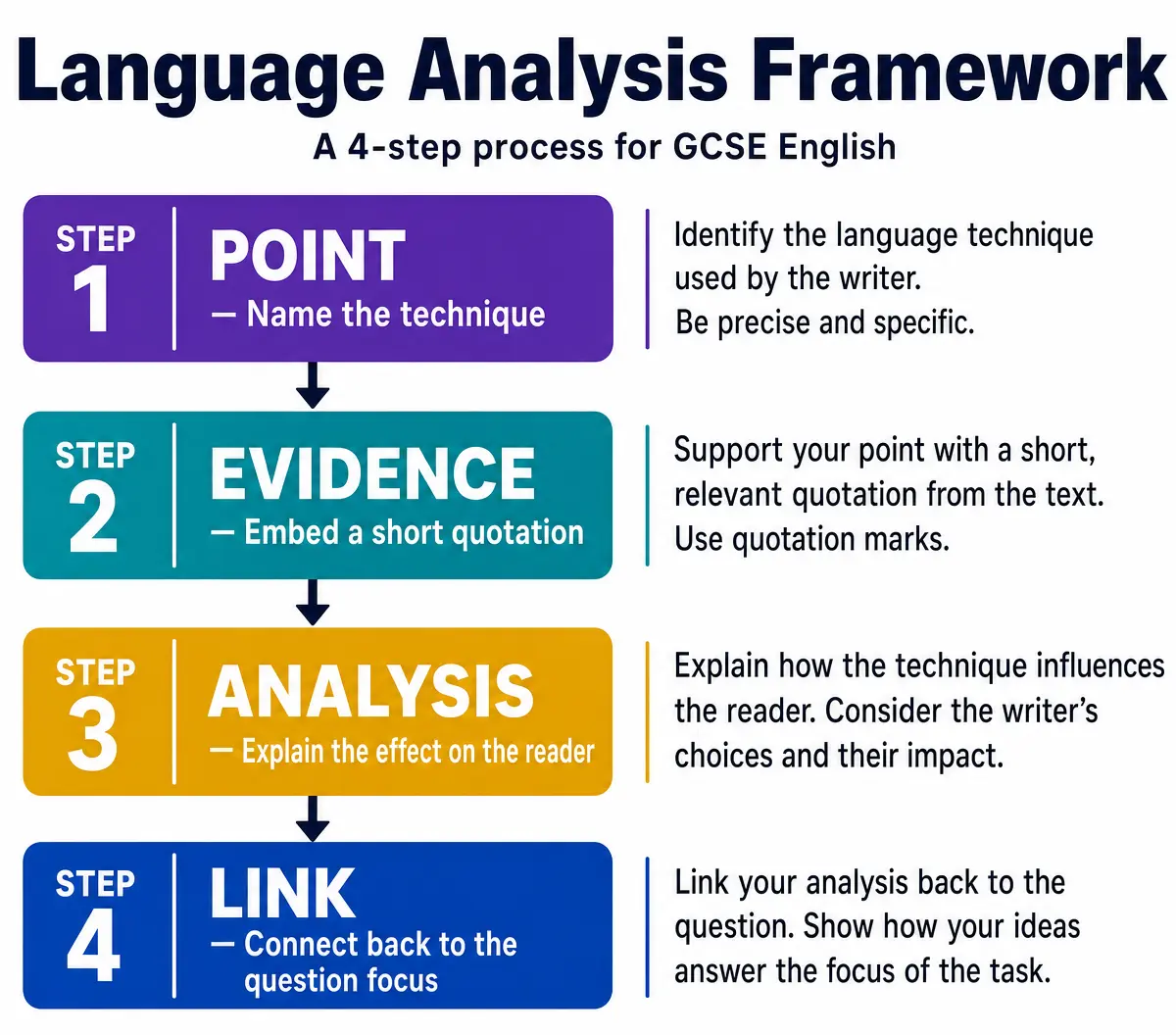
Analysing Structure
Structure is about how the text is put together. Examiners reward candidates who can track the journey of a text.
- Openings: How does the writer hook you? Is it in media res (in the middle of the action)?
- Shifts in Focus: Does the writer move from the big picture (panorama) to a tiny detail (zoom)?
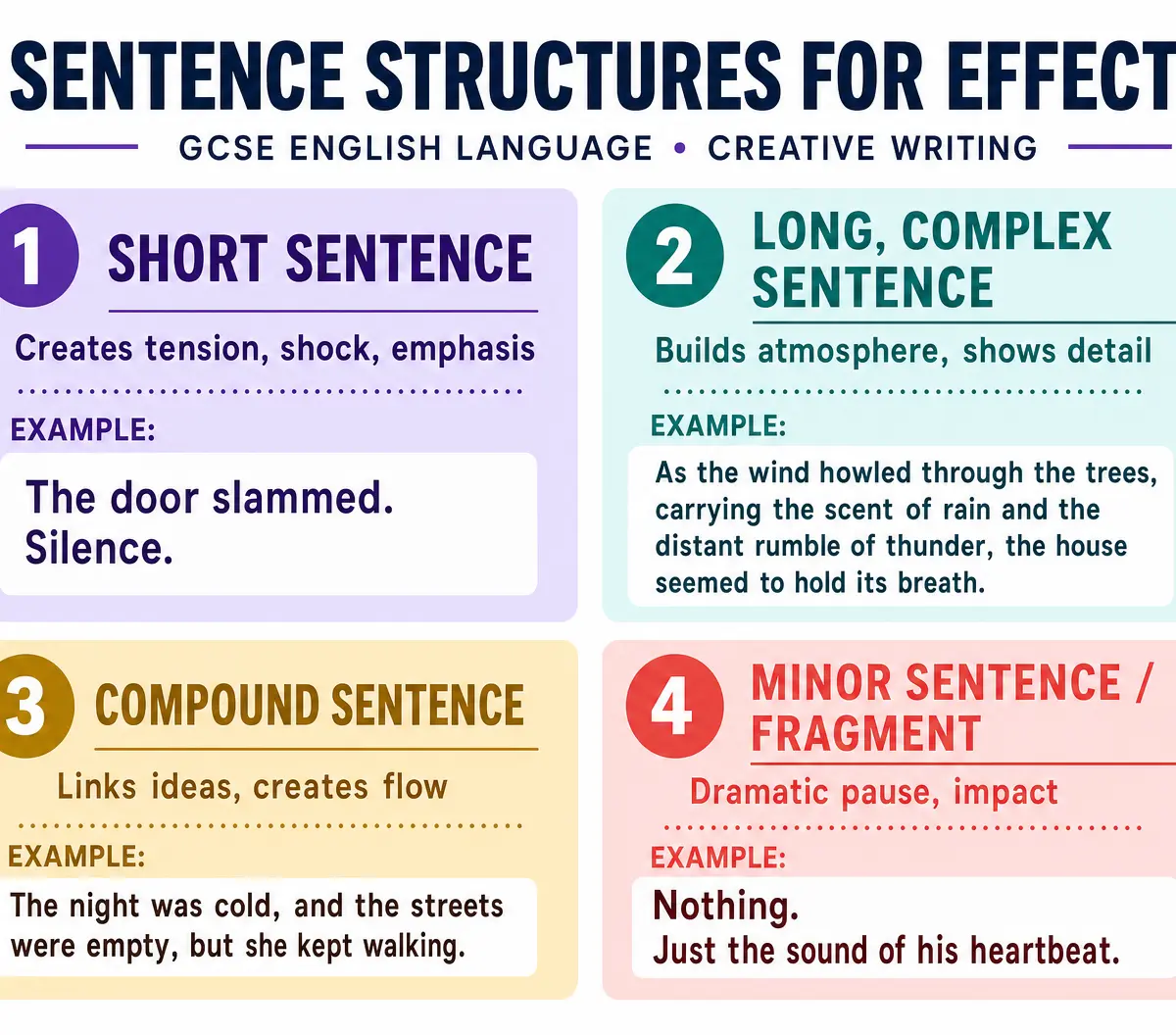
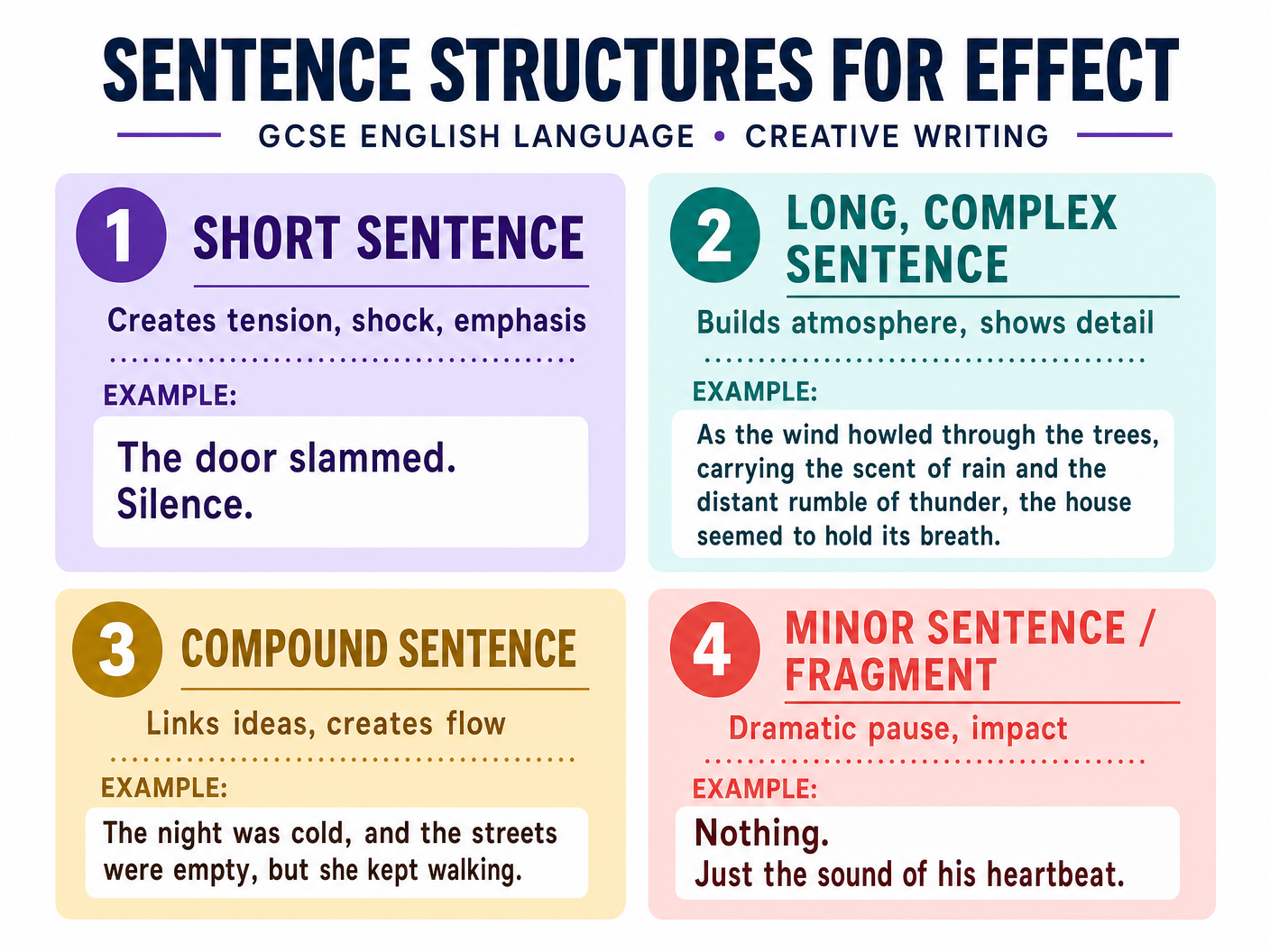
- Pacing: Do short sentences speed up the action? Do long paragraphs slow it down?
- Endings: Is there a cyclical structure where the ending echoes the beginning?
Evaluating Critically
When asked to evaluate a text (e.g., "To what extent do you agree?"), you need to form an opinion and support it with evidence.
Statement → Evidence → Analysis → Link back to your opinion.
Writing Skills: Crafting Your Response
Now, let's turn to your own writing.
Creative Writing: Narrative and Description
The best creative writing at GCSE level is tightly focused. Do not try to write an entire novel in 45 minutes.
- The One-Scene Rule: Focus on a single moment, a single setting, or a single interaction. Zoom in on the details.
- Show, Don't Tell: Instead of saying "He was nervous," describe his physical reactions: "His palms were slick with sweat, and he couldn't stop his leg from bouncing."
- Engaging Openings: Start with action, a piece of dialogue, or a striking description. Avoid "I woke up and..."
- Satisfying Endings: Your ending should feel deliberate. It could be a cliffhanger, a resolution, or a reflection.
Technical Accuracy (SPaG)
Spelling, Punctuation, and Grammar (SPaG) account for a significant portion of your writing marks.
- Ambitious Punctuation: To reach the top bands, you must use a range of punctuation correctly.
- Semicolon (;) - Links two related independent clauses. (The sun set; the stars emerged.)
- Colon (:) - Introduces a list, an explanation, or a dramatic reveal. (She had one thought: survival.)
- Dash (-) - Creates a dramatic pause or adds an afterthought. (He looked back - a fatal mistake.)
- Paragraph Cohesion: Use discourse markers to link your paragraphs smoothly. Words like subsequently, however, consequently, amidst the chaos show the examiner you are structuring your narrative consciously.
Visual Resources
2 diagrams and illustrations
Interactive Diagrams
2 interactive diagrams to visualise key concepts
Conceptual Flow Outline
Creative Writing Planning Flowchart
Conceptual Flow Outline
Sentence Structures and Their Effects
Worked Examples
3 worked examples — open one to explore the question and available guidance.
Practice Questions
Test your understanding — click to reveal model answers
Read the following sentence: 'The old house sat on the hill, watching the town below with dark, empty windows.' Identify the language technique used and explain its effect.
Hint: Think about what human qualities are being given to the house.
Write the opening paragraph of a story titled 'The Storm'. Focus on using sensory description and varying your sentence lengths.
Hint: Start with a minor sentence for impact. Then build the atmosphere using sight and sound.