Pearson Edexcel · GCSE · English Language
Writing: Non-fiction and Transactional Writing
This guide focuses on the essential skills required for reading and writing non-fiction and transactional texts. It covers how to analyse a writer's methods and how to craft persuasive, well-structured, and technically accurate responses for the exam.
- 6 min read
- 3 worked examples
- 5 practice questions
- 8 key terms
Study Notes
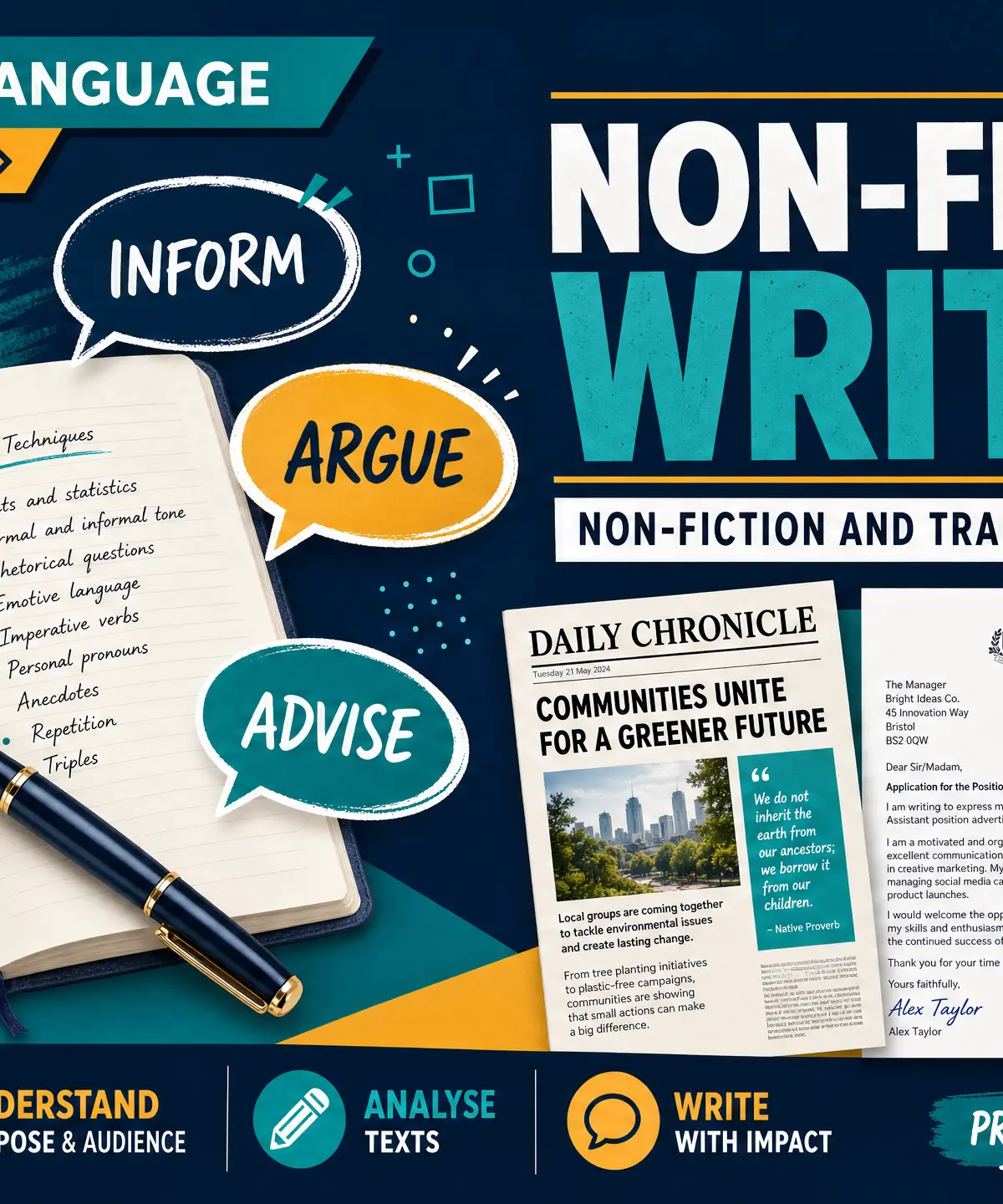
Overview
Welcome to the ultimate guide on Non-fiction and Transactional Writing for GCSE English Language. This topic is heavily assessed across all exam boards, usually appearing as a high-tariff writing task (often worth 24-40 marks) where you are required to write for a specific purpose, audience, and form.
This guide will equip you with the reading skills to analyse how professional writers use non-fiction techniques, and the writing skills to apply these techniques in your own exam responses. Examiners reward candidates who can adapt their tone and style seamlessly while maintaining a high level of technical accuracy.
Listen to our expert tutor break down the key concepts in this 10-minute podcast:

Reading Skills
Before you can write effective non-fiction, you need to understand how writers construct their texts. In the reading section of your exam, you will be presented with unseen non-fiction texts (such as articles, letters, or essays) and asked to analyse them.
Identifying Information & Ideas
The first skill is retrieving information. Examiners will ask you to locate explicit (clearly stated) and implicit (suggested or hinted at) information.
- Explicit: "The council spent £2 million on the new park."
- Implicit: "Despite the grand promises, the park remains largely empty." (Implies the project was a failure or a waste of money).
Analysing Language
When asked "How does the writer use language to...", you must move beyond simply identifying features. You must explain the effect on the reader.
Key Language Features to Identify
| Feature | Definition | Effect on Reader | Example |
|---|---|---|---|
| Metaphor | Describing something as if it were something else. | Creates a vivid image and forces the reader to see the subject in a new light. | "The classroom was a zoo." |
| Simile | Comparing two things using 'like' or 'as'. | Makes descriptions more relatable and easier to visualise. | "He fought like a lion." |
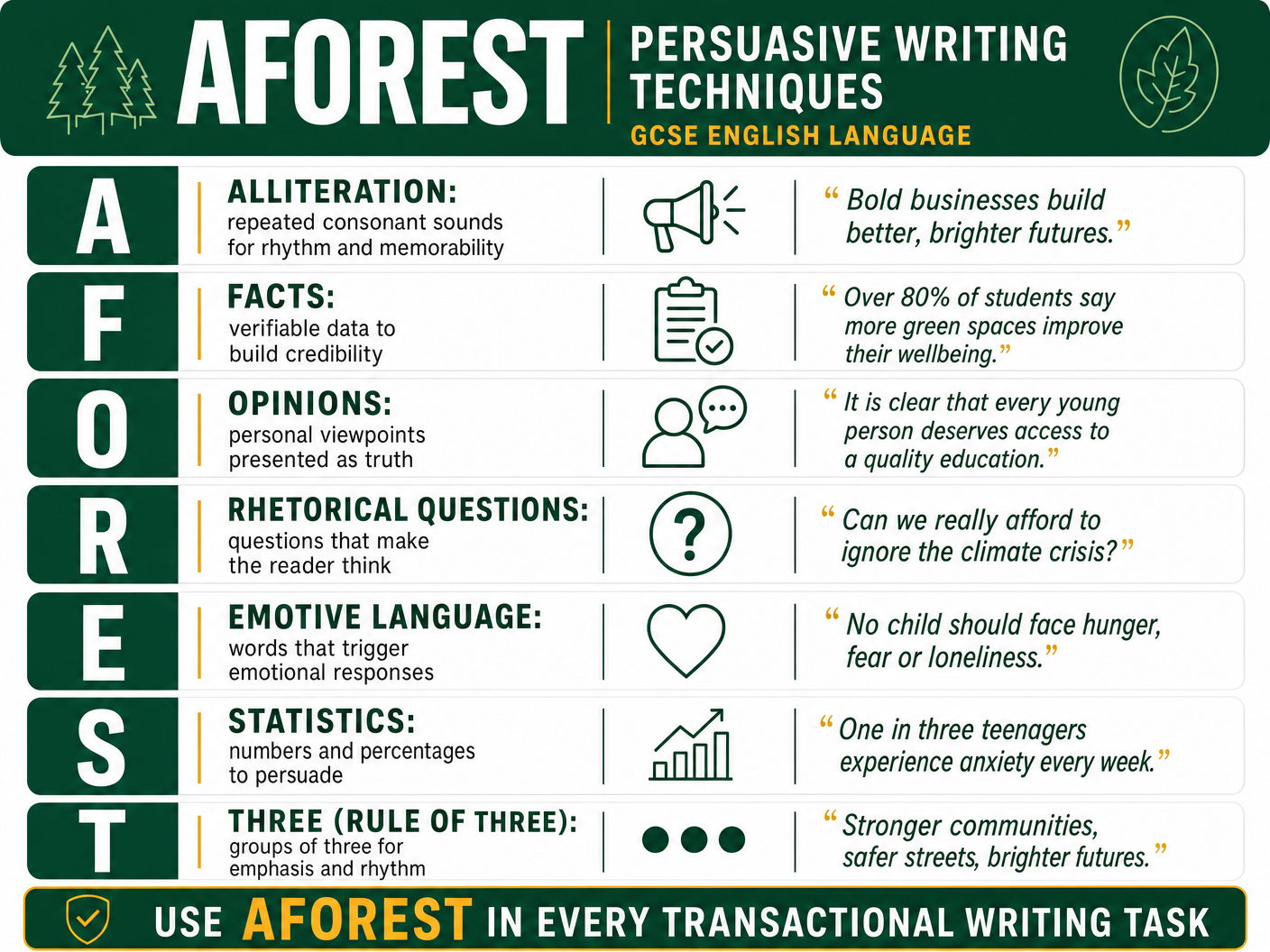
| Alliteration | Repetition of consonant sounds at the start of words. | Creates rhythm, draws attention to the phrase, and makes it memorable. | "Bold, brave, brilliant." |
| Emotive Language | Words carefully chosen to provoke an emotional reaction. | Manipulates the reader to feel sympathy, anger, or urgency. | "Heartbreaking tragedy." |
| Rhetorical Question | A question asked for effect, not requiring an answer. | Engages the reader directly, forcing them to consider the writer's viewpoint. | "Can we really ignore this?" |
| Direct Address | Using pronouns like 'you' or 'we'. | Makes the text feel personal and involves the reader in the argument. | "You must take action now." |
Analysing Structure
Structure refers to how the text is put together. Examiners want to see that you understand how the writer guides the reader through the text.
- Openings: Does it start with a shocking fact, an anecdote, or a question? Why?
- Shifts in Focus: Does the text move from a global perspective to a personal one? From the past to the future?
- Paragraphing: Are there short, single-sentence paragraphs for dramatic effect?
- Endings: Does it end with a call to action or a cyclical return to the opening idea?
Evaluating Critically
Evaluation questions (e.g., "To what extent do you agree with this statement?") require you to form a judgment.
- Statement: Give your clear opinion.
- Evidence: Provide a quotation.
- Analysis: Examine the methods the writer used.
- Link: Connect back to why this makes you agree or disagree.
Comparing Writers' Viewpoints
When comparing two non-fiction texts, focus on:
- What the writers think (their viewpoints/attitudes).
- How they convey these thoughts (their methods/language/structure).
Always use comparative connectives (e.g., Similarly, In contrast, Whereas).
Writing Skills
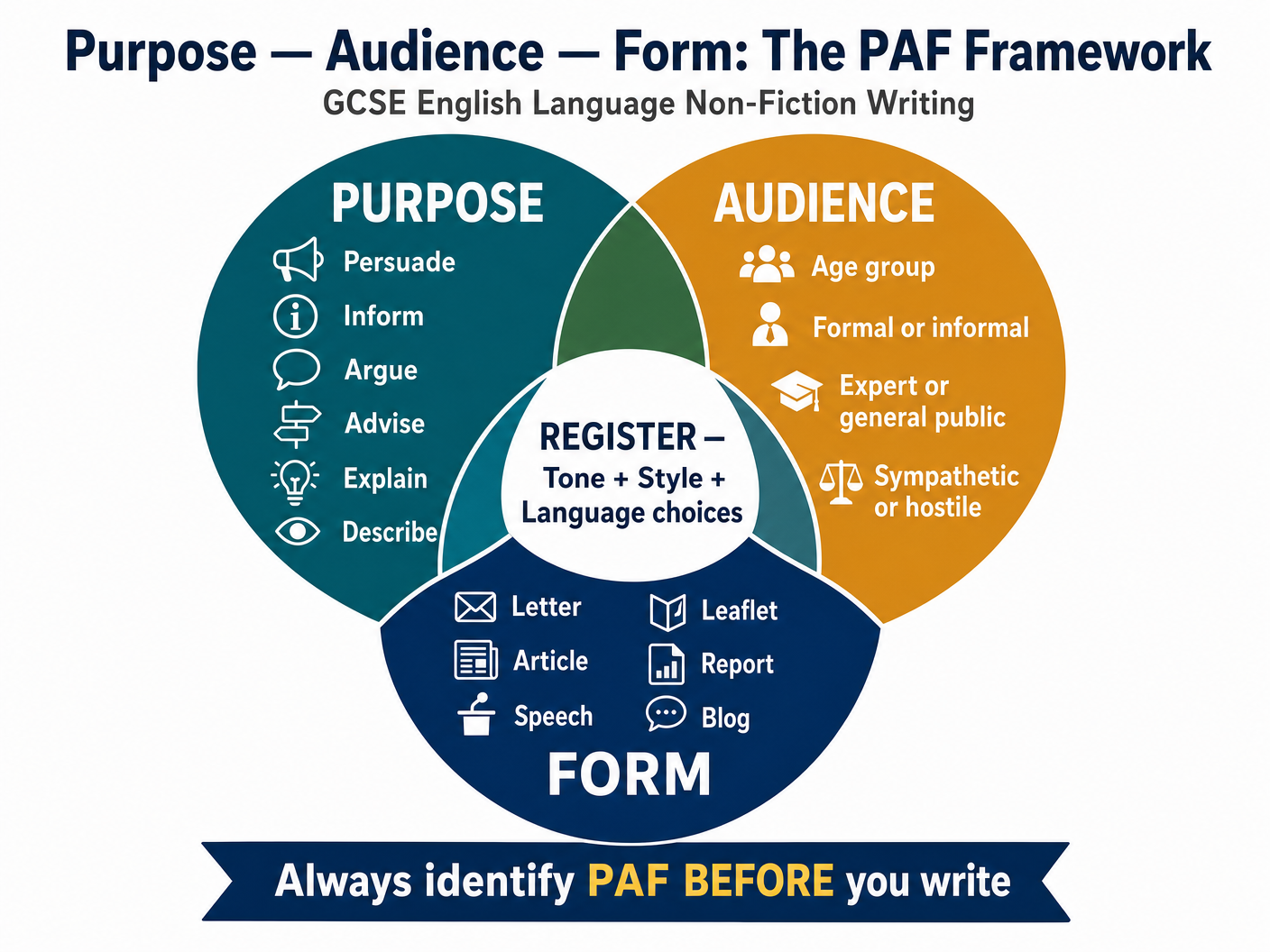
The writing section tests your ability to craft your own non-fiction texts. This is where you apply the PAF framework.
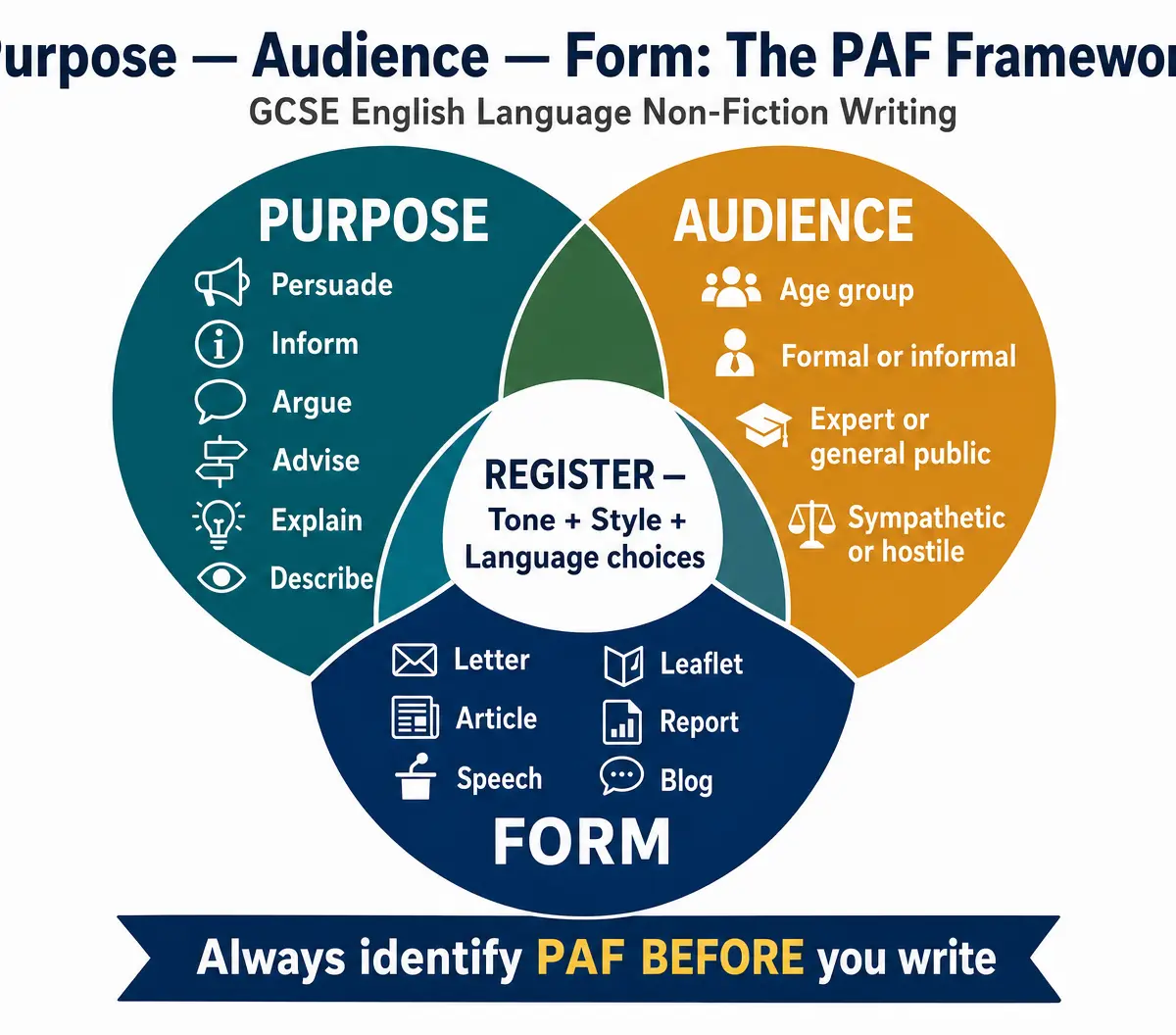
Transactional/Non-Fiction Writing
Transactional writing is writing with a purpose. You must always consider:
- Purpose: Are you writing to persuade, argue, advise, or inform?
- Audience: Who is reading this? A headteacher (formal) or a peer (informal)?
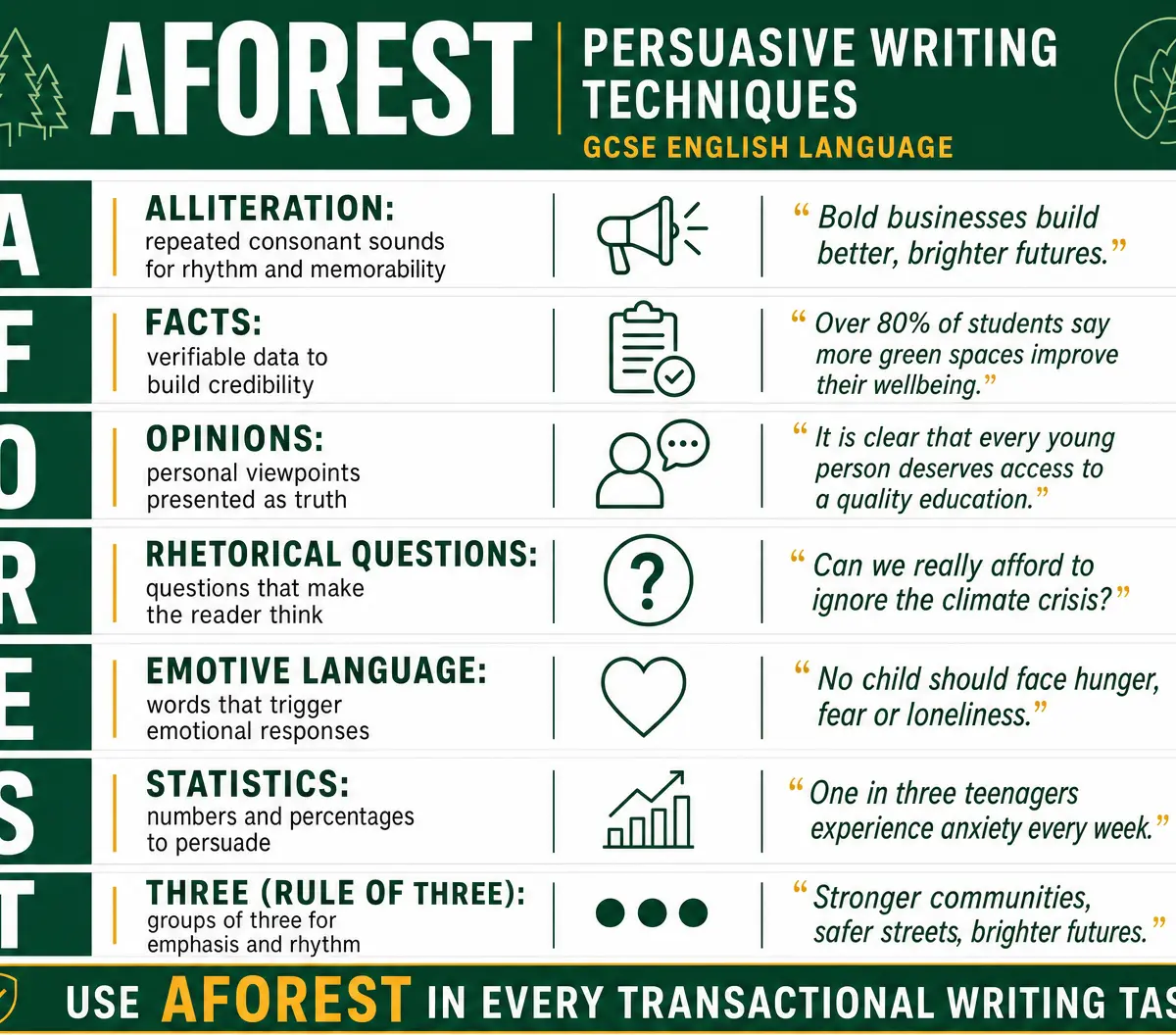
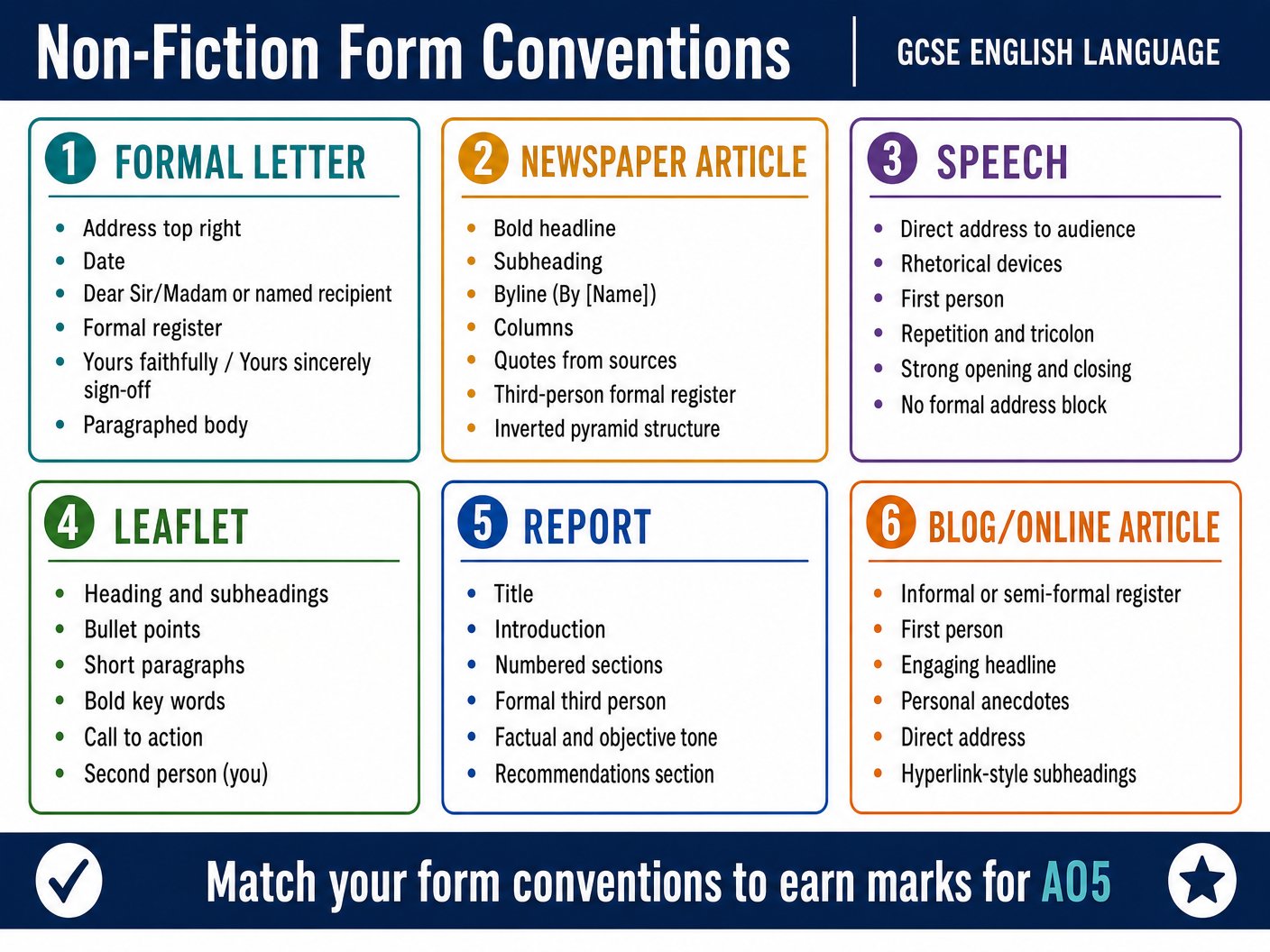
- Form: What are the conventions of the text type?
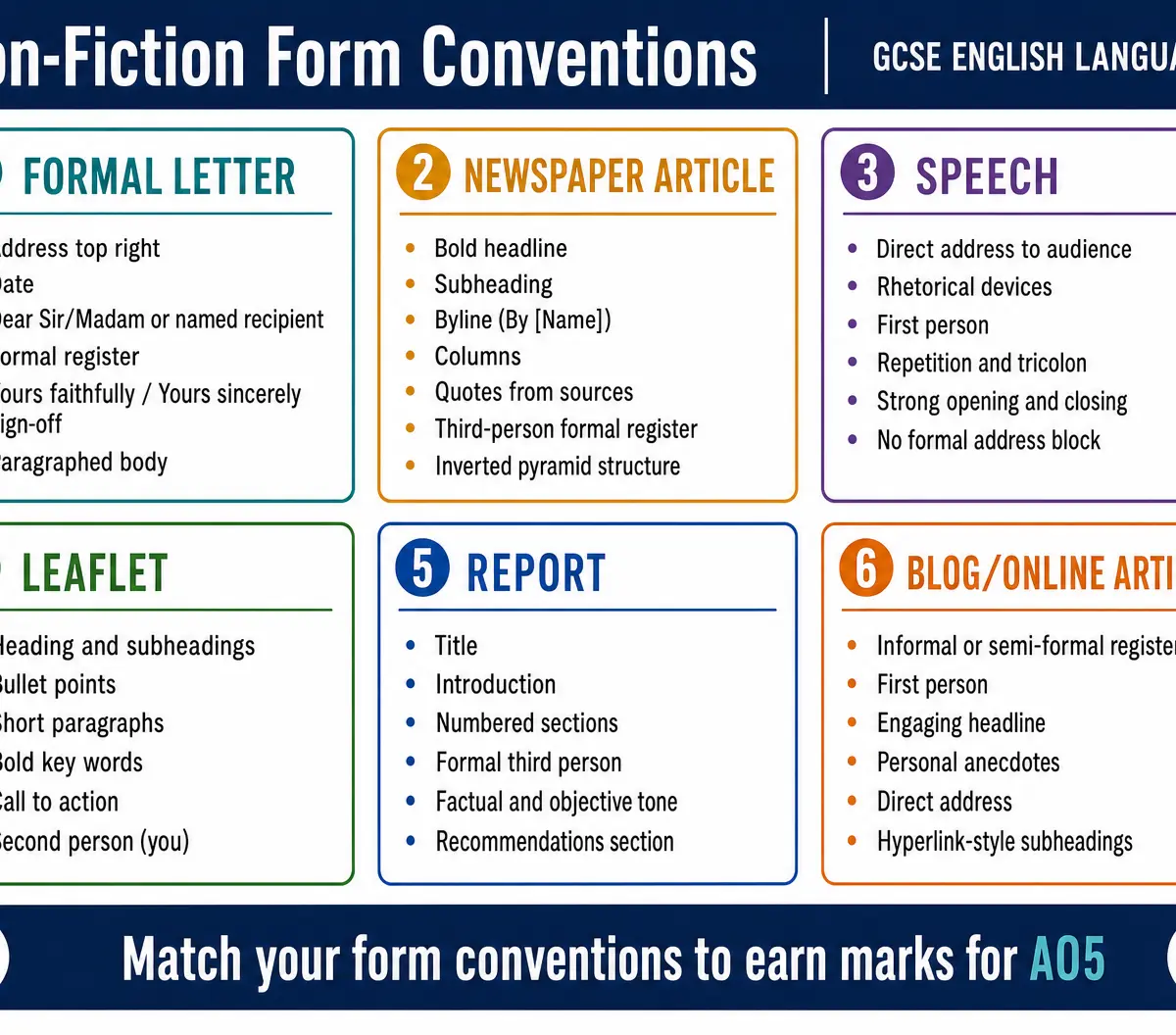
Use the AFOREST techniques to make your writing persuasive and engaging.
Technical Accuracy (SPaG)
Spelling, Punctuation, and Grammar (SPaG) account for a significant portion of your marks (often 16 out of 40 for the writing task).
- Ambitious Punctuation: Use semicolons (;) to link related independent clauses, colons (:) to introduce lists or explanations, and dashes (-) for emphasis.
- Sentence Variation: Mix short, punchy sentences (for impact) with complex sentences (to show control).
- Paragraph Cohesion: Use discourse markers (Furthermore, Consequently, Nevertheless) to link your paragraphs smoothly.
Visual Resources
3 diagrams and illustrations
Interactive Diagrams
2 interactive diagrams to visualise key concepts
Conceptual Flow Outline
English Language Exam Approach Flowchart
Conceptual Flow Outline
Comparison Question Framework
Worked Examples
3 worked examples — open one to explore the question and available guidance.
Practice Questions
Test your understanding — click to reveal model answers
Identify four things we learn about the narrator's journey from the first paragraph. (4 marks)
Hint: Look only at paragraph one. You do not need to write full sentences or analyse language.
How does the writer use language to describe the conditions in the factory? (8 marks)
Hint: Focus on specific words, imagery, and sentence forms. Remember to explain the EFFECT on the reader.
'The local council should ban all cars from the city centre to improve air quality.' Write a letter to your local newspaper arguing your point of view on this statement. (40 marks)
Hint: Remember your PAF. Form: Letter to a newspaper (needs Dear Editor). Audience: Local residents (formal but engaging). Purpose: Argue. Use AFOREST.
Compare how the writers convey their different perspectives on extreme sports. (16 marks)
Hint: Identify the main difference in viewpoint first. Then find a quote from Source A and a quote from Source B to compare HOW they show this.
Evaluate the statement: 'The writer successfully makes the reader feel the panic of the situation.' To what extent do you agree? (20 marks)
Hint: You must give a clear opinion. Use the 'Statement, Evidence, Analysis, Link' structure. Look at both language and structure.