COMPONENT 1
Master the essential reading and creative writing skills for WJEC Eduqas GCSE English Language Component 1. This guide covers how to analyse 20th-century unseen prose and how to craft compelling, high-scoring creative narratives.
Study Notes
Overview
Component 1 of the WJEC Eduqas GCSE English Language specification focuses on 20th-century literature reading and creative prose writing. This paper tests your ability to understand and analyse unseen fiction, and then apply those same structural and linguistic techniques to your own creative writing. The exam is 1 hour 45 minutes long, divided into Section A (Reading, 40 marks) and Section B (Prose Writing, 40 marks).
Listen to our comprehensive audio guide for a deep dive into the skills required:
Section A: Reading Skills (40 Marks)
Identifying Information & Ideas (AO1)
The opening questions will ask you to locate explicit and implicit information in the unseen 20th-century prose extract.
- Explicit information is stated directly in the text (e.g., "The door was painted red").
- Implicit information requires you to read between the lines (e.g., "He hesitated before turning the handle," implying fear or uncertainty).
- Examiner Tip: When asked to list or identify, be concise. Quote directly or paraphrase closely. Do not waste time analysing language here.
Analysing Language (AO2)
This is where the heavy lifting happens. Examiners want to see you explain, comment on, and analyse how writers use language to achieve effects.
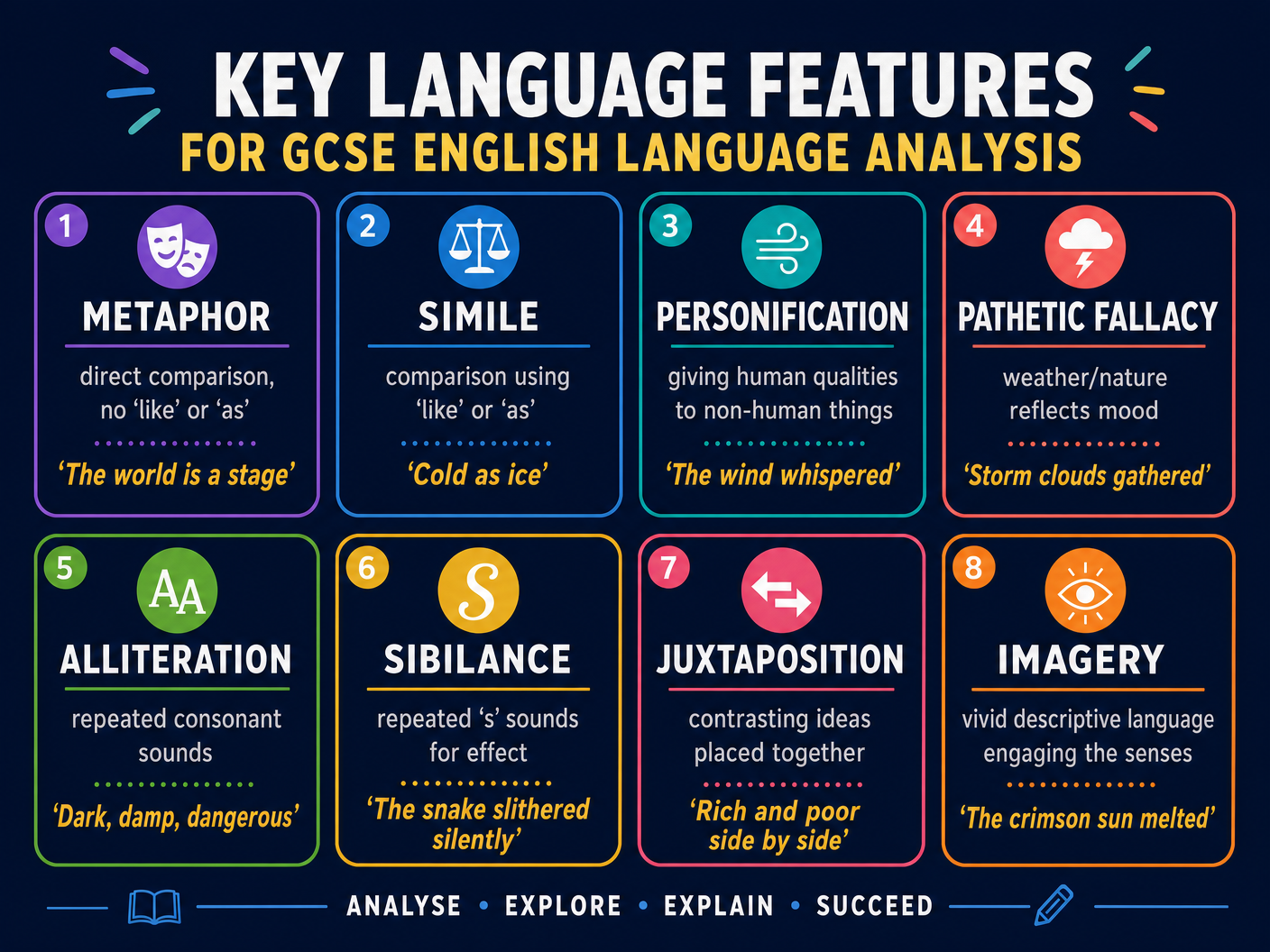
Key Language Features to Identify
| Feature | Definition | Effect on Reader | Example |
|---|---|---|---|
| Metaphor | A direct comparison stating one thing is another. | Creates a vivid, striking image; often reveals a deeper truth about the subject. | "The world is a stage." |
| Simile | A comparison using 'like' or 'as'. | Helps the reader visualise something unfamiliar by comparing it to something familiar. | "Cold as ice." |
| Personification | Giving human qualities to non-human things. | Brings the inanimate to life, often making the environment feel threatening or sympathetic. | "The wind whispered." |
| Pathetic Fallacy | When the weather or nature reflects human emotion. | Sets the atmosphere or foreshadows upcoming events. | "Storm clouds gathered as the argument began." |
| Alliteration | Repeated consonant sounds at the start of words. | Draws attention to a phrase, creating rhythm or emphasizing a harsh/soft tone. | "Dark, damp, dangerous." |
| Sibilance | Repeated 's' or 'sh' sounds. | Can create a sinister, hissing effect or a soft, soothing atmosphere. | "The snake slithered silently." |
| Juxtaposition | Contrasting ideas placed closely together. | Highlights differences, creating tension or irony. | "Rich and poor side by side." |
Analysing Structure (AO2)
Structure refers to how the text is built and organized. Examiners reward candidates who look beyond individual words and consider the text as a constructed whole. Look for:
- Openings: Does it drop you in the middle of the action (in media res) or set the scene slowly?
- Shifts in Focus: Does the writer zoom in on a tiny detail, then pan out to a wide landscape?
- Sentence Length: Short sentences build tension and pace. Long, complex sentences slow the reader down and mimic reflection or confusion.
- Paragraphing: A single-sentence paragraph forces the reader to pause. It creates impact.
- Narrative Perspective: First-person ("I") creates intimacy and bias. Third-person ("He/She") can be omniscient (knowing everything) or limited.
Evaluating Critically (AO4)
Evaluation requires you to form a judgment about the text. The question will often provide a statement (e.g., "A student said: 'The writer successfully makes the ending terrifying.' To what extent do you agree?").
- Examiner Tip: Use hedged, evaluative language. Phrases like "The writer is particularly effective when...", "This is highly convincing because...", or "To a great extent, the atmosphere is..."
- Support your evaluation with precise textual references (AO1) and analysis of methods (AO2).
Section B: Prose Writing (40 Marks)
Creative Writing (AO5 & AO6)
You will be given a choice of four titles. You must write a narrative (story) or a recount.
CRITICAL: You must write in prose. Do not write a poem or a play script.
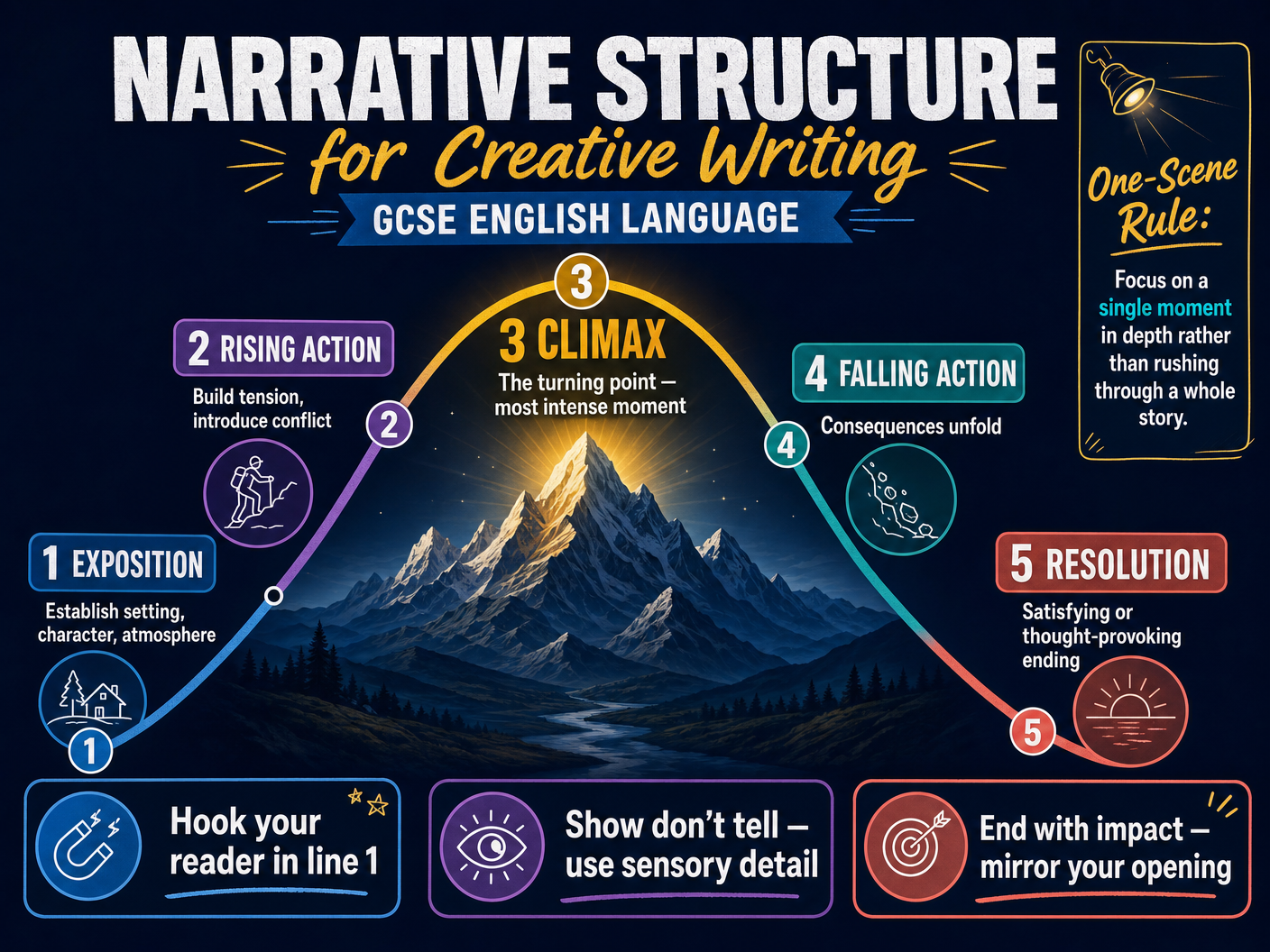
Key Narrative Techniques:
- Show, Don't Tell: Instead of writing "He was angry," write "His jaw clenched and his knuckles turned white." Let the reader deduce the emotion from sensory details and actions.
- The One-Scene Rule: In exam conditions, you don't have time for a sprawling epic spanning years. Focus on a single moment, a single scene, or a short chronological sequence. Depth is better than breadth.
- Engaging Openings: Hook the reader immediately. Start with action, a striking image, or an intriguing piece of dialogue.
- Satisfying Endings: Your ending should resolve the narrative arc or leave a deliberate, thought-provoking ambiguity. Try to link your ending back to an image or idea from your opening (cyclical structure).
Technical Accuracy (SPaG - AO6)
16 of the 40 marks in Section B are awarded for vocabulary, sentence structure, spelling, and punctuation.
- Ambitious Punctuation: Show the examiner you can use more than just full stops and commas. Use a semicolon to link two closely related independent clauses. Use a colon to introduce a list or a dramatic revelation. Use dashes for a sudden pause.
- Paragraph Cohesion: Use discourse markers (e.g., Consequently, Furthermore, In stark contrast) to guide the reader through your narrative.
- Vocabulary: Avoid basic adjectives like 'good', 'bad', 'happy', 'sad'. Upgrade your vocabulary (e.g., benevolent, detrimental, ecstatic, melancholic).
Visual Resources
3 diagrams and illustrations
Interactive Diagrams
2 interactive diagrams to visualise key concepts
Conceptual Flow Outline
Component 1 Exam Strategy Flowchart
Conceptual Flow Outline
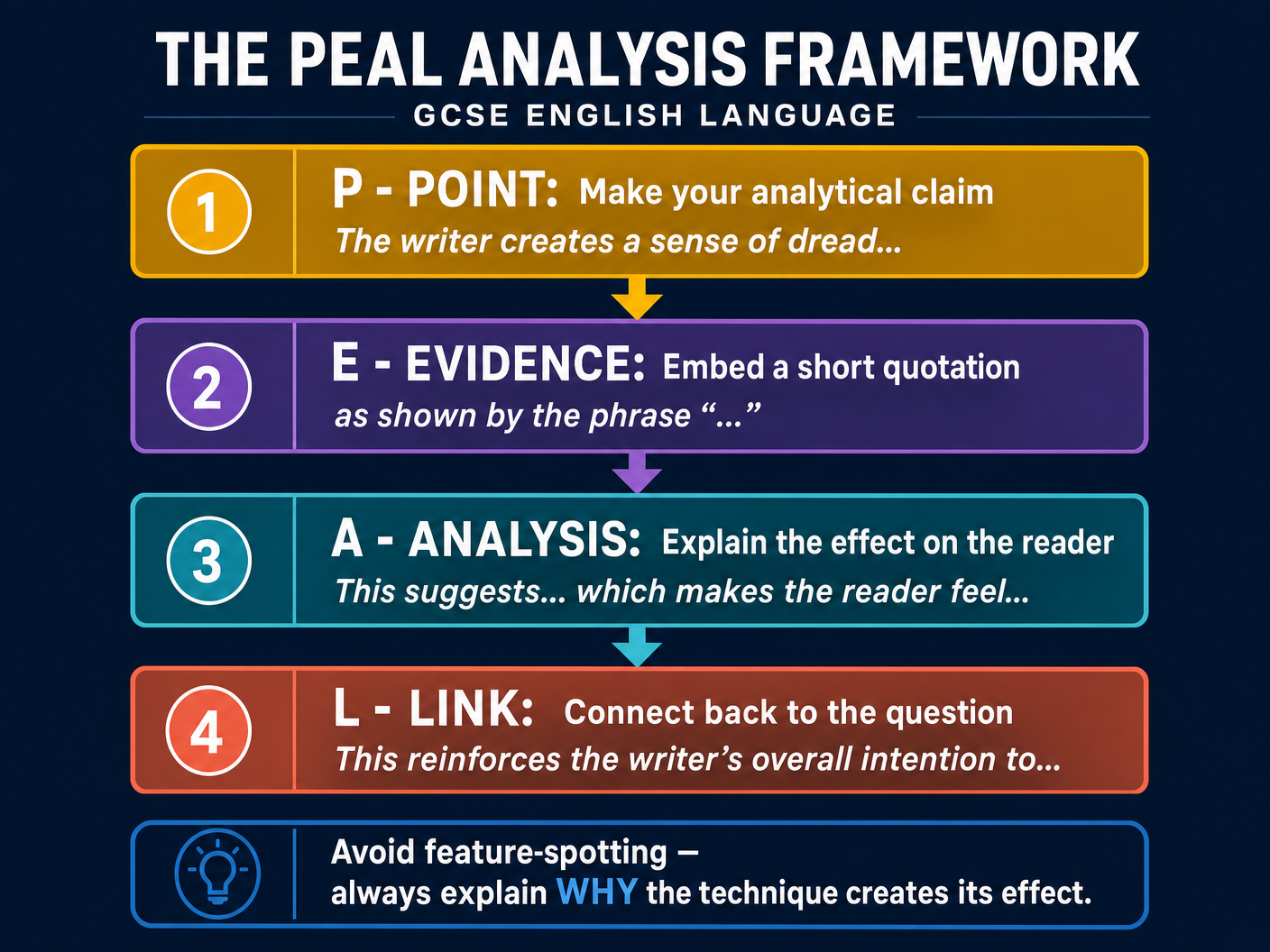
The PEAL Paragraph Structure
Worked Examples
3 detailed examples with solutions and examiner commentary
Practice Questions
Test your understanding — click to reveal model answers
Read lines 1-5. List five things you learn about the house. [5 marks]
Hint: Look for explicit facts stated in the text. You do not need to write in full sentences.
How does the writer use language in lines 10-20 to describe the storm? [10 marks]
Hint: Use PEAL. Look for verbs, adjectives, and imagery (personification/metaphor). Focus on how the storm makes the reader feel.
How does the writer structure the text to build tension? [10 marks]
Hint: Look at the progression of the text. Where does it start? How do the sentences change as the climax approaches?
A student said: 'The ending of the story is highly effective because it leaves the reader with a sense of hope.' To what extent do you agree? [10 marks]
Hint: You must evaluate. Use words like 'highly effective', 'somewhat convincing'. Provide evidence from the text to support your view.
Write a narrative which includes a significant discovery. [40 marks]
Hint: Plan your narrative arc. Focus on one scene. Show, don't tell the emotion of the discovery.