Eduqas · GCSE · English Language
Component 2: 19th and 21st Century Non-Fiction Reading Study and Transactional/Persuasive Writing (60%, 2 hours)
This component assesses your ability to critically analyse unseen 19th and 21st-century non-fiction texts and produce your own compelling transactional or persuasive writing. Success requires mastering specific analytical frameworks (like PEAL) and consciously adapting your writing style, tone, and register for different audiences and purposes.
- 9 min read
- 3 worked examples
- 3 practice questions
- 8 key terms
Study Notes
Overview
Component 2 of your GCSE English Language qualification is a demanding, two-hour examination worth 60% of your total grade. It focuses heavily on your ability to engage with non-fiction texts from different historical periods (the 19th and 21st centuries) and your capacity to produce highly effective transactional or persuasive writing. This is a skills-based paper; there are no set texts to memorise. Instead, examiners will test your ability to read critically and write purposefully under timed conditions.
The paper is divided equally into Section A (Reading) and Section B (Writing). Section A tests Assessment Objectives 1 through 4, requiring you to identify information, analyse language and structure, compare writers' viewpoints, and evaluate texts critically. Section B tests Assessment Objectives 5 and 6, demanding that you communicate clearly and imaginatively while maintaining high standards of technical accuracy in your spelling, punctuation, and grammar (SPaG).
To maximise your marks, you must understand exactly what each question is asking and deploy the right analytical or creative tools. Let's break down the core skills required for success.
Reading Skills (Section A)
Identifying Information & Ideas (AO1)
Questions testing AO1 are typically low-tariff (worth 2-4 marks) and ask you to "identify," "list," or "find" specific details. The examiner wants to see that you can locate both explicit (directly stated) and implicit (suggested) information within an unseen text.
Strategy: Do not overthink these questions. Scan the specified lines of the text, locate the relevant information, and write it down clearly. You do not need to analyse the language or explain the effect. A common pitfall is writing lengthy, analytical paragraphs for a simple 3-mark identification question, thereby wasting valuable time needed for the higher-tariff questions later in the paper.
Analysing Language (AO2)
When you see the command words "How does the writer use language...", you are being tested on AO2. This is where many candidates lose marks by simply "feature-spotting" — naming a technique without explaining its impact. To achieve Level 3 or Level 4 marks, you must explain why the writer chose specific words and what effect they have on the reader.
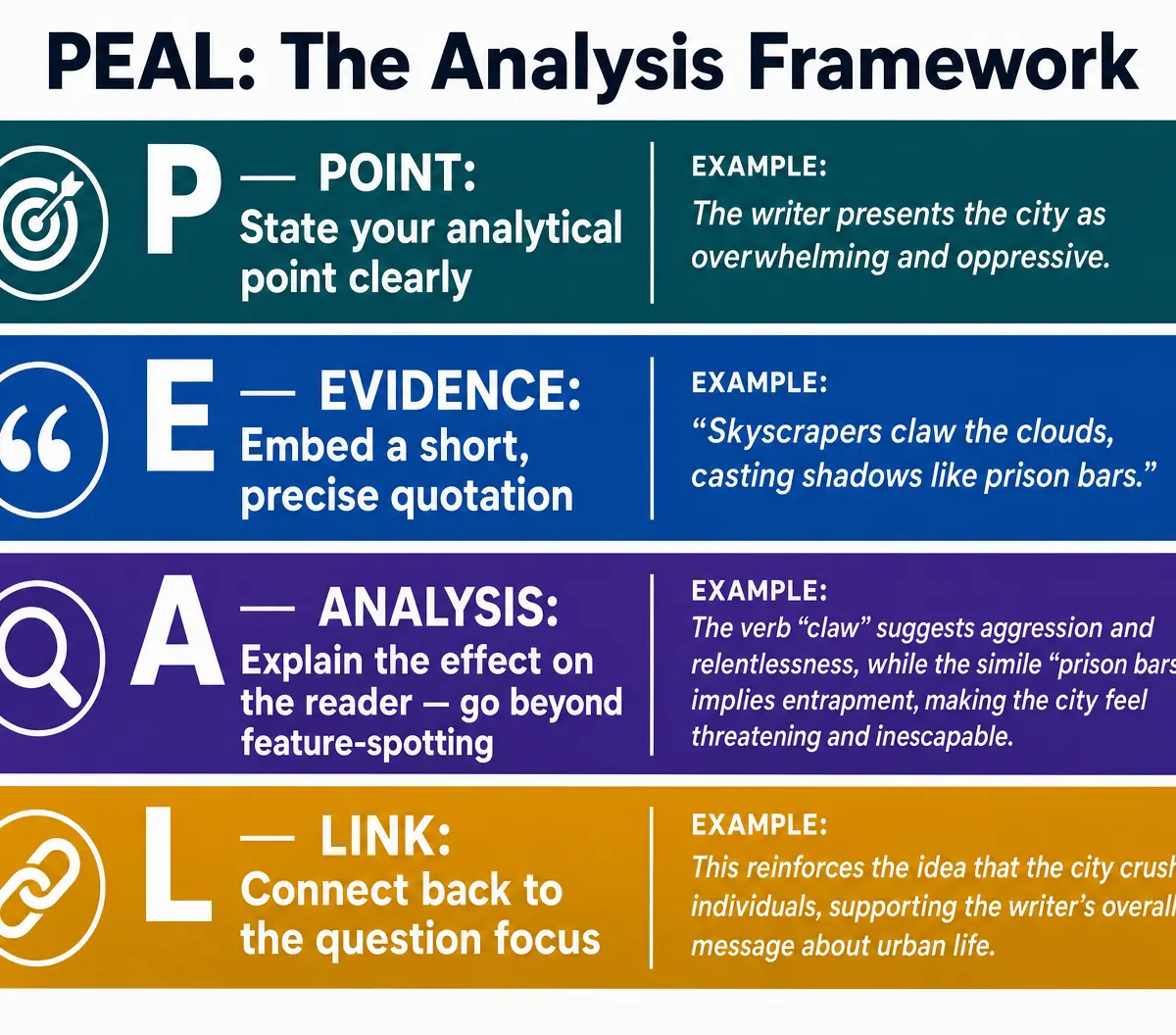
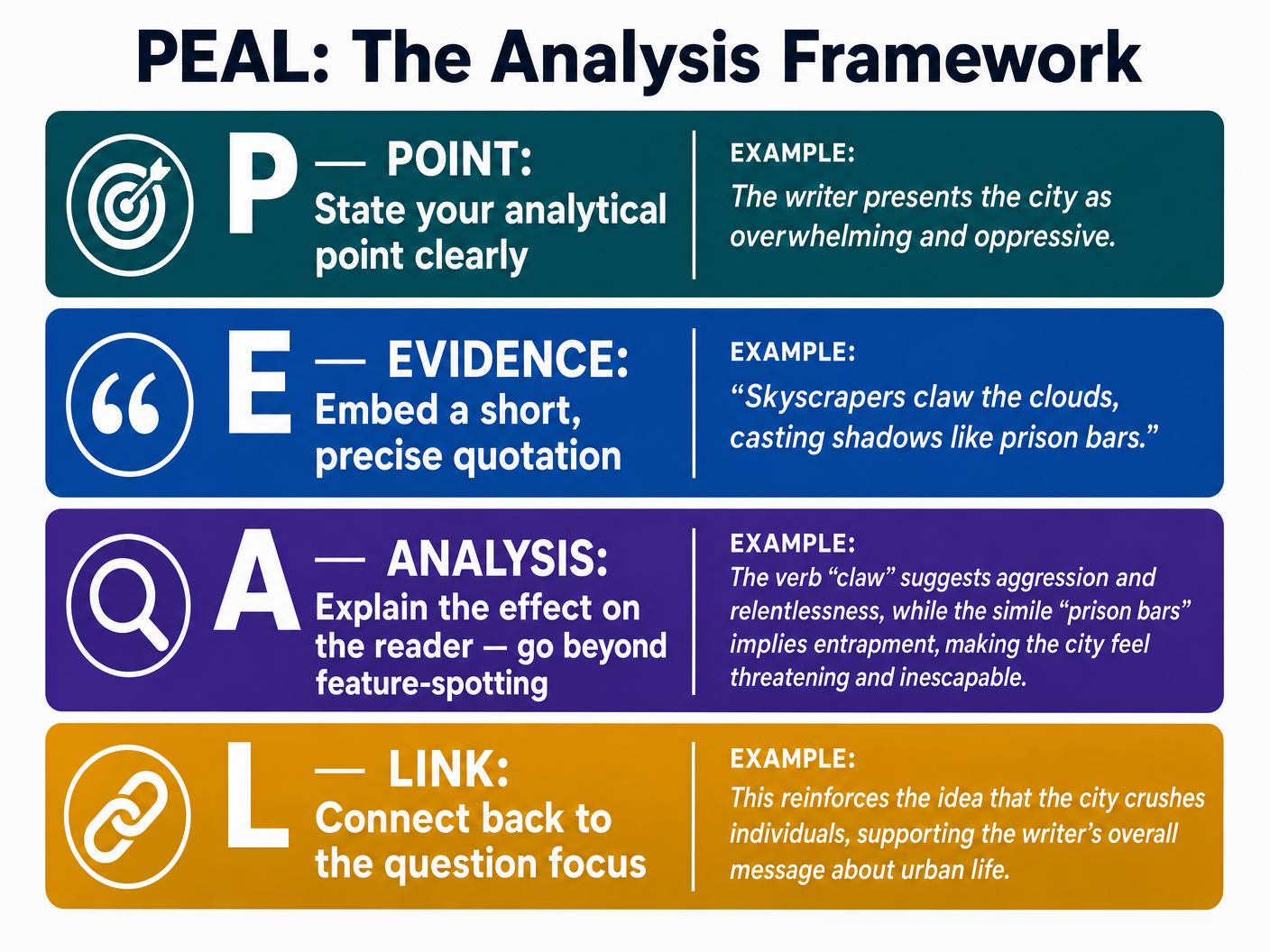
The PEAL FrameworkEvery analytical paragraph should follow a clear structure to ensure you meet the Assessment Objectives:
- Point: State your analytical point clearly, directly answering the question.
- Evidence: Embed a short, precise quotation into your sentence.
- Analysis: Explain the effect on the reader. Zoom in on specific words and explore their connotations.
- Link: Connect your analysis back to the writer's overall purpose or the specific focus of the question.
Key Language Features to Identify
| Feature | Definition | Effect on Reader | Example |
|---|---|---|---|
| Metaphor | Describing something as if it were something else, without using 'like' or 'as'. | Creates vivid, powerful imagery; transfers the qualities of one thing to another. | "The city was a machine that devoured its workers." |
| Simile | Comparing two things using 'like' or 'as'. | Helps the reader visualise the subject by comparing it to something familiar. | "The fog clung to the streets like a damp shroud." |
| Personification | Giving human qualities to non-human things. | Makes descriptions more relatable and dynamic; can create a specific mood (e.g., threatening or welcoming). | "The wind howled angrily through the broken windows." |
| Emotive Language | Words chosen specifically to provoke an emotional reaction. | Manipulates the reader into feeling sympathy, anger, fear, or joy, aligning them with the writer's viewpoint. | "The innocent victims suffered unimaginable cruelty." |
| Juxtaposition | Placing two contrasting ideas or images close together. | Highlights the differences between the two elements, often to make a critical point. | "The opulent mansion stood in the shadow of the starving slums." |
| Hyperbole | Deliberate exaggeration for effect. | Emphasises a point strongly; can add humour, drama, or outrage. | "I've told you a million times to clean this room." |
Analysing Structure (AO2)
Structure questions ask how the text is put together, not what words are used. You need to track the reader's journey through the text.
Key Structural Features:
- Openings: Does it start in media res (in the middle of the action)? Does it open with a shocking statistic or a personal anecdote?
- Shifts in Focus: Track where the writer's attention moves. Do they shift from the general to the specific? From the past to the present? From an external description to an internal thought?
- Narrative Perspective: Who is telling the story? Does the perspective change?
- Paragraph and Sentence Length: Short, punchy paragraphs can create tension or emphasise a point. Long, flowing paragraphs might build a complex argument or a detailed description.
- Endings: Does the text have a cyclical structure (returning to the opening idea)? Does it end on a cliffhanger, a call to action, or a reflective thought?
Evaluating Critically (AO4)
Evaluation questions (e.g., "To what extent do you agree with this statement?") require you to form a justified opinion about the text. You must assess how successfully the writer has achieved their aims, supporting your views with textual references.
Strategy: Always address both sides of the argument, even if you lean heavily towards one. Use a structure like: "To a significant extent, the writer successfully conveys... because [Evidence + Analysis]. However, one might also argue that..."
Comparing Writers' Viewpoints (AO3)
This is often the most challenging reading task. You must compare how two different writers (usually from different centuries) present their ideas and perspectives on a similar topic.
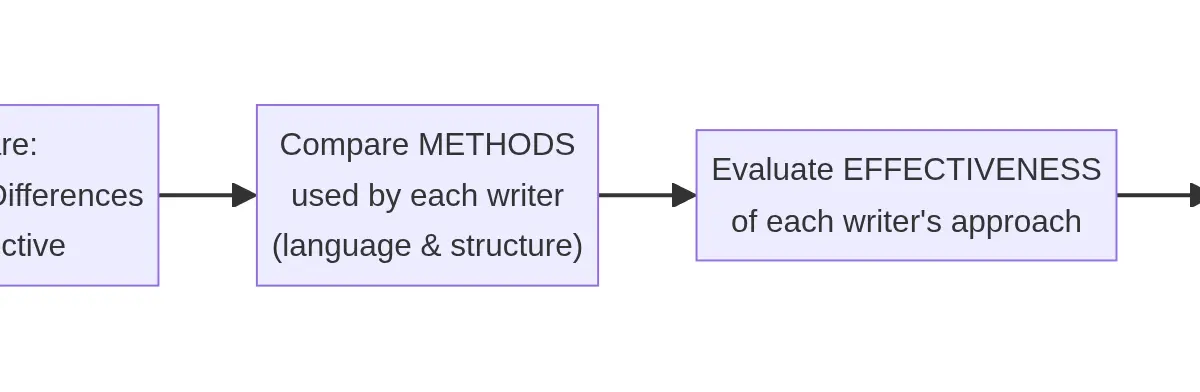
Framework for Comparison:
- Identify Viewpoints: What is Writer A's perspective? What is Writer B's perspective?
- Compare Methods: How does Writer A use language/structure to show their view? How does Writer B do it differently (or similarly)?
- Evaluate Effectiveness: Which approach is more powerful or appropriate for its context?
Examiner Tip: Always use comparison connectives (e.g., similarly, whereas, in contrast, conversely) to ensure you are genuinely comparing, rather than just writing two separate mini-essays.
Writing Skills (Section B)
Transactional and Persuasive Writing (AO5 & AO6)
Section B requires you to write for a specific purpose, audience, and form (PAF). You might be asked to write a letter, an article, a speech, a leaflet, or a review.
Purpose, Audience, and Form (PAF):
- Purpose: Are you trying to persuade, argue, advise, or inform? Your purpose dictates your techniques.
- Audience: Who are you writing to? A headteacher requires a formal, respectful register. A peer group allows for a more colloquial, engaging tone.
- Form: You MUST follow the conventions of the requested form. A letter needs an address and sign-off; an article needs a headline; a speech needs direct address to the audience.
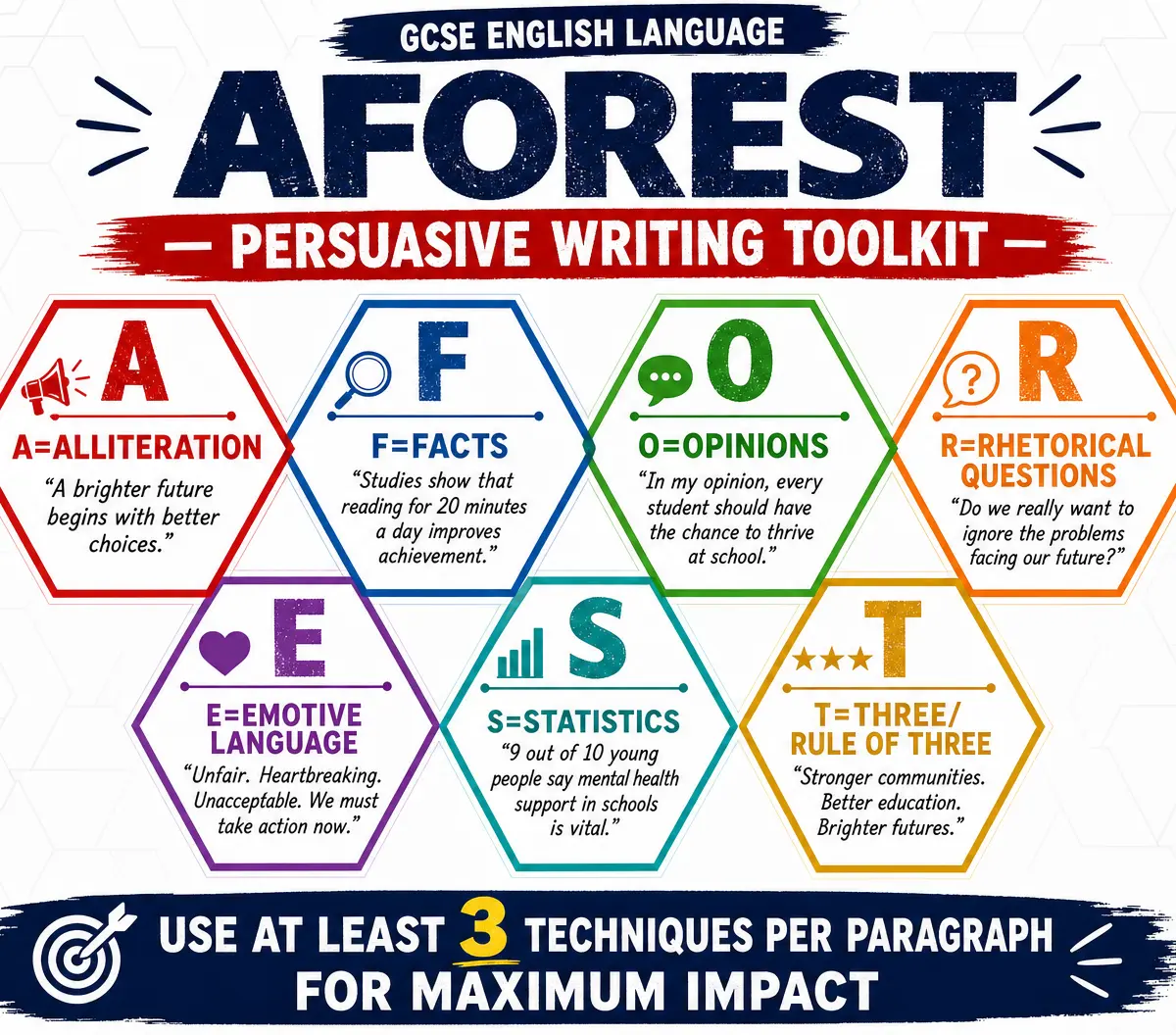
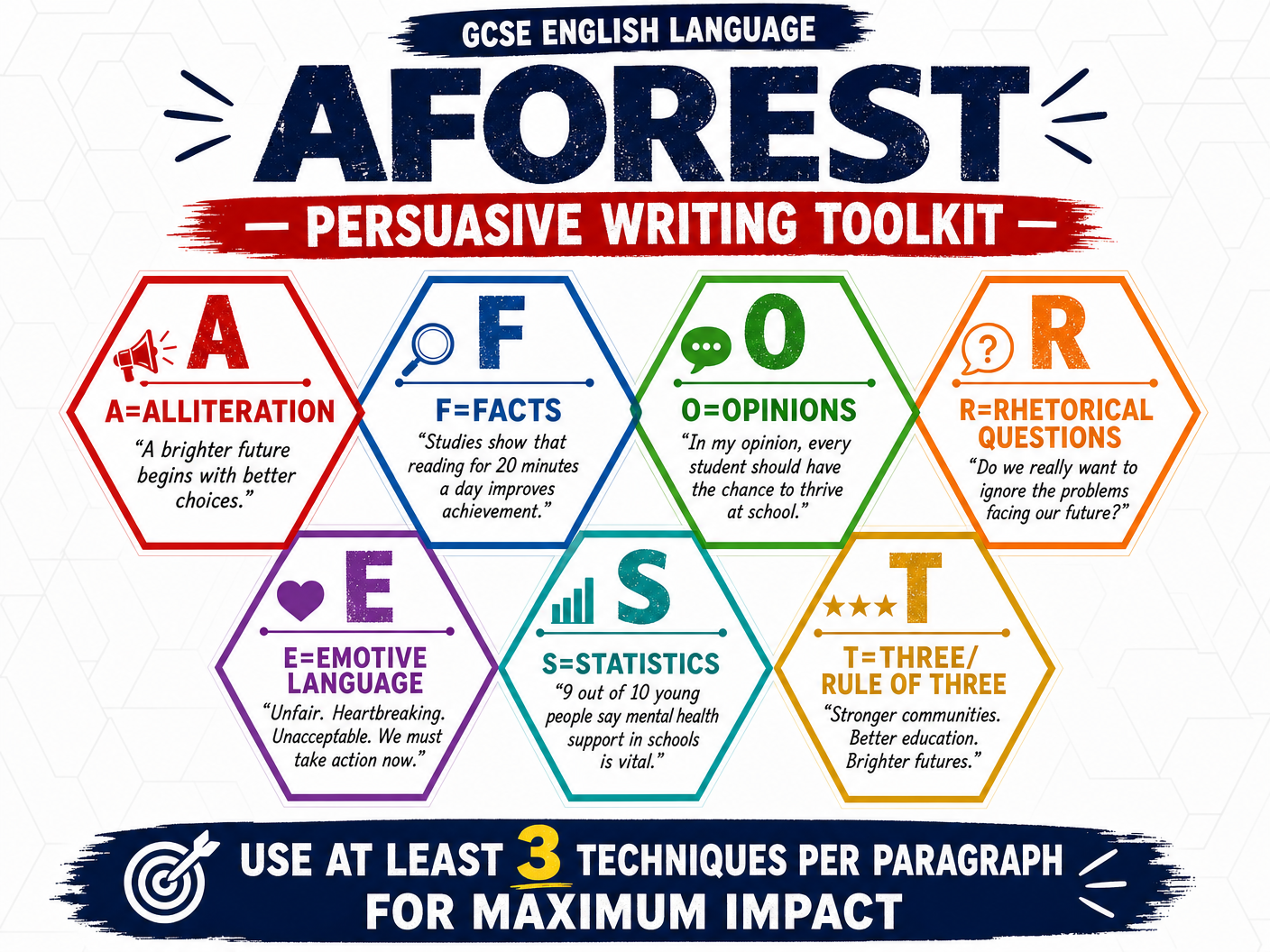
The AFOREST ToolkitWhen writing persuasively, consciously deploy these techniques to manipulate your reader:
- Alliteration: "A brighter future begins with better choices."
- Facts: "The library is currently closed on weekends."
- Opinions: "In my opinion, every student deserves access to quiet study spaces."
- Rhetorical Questions: "Do we really want to ignore the problems facing our future?"
- Emotive Language: "It is heartbreaking to see potential wasted."
- Statistics: "Over 80% of students surveyed requested longer opening hours."
- Three (Rule of Three): "We need action, investment, and commitment."
Technical Accuracy (SPaG - AO6)
Up to 20% of the total marks for the paper are awarded for Spelling, Punctuation, and Grammar. This is not an afterthought; it is a core requirement.
- Sentence Variety: Do not rely solely on simple sentences. Use complex and compound sentences to build sophisticated arguments. Use short sentences deliberately for dramatic impact.
- Ambitious Punctuation: Demonstrate your control by correctly using semicolons (to link closely related independent clauses), colons (to introduce lists or explanations), dashes (for emphasis or parenthetical asides), and brackets.
- Cohesion: Use discourse markers (Furthermore, Consequently, Nevertheless, Conversely) to guide the reader logically from one paragraph to the next.
Audio Revision
Listen to our comprehensive 10-minute podcast covering all the essential skills and common pitfalls for Component 2.
Visual Resources
2 diagrams and illustrations
Interactive Diagrams
2 interactive diagrams to visualise key concepts
Conceptual Flow Outline
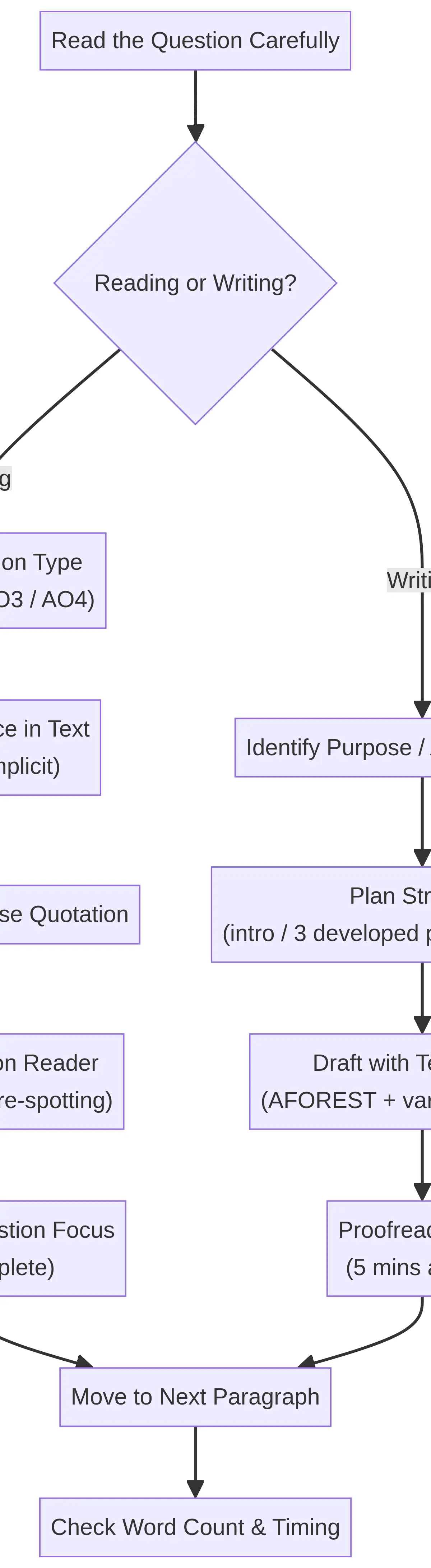
English Language exam approach flowchart
Conceptual Flow Outline
Comparison framework for AO3 questions
Worked Examples
3 worked examples — open one to explore the question and available guidance.
Practice Questions
Test your understanding — click to reveal model answers
Read lines 1-10. List four things you learn about the narrator's journey.
Hint: Keep it simple. Find four distinct facts in the specified lines. You do not need to write full paragraphs.
How does the writer use language in lines 15-25 to convey their anger about the situation?
Hint: Look for emotive language, strong verbs, and any use of hyperbole. Remember to use the PEAL structure.
Write an article for a broadsheet newspaper arguing that teenagers are unfairly stereotyped by the media.
Hint: Identify PAF: Purpose (to argue), Audience (broadsheet readers - educated adults), Form (article - needs a headline). Use AFOREST techniques.