Producing clear and coherent text: writing effectively for different purposes and audiences: to describe, narrate, explain, instruct, give and respond to information, and argue; selecting vocabulary, grammar, form, and structural and organisational features judiciously to reflect audience, purpose and context; using language imaginatively and creatively; using information provided by others to write (in different forms); maintaining a consistent point of view; maintaining coherence and consistency across a text
This topic assesses your ability to write clearly, coherently, and imaginatively for different purposes and audiences. You will be tested on your selection of vocabulary, structural features, and technical accuracy (SPaG).
Study Notes
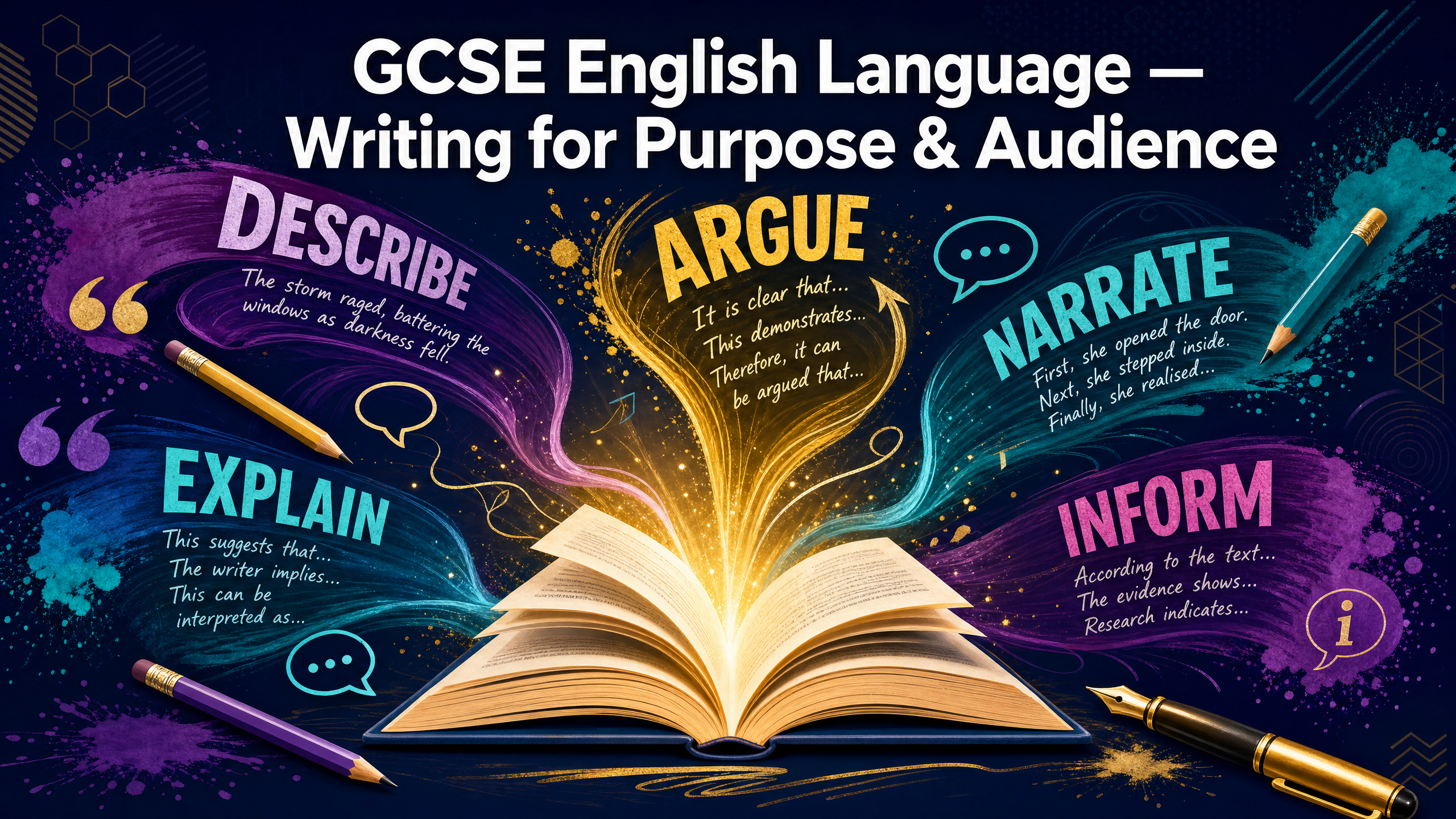
Overview
Writing effectively for different purposes and audiences is a core skill assessed in GCSE English Language. Examiners are looking for candidates who can adapt their tone, style, and register to suit specific tasks, whether that is writing a compelling narrative or a persuasive speech. This topic covers both creative writing (describing and narrating) and transactional writing (arguing, persuading, and informing).
Reading Skills: The Foundation of Good Writing
Before you can write effectively, you must understand how professional writers craft their texts. The reading section of your exam tests your ability to identify and analyse these techniques.
Identifying Information & Ideas
When approaching unseen texts, candidates must locate explicit information (facts directly stated) and implicit ideas (inferred meanings). Examiners reward candidates who can synthesise evidence from across a text to support their points.
Analysing Language
To achieve high marks in language analysis, you must go beyond simply identifying techniques. You must explain the effect of these techniques on the reader.
Key Language Features to Identify
| Feature | Definition | Effect on Reader | Example |
|---|---|---|---|
| Metaphor | Describing something as if it were something else. | Creates vivid imagery and helps the reader understand complex ideas through comparison. | "The classroom was a zoo." |
| Simile | Comparing two things using 'like' or 'as'. | Makes descriptions more relatable and visual. | "She was as quiet as a mouse." |
| Personification | Giving human qualities to non-human things. | Brings objects or settings to life, often reflecting the mood of the characters. | "The wind howled through the trees." |
| Pathetic Fallacy | Using the weather or setting to reflect human emotions. | Establishes atmosphere and foreshadows events. | "The sky wept grey tears." |
| Sibilance | Repetition of 's' sounds. | Can create a sinister, hissing effect or a soft, soothing tone depending on context. | "The snake slithered silently." |
| Juxtaposition | Placing two contrasting ideas close together. | Highlights differences and creates tension or dramatic effect. | "A dark shadow across the bright snow." |
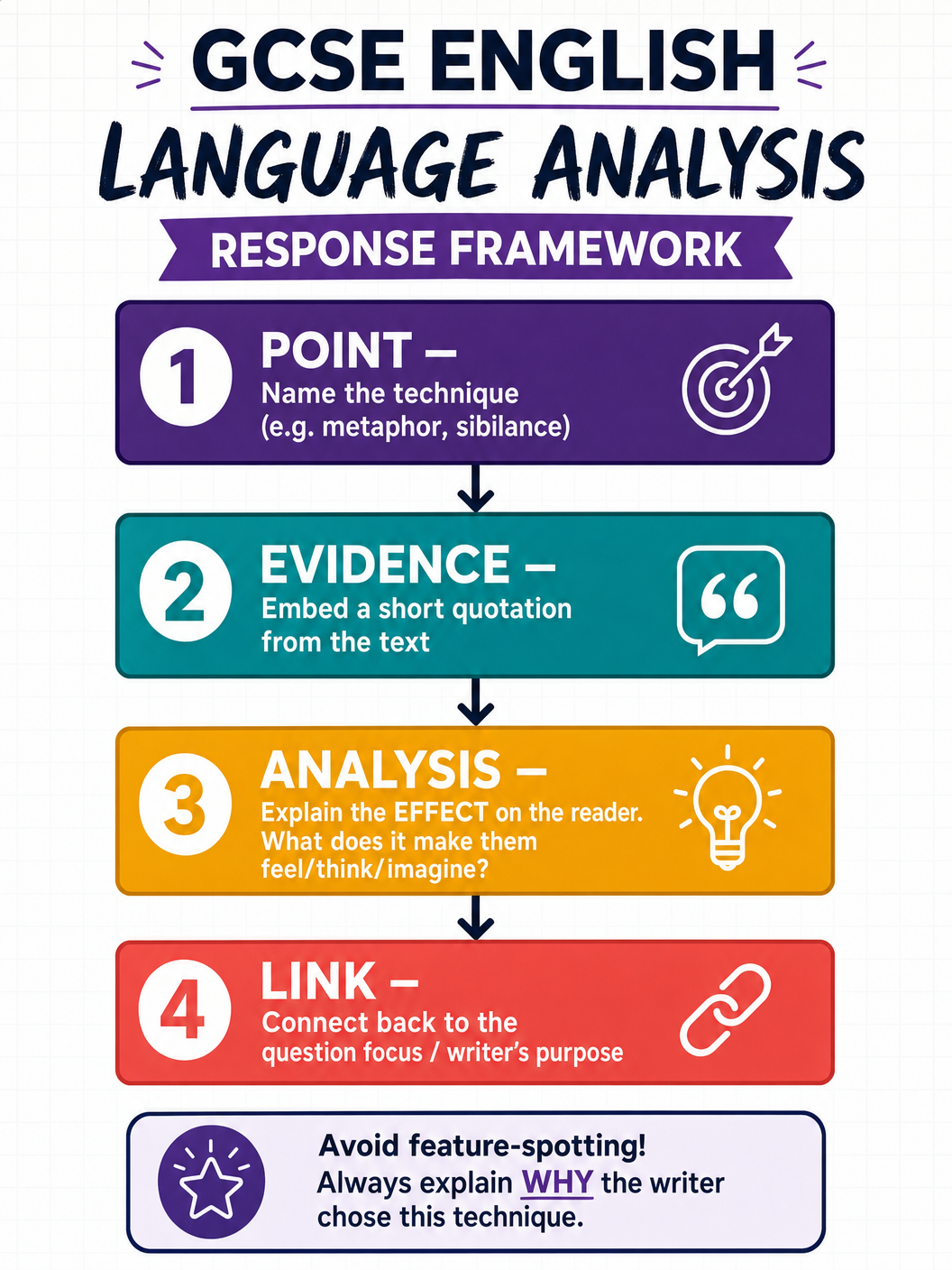
Analysing Structure
Structure refers to how a text is put together. Examiners look for analysis of:
- Openings and Endings: How does the writer hook the reader? Is the ending satisfying or ambiguous?
- Shifts in Focus: Moving from a wide landscape view to a specific detail (zooming in/out).
- Narrative Perspective: Who is telling the story? How does this affect our understanding?
- Sentence Length Variation: Short sentences for impact/tension; long, flowing sentences for description/atmosphere.
- Cyclical Structure: Ending where the text began to show lack of progress or inevitability.
Evaluating Critically
Evaluation questions ask for your opinion on a text, supported by evidence. A strong approach is:
- Statement: State your opinion clearly (e.g., "To a large extent, I agree...").
- Evidence: Provide a quotation.
- Analysis: Analyse the methods the writer uses to create this effect.
- Link: Link back to your overall evaluation.
Comparing Writers' Viewpoints
When comparing texts, candidates must identify the writers' differing perspectives and compare the methods they use to convey them. Use a point-by-point structure, ensuring you constantly link back to the focus of the question.
Writing Skills: Putting it into Practice
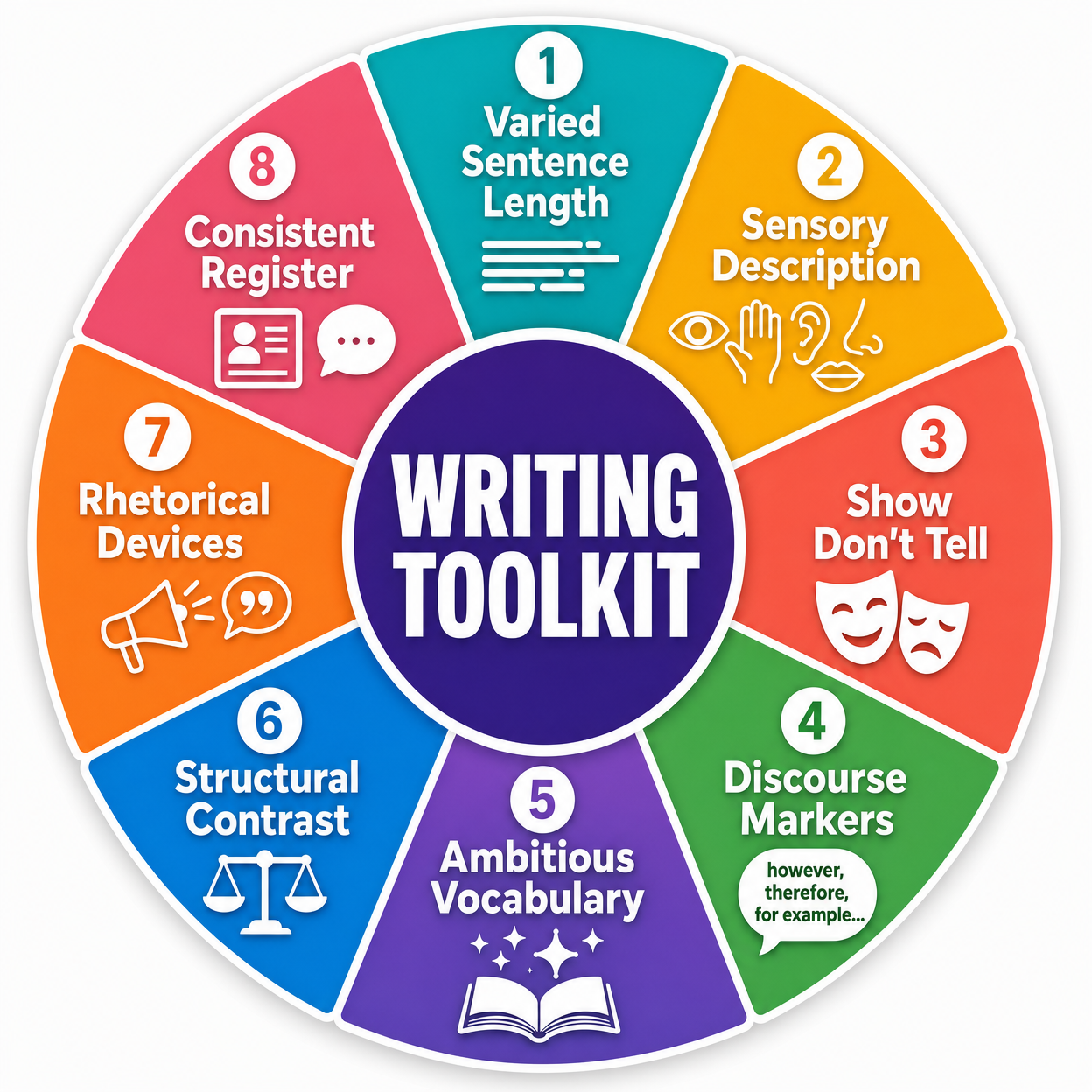
Creative Writing (Describing and Narrating)
In creative writing tasks, examiners reward imaginative vocabulary and structural control.
- Show, Don't Tell: Instead of stating emotions ("He was angry"), describe physical reactions ("His fists clenched until his knuckles turned white").
- Sensory Description: Use sight, sound, smell, touch, and taste to build a three-dimensional world.
- The One-Scene Rule: For narrative writing, focus on exploring one moment or scene in depth rather than rushing through a complex plot.
- Engaging Openings: Start in media res (in the middle of the action) to hook the reader immediately.
Transactional Writing (Non-Fiction)
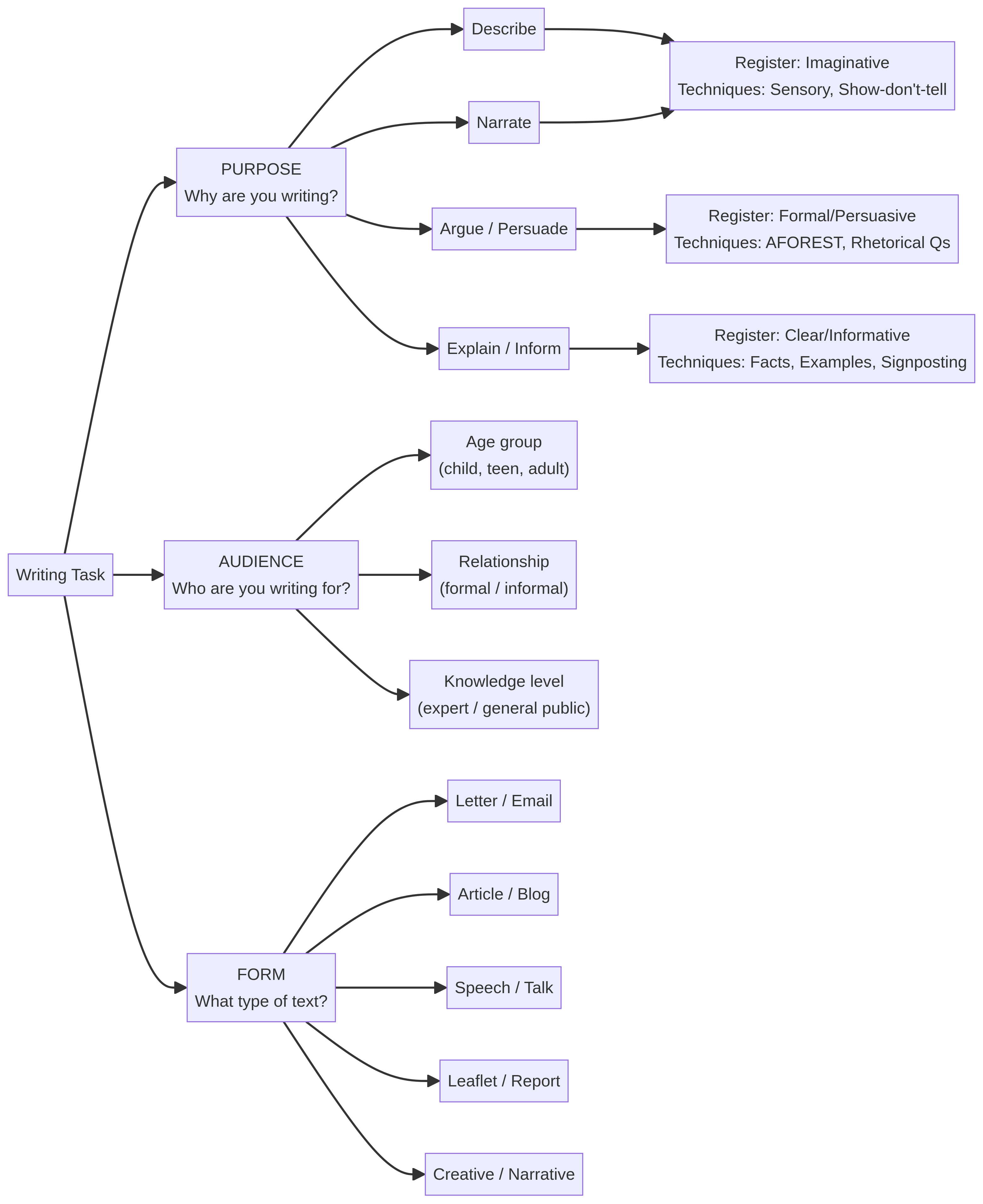
Transactional writing includes letters, articles, speeches, and leaflets. You must clearly identify the Purpose, Audience, and Form (PAF).
- Form Conventions: A letter needs a greeting and sign-off; a speech needs direct address; an article needs a headline.
- Persuasive Techniques (AFOREST): Use Alliteration, Facts, Opinions, Rhetorical questions, Emotive language, Statistics, and the rule of Three.
- Register: Maintain a consistent tone appropriate for your audience (e.g., formal for a broadsheet article, informal for a teen blog).
Technical Accuracy (SPaG)
Spelling, Punctuation, and Grammar (SPaG) account for a significant portion of your writing marks.
- Ambitious Punctuation: Move beyond full stops and commas. Use semicolons to link related clauses, colons to introduce ideas, and dashes for parenthetical asides.
- Paragraph Cohesion: Use discourse markers (e.g., "Furthermore", "Conversely", "Consequently") to link paragraphs logically.
- Sentence Variety: Deliberately mix simple, compound, and complex sentences for effect.
Visual Resources
4 diagrams and illustrations
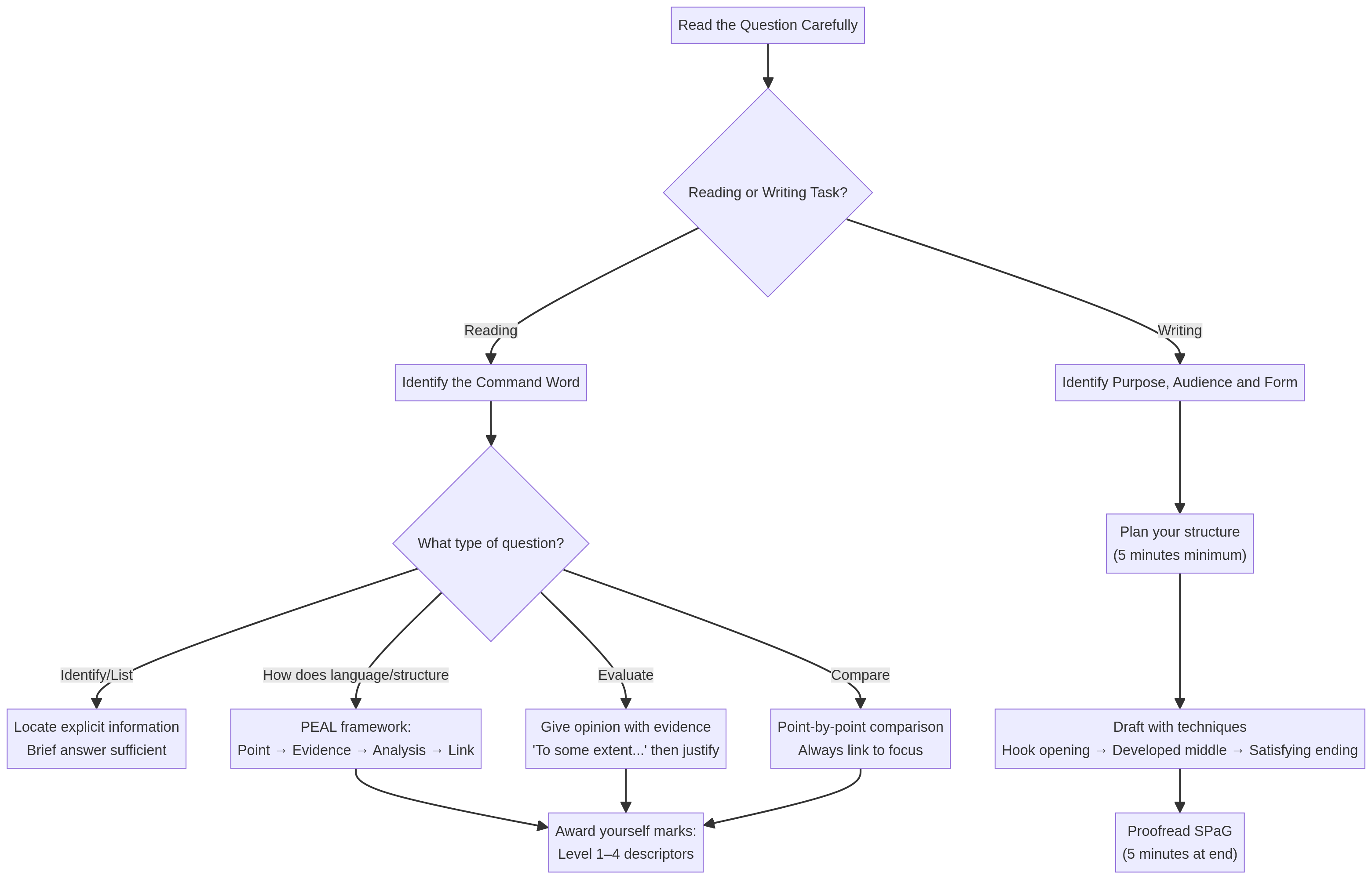
Interactive Diagrams
2 interactive diagrams to visualise key concepts
Conceptual Flow Outline
GCSE English Language Exam Approach Flowchart
Conceptual Flow Outline
Purpose, Audience, and Form (PAF) Framework for Writing
Worked Examples
3 detailed examples with solutions and examiner commentary
Practice Questions
Test your understanding — click to reveal model answers
Read lines 1-10. List four things we learn about the setting.
Hint: Look for explicit facts. You do not need to write in full paragraphs.
How does the writer use language to describe the storm? (8 marks)
Hint: Identify 2-3 language features (e.g., metaphor, verbs). Quote them and explain their effect on the reader.
Write a descriptive piece suggested by this image: [An image of a busy, neon-lit city street at night]. (24 marks content, 16 marks SPaG)
Hint: Use sensory description and vary your sentence lengths. Do not write a story with a complex plot.
Write a speech to your school assembly arguing that the school day should start later. (24 marks content, 16 marks SPaG)
Hint: Use AFOREST techniques. Ensure the register is appropriate for a formal assembly but engaging for students.
Compare how the writers of Text A and Text B convey their perspectives on extreme sports. (14 marks)
Hint: Identify the differing perspectives first, then compare the specific language/structural methods they use to show them.