Eduqas · GCSE · English Language
Writing for impact: selecting, organising and emphasising facts, ideas and key points; citing evidence and quotation effectively and pertinently to support views; creating emotional impact; using language creatively, imaginatively and persuasively, including rhetorical devices (such as rhetorical questions, antithesis, parenthesis)
Master the art of persuasive and impactful writing. This guide focuses on selecting and organising evidence, using rhetorical devices purposefully, and creating emotional resonance to secure top marks in GCSE English Language.
- 5 min read
- 3 worked examples
- 3 practice questions
- 8 key terms
Study Notes
Overview
In GCSE English Language, the ability to write for impact is assessed heavily under Assessment Objectives AO5 and AO6. Examiners are not just looking for what you say, but how powerfully you say it. This topic covers the essential skills of selecting the right evidence, organising your points for maximum momentum, and deploying language creatively to persuade, argue, and move your reader. Whether you are analysing a writer's methods in the reading section or crafting your own speech in the writing section, mastering these techniques is the key to unlocking the highest grades.
Reading Skills: Analysing Impact
When reading unseen texts, you must move beyond simply identifying features. The examiner wants to see you analyse the effect of language choices.
Identifying Information & Ideas (AO1)
Before you can analyse impact, you must locate the writer's key points. Skim the text to identify explicit facts, but also read between the lines for implicit ideas. Ask yourself: What is the writer's underlying agenda? What evidence have they selected to support their view?
Analysing Language (AO2)
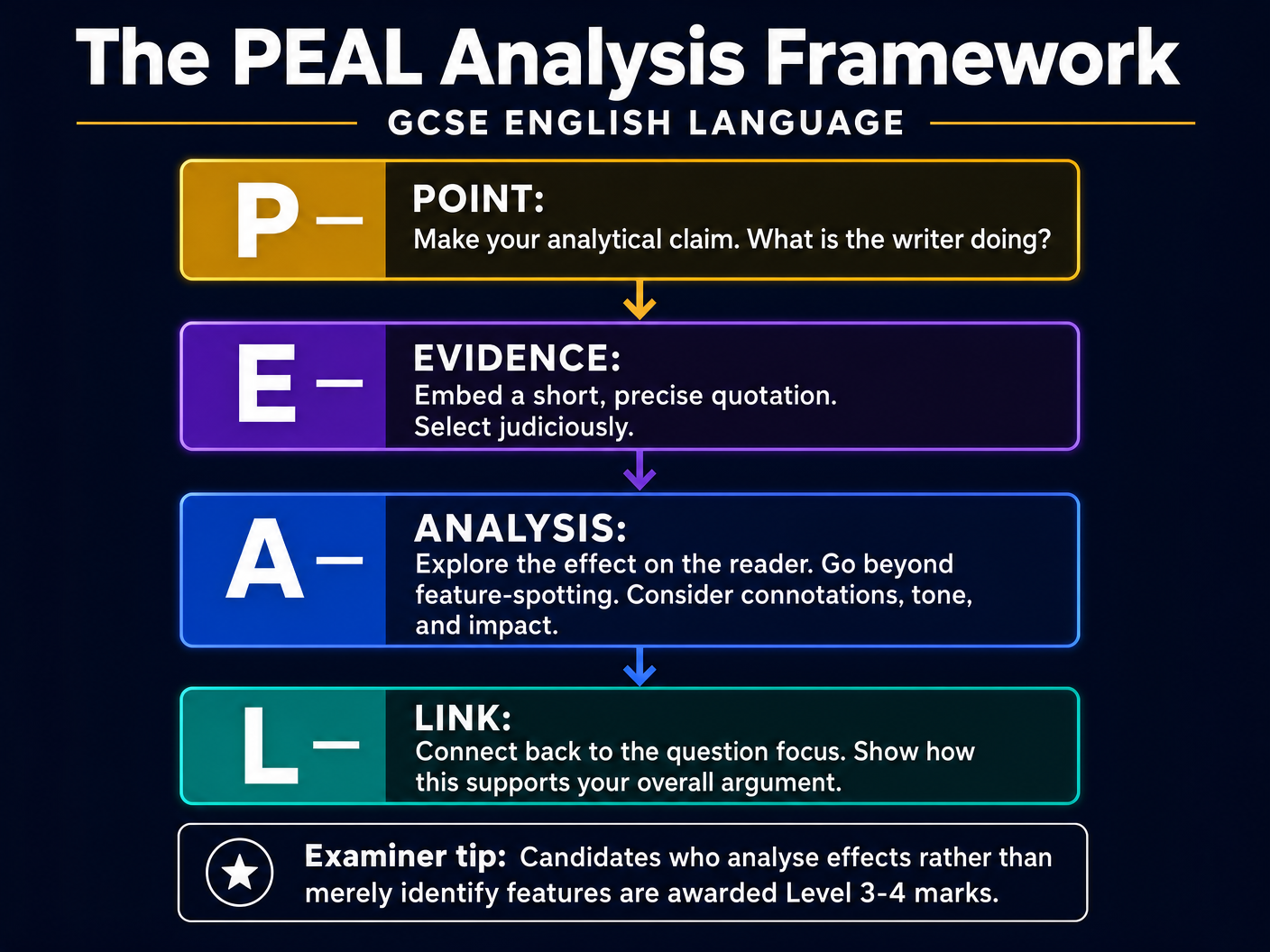
When analysing language, you must focus on how the writer achieves effects and influences the reader. Use the PEAL framework to structure your response.
Key Language Features to Identify
| Feature | Definition | Effect on Reader | Example |
|---|---|---|---|
| Metaphor | Saying one thing is another | Creates vivid imagery and strong associations | "The classroom was a zoo." |
| Simile | Comparing using like or as | Helps the reader visualise an unfamiliar concept | "As quiet as a grave." |
| Personification | Giving human traits to non-human things | Makes abstract concepts feel alive and relatable | "The wind howled through the night." |
| Emotive Language | Words chosen to trigger feelings | Manipulates the reader's emotions (anger, pity) | "Innocent victims suffer daily." |
| Semantic Field | A group of words related to a single theme | Builds a consistent atmosphere or tone | "Blood, battle, victory, march" (War) |
| Juxtaposition | Placing contrasting ideas close together | Highlights differences to make a stark point | "Wealthy mansions beside starving beggars." |
Analysing Structure (AO2)
Structure is how the writer builds their text over time. Look for:
- Openings: Does it hook the reader with a shocking fact or an emotional anecdote?
- Shifts in Focus: Does the writer move from the general to the specific, or from the past to the future?
- Sentence Variation: Short sentences create tension and impact; long, complex sentences build detail and momentum.
- Endings: Is there a call to action or a cyclical return to the beginning?
Evaluating Critically (AO4)
Evaluation requires you to give a considered opinion on how successfully a writer has achieved their aim. Use evaluative adverbs like skilfully, powerfully, or subtly.
Statement → Evidence → Analysis → Link to your evaluation.
Writing Skills: Creating Impact
Transactional & Persuasive Writing (AO5 & AO6)
When asked to write a speech, article, or letter, your first step is to identify your PAF: Purpose, Audience, and Form.
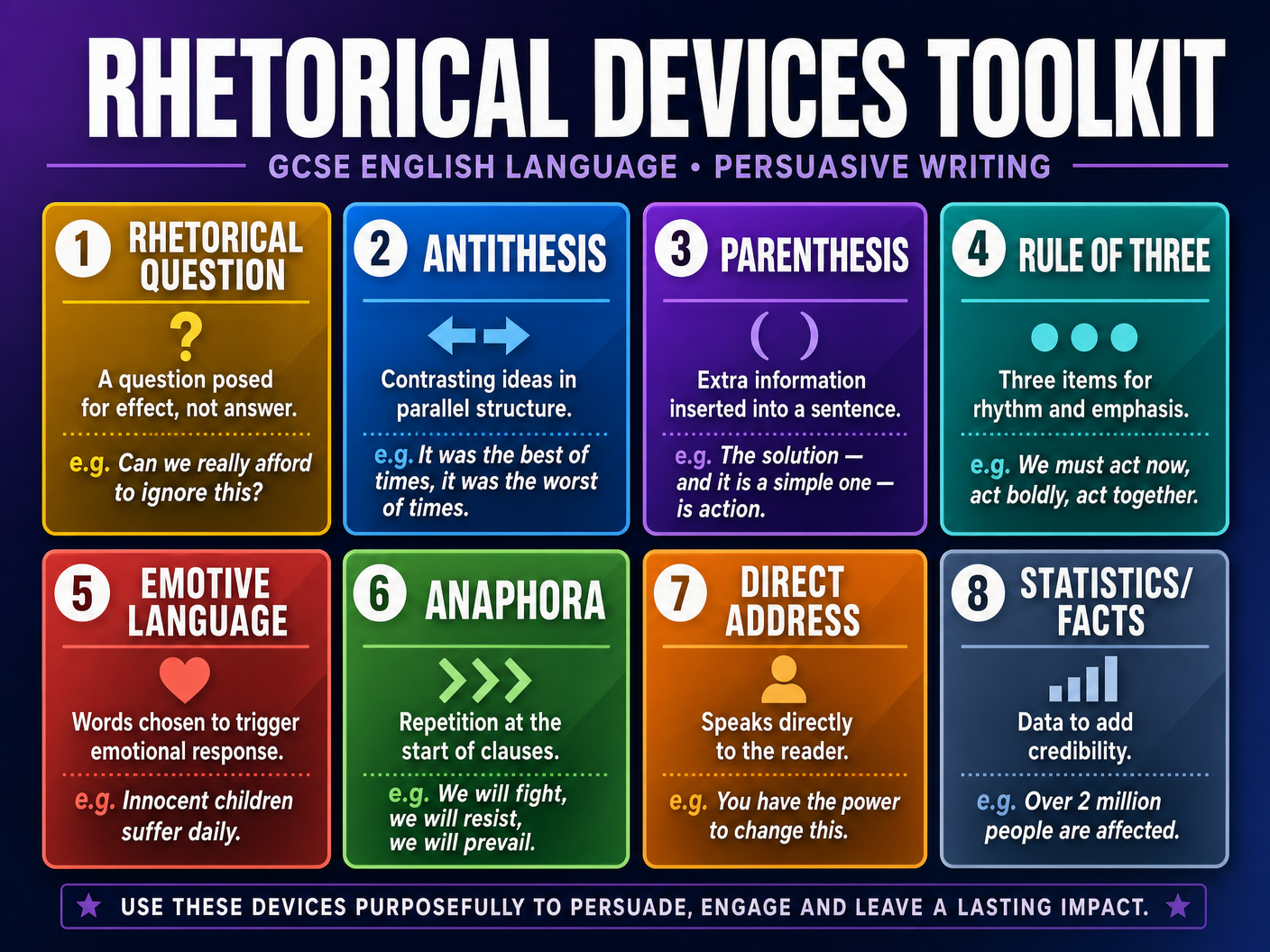
The Power Sandwich Structure
Organise your points strategically. Start with your strongest, most engaging point. Build your argument logically through the middle. End with your most emotionally resonant point to leave a lasting impression.
Using Evidence Effectively
Do not just drop statistics into a paragraph. Embed them.
Weak: "80% of people agree. This shows it is true."
Strong: "When a staggering 80% of the population demands change, how can the government continue to ignore them?"
Technical Accuracy (SPaG)
Your spelling, punctuation, and grammar (AO6) must be secure, but also ambitious. Use semicolons to link related independent clauses. Use dashes for parenthesis to add a whispered aside or a pointed comment. Control your paragraphing using sophisticated discourse markers (e.g., Furthermore, Consequently, Conversely).
Listen to the Podcast:
Interactive Diagrams
2 interactive diagrams to visualise key concepts
Conceptual Flow Outline
Writing Task Planning Workflow
Conceptual Flow Outline
The PEAL Analysis Chain
Worked Examples
3 worked examples — open one to explore the question and available guidance.
Practice Questions
Test your understanding — click to reveal model answers
Read lines 1-10. List four things you learn about the narrator's situation.
Hint: Keep your answers brief. You do not need to quote or analyse, just extract the facts.
How does the writer use language in paragraphs 2 and 3 to make the argument sound urgent?
Hint: Look for short sentences, emotive vocabulary, and direct address.
Write a letter to your local newspaper arguing that young people should have more say in local politics. (40 marks)
Hint: Remember your PAF. Form: Letter (needs Dear Editor, Yours faithfully). Audience: Adult newspaper readers (needs formal but engaging tone). Purpose: Argue.