Section A (30%) – Reading
This study guide covers Section A (Reading) of the GCSE English Language exam. It focuses on the core skills of identifying information, analysing language and structure, comparing texts, and evaluating writers' methods.
Study Notes
Overview
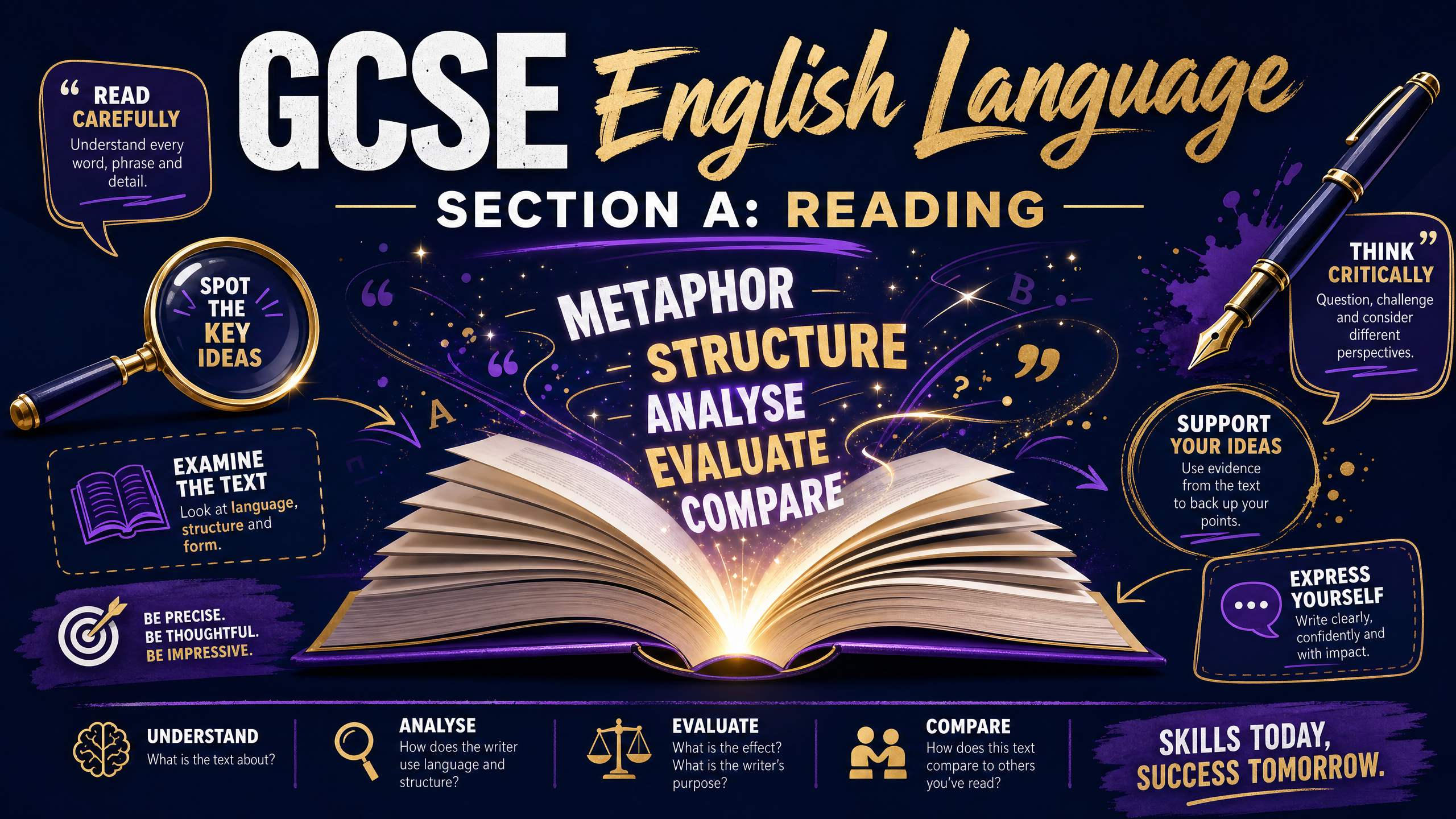
Section A of the GCSE English Language exam focuses entirely on your Reading skills. It accounts for 30% of your total GCSE grade. This section is not about what happens in the text; it is about how the writer has crafted the text and why they made those choices. You will be assessed on four key Assessment Objectives (AOs): identifying information (AO1), analysing language and structure (AO2), comparing texts (AO3), and evaluating critically (AO4).
Listen to our comprehensive audio guide for a detailed breakdown of these skills:
Reading Skills
Identifying Information & Ideas (AO1)
This skill requires you to locate and retrieve specific information from unseen texts. The information can be explicit (directly stated) or implicit (suggested or implied). When asked to 'list' or 'identify', keep your answers brief and focused. Do not waste time analysing here; simply find the facts.
Analysing Language (AO2)
This is where you explain how the writer uses words and phrases to influence the reader. You must use subject terminology accurately, but remember: identifying a feature earns no marks unless you explain its effect.
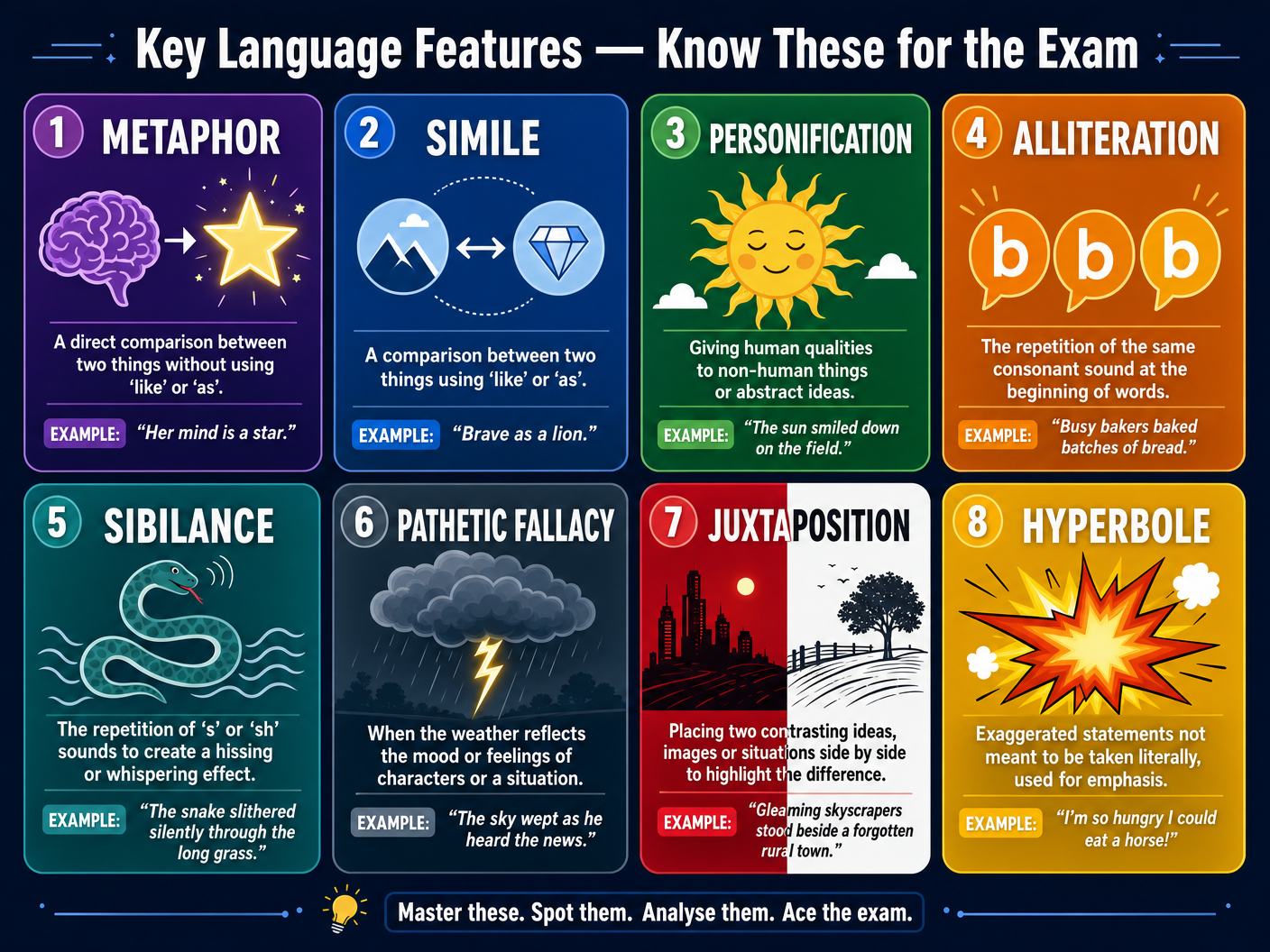
Key Language Features to Identify
| Feature | Definition | Effect on Reader | Example |
|---|---|---|---|
| Metaphor | A direct comparison stating something is something else | Creates a powerful, absolute image that forces the reader to see the subject in a new light | "The city was a concrete jungle." |
| Simile | A comparison using 'like' or 'as' | Helps the reader visualise something unfamiliar by comparing it to something familiar | "He was as brave as a lion." |
| Personification | Giving human qualities to non-human things | Makes the inanimate seem alive, often creating a sense of threat or comfort | "The wind howled through the trees." |
| Pathetic Fallacy | Weather reflecting the mood of characters or the scene | Establishes atmosphere and foreshadows events | "Thunder crashed as the villain entered." |
| Alliteration | Repetition of consonant sounds at the start of words | Creates rhythm and draws attention to specific words | "The dark, damp, desolate street." |
| Sibilance | Repetition of 's' or 'sh' sounds | Creates a hissing, whispering, or sinister effect | "The snake slithered silently." |
| Juxtaposition | Placing contrasting ideas side by side | Highlights the stark differences between two elements | "The gleaming tower above the slums." |
| Hyperbole | Deliberate exaggeration | Emphasises extreme emotion or importance | "I've told you a million times." |
Analysing Structure (AO2)
Structure is how the text is put together. Examiners often note that candidates ignore structure in favour of language. Look for:
- Openings and Endings: How does the text hook the reader? Is the ending resolved or cyclical?
- Shifts in Focus: Where does the writer zoom in on a detail or pull back to a wide view?
- Narrative Perspective: Is it first person (intimate) or third person (detached)?
- Sentence Length: Short sentences build tension; long sentences create flow or complexity.
- Paragraphing: A single-sentence paragraph has massive dramatic impact.
Comparing Writers' Viewpoints (AO3)
When comparing texts, you must compare methods, not just content. Identify the writers' viewpoints, then compare how they convey those viewpoints. Use comparative discourse markers like 'Similarly', 'In contrast', and 'Whereas'.
Evaluating Critically (AO4)
Evaluation questions ask for your opinion on how successfully a writer has achieved an effect. You must provide a balanced, reasoned judgement supported by textual evidence. Use phrases like 'To some extent' and 'This is highly effective because...'.
Writing Skills
While this guide focuses primarily on Reading, remember that reading and writing are intrinsically linked. The texts you analyse in Section A should serve as models for your own writing in Section B.
Creative Writing
For narrative and descriptive tasks, remember to 'show, don't tell'. Use sensory description, vary your sentence structures, and avoid the trap of writing purely descriptively when a narrative is required. The 'one-scene rule' is highly effective: focus deeply on a single moment rather than rushing through a complex plot.
Transactional/Non-Fiction Writing
For letters, articles, speeches, and leaflets, always consider the Purpose, Audience, and Form (PAF). Use persuasive techniques (like the AFOREST acronym) appropriately.
Technical Accuracy (SPaG)
Spelling, punctuation, and grammar (SPaG) account for a significant portion of your writing marks. Use ambitious punctuation (semicolons, colons, dashes) correctly, and ensure your paragraphs flow logically using discourse markers.
Interactive Diagrams
2 interactive diagrams to visualise key concepts
Conceptual Flow Outline
English Language Exam Approach Flowchart
Conceptual Flow Outline
Framework for AO3 Comparison Questions
Worked Examples
3 detailed examples with solutions and examiner commentary
Practice Questions
Test your understanding — click to reveal model answers
List four things you learn about the house from lines 1-5.
Hint: This is an AO1 task. Look for explicit facts. Do not analyse.
Analyse how the writer uses language in lines 10-20 to describe the character's fear.
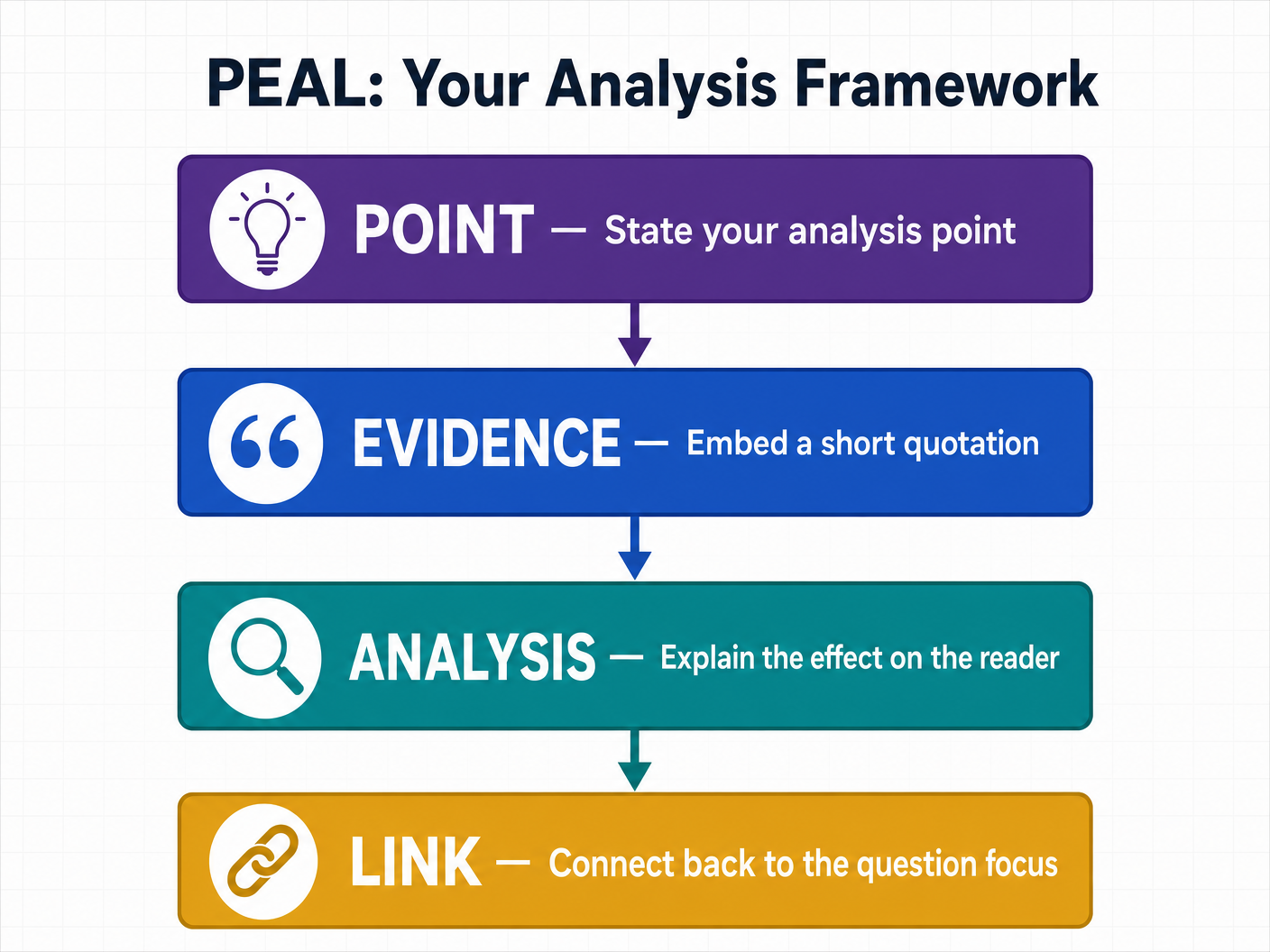
Hint: Use PEAL. Find a language feature, embed a quote, and explain the effect.
Evaluate the statement: 'The writer successfully creates a sense of complete hopelessness in the final paragraph.' To what extent do you agree?
Hint: This is AO4. Give a balanced judgement. Use 'To some extent' and support with evidence.
Compare how the writers of Text 1 and Text 2 convey their attitudes towards technology.
Hint: This is AO3. Compare the *methods* used by both writers.
Write a descriptive piece based on the image provided. (24 marks Content/Org, 16 marks SPaG)
Hint: This is Section B writing. Focus on sensory details, varied sentences, and accurate SPaG.