AQA · A-Level · English Literature
Course version: 7717 · Version from Sept 2026
Drama and further texts: Andrea Levy: Small Island
Full specification wording
Aspects of comedy - Set texts: Drama and further texts: Andrea Levy: Small Island
Levy's 2004 novel interweaves four narrators — Hortense, Queenie, Gilbert and Bernard — across Jamaica and Britain before, during and after the Second World War.
Checked against the AQA 7717 specification (opens in a new tab) on .
- Point 4 of 6
- 4 key terms
Study notes
From the checked teaching notes for this specification point.
The idea
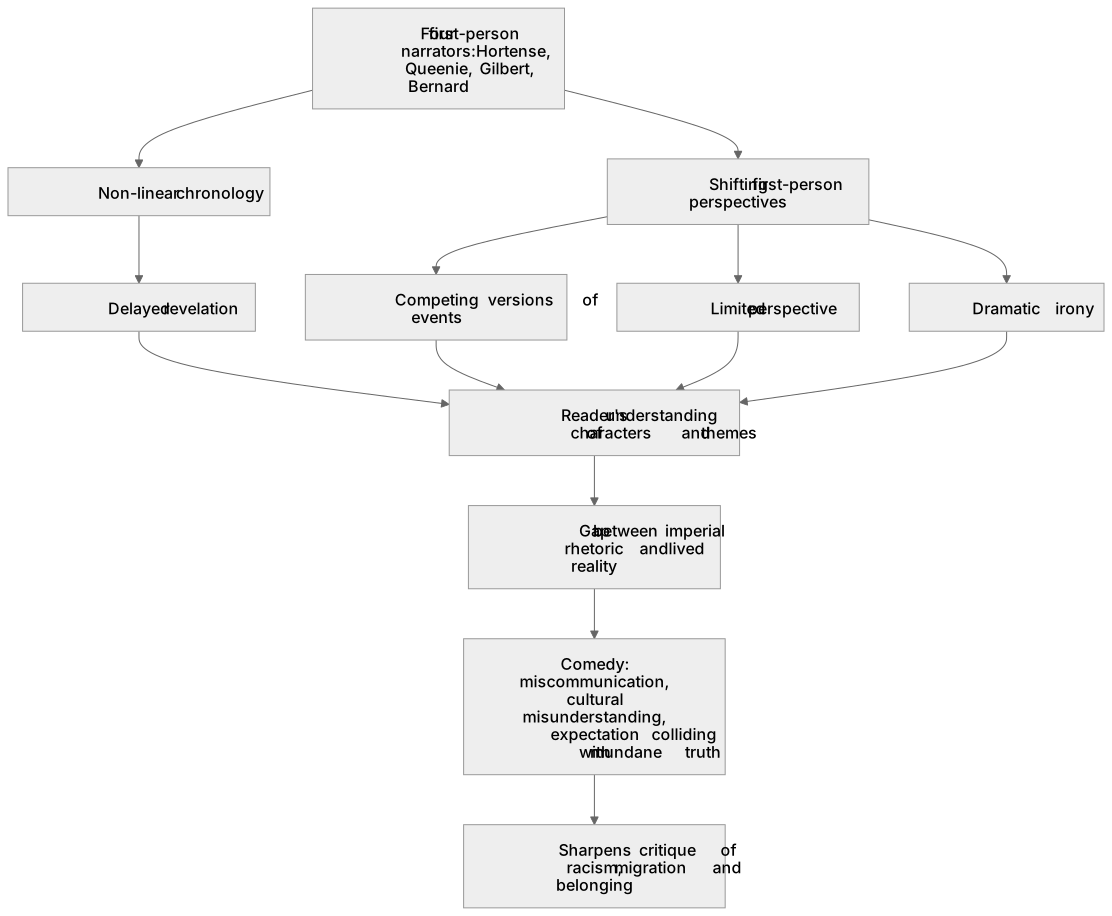
Levy's 2004 novel interweaves four narrators — Hortense, Queenie, Gilbert and Bernard — across Jamaica and Britain before, during and after the Second World War. Hortense arrives in 1948 expecting the England of her colonial education; Gilbert, a Jamaican RAF volunteer, faces colour bars and hostility; Queenie and Bernard run a London lodging house. Levy uses shifting first-person perspectives, non-linear chronology and dramatic irony to expose the gap between imperial rhetoric and lived reality. Comedy arises from miscommunication, cultural misunderstanding and the collision of expectation with mundane truth, yet it sharpens rather than softens the novel's critique of racism, migration and belonging. Study how narrative voice, structure and historical context shape meaning, and how Levy balances humour with loss.
What earns the marks
- Analyse how Levy's four first-person narrators create competing versions of events, and evaluate the effects of limited perspective and dramatic irony.
- Examine the non-linear structure and shifting chronology, explaining how delayed revelation shapes the reader's understanding of characters and themes.
- Discuss the gap between colonial expectation and post-war British reality, using Hortense's arrival and Gilbert's experiences as evidence.
- Explore how Levy uses comedy, misunderstanding and irony to expose racism and class prejudice without diminishing their seriousness.
- Consider the novel's treatment of migration, belonging and 'home', including the significance of the Empire Windrush context and the 1948 setting.
- Evaluate how Levy presents gender and marriage through Hortense, Queenie and their relationships, and how these intersect with race and class.
Common mistakes and how to put them right
Reading the novel as a single straightforward story rather than four constructed perspectives.
Put it right by comparing narrators' accounts of the same events.
Assuming the humour signals a light treatment of racism.
Put it right by showing how comic misunderstanding exposes prejudice and its human cost.
Treating historical context as background decoration.
Put it right by linking specific references to empire, war and migration to the novel's themes and form.
Exam tips
- Use precise references to narrator and chapter, and compare how different voices frame the same event to demonstrate structural awareness.
- When writing about comedy, identify the source of humour (misunderstanding, irony, juxtaposition) and then analyse its serious purpose.
- Keep context integrated: connect a specific historical detail to a specific textual moment rather than adding general background.
Try the lesson
The start of the Aspects of comedy - Set texts: Drama and further texts: Andrea Levy: Small Island lesson, made from checked teaching notes for this specification point.
Have a go first
In Small Island, which two characters arrive in London from Jamaica in 1948?
Listen
Levy's 2004 novel interweaves four narrators — Hortense, Queenie, Gilbert and Bernard — across Jamaica and Britain before, during and after the Second World War. Hortense arrives in 1948 expecting the England of her colonial education; Gilbert, a Jamaican RAF volunteer, faces colour bars and hostility; Queenie and Bernard run a London lodging house. Levy uses shifting first-person perspectives, non-linear chronology and dramatic irony to expose the gap between imperial rhetoric and lived reality. Comedy arises from miscommunication, cultural misunderstanding and the collision of expectation with mundane truth, yet it sharpens rather than softens the novel's critique of racism, migration and belonging. Study how narrative voice, structure and historical context shape meaning, and how Levy balances humour with loss. A strong answer earns marks for these points. Analyse how Levy's four first-person narrators create competing versions of events, and evaluate the effects of limited perspective and dramatic irony. Examine the non-linear structure and shifting chronology, explaining how delayed revelation shapes the reader's understanding of characters and themes. Discuss the gap between colonial expectation and post-war British reality, using Hortense's arrival and Gilbert's experiences as evidence. Explore how Levy uses comedy, misunderstanding and irony to expose racism and class prejudice without diminishing their seriousness. A common slip: Reading the novel as a single straightforward story rather than four constructed perspectives. Instead, comparing narrators' accounts of the same events. Exam tip: Use precise references to narrator and chapter, and compare how different voices frame the same event to demonstrate structural awareness.
See it
Key words
Say what each word means before you turn the card.
Migration and belonging
Try answering aloud or in your head before turning the card.
Race, empire and prejudice
Try answering aloud or in your head before turning the card.
Memory and narrative perspective
Try answering aloud or in your head before turning the card.
Expectation versus reality
Try answering aloud or in your head before turning the card.
See every definition
- Migration and belonging
- The novel's treatment of movement between Jamaica and Britain and the search for 'home', including the significance of the Empire Windrush context and the 1948 setting.
- Race, empire and prejudice
- Levy's critique of racism and class prejudice, exposed through comedy, misunderstanding and irony without diminishing their seriousness.
- Memory and narrative perspective
- The use of four first-person narrators creating competing versions of events, with limited perspective and dramatic irony shaping the reader's understanding.
- Expectation versus reality
- The gap between colonial expectation and post-war British reality, shown through Hortense's arrival and Gilbert's experiences.
Label the diagram
Some boxes have lost their names. Pick the right name for each number.
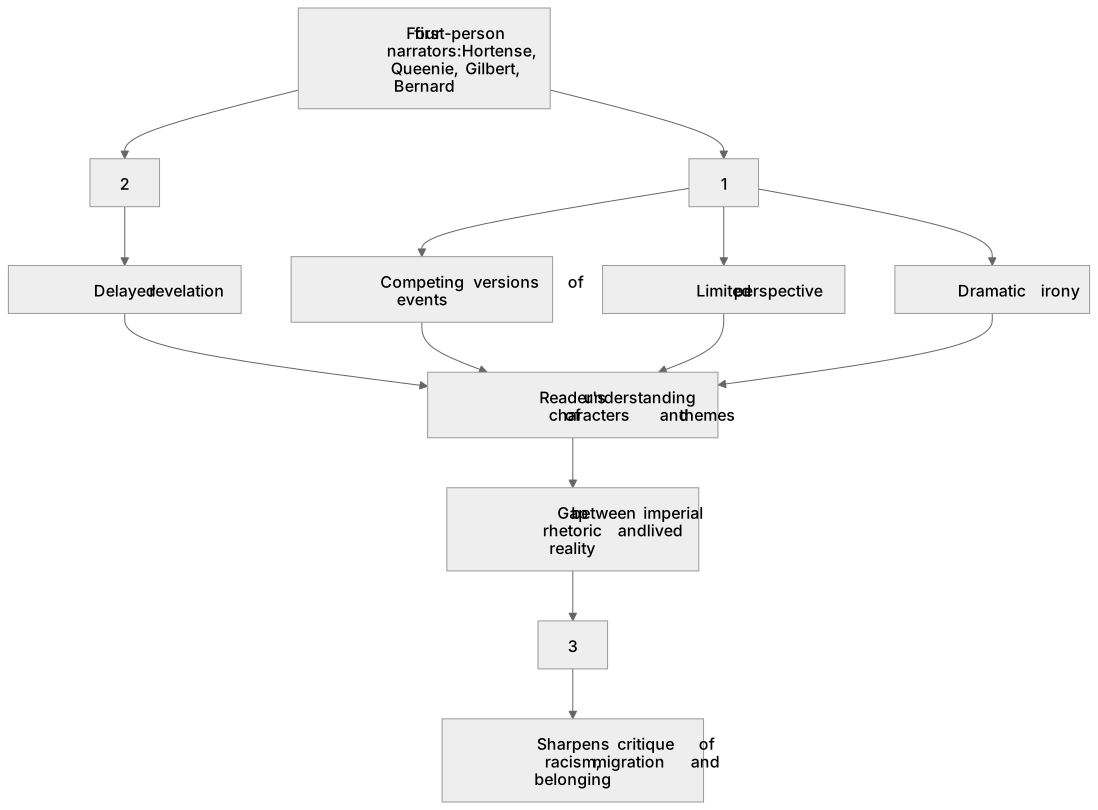
1Box 1
2Box 2
3Box 3
There is more to this lesson
The full lesson goes on to check your understanding and help you earn the marks. Create a free account to carry on, with your progress saved.
A week of Premium from your first lesson · Then the free plan continues · No card, no charge
Test your understanding of Aspects of comedy - Set texts: Drama and further texts: Andrea Levy: Small Island
Active recall beats re-reading. Take an instant quiz now to test what you’ve learned and lock it into long-term memory.
A week of Premium from your first lesson · Then the free plan continues · No card, no charge