AQA · A-Level · English Literature
Course version: 7717 · Version from Sept 2026
Drama and further texts: AQA English Literature B Poetry anthology…
Full specification wording
Aspects of comedy - Set texts: Drama and further texts: AQA English Literature B Poetry anthology (comedy): ‘The Flea’, ‘Tam o' Shanter’, ‘A Satirical Elegy on the Death of a Late Famous General’, ‘Sunny Prestatyn’, ‘Mrs Sisyphus’, ‘Not My Best Side’, ‘My Rival’s House’
This anthology spans comic modes from metaphysical seduction to modern satire.
Checked against the AQA 7717 specification (opens in a new tab) on .
- Point 6 of 6
- 4 key terms
Study notes
From the checked teaching notes for this specification point.
The idea
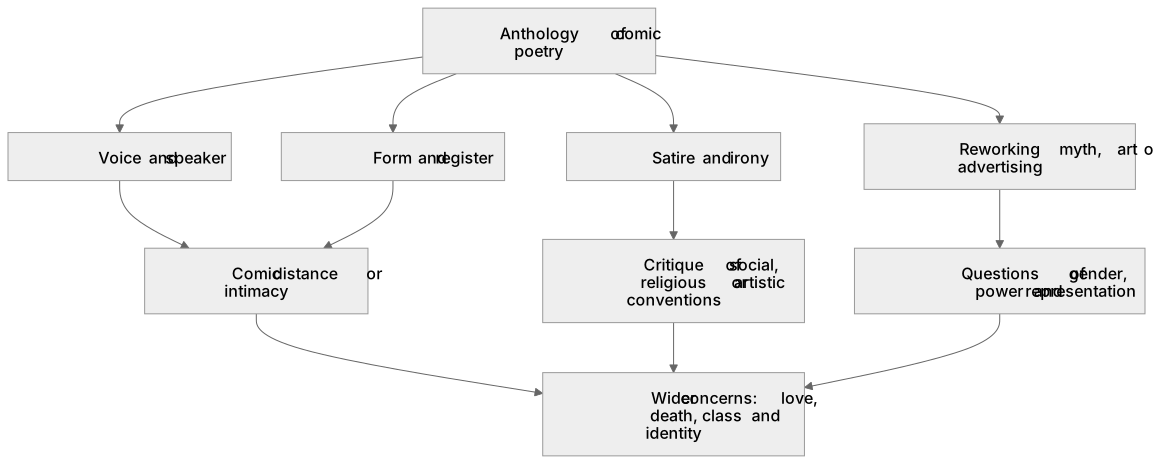
This anthology spans comic modes from metaphysical seduction to modern satire. Donne's ‘The Flea’ uses a conceit to argue seduction, mixing wit with absurdity. Burns's ‘Tam o' Shanter’ narrates a drunken ride and witch chase in Scots verse, blending humour with the supernatural. Swift's ‘A Satirical Elegy’ mocks a dead general through mock-praise. Larkin's ‘Sunny Prestatyn’ attacks advertising imagery with brutal defacement. Duffy's ‘Mrs Sisyphus’ gives a domestic voice to a mythic wife. Fanthorpe's ‘Not My Best Side’ rewrites Uccello's painting from the dragon, maiden and knight. ‘My Rival’s House’ explores jealousy through domestic observation. Compare how each poem uses voice, form and register to create comedy and critique.
What earns the marks
- Compare how poets use speaker and voice, including dramatic monologue and mock-elegy, to create comic distance or intimacy.
- Analyse how form and register, such as Burns's Scots verse or Donne's conceit, shape comic effect and meaning.
- Examine how satire targets social, religious or artistic conventions through irony, parody and deflation.
- Discuss how modern poems rework myth, art or advertising to question gender, power and representation.
- Connect comic techniques to the anthology's wider concerns with love, death, class and identity.
Common mistakes and how to put them right
Summarising each poem's plot without comparing methods.
Put it right by organising responses around shared techniques such as voice, form and irony.
Assuming comedy means light-hearted.
Put it right by showing how humour can carry serious critique of power, gender or mortality.
Neglecting context where it matters.
Put it right by linking, for example, Burns's Scots tradition or Larkin's post-war Britain to the poem's comic effects.
Exam tips
- Build comparisons around methods, not just themes, and use connectives to show similarity and difference.
- Quote precisely and analyse individual words, sounds and line breaks rather than paraphrasing.
- Keep the comedy genre central, explaining how each poem makes readers laugh and what that laughter reveals.
Try the lesson
The start of the Aspects of comedy - Set texts: Drama and further texts: AQA English Literature B Poetry anthology (comedy): ‘The Flea’, ‘Tam o' Shanter’, ‘A Satirical Elegy on the Death of a Late Famous General’, ‘Sunny Prestatyn’, ‘Mrs Sisyphus’, ‘Not My Best Side’, ‘My Rival’s House’ lesson, made from checked teaching notes for this specification point.
Have a go first
In John Donne's 'The Flea', what does the speaker use the flea to argue about his relationship with the woman?
Listen
This anthology spans comic modes from metaphysical seduction to modern satire. Donne's ‘The Flea’ uses a conceit to argue seduction, mixing wit with absurdity. Burns's ‘Tam o' Shanter’ narrates a drunken ride and witch chase in Scots verse, blending humour with the supernatural. Swift's ‘A Satirical Elegy’ mocks a dead general through mock-praise. Larkin's ‘Sunny Prestatyn’ attacks advertising imagery with brutal defacement. Duffy's ‘Mrs Sisyphus’ gives a domestic voice to a mythic wife. Fanthorpe's ‘Not My Best Side’ rewrites Uccello's painting from the dragon, maiden and knight. My Rival’s House’ explores jealousy through domestic observation. Compare how each poem uses voice, form and register to create comedy and critique. A strong answer earns marks for these points. Compare how poets use speaker and voice, including dramatic monologue and mock-elegy, to create comic distance or intimacy. Analyse how form and register, such as Burns's Scots verse or Donne's conceit, shape comic effect and meaning. Examine how satire targets social, religious or artistic conventions through irony, parody and deflation. Discuss how modern poems rework myth, art or advertising to question gender, power and representation. A common slip: Summarising each poem's plot without comparing methods. Instead, organising responses around shared techniques such as voice, form and irony. Exam tip: Build comparisons around methods, not just themes, and use connectives to show similarity and difference.
See it
Key words
Say what each word means before you turn the card.
Love, seduction and gender relations
Try answering aloud or in your head before turning the card.
Death, mortality and mock-elegy
Try answering aloud or in your head before turning the card.
Satire of power, class and advertising
Try answering aloud or in your head before turning the card.
Myth, art and rewriting tradition
Try answering aloud or in your head before turning the card.
See every definition
- Love, seduction and gender relations
- A comic mode in the anthology running from metaphysical seduction, where a conceit argues seduction, to poems questioning gender and representation.
- Death, mortality and mock-elegy
- A concern of the anthology in which a dead general is mocked through mock-praise in a mock-elegy, showing humour can carry serious critique of mortality.
- Satire of power, class and advertising
- Comic critique in which satire targets social, religious or artistic conventions through irony, parody and deflation, including attacks on advertising imagery.
- Myth, art and rewriting tradition
- The reworking of myth and art, as when a mythic wife is given a domestic voice or a painting is rewritten from the dragon, maiden and knight.
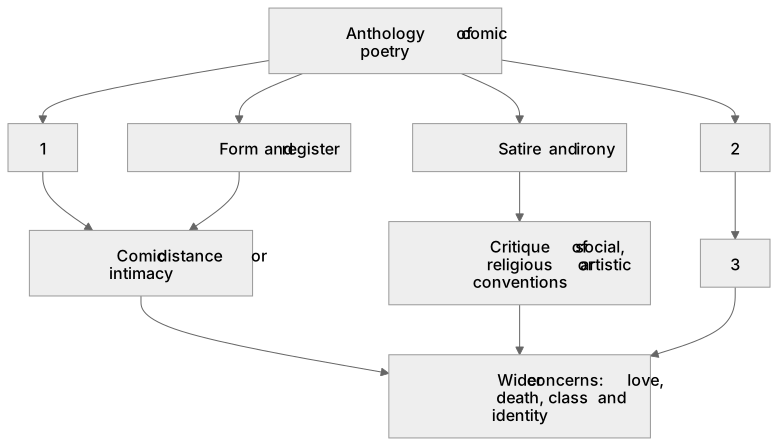
Label the diagram
Some boxes have lost their names. Pick the right name for each number.
1Box 1
2Box 2
3Box 3
There is more to this lesson
The full lesson goes on to check your understanding and help you earn the marks. Create a free account to carry on, with your progress saved.
A week of Premium from your first lesson · Then the free plan continues · No card, no charge
Test your understanding of Aspects of comedy - Set texts: Drama and further texts: AQA English Literature B Poetry anthology (comedy): ‘The Flea’, ‘Tam o' Shanter’, ‘A Satirical Elegy on the Death of a Late Famous General’, ‘Sunny Prestatyn’, ‘Mrs Sisyphus’, ‘Not My Best Side’, ‘My Rival’s House’
Active recall beats re-reading. Take an instant quiz now to test what you’ve learned and lock it into long-term memory.
A week of Premium from your first lesson · Then the free plan continues · No card, no charge