AQA · A-Level · English Literature
Course version: 7717 · Version from Sept 2026
Aspects of tragedy - Set texts: Shakespeare: William Shakespeare: Othello
Othello is a Shakespearean tragedy centred on a respected Moorish general whose marriage to Desdemona is destroyed by Iago's manipulative insinuations.
Checked against the AQA 7717 specification (opens in a new tab) on .
- Point 1 of 2
- 4 key terms
Study notes
From the checked teaching notes for this specification point.
The idea
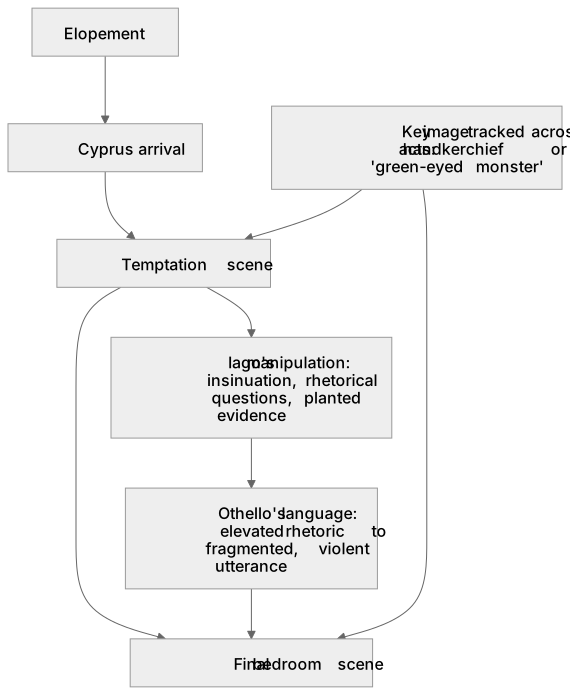
Othello is a Shakespearean tragedy centred on a respected Moorish general whose marriage to Desdemona is destroyed by Iago's manipulative insinuations. Study the play through the lens of tragedy: trace how Othello's nobility, love and jealousy interact with Iago's motiveless malignity, how language shifts from harmonious verse to destructive imagery, and how the Venetian setting and military context shape the action. Consider Desdemona, Cassio, Emilia and Roderigo as agents and victims of the tragic trajectory. A useful method is to track a key image, such as the handkerchief or the 'green-eyed monster', across acts, noting how its meaning changes and how it contributes to the catastrophe.
What earns the marks
- Demonstrates secure knowledge of the whole play, including act and scene placing of key moments such as the elopement, the Cyprus arrival, the temptation scene and the final bedroom scene.
- Analyses how Shakespeare's language choices construct Othello's changing identity, for example the shift from elevated, controlled rhetoric to fragmented and violent utterance.
- Explores Iago's methods of manipulation, including insinuation, rhetorical questions, planted evidence and the exploitation of others' desires and fears.
- Examines the roles of Desdemona, Emilia, Cassio and Roderigo in advancing or complicating the tragic action, rather than treating them as passive background.
- Connects the play's dramatic methods, such as soliloquy, dramatic irony, stage action and props, to the audience's experience of pity, fear and recognition.
- Uses relevant contextual understanding of early modern attitudes to race, gender, marriage and military honour to illuminate rather than replace close reading.
Common mistakes and how to put them right
Treating Iago simply as a motiveless villain and ignoring the specific grievances he voices.
Put it right by weighing each stated motive against his actions and the timing of his soliloquies.
Reducing Othello to a jealous stereotype and overlooking his earlier dignity and self-control.
Put it right by comparing his early and late speech and behaviour in detail.
Quoting isolated lines without locating them in the play's structure.
Put it right by linking each quotation to its act, scene and position in the tragic trajectory.
Exam tips
- Plan responses around the terms of the question, selecting three or four pivotal moments that allow detailed language analysis rather than retelling the plot.
- Integrate short, precise quotations into your own sentences and analyse individual words and images, showing how meaning is made.
- When context is relevant, weave it into the argument about the text rather than bolting on a separate paragraph of historical information.
Try the lesson
The start of the Aspects of tragedy - Set texts: Shakespeare: William Shakespeare: Othello lesson, made from checked teaching notes for this specification point.
Have a go first
In Othello, which character secretly plots Othello's downfall by exploiting his trust?
Listen
Othello is a Shakespearean tragedy centred on a respected Moorish general whose marriage to Desdemona is destroyed by Iago's manipulative insinuations. Study the play through the lens of tragedy: trace how Othello's nobility, love and jealousy interact with Iago's motiveless malignity, how language shifts from harmonious verse to destructive imagery, and how the Venetian setting and military context shape the action. Consider Desdemona, Cassio, Emilia and Roderigo as agents and victims of the tragic trajectory. A useful method is to track a key image, such as the handkerchief or the 'green-eyed monster', across acts, noting how its meaning changes and how it contributes to the catastrophe. A strong answer earns marks for these points. Demonstrates secure knowledge of the whole play, including act and scene placing of key moments such as the elopement, the Cyprus arrival, the temptation scene and the final bedroom scene. Analyses how Shakespeare's language choices construct Othello's changing identity, for example the shift from elevated, controlled rhetoric to fragmented and violent utterance. Explores Iago's methods of manipulation, including insinuation, rhetorical questions, planted evidence and the exploitation of others' desires and fears. Examines the roles of Desdemona, Emilia, Cassio and Roderigo in advancing or complicating the tragic action, rather than treating them as passive background. A common slip: Treating Iago simply as a motiveless villain and ignoring the specific grievances he voices. Instead, weighing each stated motive against his actions and the timing of his soliloquies. Exam tip: Plan responses around the terms of the question, selecting three or four pivotal moments that allow detailed language analysis rather than retelling the plot.
See it
Key words
Say what each word means before you turn the card.
Jealousy and suspicion
Try answering aloud or in your head before turning the card.
Manipulation and language
Try answering aloud or in your head before turning the card.
Race, identity and the outsider
Try answering aloud or in your head before turning the card.
Appearance versus reality
Try answering aloud or in your head before turning the card.
See every definition
- Jealousy and suspicion
- Othello's nobility and love interact with jealousy, while Iago's insinuations destroy his marriage to Desdemona.
- Manipulation and language
- Iago's methods include insinuation, rhetorical questions and planted evidence, while Shakespeare's language shifts from harmonious verse to destructive imagery.
- Race, identity and the outsider
- Othello is a respected Moorish general whose changing identity is constructed through a shift from elevated, controlled rhetoric to fragmented and violent utterance.
- Appearance versus reality
- Iago's motiveless malignity works through insinuation and planted evidence, so that stated motives must be weighed against his actions and the timing of his soliloquies.
Label the diagram
Some boxes have lost their names. Pick the right name for each number.
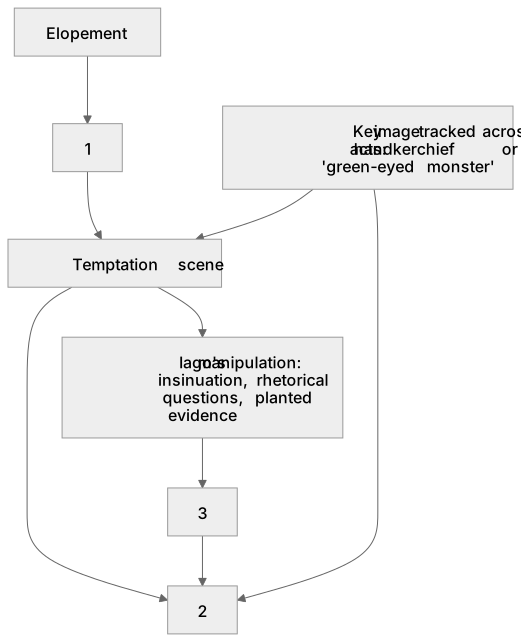
1Box 1
2Box 2
3Box 3
There is more to this lesson
The full lesson goes on to check your understanding and help you earn the marks. Create a free account to carry on, with your progress saved.
A week of Premium from your first lesson · Then the free plan continues · No card, no charge
Test your understanding of Aspects of tragedy - Set texts: Shakespeare: William Shakespeare: Othello
Active recall beats re-reading. Take an instant quiz now to test what you’ve learned and lock it into long-term memory.
A week of Premium from your first lesson · Then the free plan continues · No card, no charge