AQA · A-Level · English Literature
Course version: 7717 · Version from Sept 2026
The role of the tragic villain or opponent, who directly affects the…
Full specification wording
Aspects of tragedy: the role of the tragic villain or opponent, who directly affects the fortune of the hero, who engages in a contest of power and is partly responsible for the hero’s demise
The tragic villain or opponent is not merely wicked; the role shapes the hero's fortune through direct action and a contest of power.
Checked against the AQA 7717 specification (opens in a new tab) on .
- Point 7 of 14
- 2 key terms
Study notes
From the checked teaching notes for this specification point.
The idea
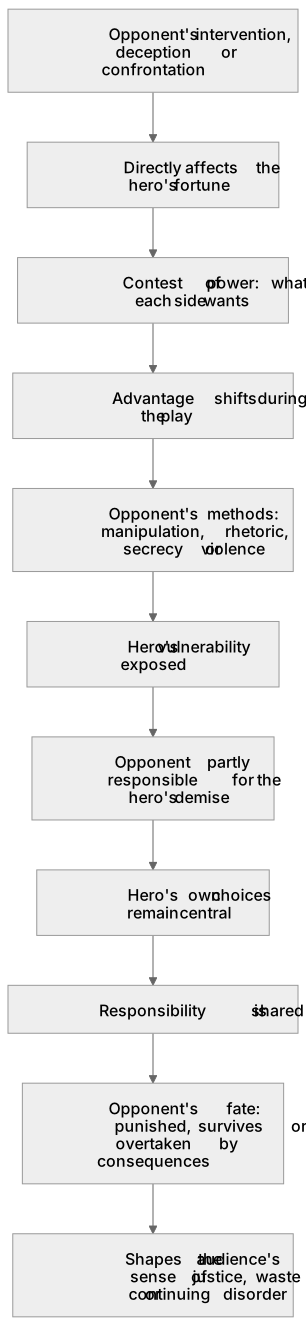
The tragic villain or opponent is not merely wicked; the role shapes the hero's fortune through direct action and a contest of power. Iago steers Othello's jealousy, Claudius removes Hamlet's father and then plots against Hamlet, and Creon's decree sets Antigone's fate in motion. Such figures are partly responsible for the hero's demise, yet the hero's own choices remain central, so responsibility is shared. Analyse how the opponent gains leverage, what methods are used, and how the power struggle exposes the hero's vulnerability. Consider whether the opponent is punished, survives or is overtaken by the consequences, and how that affects tragic meaning.
What earns the marks
- Explains how the villain or opponent directly affects the hero's fortune through a specific intervention, deception or confrontation.
- Analyses the contest of power, identifying what each side wants and how advantage shifts during the play.
- Argues how far the opponent is partly responsible for the hero's demise while acknowledging the hero's own contribution.
- Examines the opponent's methods, such as manipulation, rhetoric, secrecy or violence, with close reference to language and action.
- Considers the opponent's fate and how it shapes the audience's sense of justice, waste or continuing disorder.
- Uses appropriate terminology for character function and dramatic conflict without reducing the figure to a stock type.
Common mistakes and how to put them right
Calling the opponent purely evil and ignoring motive.
Put it right: Explore the reasoning or grievance that makes the figure credible and dangerous.
Blaming the opponent entirely for the hero's downfall.
Put it right: Balance external pressure with the hero's own choices and weaknesses.
Describing the plot without analysing power.
Put it right: Show how each move changes the balance between the two figures.
Exam tips
- Select two or three key encounters and analyse how language reveals the shifting power between opponent and hero.
- Use the word partly deliberately: argue a proportion of responsibility rather than an absolute verdict.
- Link the opponent's role to the tragic ending, showing how the contest of power produces the hero's demise.
Try the lesson
The start of the Aspects of tragedy: the role of the tragic villain or opponent, who directly affects the fortune of the hero, who engages in a contest of power and is partly responsible for the hero’s demise lesson, made from checked teaching notes for this specification point.
Have a go first
In a tragedy, how does the role of the tragic opponent typically differ from that of a minor antagonist in bringing about the hero's demise?
Listen
The tragic villain or opponent is not merely wicked; the role shapes the hero's fortune through direct action and a contest of power. Iago steers Othello's jealousy, Claudius removes Hamlet's father and then plots against Hamlet, and Creon's decree sets Antigone's fate in motion. Such figures are partly responsible for the hero's demise, yet the hero's own choices remain central, so responsibility is shared. Analyse how the opponent gains leverage, what methods are used, and how the power struggle exposes the hero's vulnerability. Consider whether the opponent is punished, survives or is overtaken by the consequences, and how that affects tragic meaning. A strong answer earns marks for these points. Explains how the villain or opponent directly affects the hero's fortune through a specific intervention, deception or confrontation. Analyses the contest of power, identifying what each side wants and how advantage shifts during the play. Argues how far the opponent is partly responsible for the hero's demise while acknowledging the hero's own contribution. Examines the opponent's methods, such as manipulation, rhetoric, secrecy or violence, with close reference to language and action. A common slip: Calling the opponent purely evil and ignoring motive. Instead, explore the reasoning or grievance that makes the figure credible and dangerous. Exam tip: Select two or three key encounters and analyse how language reveals the shifting power between opponent and hero.
See it
Key words
Say what each word means before you turn the card.
Tragic villain or opponent
Try answering aloud or in your head before turning the card.
Partly responsible
Try answering aloud or in your head before turning the card.
See every definition
- Tragic villain or opponent
- A figure who directly affects the fortune of the hero, engages in a contest of power and is partly responsible for the hero's demise.
- Partly responsible
- Sharing responsibility for the hero's demise with the hero, whose own choices remain central, so responsibility is shared.
Label the diagram
Some boxes have lost their names. Pick the right name for each number.
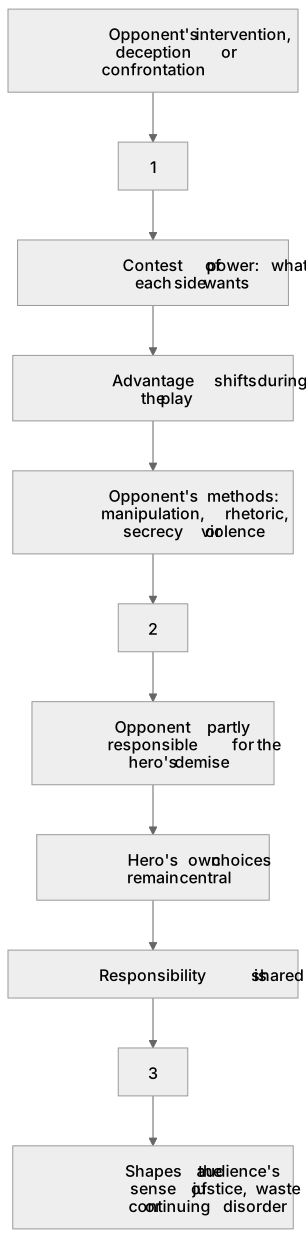
1Box 1
2Box 2
3Box 3
There is more to this lesson
The full lesson goes on to check your understanding and help you earn the marks. Create a free account to carry on, with your progress saved.
A week of Premium from your first lesson · Then the free plan continues · No card, no charge
Test your understanding of Aspects of tragedy: the role of the tragic villain or opponent, who directly affects the fortune of the hero, who engages in a contest of power and is partly responsible for the hero’s demise
Active recall beats re-reading. Take an instant quiz now to test what you’ve learned and lock it into long-term memory.
A week of Premium from your first lesson · Then the free plan continues · No card, no charge