AQA · A-Level · English Literature
Course version: 7717 · Version from Sept 2026
AO2: Analyse ways in which meanings are shaped in literary texts.
Full specification wording
Assessment objectives: AO2: Analyse ways in which meanings are shaped in literary texts.
AO2 asks how meaning is made, not just what a text means.
- 4 key terms
Study notes
From the checked teaching notes for this specification point.
The idea
AO2 asks how meaning is made, not just what a text means. You analyse the writer's choices: form, structure and language. Form includes genre and mode, such as whether a text is a tragedy or a first-person narrative. Structure covers ordering, pacing, juxtaposition, shifts in time or voice, and patterns across a whole text. Language covers word choice, imagery, syntax, rhythm and figurative devices. A strong response moves from a specific feature to its effect: for example, a short, clipped sentence at a moment of shock creates a sense of fractured control. You should analyse several features across a text, not just identify them, and connect each choice to the meanings it produces for a reader. Assessment rewards precise, exploratory analysis rather than feature-spotting.
What earns the marks
- Analysis of language choices, such as imagery, diction, syntax and sound, linked to meaning.
- Analysis of form, including genre, mode, narrative perspective and dramatic conventions where relevant.
- Analysis of structure, including ordering, pacing, repetition, juxtaposition and shifts across the text.
- Exploration of how features work together to shape meaning, rather than treating them in isolation.
- Use of precise quotation as evidence, with comment on specific words or patterns.
- Consideration of effects on the reader or audience, supported by the text rather than asserted.
Common mistakes and how to put them right
Labelling a device without analysing its effect.
Put it right by explaining what the feature makes a reader think or feel.
Treating structure as only beginning, middle and end.
Put it right by discussing patterns, shifts and juxtaposition.
Analysing one quotation in isolation from the rest of the text.
Put it right by linking it to wider patterns and the whole text.
Exam tips
- Choose quotations that contain something worth analysing, such as unusual wording or a striking image.
- Use the wording of the question to keep your analysis focused on how meaning is shaped.
- Zoom in on a single word or phrase, then zoom out to its effect on the text as a whole.
Try the lesson
The start of the Assessment objectives: AO2: Analyse ways in which meanings are shaped in literary texts. lesson, made from checked teaching notes for this specification point.
Have a go first
Which of the following activities is the primary focus when a student is asked to analyse how meanings are shaped in a literary text?
Listen
AO2 asks how meaning is made, not just what a text means. You analyse the writer's choices: form, structure and language. Form includes genre and mode, such as whether a text is a tragedy or a first-person narrative. Structure covers ordering, pacing, juxtaposition, shifts in time or voice, and patterns across a whole text. Language covers word choice, imagery, syntax, rhythm and figurative devices. A strong response moves from a specific feature to its effect: for example, a short, clipped sentence at a moment of shock creates a sense of fractured control. You should analyse several features across a text, not just identify them, and connect each choice to the meanings it produces for a reader. Assessment rewards precise, exploratory analysis rather than feature-spotting. A strong answer earns marks for these points. Analysis of language choices, such as imagery, diction, syntax and sound, linked to meaning. Analysis of form, including genre, mode, narrative perspective and dramatic conventions where relevant. Analysis of structure, including ordering, pacing, repetition, juxtaposition and shifts across the text. Exploration of how features work together to shape meaning, rather than treating them in isolation. A common slip: Labelling a device without analysing its effect. Instead, explaining what the feature makes a reader think or feel. Exam tip: Choose quotations that contain something worth analysing, such as unusual wording or a striking image.
See it
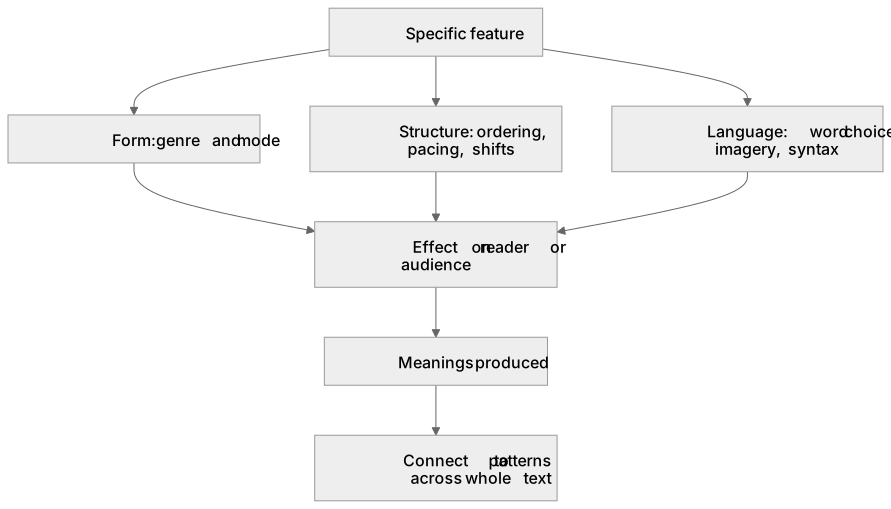
Key words
Say what each word means before you turn the card.
Language choices
Try answering aloud or in your head before turning the card.
Form and genre
Try answering aloud or in your head before turning the card.
Structure and patterns
Try answering aloud or in your head before turning the card.
Effects on readers
Try answering aloud or in your head before turning the card.
See every definition
- Language choices
- Word choice, imagery, syntax, rhythm and figurative devices, analysed in relation to the meanings they produce.
- Form and genre
- Includes genre and mode, such as whether a text is a tragedy or a first-person narrative.
- Structure and patterns
- Covers ordering, pacing, juxtaposition, shifts in time or voice, and patterns across a whole text.
- Effects on readers
- The meanings a writer's choices produce for a reader, supported by the text rather than asserted.
Label the diagram
Some boxes have lost their names. Pick the right name for each number.
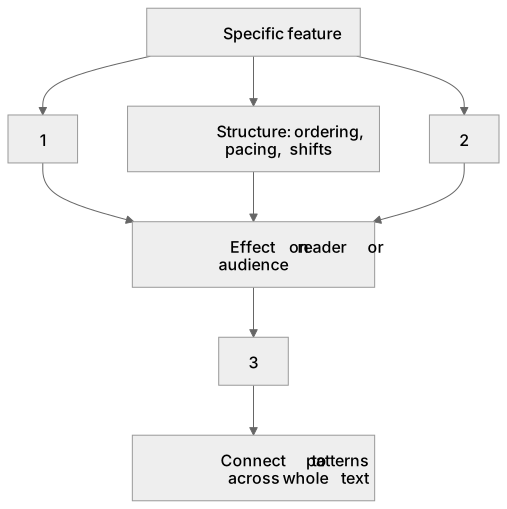
1Box 1
2Box 2
3Box 3
There is more to this lesson
The full lesson goes on to check your understanding and help you earn the marks. Create a free account to carry on, with your progress saved.
A week of Premium from your first lesson · Then the free plan continues · No card, no charge
Test your understanding of Assessment objectives: AO2: Analyse ways in which meanings are shaped in literary texts.
Active recall beats re-reading. Take an instant quiz now to test what you’ve learned and lock it into long-term memory.
A week of Premium from your first lesson · Then the free plan continues · No card, no charge