AQA · A-Level · English Literature
Course version: 7717 · Version from Sept 2026
George Crabbe, Robert Browning and Oscar Wilde: ‘Peter Grimes’,‘The…
Full specification wording
Elements of crime writing - Set texts: George Crabbe, Robert Browning and Oscar Wilde: ‘Peter Grimes’,‘The Laboratory’, ‘My Last Duchess’, ‘Porphyria’s Lover’, 'The Ballad of Reading Gaol' (Pre-1900)
This cluster of pre-1900 poems explores crime through monologue, narrative and ballad.
Checked against the AQA 7717 specification (opens in a new tab) on .
- Point 4 of 9
- 4 key terms
Study notes
From the checked teaching notes for this specification point.
The idea
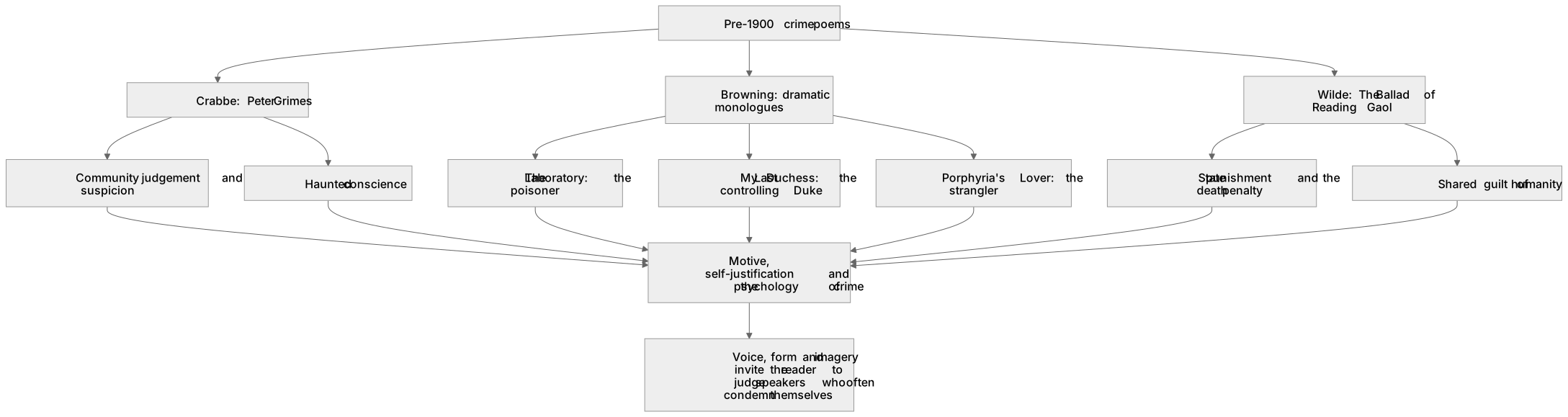
This cluster of pre-1900 poems explores crime through monologue, narrative and ballad. Crabbe's Peter Grimes presents a fisherman whose cruelty and suspected murders are judged by a community and by his own haunted conscience. Browning's dramatic monologues give voice to criminals and killers: the poisoner in The Laboratory, the controlling Duke in My Last Duchess and the strangler in Porphyria's Lover. Wilde's The Ballad of Reading Gaol examines state punishment, the hanging of a fellow prisoner and the shared guilt of humanity.
What earns the marks
- Analyses how Crabbe presents Peter Grimes through community judgement, suspicion and the protagonist's haunted conscience.
- Examines Browning's dramatic monologues as studies in criminal psychology, self-justification and the gap between speaker and reader.
- Explores Wilde's treatment of state punishment, the death penalty and shared guilt in The Ballad of Reading Gaol.
- Compares the poets' use of form and voice, including ballad metre, rhyming couplets, dramatic monologue and narrative commentary.
- Considers how imagery of possession, poison, strangulation and imprisonment shapes the reader's response to crime and punishment.
- Connects the poems to the genre of crime writing through motive, detection, confession, judgement and retribution.
Common mistakes and how to put them right
Assuming a dramatic monologue expresses the poet's own views.
Put it right: Distinguish between speaker and poet and analyse how Browning creates ironic distance.
Treating the Duke in My Last Duchess as merely a jealous husband rather than a criminal speaker.
Put it right: Examine how his language reveals control, possession and the implied murder.
Reading The Ballad of Reading Gaol only as protest without attention to its ballad form and religious imagery.
Put it right: Analyse how form and imagery shape its argument about guilt and punishment.
Exam tips
- Prepare comparative points that link at least two poems through a shared idea such as self-justification, punishment or the failure of human judgement.
- Use short embedded quotations and comment on form and voice, because the assessment rewards analysis of how meaning is made rather than plot summary.
- When discussing context, focus on relevant attitudes to crime, class, gender and punishment in the nineteenth century rather than listing biographical facts.
Try the lesson
The start of the Elements of crime writing - Set texts: George Crabbe, Robert Browning and Oscar Wilde: ‘Peter Grimes’,‘The Laboratory’, ‘My Last Duchess’, ‘Porphyria’s Lover’, 'The Ballad of Reading Gaol' (Pre-1900) lesson, made from checked teaching notes for this specification point.
Have a go first
In Browning's 'The Laboratory', what crime does the female speaker pay the apothecary to help her commit?
Listen
This cluster of pre-1900 poems explores crime through monologue, narrative and ballad. Crabbe's Peter Grimes presents a fisherman whose cruelty and suspected murders are judged by a community and by his own haunted conscience. Browning's dramatic monologues give voice to criminals and killers: the poisoner in The Laboratory, the controlling Duke in My Last Duchess and the strangler in Porphyria's Lover. Wilde's The Ballad of Reading Gaol examines state punishment, the hanging of a fellow prisoner and the shared guilt of humanity. A strong answer earns marks for these points. Analyses how Crabbe presents Peter Grimes through community judgement, suspicion and the protagonist's haunted conscience. Examines Browning's dramatic monologues as studies in criminal psychology, self-justification and the gap between speaker and reader. Explores Wilde's treatment of state punishment, the death penalty and shared guilt in The Ballad of Reading Gaol. Compares the poets' use of form and voice, including ballad metre, rhyming couplets, dramatic monologue and narrative commentary. A common slip: Assuming a dramatic monologue expresses the poet's own views. Instead, distinguish between speaker and poet and analyse how Browning creates ironic distance. Exam tip: Prepare comparative points that link at least two poems through a shared idea such as self-justification, punishment or the failure of human judgement.
See it
Key words
Say what each word means before you turn the card.
Criminal psychology
Try answering aloud or in your head before turning the card.
Judgement and punishment
Try answering aloud or in your head before turning the card.
Power and possession
Try answering aloud or in your head before turning the card.
Guilt and confession
Try answering aloud or in your head before turning the card.
See every definition
- Criminal psychology
- The study of motive, self-justification and the psychology of crime, which Browning's dramatic monologues are examined as studies in.
- Judgement and punishment
- The treatment of community judgement, state punishment and the death penalty, and how the poems invite readers to judge speakers who often condemn themselves.
- Power and possession
- A theme shaped by imagery of possession, poison, strangulation and imprisonment, which shapes the reader's response to crime and punishment.
- Guilt and confession
- The shared guilt of humanity and the speakers' self-justifications, connected to crime writing through motive, detection, confession, judgement and retribution.
Label the diagram
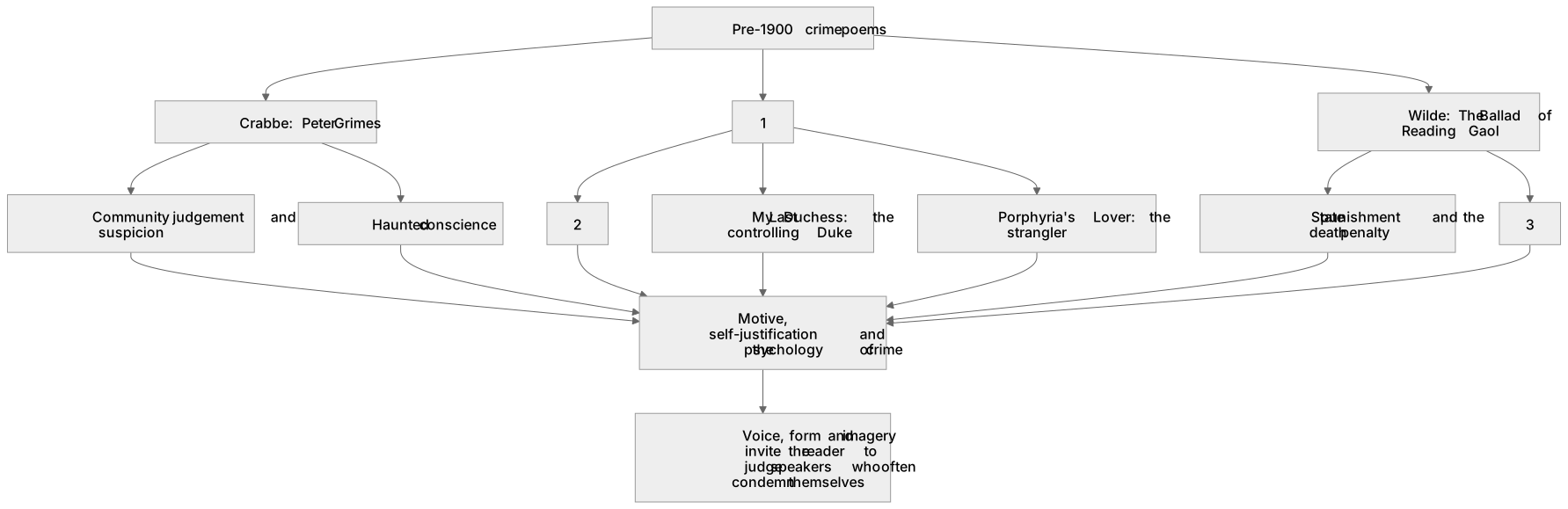
Some boxes have lost their names. Pick the right name for each number.
1Box 1
2Box 2
3Box 3
There is more to this lesson
The full lesson goes on to check your understanding and help you earn the marks. Create a free account to carry on, with your progress saved.
A week of Premium from your first lesson · Then the free plan continues · No card, no charge
Test your understanding of Elements of crime writing - Set texts: George Crabbe, Robert Browning and Oscar Wilde: ‘Peter Grimes’,‘The Laboratory’, ‘My Last Duchess’, ‘Porphyria’s Lover’, 'The Ballad of Reading Gaol' (Pre-1900)
Active recall beats re-reading. Take an instant quiz now to test what you’ve learned and lock it into long-term memory.
A week of Premium from your first lesson · Then the free plan continues · No card, no charge