AQA · A-Level · English Literature
Course version: 7717 · Version from Sept 2026
Elements of crime writing - Set texts: Graham Greene: Brighton Rock
Brighton Rock is a twentieth-century crime text for the Elements of crime writing paper.
Checked against the AQA 7717 specification (opens in a new tab) on .
- Point 6 of 9
- 4 key terms
Study notes
From the checked teaching notes for this specification point.
The idea
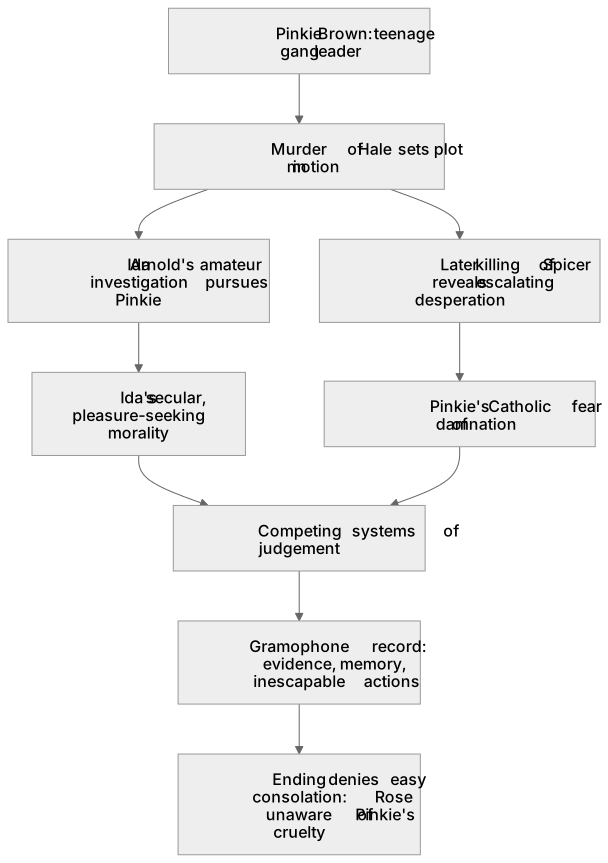
Brighton Rock is a twentieth-century crime text for the Elements of crime writing paper. Greene follows Pinkie Brown, a teenage gang leader whose murder of Hale sets the plot in motion, and Ida Arnold, whose amateur investigation pursues him. The novel blends gangster thriller with Catholic theology: Pinkie believes he is damned, while Rose's love and Ida's worldly morality complicate simple judgement. Study how Greene uses Brighton's two faces, the respectable pier and the seedy underworld, to expose the fragility of order. Track the motifs of heat, cold, damnation and recording, including the gramophone record Pinkie leaves for Rose. Consider how the ending denies the reader easy consolation, leaving Rose unaware of Pinkie's cruelty.
What earns the marks
- Analyses Pinkie's criminality as bound up with his youth, poverty and Catholic fear of damnation, rather than as simple villainy.
- Examines the murder of Hale and the later killing of Spicer as plot mechanisms that reveal Pinkie's escalating desperation and loss of control.
- Contrasts Ida Arnold's secular, pleasure-seeking morality with Pinkie's and Rose's religious frameworks, showing how the novel stages competing systems of judgement.
- Discusses Greene's use of Brighton's dual geography, the pier, racetrack and backstreets, to make respectability and crime interdependent.
- Explores the recording motif, especially the gramophone record, as a symbol of evidence, memory and the impossibility of escaping one's actions.
- Evaluates the ending's refusal of closure, considering how Rose's ignorance shapes the reader's sense of justice and tragedy.
Common mistakes and how to put them right
Reading Pinkie as a purely evil figure without noting his fear, youth and religious terror.
Put it right by analysing his inner conflict alongside his violence.
Treating Ida as an unambiguous hero.
Put it right by examining her limited understanding and the novel's ironic treatment of her moral certainty.
Ignoring the Catholic framework and reducing the novel to a gangster story.
Put it right by connecting damnation, sin and grace to specific scenes and images.
Exam tips
- Select episodes that let you compare Pinkie and Ida as investigators or moral agents, since the question often turns on judgement.
- Use short quotations that carry theological or sensory weight, such as images of heat, cold or recording, and unpack their connotations.
- Keep context precise: reference interwar Brighton, organised crime and changing moral attitudes only where the text invites it.
Try the lesson
The start of the Elements of crime writing - Set texts: Graham Greene: Brighton Rock lesson, made from checked teaching notes for this specification point.
Have a go first
In Brighton Rock, which character is the teenage gang leader whose violence drives the novel's criminal plot?
Listen
Brighton Rock is a twentieth-century crime text for the Elements of crime writing paper. Greene follows Pinkie Brown, a teenage gang leader whose murder of Hale sets the plot in motion, and Ida Arnold, whose amateur investigation pursues him. The novel blends gangster thriller with Catholic theology: Pinkie believes he is damned, while Rose's love and Ida's worldly morality complicate simple judgement. Study how Greene uses Brighton's two faces, the respectable pier and the seedy underworld, to expose the fragility of order. Track the motifs of heat, cold, damnation and recording, including the gramophone record Pinkie leaves for Rose. Consider how the ending denies the reader easy consolation, leaving Rose unaware of Pinkie's cruelty. A strong answer earns marks for these points. Analyses Pinkie's criminality as bound up with his youth, poverty and Catholic fear of damnation, rather than as simple villainy. Examines the murder of Hale and the later killing of Spicer as plot mechanisms that reveal Pinkie's escalating desperation and loss of control. Contrasts Ida Arnold's secular, pleasure-seeking morality with Pinkie's and Rose's religious frameworks, showing how the novel stages competing systems of judgement. Discusses Greene's use of Brighton's dual geography, the pier, racetrack and backstreets, to make respectability and crime interdependent. A common slip: Reading Pinkie as a purely evil figure without noting his fear, youth and religious terror. Instead, analysing his inner conflict alongside his violence. Exam tip: Select episodes that let you compare Pinkie and Ida as investigators or moral agents, since the question often turns on judgement.
See it
Key words
Say what each word means before you turn the card.
Catholicism, sin and damnation
Try answering aloud or in your head before turning the card.
Secular versus religious morality
Try answering aloud or in your head before turning the card.
The dual face of Brighton and respectable society
Try answering aloud or in your head before turning the card.
Recording, evidence and memory
Try answering aloud or in your head before turning the card.
See every definition
- Catholicism, sin and damnation
- The Catholic theology that runs through the novel, in which Pinkie believes he is damned and Rose's love complicates simple judgement.
- Secular versus religious morality
- The contrast between Ida Arnold's worldly morality and the religious frameworks of Pinkie and Rose, staging competing systems of judgement.
- The dual face of Brighton and respectable society
- Brighton's two faces, the respectable pier and the seedy underworld, which Greene uses to expose the fragility of order and make respectability and crime interdependent.
- Recording, evidence and memory
- A motif, including the gramophone record Pinkie leaves for Rose, symbolising evidence, memory and the impossibility of escaping one's actions.
Label the diagram
Some boxes have lost their names. Pick the right name for each number.
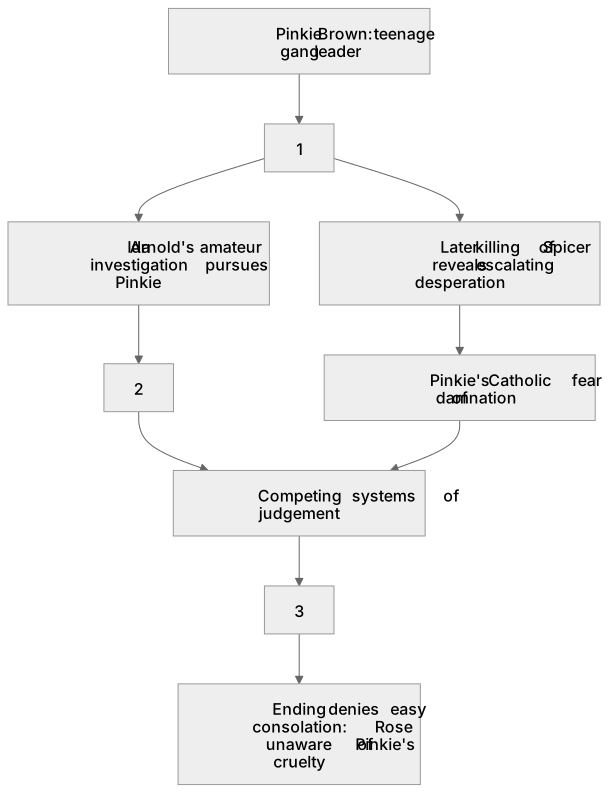
1Box 1
2Box 2
3Box 3
There is more to this lesson
The full lesson goes on to check your understanding and help you earn the marks. Create a free account to carry on, with your progress saved.
A week of Premium from your first lesson · Then the free plan continues · No card, no charge
Test your understanding of Elements of crime writing - Set texts: Graham Greene: Brighton Rock
Active recall beats re-reading. Take an instant quiz now to test what you’ve learned and lock it into long-term memory.
A week of Premium from your first lesson · Then the free plan continues · No card, no charge