AQA · A-Level · English Literature
Course version: 7717 · Version from Sept 2026
Kate Atkinson: When Will There Be Good News? (Post-2000)
Full specification wording
Elements of crime writing - Set texts: Kate Atkinson: When Will There Be Good News? (Post-2000)
Atkinson's novel opens with a past crime: the murder of Joanna Mason's family, witnessed by six-year-old Joanna.
Checked against the AQA 7717 specification (opens in a new tab) on .
- Point 1 of 9
- 3 key terms
Study notes
From the checked teaching notes for this specification point.
The idea
Atkinson's novel opens with a past crime: the murder of Joanna Mason's family, witnessed by six-year-old Joanna. Decades later, Joanna and her baby vanish, leaving her husband Neil behind. The narrative braids her story with Reggie, a teenage orphan, and Brodie, an ex-detective. Atkinson uses multiple narrators, time shifts and withheld information to test how readers construct guilt. Crime is not solved by a single detective: coincidence, memory and trauma drive events. Study how the post-2000 context shapes form: fragmented chronology, domestic settings and unresolved endings question the comforting closure of Golden Age detection. Track motifs of trains, tunnels and darkness, and the tension between rescue and loss.
What earns the marks
- Analyse how Atkinson's fragmented, multi-perspective narration delays and distributes information, so the reader's suspicion shifts between characters rather than settling on one culprit.
- Examine the presentation of Joanna's trauma across time, showing how the opening massacre shapes her adult identity, relationships and capacity for trust.
- Discuss Reggie as an unconventional investigator whose age, gender and class unsettle the hard-boiled detective archetype while still driving the plot's discoveries.
- Consider how the post-2000 context and domestic settings reframe crime writing: violence intrudes on ordinary family life rather than a stylised criminal underworld.
- Explore how motifs of trains, tunnels and darkness create patterns of pursuit, escape and buried memory that structure the reader's experience of suspense.
- Evaluate the ending's partial resolution, arguing how far Atkinson satisfies or deliberately frustrates the genre's expectation of explanation and justice.
Common mistakes and how to put them right
Treating the novel as a conventional whodunnit and hunting for one detective figure.
Put it right: Trace how detection is shared among Reggie, Brodie and Joanna and how that dispersal shapes meaning.
Retelling the plot in chronological order without analysing narrative method.
Put it right: Select short quotations that show time shifts, focalisation or withheld information and comment on their effects.
Assuming the past crime is simply backstory.
Put it right: Argue how the opening murder remains causally and emotionally present in the adult narrative and in the reader's reading process.
Exam tips
- Plan around the assessment objective for form, structure and language: choose two or three short quotations that demonstrate narrative technique, not just theme.
- When a question names a theme such as crime or detection, connect it to Atkinson's methods, for example non-linear structure or multiple narrators, rather than listing plot events.
Try the lesson
The start of the Elements of crime writing - Set texts: Kate Atkinson: When Will There Be Good News? (Post-2000) lesson, made from checked teaching notes for this specification point.
Have a go first
In Kate Atkinson's When Will There Be Good News?, which character survives the massacre of her family that opens the novel?
Listen
Atkinson's novel opens with a past crime: the murder of Joanna Mason's family, witnessed by six-year-old Joanna. Decades later, Joanna and her baby vanish, leaving her husband Neil behind. The narrative braids her story with Reggie, a teenage orphan, and Brodie, an ex-detective. Atkinson uses multiple narrators, time shifts and withheld information to test how readers construct guilt. Crime is not solved by a single detective: coincidence, memory and trauma drive events. Study how the post-2000 context shapes form: fragmented chronology, domestic settings and unresolved endings question the comforting closure of Golden Age detection. Track motifs of trains, tunnels and darkness, and the tension between rescue and loss. A strong answer earns marks for these points. Analyse how Atkinson's fragmented, multi-perspective narration delays and distributes information, so the reader's suspicion shifts between characters rather than settling on one culprit. Examine the presentation of Joanna's trauma across time, showing how the opening massacre shapes her adult identity, relationships and capacity for trust. Discuss Reggie as an unconventional investigator whose age, gender and class unsettle the hard-boiled detective archetype while still driving the plot's discoveries. Consider how the post-2000 context and domestic settings reframe crime writing: violence intrudes on ordinary family life rather than a stylised criminal underworld. A common slip: Treating the novel as a conventional whodunnit and hunting for one detective figure. Instead, trace how detection is shared among Reggie, Brodie and Joanna and how that dispersal shapes meaning. Exam tip: Plan around the assessment objective for form, structure and language: choose two or three short quotations that demonstrate narrative technique, not just theme.
See it
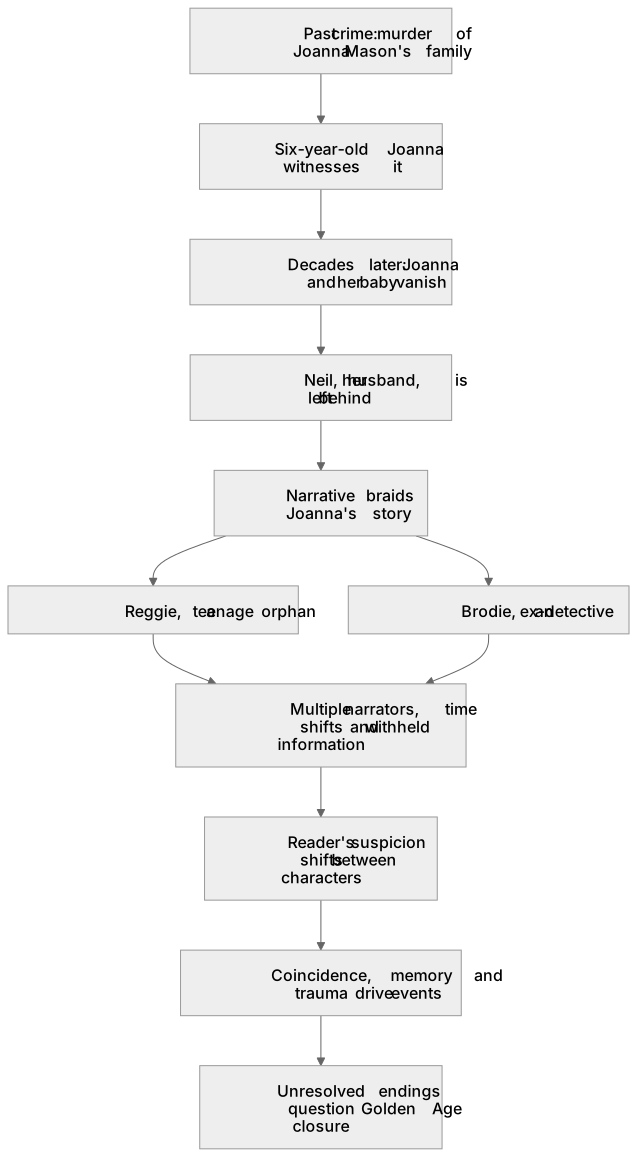
Key words
Say what each word means before you turn the card.
Trauma and memory
Try answering aloud or in your head before turning the card.
Detection and uncertainty
Try answering aloud or in your head before turning the card.
Family and loss
Try answering aloud or in your head before turning the card.
See every definition
- Trauma and memory
- The opening massacre shapes Joanna's adult identity, relationships and capacity for trust, and memory and trauma drive events rather than a single detective.
- Detection and uncertainty
- Detection is shared among Reggie, Brodie and Joanna, and fragmented, multi-perspective narration delays and distributes information so suspicion shifts between characters.
- Family and loss
- Violence intrudes on ordinary family life rather than a stylised criminal underworld, and the tension between rescue and loss runs through the novel.
Label the diagram
Some boxes have lost their names. Pick the right name for each number.
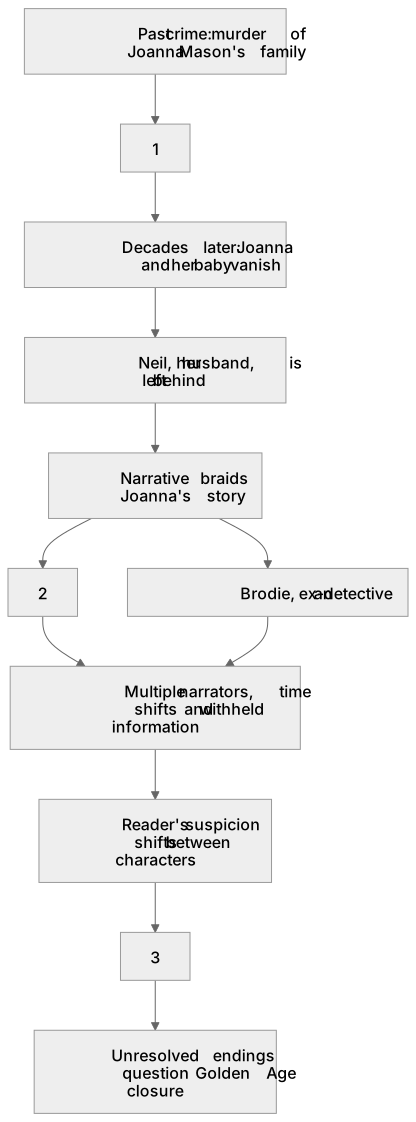
1Box 1
2Box 2
3Box 3
There is more to this lesson
The full lesson goes on to check your understanding and help you earn the marks. Create a free account to carry on, with your progress saved.
A week of Premium from your first lesson · Then the free plan continues · No card, no charge
Test your understanding of Elements of crime writing - Set texts: Kate Atkinson: When Will There Be Good News? (Post-2000)
Active recall beats re-reading. Take an instant quiz now to test what you’ve learned and lock it into long-term memory.
A week of Premium from your first lesson · Then the free plan continues · No card, no charge