AQA · A-Level · English Literature
Course version: 7717 · Version from Sept 2026
William Shakespeare: Hamlet (Pre-1900)
Full specification wording
Elements of crime writing - Set texts: William Shakespeare: Hamlet (Pre-1900)
Hamlet is a pre-1900 tragedy that can be studied through the lens of crime writing.
Checked against the AQA 7717 specification (opens in a new tab) on .
- Point 8 of 9
- 4 key terms
Study notes
From the checked teaching notes for this specification point.
The idea
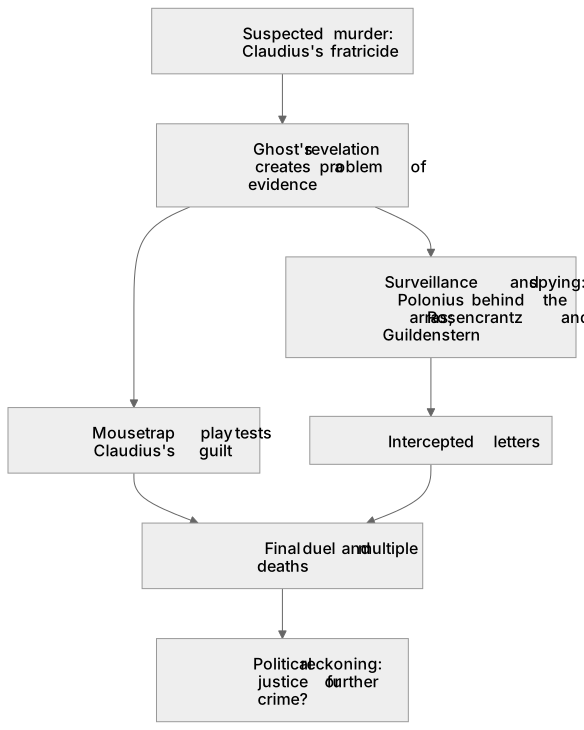
Hamlet is a pre-1900 tragedy that can be studied through the lens of crime writing. The play opens with a suspected murder, develops through surveillance, spying and a play-within-a-play designed to test guilt, and ends with multiple deaths and a political reckoning. The play's soliloquies and dramatic structure invite analysis of motive, conscience and delay. Effective study combines close reading of language and dramatic method with awareness of early modern contexts of revenge, kingship and providence, and debates about whether Hamlet's actions constitute justice or further crime.
What earns the marks
- Explains how Claudius's murder of Old Hamlet functions as the originating crime and how the Ghost's revelation creates a problem of evidence.
- Analyses Hamlet's use of the Mousetrap play to test Claudius's guilt, and evaluates how this functions as detection within the drama.
- Discusses surveillance and spying, including Polonius behind the arras and Rosencrantz and Guildenstern, as methods of investigation and betrayal.
- Examines the play's ending as a scene of retribution and political resolution, considering how multiple deaths raise questions about justice.
- Uses contextual knowledge of revenge tragedy, early modern law and providence to illuminate the play's treatment of crime and punishment.
- Supports interpretations with precise textual reference, including quotation and analysis of dramatic form, soliloquy and stagecraft.
Common mistakes and how to put them right
Treating Hamlet's delay as mere indecision without connecting it to questions of evidence, conscience and the morality of revenge.
Put it right: Analyse delay as a dramatic and thematic exploration of crime and justice.
Assuming the Ghost's account is straightforwardly true.
Put it right: Examine how the play tests and questions evidence, including through the Mousetrap and Hamlet's own uncertainty.
Reducing the play to plot summary.
Put it right: Integrate analysis of language, soliloquy, structure and dramatic method into arguments about crime writing.
Exam tips
- Plan responses around the assessment objectives: combine close textual analysis with discussion of crime writing conventions and relevant contextual factors.
- Use precise quotations and references to specific scenes, then explain how Shakespeare's dramatic choices shape meaning rather than retelling the plot.
- When debating justice and revenge, weigh different interpretations and reach a justified judgement about how the play presents crime, evidence and punishment.
Try the lesson
The start of the Elements of crime writing - Set texts: William Shakespeare: Hamlet (Pre-1900) lesson, made from checked teaching notes for this specification point.
Have a go first
In Hamlet, which act of secret killing most clearly establishes the crime that drives the revenge plot?
Listen
Hamlet is a pre-1900 tragedy that can be studied through the lens of crime writing. The play opens with a suspected murder, develops through surveillance, spying and a play-within-a-play designed to test guilt, and ends with multiple deaths and a political reckoning. The play's soliloquies and dramatic structure invite analysis of motive, conscience and delay. Effective study combines close reading of language and dramatic method with awareness of early modern contexts of revenge, kingship and providence, and debates about whether Hamlet's actions constitute justice or further crime. A strong answer earns marks for these points. Explains how Claudius's murder of Old Hamlet functions as the originating crime and how the Ghost's revelation creates a problem of evidence. Analyses Hamlet's use of the Mousetrap play to test Claudius's guilt, and evaluates how this functions as detection within the drama. Discusses surveillance and spying, including Polonius behind the arras and Rosencrantz and Guildenstern, as methods of investigation and betrayal. Examines the play's ending as a scene of retribution and political resolution, considering how multiple deaths raise questions about justice. A common slip: Treating Hamlet's delay as mere indecision without connecting it to questions of evidence, conscience and the morality of revenge. Instead, analyse delay as a dramatic and thematic exploration of crime and justice. Exam tip: Plan responses around the assessment objectives: combine close textual analysis with discussion of crime writing conventions and relevant contextual factors.
See it
Key words
Say what each word means before you turn the card.
Murder and revenge
Try answering aloud or in your head before turning the card.
Evidence and detection
Try answering aloud or in your head before turning the card.
Conscience and delay
Try answering aloud or in your head before turning the card.
Surveillance and deception
Try answering aloud or in your head before turning the card.
See every definition
- Murder and revenge
- The play opens with a suspected murder and raises questions about revenge through Claudius's fratricide and Hamlet's actions.
- Evidence and detection
- The Ghost's revelation creates a problem of evidence, and the Mousetrap play is designed to test guilt as detection within the drama.
- Conscience and delay
- The soliloquies and dramatic structure invite analysis of motive, conscience and delay.
- Surveillance and deception
- The play develops through surveillance, spying and a play-within-a-play, including Polonius's eavesdropping and the intercepted letters.
Label the diagram
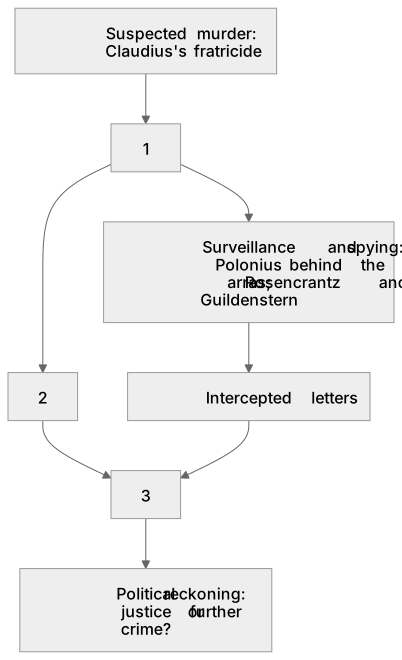
Some boxes have lost their names. Pick the right name for each number.
1Box 1
2Box 2
3Box 3
There is more to this lesson
The full lesson goes on to check your understanding and help you earn the marks. Create a free account to carry on, with your progress saved.
A week of Premium from your first lesson · Then the free plan continues · No card, no charge
Test your understanding of Elements of crime writing - Set texts: William Shakespeare: Hamlet (Pre-1900)
Active recall beats re-reading. Take an instant quiz now to test what you’ve learned and lock it into long-term memory.
A week of Premium from your first lesson · Then the free plan continues · No card, no charge