AQA · A-Level · English Literature
Course version: 7717 · Version from Sept 2026
The way that language is used in the world that is created; there may be…
Full specification wording
Elements of crime writing: the way that language is used in the world that is created; there may be use of a criminal register, legal register, police register
Crime writing builds its world partly through specialised language.
Checked against the AQA 7717 specification (opens in a new tab) on .
- Point 19 of 21
- 4 key terms
Study notes
From the checked teaching notes for this specification point.
The idea
Crime writing builds its world partly through specialised language. A criminal register may include slang, euphemism or coded threats; a legal register may use formal, Latinate terminology and passive constructions; a police register may use procedural acronyms, evidence labels and clipped radio speech. Analyse how such lexis, syntax and tone construct authority, secrecy or menace, and how register shifts expose power. For example, a detective's formal statement contrasted with a suspect's colloquial denial can signal class and credibility. Consider also how narrators adopt or mimic these registers to manipulate the reader's trust.
What earns the marks
- Identifies lexical fields and register markers associated with crime, law or policing.
- Analyses how syntax, formality and tone construct authority, secrecy or threat.
- Explains the effects of register shifts between characters, narrators or settings.
- Connects language choices to wider themes such as power, class, guilt or institutional trust.
- Uses precise linguistic terminology, for example jargon, euphemism, passive voice or modality.
Common mistakes and how to put them right
Quoting a word without analysing its connotation or grammatical function.
Put it right by commenting on both meaning and effect.
Assuming all legal language is neutral.
Put it right by examining how formality can intimidate, exclude or persuade.
Confusing register with dialect.
Put it right by defining register as language variation according to situation and purpose.
Exam tips
- Select short quotations and zoom in on one or two words or structures.
- Name the register explicitly, then explain its effect on characterisation or atmosphere.
- Compare registers across texts to show how each writer constructs a different criminal world.
Try the lesson
The start of the Elements of crime writing: the way that language is used in the world that is created; there may be use of a criminal register, legal register, police register lesson, made from checked teaching notes for this specification point.
Have a go first
How does the use of a specific 'police register'—incorporating terms like 'SOCO', 'incident room', and 'perverting the course of justice'—function in a crime narrative?
Listen
Crime writing builds its world partly through specialised language. A criminal register may include slang, euphemism or coded threats; a legal register may use formal, Latinate terminology and passive constructions; a police register may use procedural acronyms, evidence labels and clipped radio speech. Analyse how such lexis, syntax and tone construct authority, secrecy or menace, and how register shifts expose power. For example, a detective's formal statement contrasted with a suspect's colloquial denial can signal class and credibility. Consider also how narrators adopt or mimic these registers to manipulate the reader's trust. A strong answer earns marks for these points. Identifies lexical fields and register markers associated with crime, law or policing. Analyses how syntax, formality and tone construct authority, secrecy or threat. Explains the effects of register shifts between characters, narrators or settings. Connects language choices to wider themes such as power, class, guilt or institutional trust. A common slip: Quoting a word without analysing its connotation or grammatical function. Instead, commenting on both meaning and effect. Exam tip: Select short quotations and zoom in on one or two words or structures.
See it
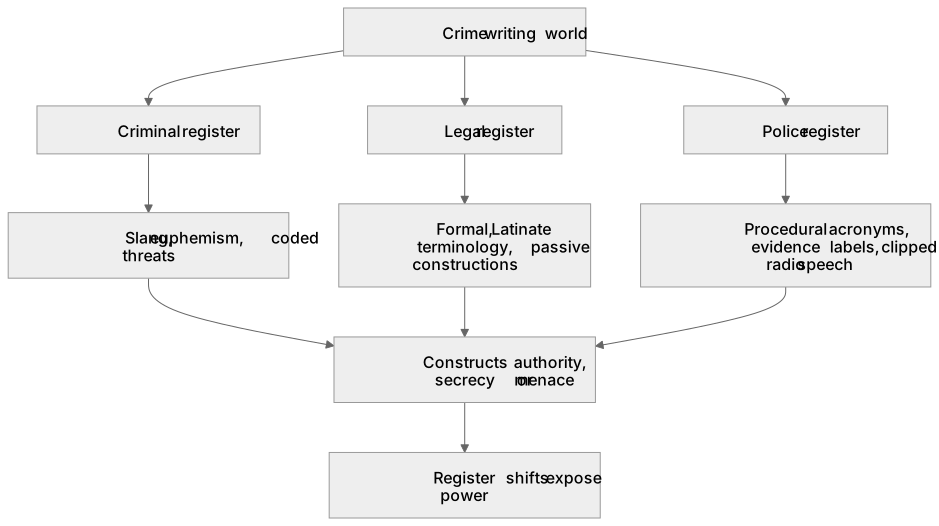
Key words
Say what each word means before you turn the card.
Language and power
Try answering aloud or in your head before turning the card.
Institutional authority
Try answering aloud or in your head before turning the card.
Secrecy and coded communication
Try answering aloud or in your head before turning the card.
Class and social voice
Try answering aloud or in your head before turning the card.
See every definition
- Language and power
- The way language choices are connected to wider themes such as power, class, guilt or institutional trust.
- Institutional authority
- Authority constructed through syntax, formality and tone, for example in a legal register using formal, Latinate terminology and passive constructions.
- Secrecy and coded communication
- Secrecy constructed through language, for example a criminal register including slang, euphemism or coded threats.
- Class and social voice
- Class signalled through register shifts, for example a detective's formal statement contrasted with a suspect's colloquial denial.
Label the diagram
Some boxes have lost their names. Pick the right name for each number.
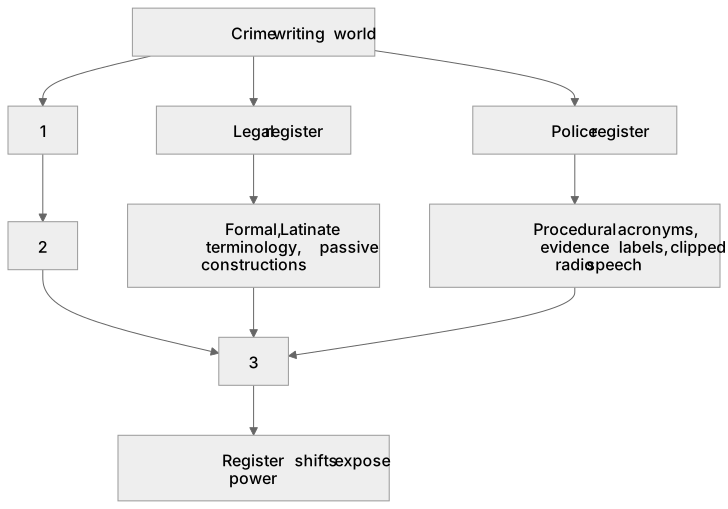
1Box 1
2Box 2
3Box 3
There is more to this lesson
The full lesson goes on to check your understanding and help you earn the marks. Create a free account to carry on, with your progress saved.
A week of Premium from your first lesson · Then the free plan continues · No card, no charge
Test your understanding of Elements of crime writing: the way that language is used in the world that is created; there may be use of a criminal register, legal register, police register
Active recall beats re-reading. Take an instant quiz now to test what you’ve learned and lock it into long-term memory.
A week of Premium from your first lesson · Then the free plan continues · No card, no charge