AQA · A-Level · English Literature
Course version: 7717 · Version from Sept 2026
Ultimately, how crime stories affect audiences and readers, creating…
Full specification wording
Elements of crime writing: ultimately, how crime stories affect audiences and readers, creating suspense, repugnance, excitement and relief.
Crime writing is designed to produce strong emotional and psychological effects in its audience.
Checked against the AQA 7717 specification (opens in a new tab) on .
- Point 21 of 21
- 4 key terms
Study notes
From the checked teaching notes for this specification point.
The idea
Crime writing is designed to produce strong emotional and psychological effects in its audience. Writers manipulate structure, pace, point of view, imagery and withheld information to generate suspense, to shock or disgust, to thrill, and finally to release tension through resolution or justice. When you study this element, you should analyse not only what happens but how the telling makes the reader feel it. For example, a delayed revelation about a murderer's identity can sustain suspense across chapters, while graphic description of a body can produce repugnance, and a sudden chase or confrontation can create excitement. Relief may come from a solution, a punishment or an unexpected mercy. The skill is to trace these effects to specific techniques and to consider how different audiences, in different periods, might respond.
What earns the marks
- Identifies the emotional effects a text creates, such as suspense, repugnance, excitement or relief, and supports each with textual evidence.
- Explains the techniques used to create those effects, including narrative structure, pace, focalisation, imagery, syntax and withheld or delayed information.
- Analyses how tension is built, sustained and released across the whole text, not only at isolated moments.
- Considers how the reader's or audience's expectations are shaped by genre conventions and then fulfilled, delayed or subverted.
- Evaluates the extent to which emotional effects serve the text's wider moral or social purposes.
- Discusses how different historical or cultural audiences might respond differently to the same techniques.
Common mistakes and how to put them right
Listing emotions without explaining the techniques that create them.
Put it right by pairing every claimed effect with a specific method and quotation.
Assuming all readers respond identically.
Put it right by acknowledging that responses vary with period, culture and individual expectation, and by qualifying your claims.
Confusing suspense with surprise.
Put it right by explaining that suspense depends on anticipation and uncertainty, while surprise depends on a sudden unforeseen revelation.
Exam tips
- Use precise emotional vocabulary and avoid repeating 'tense' or 'exciting' without analysis of how the effect is produced.
- Track a single effect, such as suspense, across the whole text to show how it is built, intensified and resolved.
- When discussing audience response, anchor your comments in the text's techniques rather than in unsupported generalisations about readers.
Try the lesson
The start of the Elements of crime writing: ultimately, how crime stories affect audiences and readers, creating suspense, repugnance, excitement and relief. lesson, made from checked teaching notes for this specification point.
Have a go first
Which narrative technique in a crime text is most likely to be used by an author to generate a feeling of repugnance in the reader?
Listen
Crime writing is designed to produce strong emotional and psychological effects in its audience. Writers manipulate structure, pace, point of view, imagery and withheld information to generate suspense, to shock or disgust, to thrill, and finally to release tension through resolution or justice. When you study this element, you should analyse not only what happens but how the telling makes the reader feel it. For example, a delayed revelation about a murderer's identity can sustain suspense across chapters, while graphic description of a body can produce repugnance, and a sudden chase or confrontation can create excitement. Relief may come from a solution, a punishment or an unexpected mercy. The skill is to trace these effects to specific techniques and to consider how different audiences, in different periods, might respond. A strong answer earns marks for these points. Identifies the emotional effects a text creates, such as suspense, repugnance, excitement or relief, and supports each with textual evidence. Explains the techniques used to create those effects, including narrative structure, pace, focalisation, imagery, syntax and withheld or delayed information. Analyses how tension is built, sustained and released across the whole text, not only at isolated moments. Considers how the reader's or audience's expectations are shaped by genre conventions and then fulfilled, delayed or subverted. A common slip: Listing emotions without explaining the techniques that create them. Instead, pairing every claimed effect with a specific method and quotation. Exam tip: Use precise emotional vocabulary and avoid repeating 'tense' or 'exciting' without analysis of how the effect is produced.
See it
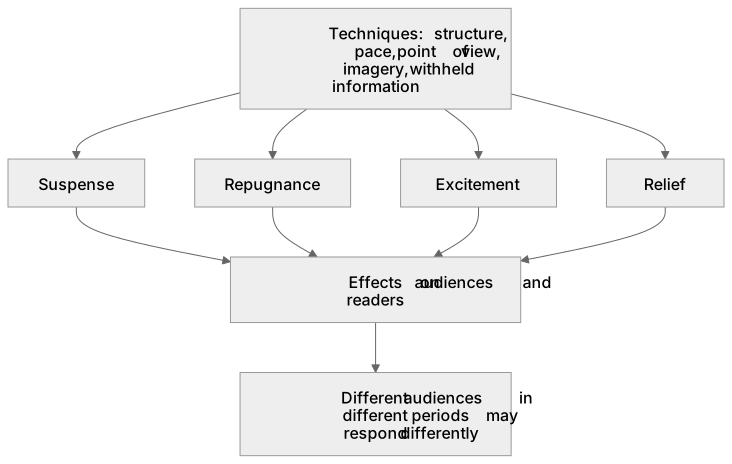
Key words
Say what each word means before you turn the card.
Suspense
Try answering aloud or in your head before turning the card.
Repugnance
Try answering aloud or in your head before turning the card.
Excitement
Try answering aloud or in your head before turning the card.
Relief
Try answering aloud or in your head before turning the card.
See every definition
- Suspense
- An effect sustained by withheld or delayed information, depending on anticipation and uncertainty rather than a sudden unforeseen revelation.
- Repugnance
- A feeling of disgust produced in the reader or audience, for example by graphic description of a body.
- Excitement
- A thrill created in the reader or audience, for example by a sudden chase or confrontation.
- Relief
- A release of tension that may come from a solution, a punishment or an unexpected mercy.
Label the diagram
Some boxes have lost their names. Pick the right name for each number.
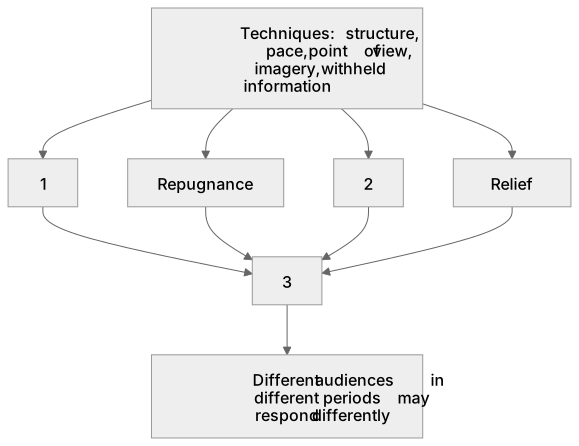
1Box 1
2Box 2
3Box 3
There is more to this lesson
The full lesson goes on to check your understanding and help you earn the marks. Create a free account to carry on, with your progress saved.
A week of Premium from your first lesson · Then the free plan continues · No card, no charge
Test your understanding of Elements of crime writing: ultimately, how crime stories affect audiences and readers, creating suspense, repugnance, excitement and relief.
Active recall beats re-reading. Take an instant quiz now to test what you’ve learned and lock it into long-term memory.
A week of Premium from your first lesson · Then the free plan continues · No card, no charge