AQA · A-Level · English Literature
Course version: 7717 · Version from Sept 2026
Charles Dickens: Hard Times (Pre-1900)
Full specification wording
Elements of political and social protest writing - Set texts: Charles Dickens: Hard Times (Pre-1900)
Hard Times is Dickens's shortest novel and his most concentrated attack on utilitarian thinking, set in the invented mill town of Coketown.
Checked against the AQA 7717 specification (opens in a new tab) on .
- Point 4 of 9
Study notes
From the checked teaching notes for this specification point.
The idea
Hard Times is Dickens's shortest novel and his most concentrated attack on utilitarian thinking, set in the invented mill town of Coketown. Gradgrind educates children on 'facts' alone, while Bounderby, the self-made manufacturer, exploits workers he calls Hands. Dickens dramatises protest through the suffering of Stephen Blackpool, refused divorce from a drunken wife and rejected by both masters and union, and through Louisa's emotional starvation. The novel interrogates education, industrial relations, class and the human cost of treating people as statistics. For this paper you study it as political and social protest writing, asking how form, voice and structure shape dissent.
What earns the marks
- Explains how Gradgrind's fact-based schooling functions as protest against utilitarian education, using the opening classroom scene as evidence.
- Analyses Dickens's presentation of industrial labour and class conflict through Bounderby, Stephen Blackpool and the Hands, linking language to social critique.
- Examines narrative method, including third-person omniscient narration, satire, caricature and the division into 'Sowing', 'Reaping' and 'Garnering'.
- Discusses how the novel's ending and Louisa's development qualify or complicate its protest, avoiding the claim that Dickens offers a single simple message.
- Connects the text to wider political and social protest writing, considering whose voices are heard and whose are marginalised.
Common mistakes and how to put them right
Treating the novel as a straightforward documentary about Victorian factories.
Put it right by analysing Dickens's satirical and symbolic methods, not just his subject matter.
Assuming Dickens simply endorses the workers' union.
Put it right by noting Stephen's refusal to join and the novel's ambivalence about collective action.
Quoting without analysing the language.
Put it right by commenting on specific word choices, imagery and narrative perspective in each quotation.
Exam tips
- Plan around the precise wording of the question, selecting two or three episodes that let you address every part of it.
- Integrate short quotations into your argument and analyse their phrasing rather than retelling plot.
- Keep the focus on political and social protest writing, linking Dickens's methods to the genre's concerns throughout.
Try the lesson
The start of the Elements of political and social protest writing - Set texts: Charles Dickens: Hard Times (Pre-1900) lesson, made from checked teaching notes for this specification point.
Have a go first
In Hard Times, which character runs a school in which children are taught that fact alone should govern their lives?
Listen
Hard Times is Dickens's shortest novel and his most concentrated attack on utilitarian thinking, set in the invented mill town of Coketown. Gradgrind educates children on 'facts' alone, while Bounderby, the self-made manufacturer, exploits workers he calls Hands. Dickens dramatises protest through the suffering of Stephen Blackpool, refused divorce from a drunken wife and rejected by both masters and union, and through Louisa's emotional starvation. The novel interrogates education, industrial relations, class and the human cost of treating people as statistics. For this paper you study it as political and social protest writing, asking how form, voice and structure shape dissent. A strong answer earns marks for these points. Explains how Gradgrind's fact-based schooling functions as protest against utilitarian education, using the opening classroom scene as evidence. Analyses Dickens's presentation of industrial labour and class conflict through Bounderby, Stephen Blackpool and the Hands, linking language to social critique. Examines narrative method, including third-person omniscient narration, satire, caricature and the division into 'Sowing', 'Reaping' and 'Garnering'. Discusses how the novel's ending and Louisa's development qualify or complicate its protest, avoiding the claim that Dickens offers a single simple message. A common slip: Treating the novel as a straightforward documentary about Victorian factories. Instead, analysing Dickens's satirical and symbolic methods, not just his subject matter. Exam tip: Plan around the precise wording of the question, selecting two or three episodes that let you address every part of it.
See it
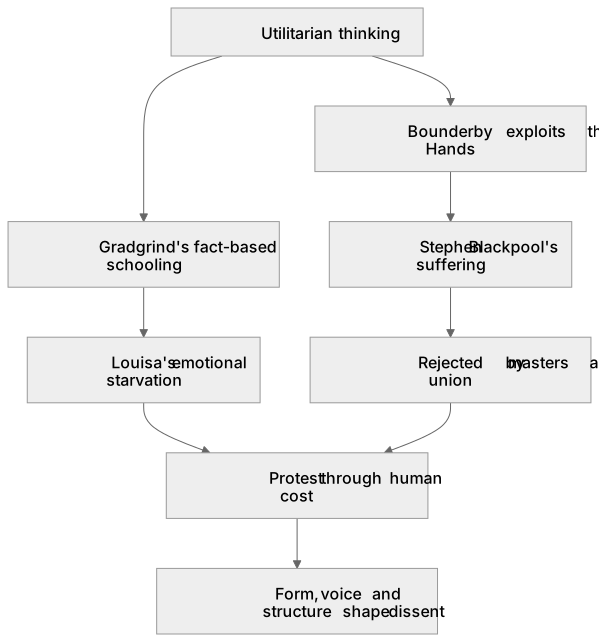
Label the diagram
Some boxes have lost their names. Pick the right name for each number.
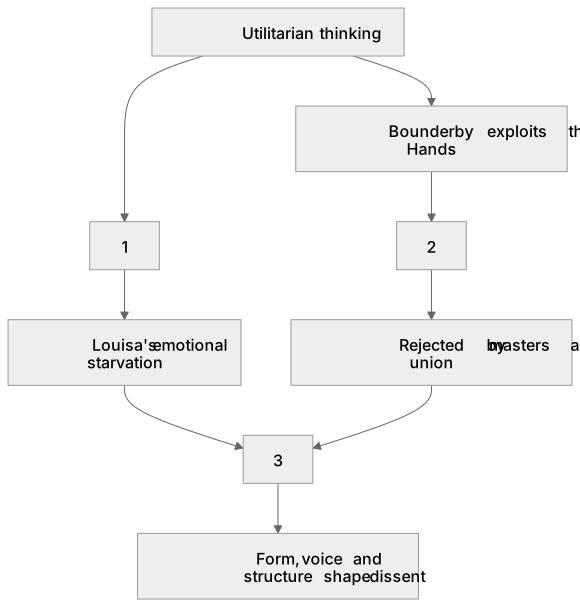
1Box 1
2Box 2
3Box 3
There is more to this lesson
The full lesson goes on to check your understanding and help you earn the marks. Create a free account to carry on, with your progress saved.
A week of Premium from your first lesson · Then the free plan continues · No card, no charge
Test your understanding of Elements of political and social protest writing - Set texts: Charles Dickens: Hard Times (Pre-1900)
Active recall beats re-reading. Take an instant quiz now to test what you’ve learned and lock it into long-term memory.
A week of Premium from your first lesson · Then the free plan continues · No card, no charge