AQA · A-Level · English Literature
Course version: 7717 · Version from Sept 2026
Khaled Hosseini: The Kite Runner (Post-2000)
Full specification wording
Elements of political and social protest writing - Set texts: Khaled Hosseini: The Kite Runner (Post-2000)
Hosseini's novel follows Amir from privileged childhood in Kabul through the Soviet invasion, exile in America and return to Taliban-ruled Afghanistan.
Checked against the AQA 7717 specification (opens in a new tab) on .
- Point 7 of 9
- 4 key terms
Study notes
From the checked teaching notes for this specification point.
The idea
Hosseini's novel follows Amir from privileged childhood in Kabul through the Soviet invasion, exile in America and return to Taliban-ruled Afghanistan. Its protest is directed at ethnic and religious prejudice, especially the persecution of Hazaras, and at the failure of adults to protect children. The kite tournament and Hassan's rape expose how cowardice and social hierarchy corrupt personal loyalty. Amir's guilt drives the narrative, and his later rescue of Sohrab in Kabul turns private redemption into a confrontation with political violence. Hosseini uses first-person retrospective narration, symbolism of kites and scars, and contrasts between Afghanistan and California to show how class, ethnicity and war shape individual lives. The novel asks whether personal atonement can answer systemic injustice, and whether storytelling can recover what violence destroys.
What earns the marks
- Analyse how the first-person retrospective narration shapes the reader's judgement of Amir's childhood cowardice and his later attempts at atonement.
- Examine the portrayal of ethnic and religious prejudice against Hazaras, especially through Hassan and Ali, and connect it to the novel's wider protest against social hierarchy.
- Discuss how the kite symbol develops from childhood competition and triumph to a figure of guilt, memory and possible redemption.
- Consider the representation of political violence, including the Soviet invasion and Taliban rule, and assess how private lives are shown to be inseparable from public events.
- Explore the contrasts between Kabul and California, analysing how exile, nostalgia and cultural displacement inform the novel's protest.
- Evaluate the role of Sohrab and the rescue plot in testing whether individual acts can repair or only partially answer systemic injustice.
Common mistakes and how to put them right
Reading the novel only as a redemption story and ignoring its political and social critique.
Put it right by linking Amir's personal journey to ethnicity, class and war.
Treating Hassan as a passive victim without analysing how the text gives him dignity, agency and moral authority.
Put it right by examining his actions and the narrative's perspective on him.
Assuming the novel presents Afghanistan or Islam as monolithic.
Put it right by distinguishing characters, regions, ethnic groups and historical periods.
Exam tips
- Organise responses around both narrative method and political context, using quotations that reveal voice, symbolism or structure.
- When discussing redemption, weigh its limits as well as its achievements, and connect this judgement to evidence from the ending.
- Use precise references to time, place and event, and avoid generalised statements about Afghanistan or Islam.
Try the lesson
The start of the Elements of political and social protest writing - Set texts: Khaled Hosseini: The Kite Runner (Post-2000) lesson, made from checked teaching notes for this specification point.
Have a go first
In The Kite Runner, which social group does Hosseini present as suffering systematic oppression under the Taliban regime in Afghanistan?
Listen
Hosseini's novel follows Amir from privileged childhood in Kabul through the Soviet invasion, exile in America and return to Taliban-ruled Afghanistan. Its protest is directed at ethnic and religious prejudice, especially the persecution of Hazaras, and at the failure of adults to protect children. The kite tournament and Hassan's rape expose how cowardice and social hierarchy corrupt personal loyalty. Amir's guilt drives the narrative, and his later rescue of Sohrab in Kabul turns private redemption into a confrontation with political violence. Hosseini uses first-person retrospective narration, symbolism of kites and scars, and contrasts between Afghanistan and California to show how class, ethnicity and war shape individual lives. The novel asks whether personal atonement can answer systemic injustice, and whether storytelling can recover what violence destroys. A strong answer earns marks for these points. Analyse how the first-person retrospective narration shapes the reader's judgement of Amir's childhood cowardice and his later attempts at atonement. Examine the portrayal of ethnic and religious prejudice against Hazaras, especially through Hassan and Ali, and connect it to the novel's wider protest against social hierarchy. Discuss how the kite symbol develops from childhood competition and triumph to a figure of guilt, memory and possible redemption. Consider the representation of political violence, including the Soviet invasion and Taliban rule, and assess how private lives are shown to be inseparable from public events. A common slip: Reading the novel only as a redemption story and ignoring its political and social critique. Instead, linking Amir's personal journey to ethnicity, class and war. Exam tip: Organise responses around both narrative method and political context, using quotations that reveal voice, symbolism or structure.
See it
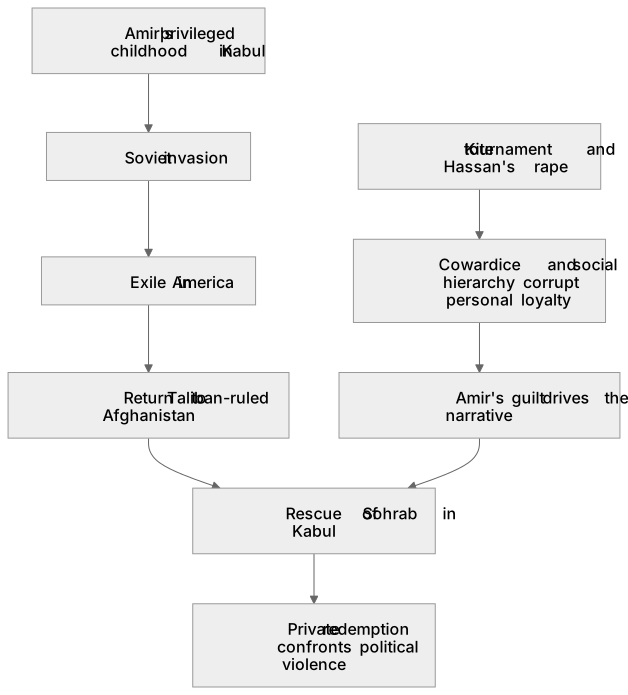
Key words
Say what each word means before you turn the card.
Guilt, betrayal and atonement
Try answering aloud or in your head before turning the card.
Ethnic and religious prejudice
Try answering aloud or in your head before turning the card.
War, exile and displacement
Try answering aloud or in your head before turning the card.
Storytelling, memory and redemption
Try answering aloud or in your head before turning the card.
See every definition
- Guilt, betrayal and atonement
- Amir's guilt drives the narrative, and his later rescue of Sohrab turns private redemption into a confrontation with political violence.
- Ethnic and religious prejudice
- The novel's protest is directed at this, especially the persecution of Hazaras.
- War, exile and displacement
- The novel follows Amir through the Soviet invasion, exile in America and return to Taliban-ruled Afghanistan, showing how war shapes individual lives.
- Storytelling, memory and redemption
- First-person retrospective narration and symbolism are used to ask whether storytelling can recover what violence destroys.
Label the diagram
Some boxes have lost their names. Pick the right name for each number.
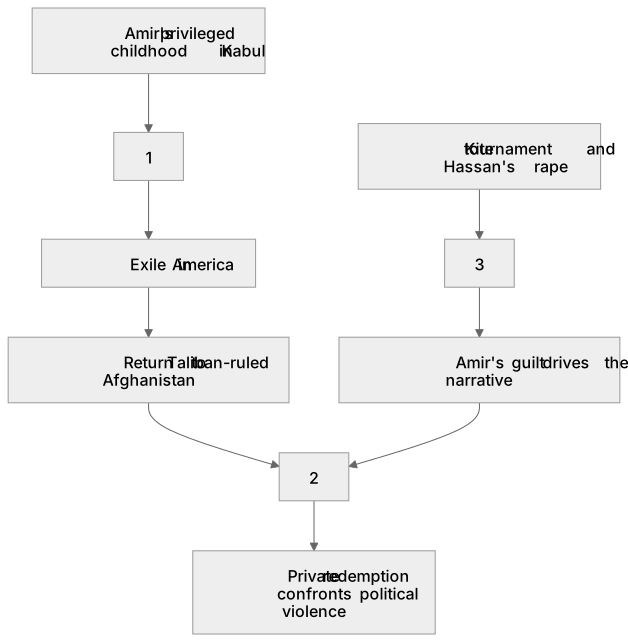
1Box 1
2Box 2
3Box 3
There is more to this lesson
The full lesson goes on to check your understanding and help you earn the marks. Create a free account to carry on, with your progress saved.
A week of Premium from your first lesson · Then the free plan continues · No card, no charge
Test your understanding of Elements of political and social protest writing - Set texts: Khaled Hosseini: The Kite Runner (Post-2000)
Active recall beats re-reading. Take an instant quiz now to test what you’ve learned and lock it into long-term memory.
A week of Premium from your first lesson · Then the free plan continues · No card, no charge