AQA · A-Level · English Literature
Course version: 7717 · Version from Sept 2026
These genres, which are heavily influenced by culture, are continually…
Full specification wording
Texts and genres: These genres, which are heavily influenced by culture, are continually evolving.
Crime writing and political and social protest writing are not fixed sets of rules.
Checked against the AQA 7717 specification (opens in a new tab) on .
- 3 key terms
Study notes
From the checked teaching notes for this specification point.
The idea
Crime writing and political and social protest writing are not fixed sets of rules. They are shaped by the cultures that produce them and change as those cultures change. Crime writing moves from detection to psychological suspense, and protest writing shifts with new movements and new media. This means genre is best understood as a living conversation between texts and their contexts. When you study a text, ask what cultural concerns it reflects and how it stretches or revises earlier conventions. A useful method is to trace one convention, such as the detective figure or the protest voice, across two texts from different periods and note how cultural context alters its presentation.
What earns the marks
- Explains that the genres are shaped by cultural context, including historical, social and political factors.
- Shows that the genres evolve over time rather than remaining fixed.
- Traces a specific convention, such as the detective figure or the protest voice, across texts from different periods.
- Links changes in genre conventions to changes in the culture that produced the texts.
- Uses contextual knowledge to explain why a text adapts, challenges or extends genre expectations.
Common mistakes and how to put them right
Describing genre as a fixed checklist of features.
Put it right: The specification stresses continual evolution, so responses should show change.
Offering context as background biography without linking it to how genre conventions shift in the text.
Assuming evolution means progress or improvement.
Put it right: It means change in response to culture, not a scale from worse to better.
Exam tips
- Anchor each claim about evolution in a specific convention and a specific textual moment.
- Use comparative connectives such as whereas, similarly and in contrast to show how two texts handle the same convention differently.
- Keep context precise and relevant, linking it directly to the genre feature under discussion.
Try the lesson
The start of the Texts and genres: These genres, which are heavily influenced by culture, are continually evolving. lesson, made from checked teaching notes for this specification point.
Have a go first
In the study of literary genres such as crime writing or political and social protest writing, how are the genres typically understood to develop?
Listen
Crime writing and political and social protest writing are not fixed sets of rules. They are shaped by the cultures that produce them and change as those cultures change. Crime writing moves from detection to psychological suspense, and protest writing shifts with new movements and new media. This means genre is best understood as a living conversation between texts and their contexts. When you study a text, ask what cultural concerns it reflects and how it stretches or revises earlier conventions. A useful method is to trace one convention, such as the detective figure or the protest voice, across two texts from different periods and note how cultural context alters its presentation. A strong answer earns marks for these points. Explains that the genres are shaped by cultural context, including historical, social and political factors. Shows that the genres evolve over time rather than remaining fixed. Traces a specific convention, such as the detective figure or the protest voice, across texts from different periods. Links changes in genre conventions to changes in the culture that produced the texts. Exam tip: Anchor each claim about evolution in a specific convention and a specific textual moment.
See it
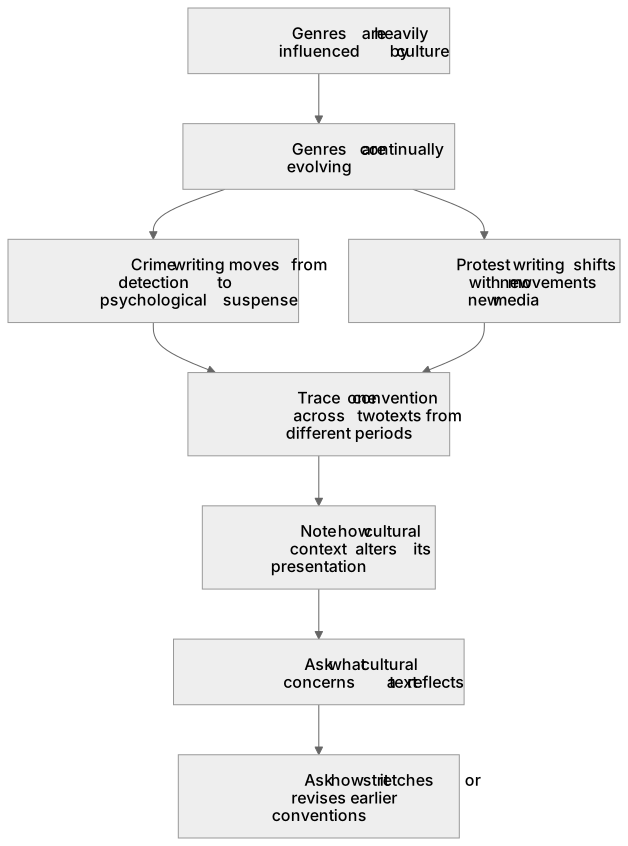
Key words
Say what each word means before you turn the card.
Cultural influence
Try answering aloud or in your head before turning the card.
Genre evolution
Try answering aloud or in your head before turning the card.
Context and text
Try answering aloud or in your head before turning the card.
See every definition
- Cultural influence
- The shaping of these genres by the cultures that produce them, so that they change as those cultures change.
- Genre evolution
- The continual changing of these genres over time rather than their remaining fixed, as crime writing moves from detection to psychological suspense and protest writing shifts with new movements and new media.
- Context and text
- The living conversation between texts and their contexts, in which cultural context alters how a convention is presented.
Label the diagram
Some boxes have lost their names. Pick the right name for each number.
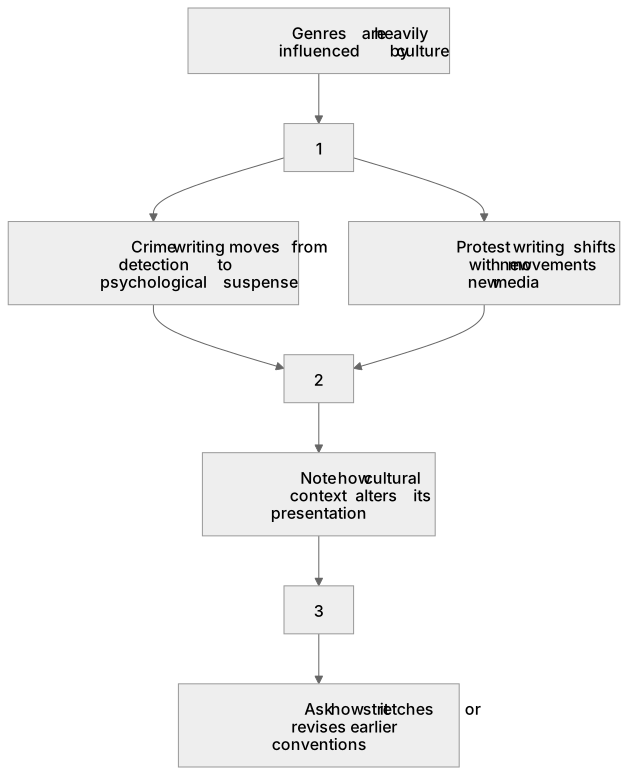
1Box 1
2Box 2
3Box 3
There is more to this lesson
The full lesson goes on to check your understanding and help you earn the marks. Create a free account to carry on, with your progress saved.
A week of Premium from your first lesson · Then the free plan continues · No card, no charge
Test your understanding of Texts and genres: These genres, which are heavily influenced by culture, are continually evolving.
Active recall beats re-reading. Take an instant quiz now to test what you’ve learned and lock it into long-term memory.
A week of Premium from your first lesson · Then the free plan continues · No card, no charge