Anita and Me
Meera Syal's 'Anita and Me' is a brilliant, humorous, and poignant coming-of-age novel set in the 1970s. It offers candidates fantastic opportunities to analyse cultural hybridity, racial tension, and the universal struggles of growing up, making it a highly rewarding text for the GCSE Literature exam.
Study Notes
Overview
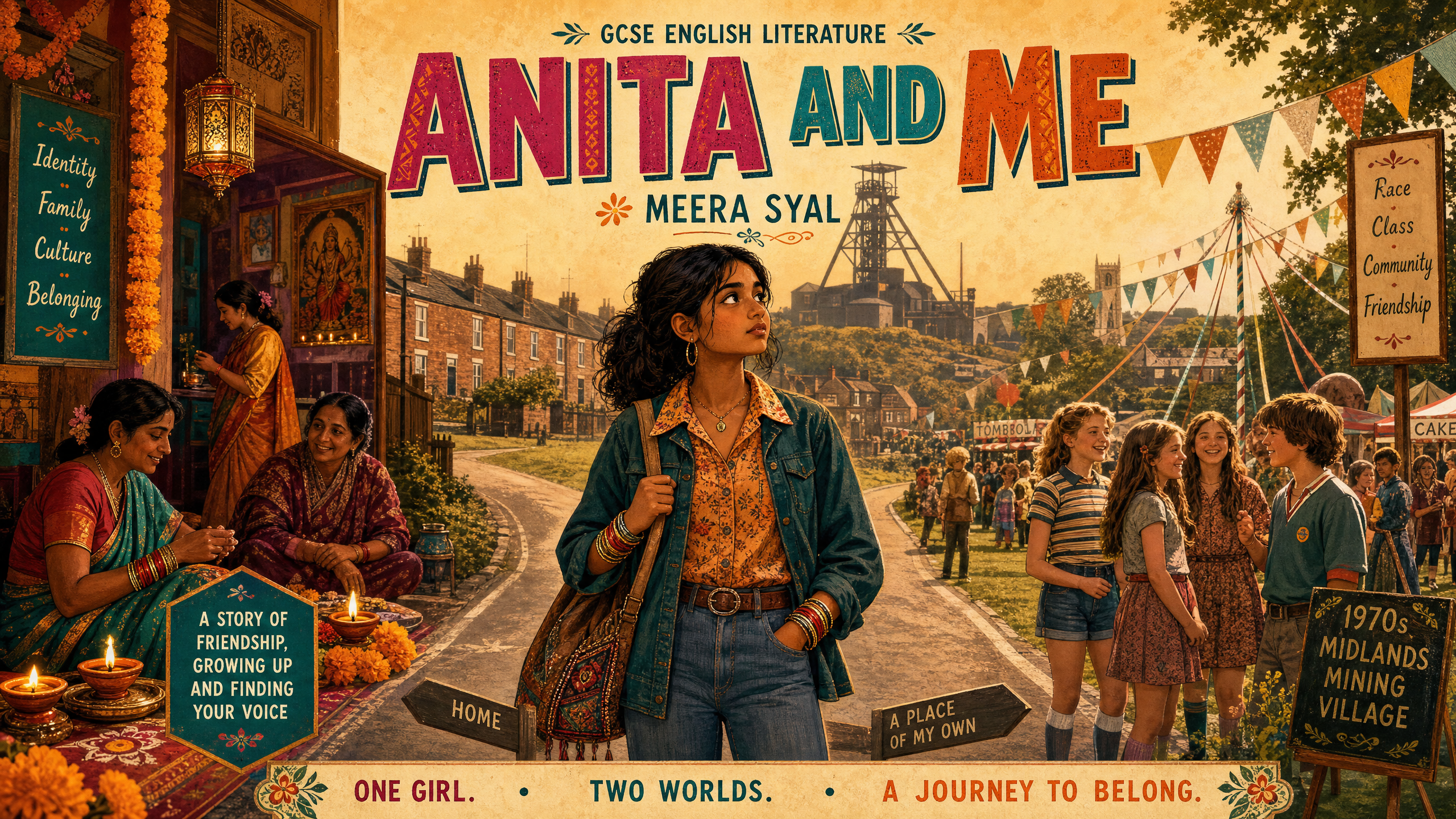
Anita and Me by Meera Syal is a semi-autobiographical novel exploring the childhood of Meena Kumar, a British Indian girl growing up in the fictional Midlands mining village of Tollington in the early 1970s. For GCSE candidates, this text is a goldmine for exploring themes of identity, belonging, racism, and family. Examiners look for perceptive analysis of Meena's internal conflict as she navigates her dual cultural heritage, moving beyond simple binaries to understand the complex 'hybridity' of her identity. High-level responses will closely analyse Syal's retrospective first-person narrative voice, her use of dialect, and the specific historical context of 1970s Britain.
Listen to the revision podcast below for a comprehensive overview of the text:
Plot/Content Overview
- Introduction to Tollington: We meet Meena, a rebellious nine-year-old, and her traditional Indian parents. Meena feels alienated from her Indian heritage and desperately wants to fit in with the local white working-class community.
- The Arrival of Anita: Meena befriends Anita Rutter, the local 'bad girl'. Anita represents the freedom and rebellion Meena craves, though their friendship is often unequal and toxic.
- The Fete and Rising Tensions: The village fete exposes the underlying racial prejudice in Tollington, particularly through the character of Sam Lowbridge. Meena begins to realise the limitations of her community.
- Nanima's Visit: Meena's grandmother arrives from India. Despite the language barrier, they form a deep bond. This is a turning point for Meena, helping her to value her Indian heritage.
- The Accident and Resolution: Meena breaks her leg and spends time in hospital, gaining perspective. She begins to distance herself from Anita, recognising Anita's vulnerabilities and limitations. Meena ultimately accepts her dual identity, moving forward with a new sense of self as she passes her 11-plus exam.
Themes
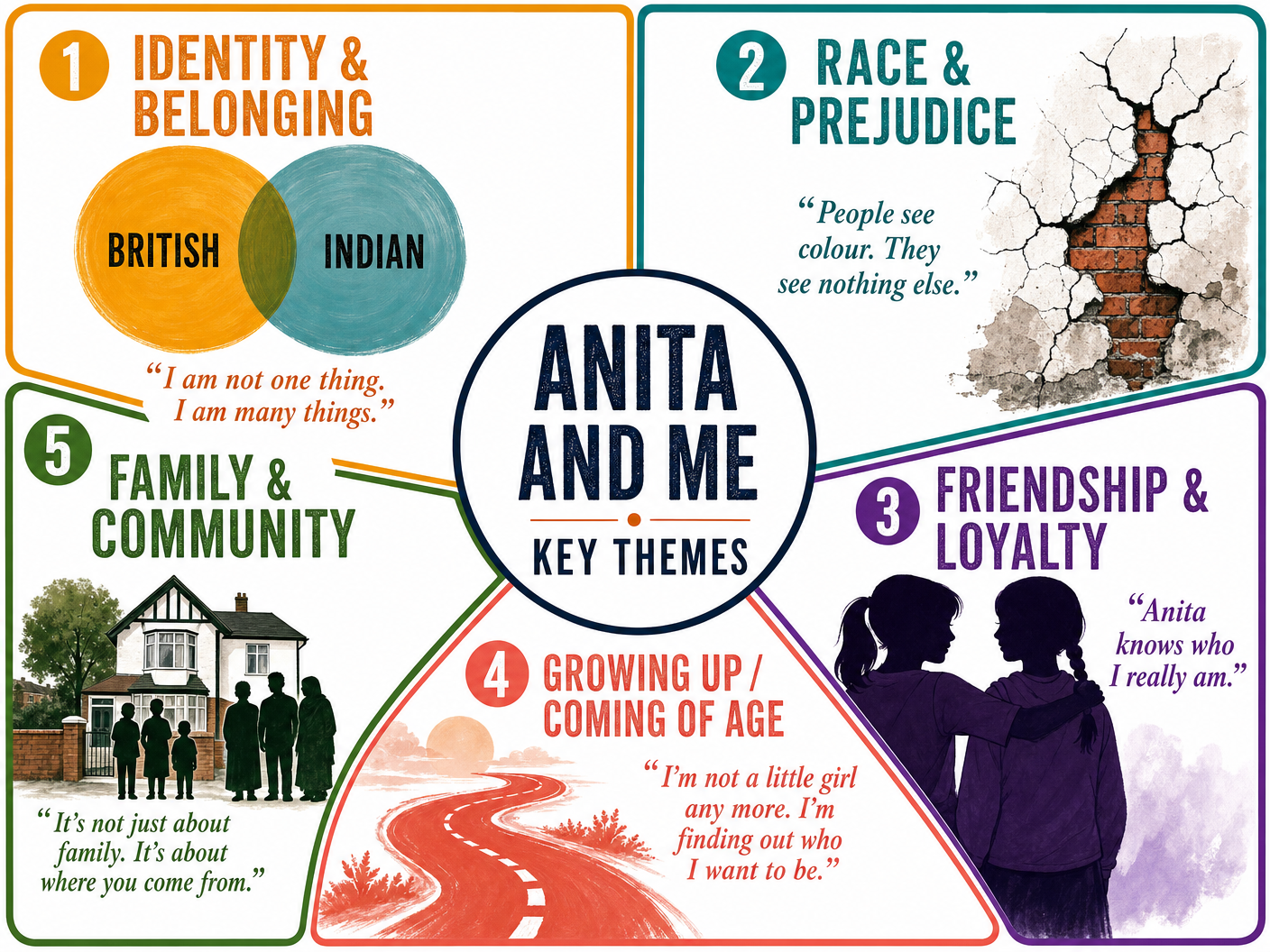
Theme 1: Identity and Belonging
Meena's central struggle is reconciling her Indian heritage with her British environment. Syal presents this not as a simple choice between two worlds, but as a complex negotiation. Initially, Meena rejects her 'Indianness' to fit in, but through her relationship with Nanima and her growing maturity, she learns to embrace a hybrid identity.
Key Quotes:
- "I was the only Indian girl for miles around." (Chapter 1) - Syal uses this simple, declarative statement to establish Meena's profound sense of isolation and uniqueness in Tollington.
- "I am not one thing. I am many things." (Chapter 13) - This quote represents the resolution of Meena's identity crisis. The repetition and short syntax emphasise her newfound certainty and acceptance of her complex self.
Theme 2: Race and Prejudice
The novel is set against the backdrop of 1970s Britain, a time of significant racial tension following post-war immigration. Syal explores both overt, aggressive racism (embodied by Sam Lowbridge) and the more subtle, ignorant prejudice of the wider community (like Mrs Worrall's patronising comments).
Key Quotes:
- "If you're going to be a Paki, you might as well be a rich one." (Chapter 4) - This shocking statement from Anita highlights the casual racism Meena endures, even from her supposed friends. The use of the slur demonstrates the normalisation of prejudice in Tollington.
- "People see colour. They see nothing else." (Chapter 10) - A moment of stark realisation for Meena, highlighting the inescapable reality of racial prejudice. The bluntness of the sentence structure mirrors the harshness of the truth.
Theme 3: Friendship and Loyalty
The relationship between Meena and Anita is central to the novel. Anita is a catalyst for Meena's rebellion, but Syal gradually reveals Anita's own vulnerabilities—her dysfunctional family and lack of prospects. Meena's eventual rejection of Anita signifies her moral growth.
Key Quotes:
- "Anita knows who I really am." (Chapter 3) - This highlights Meena's initial delusion. She believes Anita understands her, but Syal uses dramatic irony here; the reader knows Anita only sees Meena as a follower.
- "I'm not a little girl any more. I'm finding out who I want to be." (Chapter 12) - Meena's declaration of independence from Anita. The active verb 'finding out' shows her taking control of her own narrative.
Character Analysis
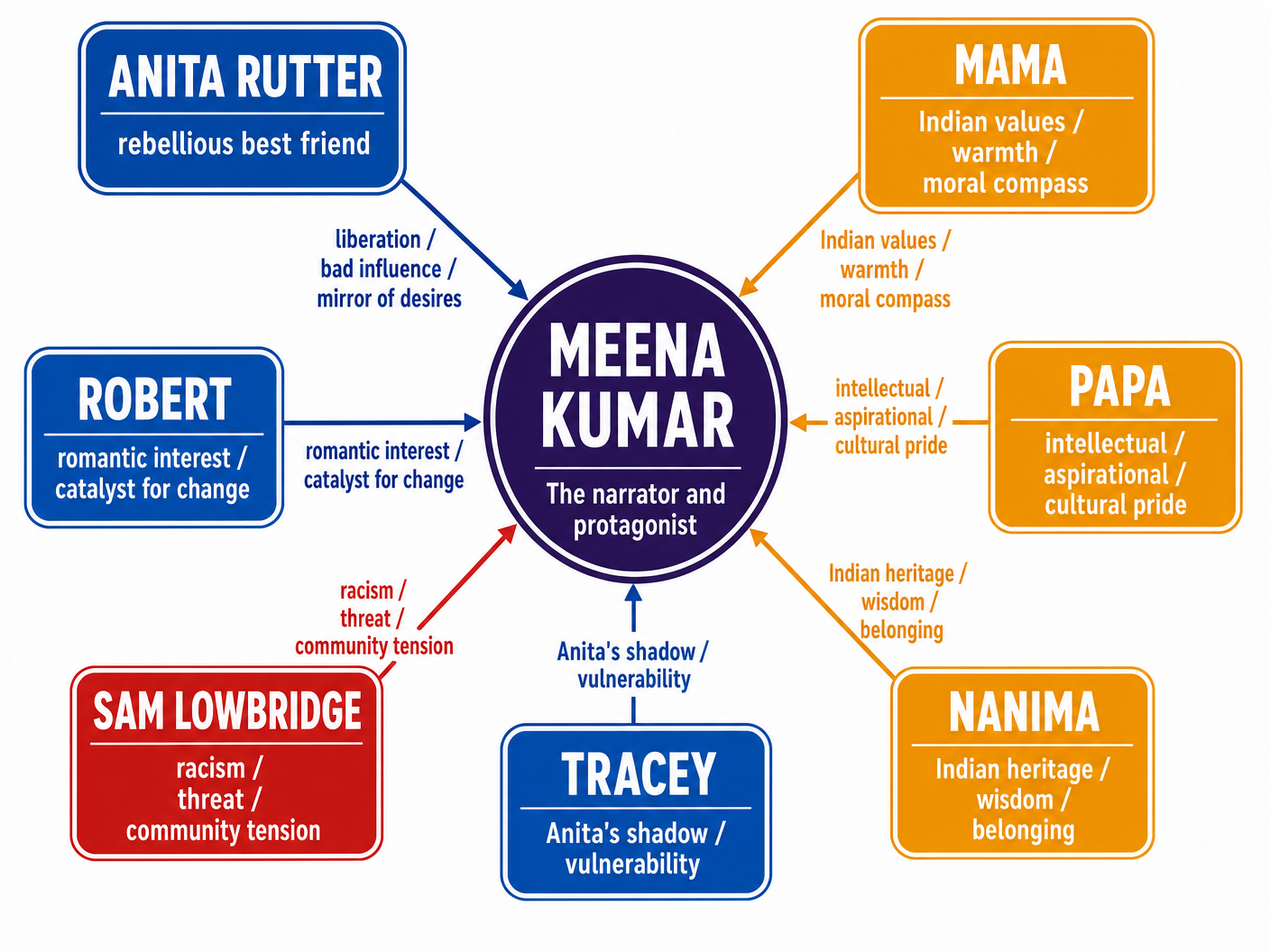
Meena Kumar
Role: The protagonist and retrospective first-person narrator.
Key Traits: Rebellious, observant, imaginative, conflicted, intelligent.
Character Arc: Meena moves from rejecting her Indian heritage and idolising Anita to accepting her dual identity and recognising her own worth. She matures from a naive child into a thoughtful young woman.
Essential Quotes:
- "I wanted to be a blonde, blue-eyed princess."
- "I felt like I was wearing a mask that was slowly slipping off."
Anita Rutter
Role: Meena's flawed idol and foil.
Key Traits: Rebellious, charismatic, vulnerable, manipulative, prejudiced.
Character Arc: Anita remains largely static, trapped by her circumstances and dysfunctional family. Her initial glamour fades as Meena matures and sees the reality of Anita's limited life.
Essential Quotes:
- "Anita was the undisputed leader of our gang."
- "She had a face like a slapped arse." (Meena's eventual, more critical view of her)
Mama and Papa (Daljit and Shyam)
Role: Meena's parents, representing her Indian heritage and moral compass.
Key Traits: Hardworking, aspirational, proud, sometimes naive about British racism, deeply loving.
Character Arc: They struggle to understand Meena's rebellion but remain a constant source of love and stability. They eventually learn to adapt to life in Britain while maintaining their cultural pride.
Essential Quotes:
- "Education is your ticket out of here, Meena." (Papa)
- "We must show them we are respectable people." (Mama)
Writer's Methods
- Retrospective First-Person Narrative: Adult Meena tells the story of her childhood. This creates dramatic irony, as the adult voice often comments on the naivety of the young Meena, allowing Syal to inject humour and mature reflection into the narrative.
- Use of Dialect and Language: Syal masterfully blends standard English, Black Country dialect (used by the Tollington residents), and Punjabi words. This linguistic hybridity perfectly mirrors Meena's cultural hybridity.
- Humour and Irony: Syal uses humour to tackle serious issues like racism and cultural dislocation. This prevents the novel from becoming overly bleak and highlights the absurdity of prejudice.
- Symbolism: The 'crossroads' of Tollington symbolises Meena's position between two cultures. Food is also heavily symbolic, representing cultural comfort (Indian food) versus the desire to assimilate (fish and chips).
Context
- 1970s Britain: A period of economic decline, strikes, and significant social change. The mining village of Tollington reflects the struggles of working-class communities.
- Immigration and Racism: Following the post-war influx of immigrants from the Commonwealth, racial tensions were high. Enoch Powell's 1968 'Rivers of Blood' speech legitimised anti-immigrant sentiment, which is reflected in the casual and overt racism Meena experiences.
- The 'Model Minority' Myth: Meena's parents represent the pressure on Asian immigrants to be hardworking, unobtrusive, and 'respectable' in order to be accepted by white British society.
- Feminism and Changing Roles: The 1970s saw the rise of second-wave feminism. Meena's mother, though traditional in some ways, is a strong, educated woman, contrasting with the limited options available to the white working-class women in Tollington (like Anita's mother).
Visual Resources
2 diagrams and illustrations
Interactive Diagrams
1 interactive diagram to visualise key concepts
Conceptual Flow Outline
Meena's Arc of Cultural Identity
Worked Examples
2 detailed examples with solutions and examiner commentary
Practice Questions
Test your understanding — click to reveal model answers
How does Syal present the relationship between Meena and Anita in the novel? (30 marks + 4 AO4)
Hint: Consider how the relationship changes over time. Why is Meena drawn to Anita initially, and what causes them to drift apart?
Explore how Syal presents the importance of family in Anita and Me. (30 marks + 4 AO4)
Hint: Contrast the Kumar family with the Rutter family. Think about Nanima's role.
How does Syal use the setting of Tollington to explore ideas about community? (30 marks + 4 AO4)
Hint: Tollington is a microcosm of 1970s Britain. Discuss the physical setting (the mine, the crossroads) and the social setting.
Starting with this extract (Chapter 10, Sam Lowbridge at the fete), explore how Syal presents the character of Sam Lowbridge. (30 marks + 4 AO4)
Hint: Look closely at Sam's dialogue in the extract. Why is he angry? How does Syal make him more than just a racist villain?