Climbing My Grandfather
'Climbing My Grandfather' is a beautifully crafted poem that uses the extended metaphor of a mountain climb to explore the deep bond between a grandchild and their grandfather. It offers rich opportunities for GCSE students to analyse structure, sensory imagery, and the complex interplay between physical details and emotional understanding.
Study Notes
Overview

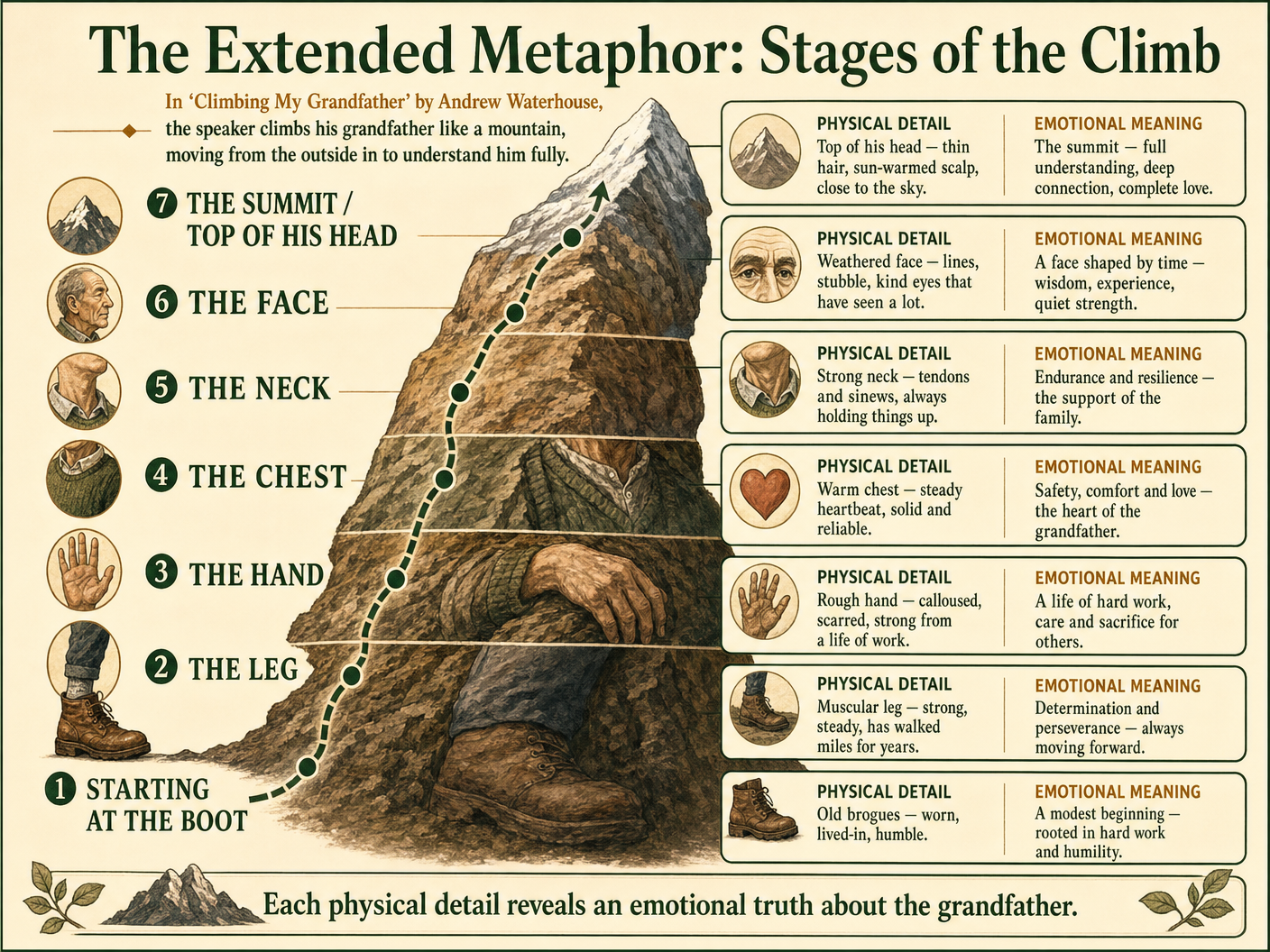
Andrew Waterhouse's 'Climbing My Grandfather' is an intimate, touching portrayal of the relationship between a grandchild and their grandfather. Through the extended metaphor of a mountain climb, the speaker moves from the 'old brogues' at the base to the 'summit' of the grandfather's head. Examiners highly reward candidates who understand that this is not a literal climb, but a metaphorical journey of emotional discovery. The poem's continuous, unbroken stanza and rich sensory details make it an excellent text for analysing structure and imagery.
Listen to our 10-minute revision podcast to consolidate your understanding:
Content Overview
The poem follows a clear, upward trajectory, mapping the stages of a climb to the physical features of the grandfather:
- The Base (Lines 1-6): The speaker begins 'without a rope or net', establishing a direct, unmediated connection, starting at the 'old brogues' and moving up the 'earth-stained hand'.
- The Ascent (Lines 7-14): The climb continues up the arm to the shoulder. The speaker notices the grandfather's 'glassy ridge of a scar', indicating a life of physical work and endurance.
- The Core (Lines 15-18): Reaching the chest, the speaker feels the 'slow pulse of his good heart', a moment of deep emotional connection and safety.
- The Summit (Lines 19-27): The speaker climbs the neck and face, finally resting at the top of the head, 'knowing' the grandfather and observing the passing of time.
Themes
Theme 1: Familial Love and Admiration
The poem presents familial love not through grand declarations, but through close, careful observation. The speaker's focused attention on the grandfather's physical details reveals deep respect and affection.
Key Quotes:
- "the slow pulse of his good heart" - The simplicity of the word 'good' conveys profound sincerity and trust.
- "smiling mouth to drink among teeth" - The grandfather's warmth and welcoming nature are highlighted here.
Theme 2: Age, Time and Heritage
The grandfather is presented as permanent and monumental as a mountain, yet marked by time. The poem explores how physical signs of aging are testaments to a life well-lived.
Key Quotes:
- "old brogues, dusty and cracked" - Suggests a life of hard work, humility, and being rooted in the earth.
- "glassy ridge of a scar" - A physical marker of past experience and endurance.
Writer's Methods
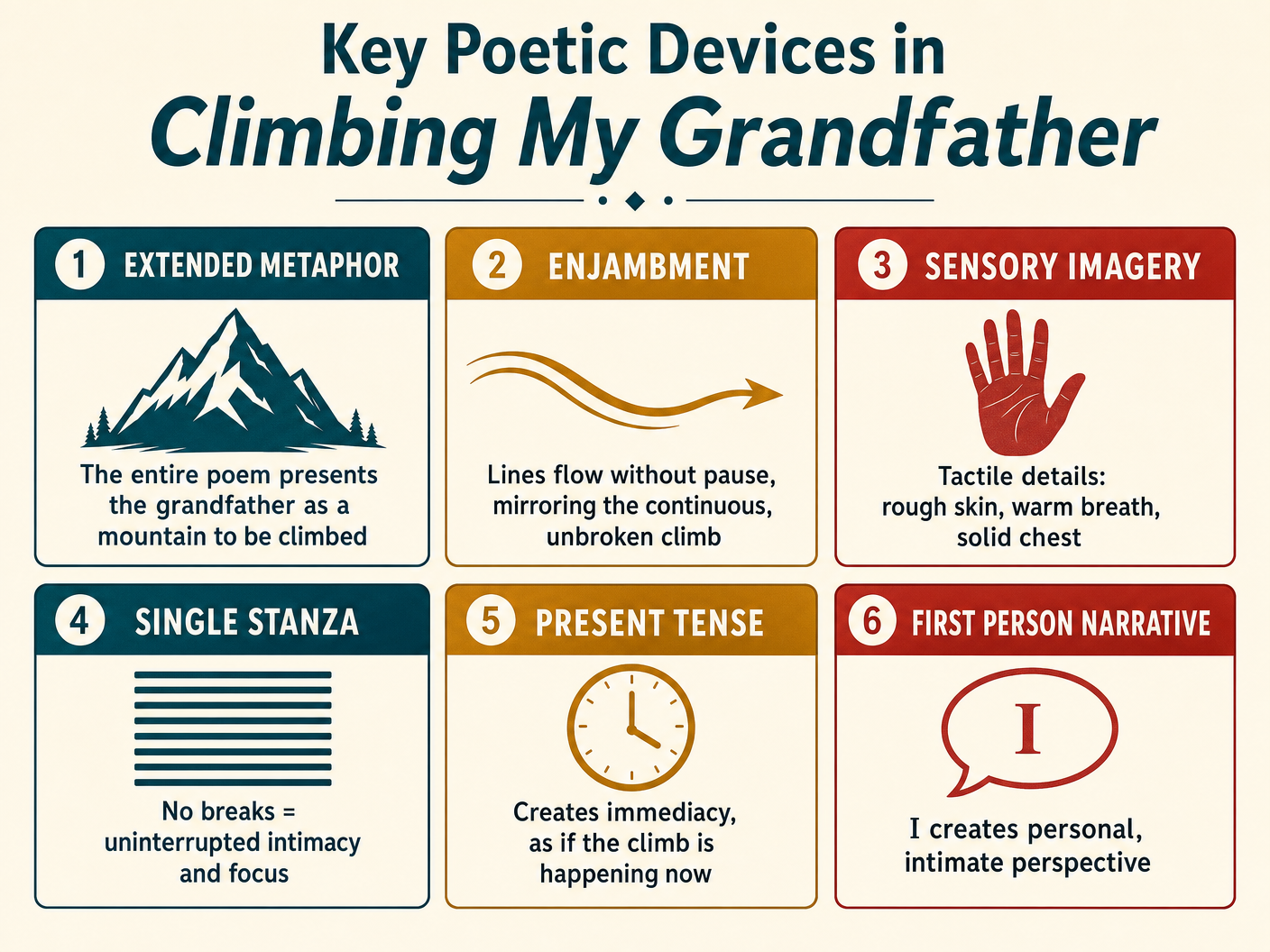
The Extended Metaphor
Waterhouse structures the entire poem around the metaphor of climbing a mountain. This elevates the grandfather, giving him scale, permanence, and majesty. It also turns the act of getting to know him into an active, deliberate effort.
Structure and Form
The poem is written in a single, unbroken stanza. This visual block of text on the page mirrors the solid, imposing presence of a mountain. Furthermore, the heavy use of enjambment (lines flowing into one another without punctuation) creates a sense of continuous, uninterrupted movement, reflecting the steady progress of the climb and the unbroken bond between the two figures.
Sensory Imagery
Waterhouse relies heavily on tactile (touch) imagery. The grandfather's skin is "warm ice", his hair is "soft and white". This creates a highly intimate, physical sense of connection, contrasting the vast scale of a mountain with the close-up reality of human touch.
Context
Andrew Waterhouse was a passionate environmentalist and geographer, which explains the deep connection between humanity and nature in his work. Understanding this helps explain why he chose to represent his grandfather as a landscape—it is the highest form of respect in Waterhouse's worldview. Examiners reward students who link this contextual knowledge to the specific language choices in the poem.
Visual Resources
2 diagrams and illustrations
Interactive Diagrams
1 interactive diagram to visualise key concepts
Conceptual Flow Outline
The trajectory of the extended metaphor mapping physical ascent to emotional understanding.
Worked Examples
2 detailed examples with solutions and examiner commentary
Practice Questions
Test your understanding — click to reveal model answers
Explore how the poet presents the speaker's feelings about their grandfather in 'Climbing My Grandfather'.
Hint: Focus on the extended metaphor, the tactile imagery, and the sense of achievement at the end.
Compare how poets present the passing of time in 'Climbing My Grandfather' and one other poem.
Hint: Consider 'Eden Rock' or 'Follower'. Focus on how physical signs of aging are portrayed.
How does Waterhouse use structure to convey meaning in 'Climbing My Grandfather'?
Hint: Look at the stanza length, line lengths, and punctuation (or lack thereof).
Explore the significance of the ending of 'Climbing My Grandfather'.
Hint: Look closely at the final three lines. What does the speaker finally achieve?