Excerpt from The Prelude
Dive into Wordsworth's powerful autobiographical epic, 'The Prelude', exploring the awe-inspiring and terrifying power of nature. This guide breaks down the boat-stealing episode, offering examiners' insights on how to secure top marks by analysing the Sublime, guilt, and the shift from innocence to experience.
Study Notes

Overview
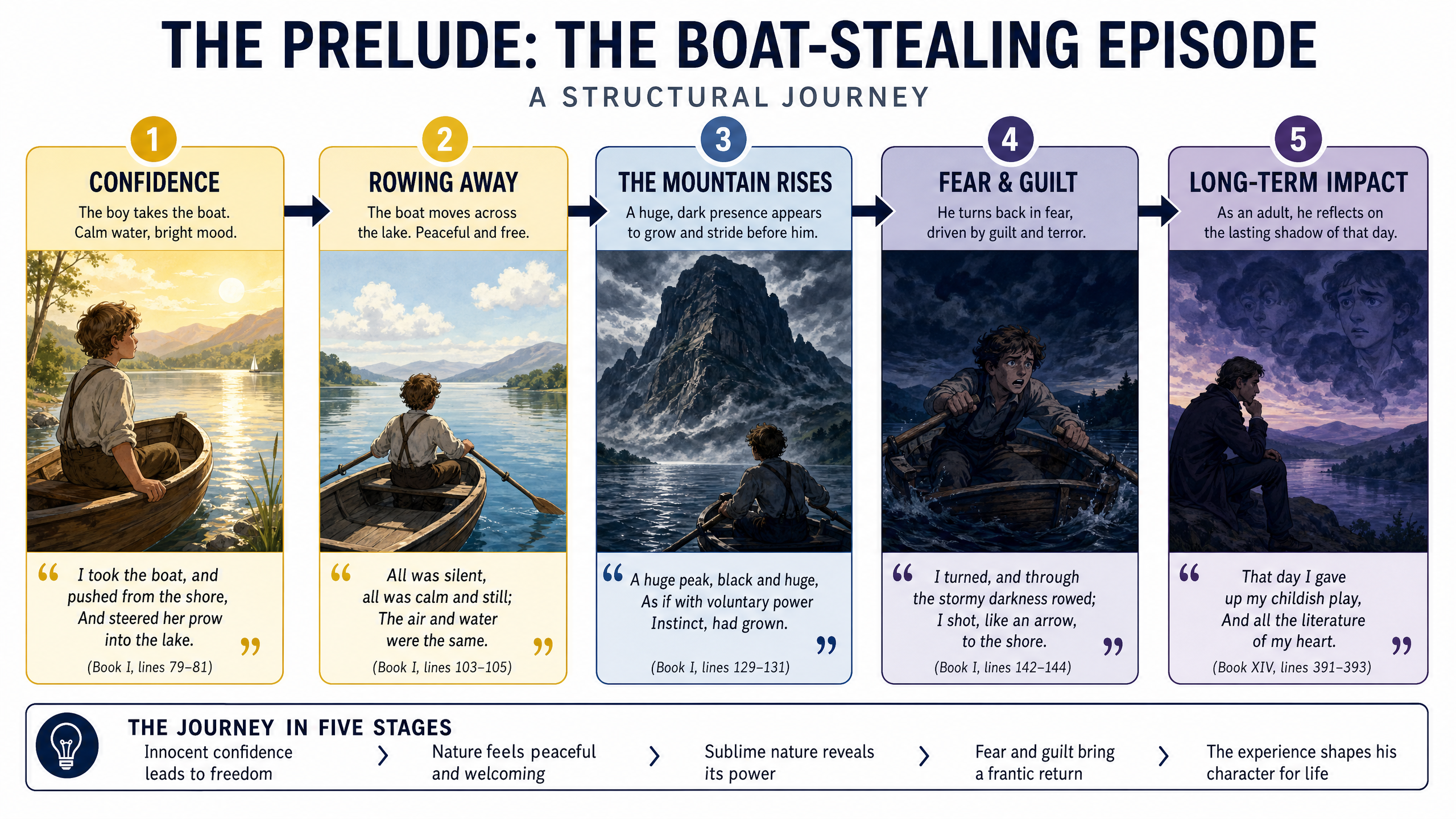
William Wordsworth's The Prelude is an autobiographical epic poem, subtitled The Growth of a Poet's Mind. The excerpt studied for GCSE Literature focuses on a single, formative childhood memory: the famous 'boat-stealing episode'. Here, a young Wordsworth takes a rowing boat without permission, only to be terrified by a huge mountain peak that seems to rise up and pursue him across the water. Examiners reward candidates who move beyond literal interpretations (e.g., "the mountain was scary") to conceptualised readings, recognising the mountain as a projection of the speaker's guilt and an embodiment of the Romantic 'Sublime'—the awe-inspiring, terrifying power of nature. Strong responses will explore how this experience permanently alters the speaker's worldview, marking a transition from childhood innocence to moral experience.
Listen to our comprehensive revision podcast for a deep dive into these concepts:
Plot/Content Overview
- The Theft: The speaker confidently takes a small boat ("elfin pinnace") on a summer evening.
- The Journey Out: He rows onto the lake, enjoying the beauty of the night and feeling a sense of power and freedom.
- The Turning Point: A huge, dark mountain peak suddenly comes into view from behind the craggy ridge.
- The Pursuit: As he rows further, the mountain appears to grow larger and seems to stride after him "like a living thing".
- The Return: Terrified and overwhelmed by guilt, he frantically rows back to the shore and returns the boat.
- The Aftermath: For days afterward, he is haunted by dark, undefined thoughts and a profound sense of nature's vast, unknown power.
Themes
Theme 1: The Power of Nature and the Sublime
Wordsworth presents nature not merely as a beautiful backdrop, but as a vast, powerful, and almost sentient force. This aligns with the Romantic concept of the Sublime—an experience of nature that is so overwhelming it produces both awe and terror. Nature is shown to have a moral authority that humbles human pride.
Key Quotes:
- "a huge peak, black and huge" - The repetition of "huge" emphasizes the sheer, overwhelming scale of nature compared to the smallness of humanity.
- "upreared its head" - Personification gives the mountain a threatening, monstrous quality, suggesting nature has its own will.
Theme 2: Guilt and Conscience
The poem externalises the internal experience of guilt. The speaker's act of stealing the boat triggers a psychological reaction where the landscape itself seems to judge and pursue him. The mountain is a physical manifestation of his awakening conscience.
Key Quotes:
- "troubled pleasure" - An oxymoron capturing the complex emotion of enjoying the theft while knowing it is morally wrong.
- "measured motion like a living thing / Strode after me" - The simile suggests the mountain has intent, reflecting the speaker's paranoia and guilt.
Theme 3: Memory and the Growth of the Mind
As part of an autobiographical epic, this excerpt illustrates what Wordsworth called "spots of time"—intense, formative childhood experiences that shape the adult mind. The trauma of the event forces the speaker to confront the limits of his understanding, ultimately deepening his philosophical awareness.
Key Quotes:
- "a dim and undetermined sense / Of unknown modes of being" - The experience shatters his simplistic worldview, leaving him grappling with complex, unnameable concepts.
- "No familiar shapes / Remained, no pleasant images of trees" - The memory strips away his innocent, picturesque view of nature, replacing it with something darker and more profound.

Writer's Methods
Form: The poem is written in blank verse (unrhymed iambic pentameter). This gives it the natural rhythm of speech, fitting for a personal, autobiographical recount, while the regular meter reflects the adult speaker's attempt to impose order on a chaotic childhood memory.
Structure: Wordsworth uses enjambment (lines flowing into one another without punctuation) to mimic the smooth, continuous motion of the boat initially, and later, the overwhelming, unstoppable nature of his fear. Caesura (mid-line pauses) is used when the mountain appears, creating a stuttering, breathless rhythm that mirrors his shock.
Language: The shift in tone is critical. It moves from confident, almost arrogant imagery ("elfin pinnace", "proud of his skill") to dark, oppressive, and ambiguous language ("darkness", "blank desertion", "huge and mighty forms").
Context
- Romanticism: Wordsworth was a key figure in the Romantic movement, which valued emotion, imagination, and the power of nature over reason and the industrial world.
- Pantheism: The poem hints at pantheistic ideas—the belief that God or a divine spirit is present in all aspects of nature.
- The Sublime: An 18th-century philosophical concept describing the awe and terror experienced when confronting the vastness of nature, popularised by thinkers like Edmund Burke.
- Autobiographical: The Prelude was published posthumously. It was a deeply personal project, tracing his spiritual and philosophical development.
Interactive Diagrams
1 interactive diagram to visualise key concepts
Conceptual Flow Outline
The psychological journey of the speaker in The Prelude
Worked Examples
2 detailed examples with solutions and examiner commentary
Practice Questions
Test your understanding — click to reveal model answers
How does Wordsworth present the transition from innocence to experience in this extract and the poem as a whole?
Hint: Track the shift in tone from the beginning (confidence, fairy-tale imagery) to the end (darkness, unknown forms).
Compare how poets present the power of nature in The Prelude and Ozymandias.
Hint: Think about what nature destroys in each poem: in Ozymandias it destroys physical statues and legacy; in The Prelude it destroys arrogance and peace of mind.
Explore how Wordsworth uses structure to convey the speaker's changing emotions.
Hint: Look closely at enjambment, caesura, and the cyclical nature of the journey (leaving the shore vs returning to the shore).
How does Wordsworth present the theme of guilt in The Prelude?
Hint: Remember that the mountain is a projection of his own conscience.