Follower
Seamus Heaney's 'Follower' is a masterful exploration of memory, admiration, and the inevitable shift in power between a father and son. It rewards close study through its brilliant use of nautical metaphors and a structural shift that perfectly mirrors the poignant role reversal at its core.
Study Notes
Overview
'Follower', published in Seamus Heaney's 1966 debut collection Death of a Naturalist, is a deeply personal and emotionally complex poem. It explores the evolving dynamic between a son and his farmer father, moving from a child's awed admiration of his father's physical prowess to an adult's poignant recognition of role reversal. Examiners highly reward candidates who can move beyond a simple reading of 'nostalgia' to explore the poem's structural disruptions, its sustained nautical metaphors, and the ambiguous, potentially resentful tone of the final stanza.
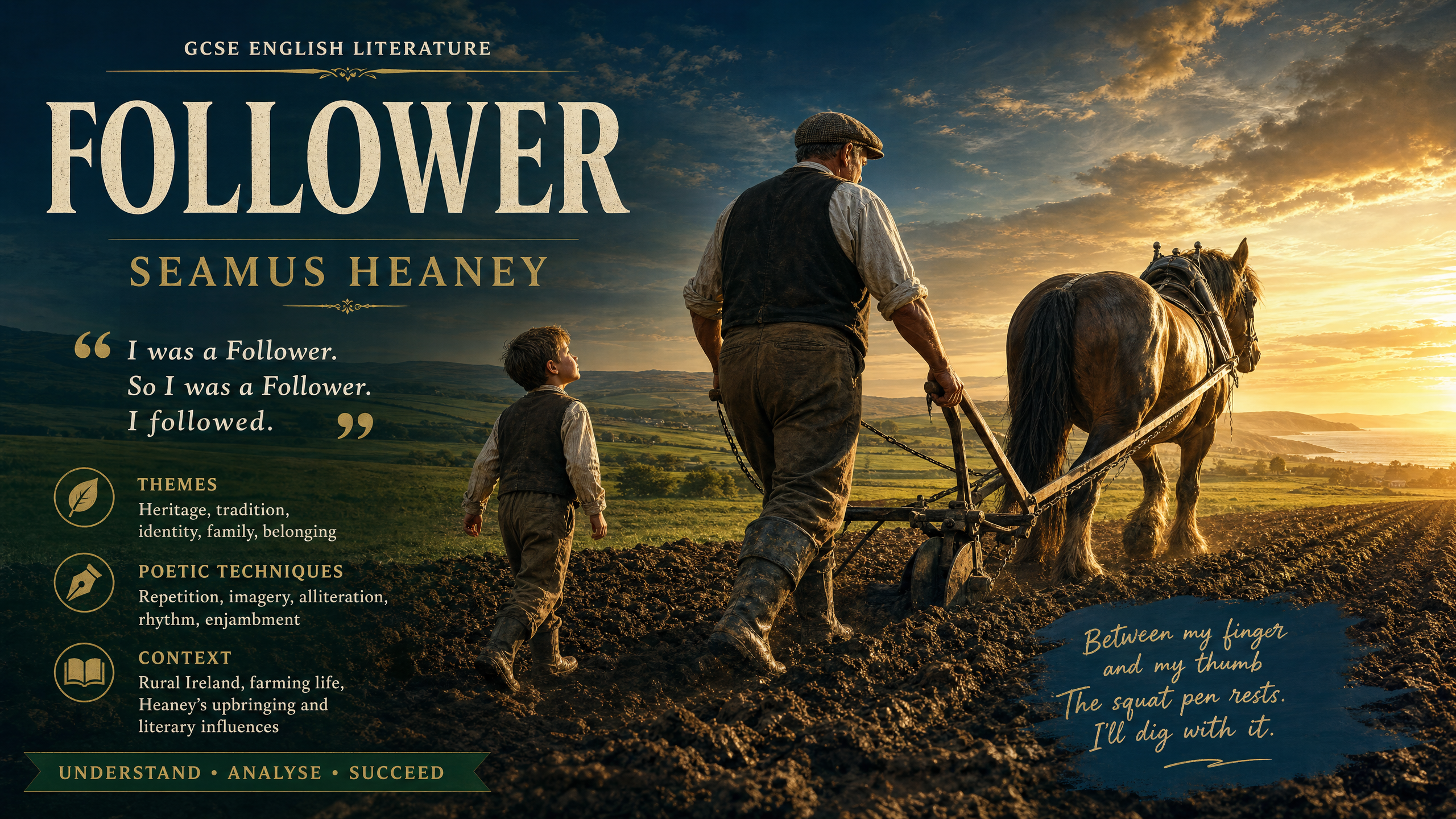
Plot/Content Overview
Stanzas 1-3: The speaker recalls his childhood, watching his father expertly plough a field with horses. The father is depicted as a master of his craft, operating with effortless precision.
Stanza 4: The focus shifts to the young speaker, who describes himself stumbling clumsily behind his father, desperate to emulate him but unable to do so.
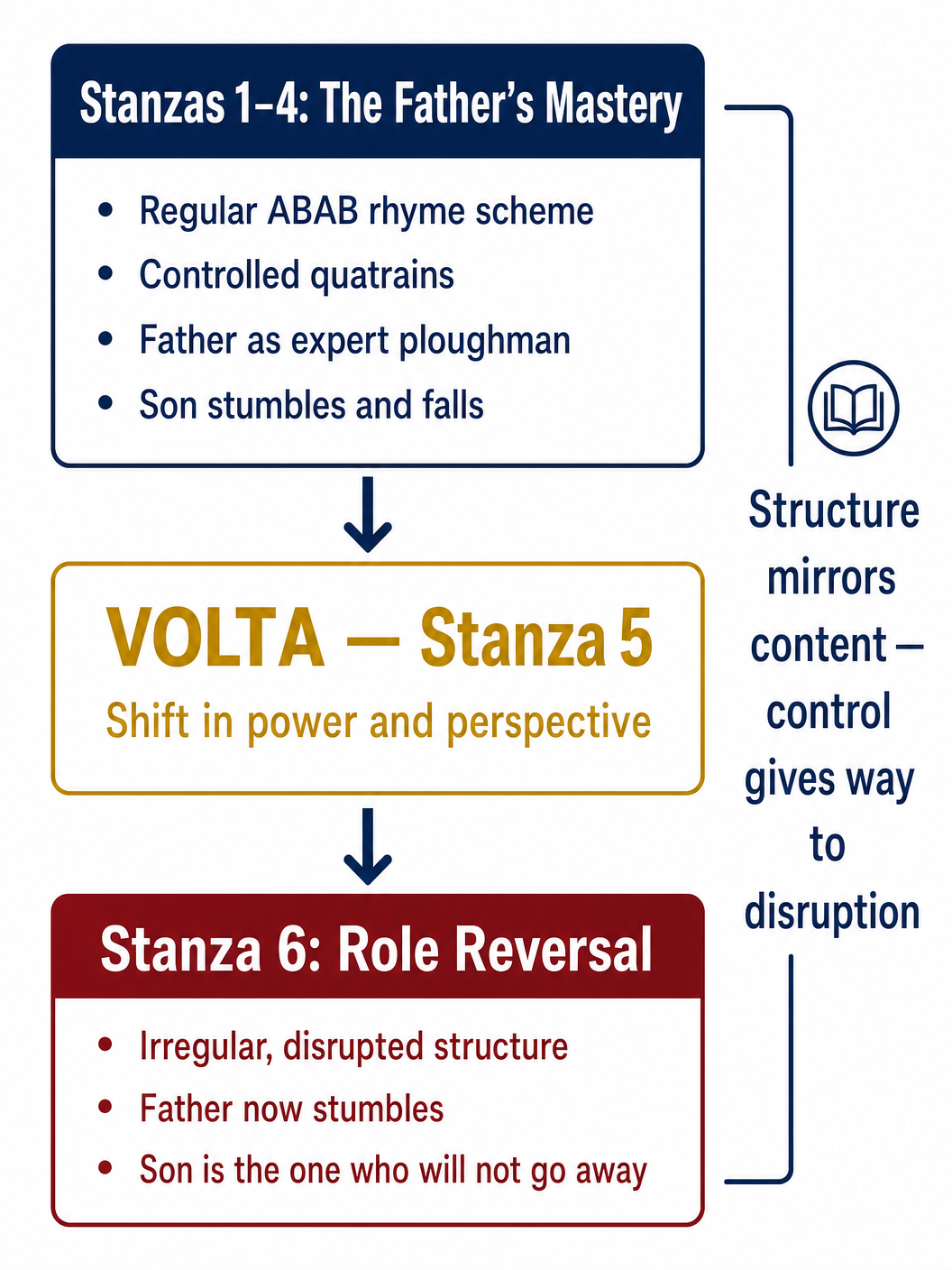
Stanza 5: The poem reaches its volta (turning point). The speaker admits he was a nuisance who 'All I ever did was follow'. The perspective then violently snaps to the present day: 'But today'.
Stanza 6: In the present, the roles are completely reversed. It is now the ageing father who is stumbling behind the adult son, and who 'will not go away'.
Themes
Theme 1: Admiration and Hero-Worship
In the early stanzas, the father is elevated to an almost mythical status. Heaney uses physical, muscular language to convey the son's absolute awe at his father's skill and strength. The father is not just a farmer; he is an expert, a captain, a force of nature.
Key Quotes:
- "An expert." (Stanza 2) - The use of a short, definitive caesura creates a tone of absolute, unquestionable fact.
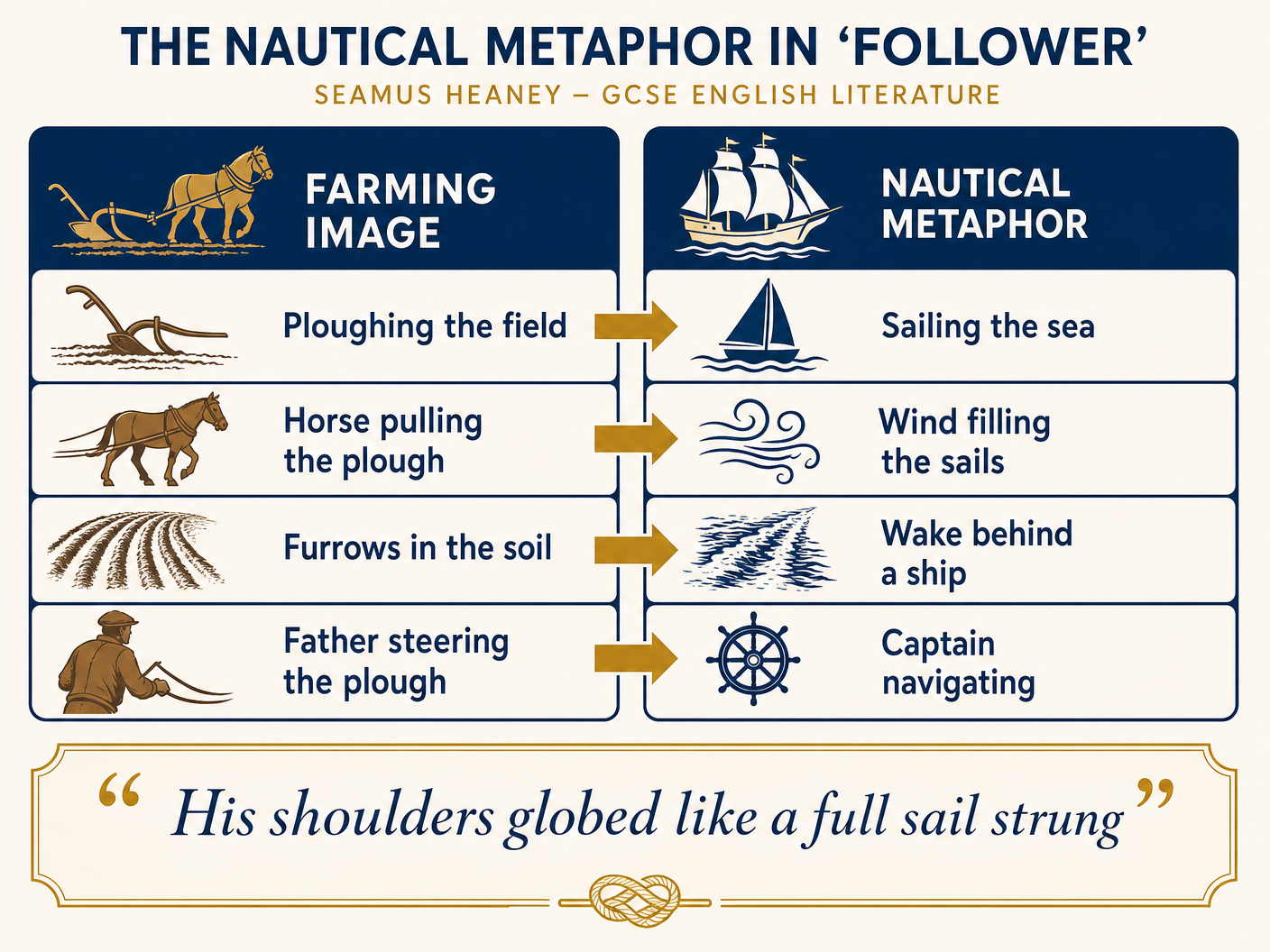
- "His shoulders globed like a full sail strung" (Stanza 1) - The simile compares the father to a ship in full sail, suggesting immense power, purpose, and mastery over his environment.
Theme 2: The Passage of Time and Role Reversal
The poem's core emotional impact relies on the cruel inevitability of time. The physical decline of the father is contrasted sharply with his former strength. The poem suggests that the dependency of childhood is eventually replaced by the dependency of old age.
Key Quotes:
- "But today / It is my father who keeps stumbling" (Stanza 5/6) - The volta shifts the poem from past to present, and the repetition of 'stumbling' (applied earlier to the son) highlights the tragic transfer of weakness.
- "Behind me, and will not go away." (Stanza 6) - The final line creates a sense of inescapable presence, suggesting the son feels burdened by the father's dependency.
Theme 3: Identity and Legacy
Heaney's own biographical context—choosing to be a poet rather than a farmer like his ancestors—underpins the poem. The son's failure to follow in his father's physical footsteps ('I wanted to grow up and plough... All I ever did was follow') reflects a break in tradition and a search for a different kind of identity.
Character Analysis
The Father
Role: The object of admiration and, later, the dependent figure.
Key Traits: Powerful, skilled, precise (in the past); frail, dependent, burdensome (in the present).
Character Arc: Moves from a figure of absolute, heroic mastery ('An expert') to a diminished, stumbling figure who relies on the son.
Essential Quotes:
- "His shoulders globed like a full sail strung"
- "my father who keeps stumbling"
The Son (Speaker)
Role: The observer, the follower, and ultimately the leader.
Key Traits: Clumsy, adoring, inadequate (in the past); independent, potentially resentful or guilty (in the present).
Character Arc: Moves from desperate imitation and physical inadequacy to independence, finding himself ultimately shadowed by the man he once shadowed.
Essential Quotes:
- "I stumbled in his hob-nailed wake"
- "I was a nuisance, tripping, falling"
Writer's Methods
The Nautical Metaphor: Heaney sustains a semantic field of sailing ('sail', 'wake'). This elevates the father's agricultural labour to the status of navigating a ship—requiring skill, command, and bravery.
Form and Structure: The poem consists of six quatrains. The first five feature a steady, controlled ABAB (often half-rhyme) scheme, mirroring the rhythmic, controlled movement of the ploughing. However, the final stanza disrupts this pattern, mirroring the disruption of the relationship and the father's loss of control.
Verbs of Motion: Heaney carefully contrasts the verbs associated with the father in the past ('rolled', 'pluck'—suggesting ease and precision) with the verbs associated with the son ('stumbled', 'tripping', 'falling'—suggesting clumsiness). The devastating irony is that the father inherits the verb 'stumbling' in the final stanza.
Listen to our deep-dive podcast for a full walkthrough of these methods:
Context
Seamus Heaney grew up on a farm in County Derry, Northern Ireland. His poetry frequently explores rural life, agricultural labour, and his own sense of guilt or displacement at having broken the family tradition of farming to become a writer. Examiners expect candidates to use this context to illuminate the poem's themes of legacy and identity, rather than just bolting on biographical facts.
Visual Resources
2 diagrams and illustrations
Interactive Diagrams
1 interactive diagram to visualise key concepts
Conceptual Flow Outline
The narrative and structural arc of 'Follower'
Worked Examples
2 detailed examples with solutions and examiner commentary
Practice Questions
Test your understanding — click to reveal model answers
How does Heaney present the effects of time on relationships in 'Follower'? (30 marks)
Hint: Structure your essay chronologically: how the relationship was in the past, the moment of transition (the volta), and how time has reversed the roles in the present.
Compare how poets present childhood memories in 'Follower' and one other poem. (30 marks)
Hint: Good comparison poems would be 'Piano' (for admiration), 'Eden Rock' (for moving away from parents), or 'Before You Were Mine' (for viewing a parent in the past).
Explore the significance of the title 'Follower' in the context of the whole poem. (30 marks)
Hint: The title has a dual meaning. Who is the follower at the start? Who is the follower at the end?
How does Heaney use form and structure to convey meaning in 'Follower'? (30 marks)
Hint: Look at the stanzas, the rhyme scheme, the enjambment, and the caesura.