Study Notes
Overview
Written by Mary Shelley when she was just nineteen and published in 1818, Frankenstein is a foundational text of both Gothic literature and science fiction. For GCSE English Literature, this text is incredibly rewarding because it offers rich opportunities for AO2 analysis (language, form, and structure) and deep AO3 integration (context). Examiners consistently reward candidates who move beyond simply seeing Victor as a 'mad scientist' or the Creature as a 'monster', and instead evaluate the novel as a complex critique of Enlightenment ambition, Romantic idealism, and societal prejudice. The key to high marks lies in understanding the epistolary frame narrative and how each narrator shapes reader sympathy.
Plot/Content Overview
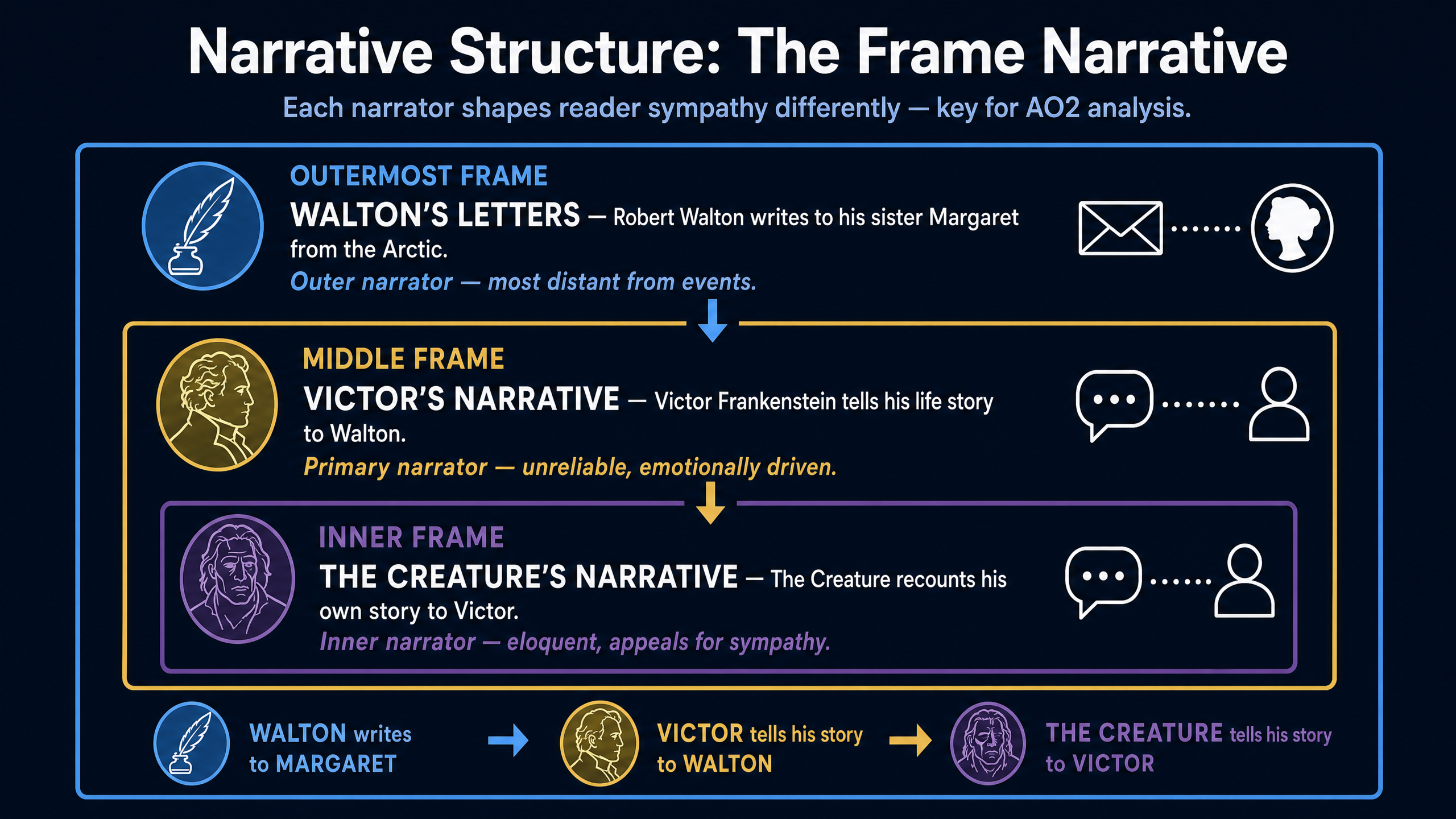
Frankenstein uses an epistolary (letter-based) frame narrative structure, nesting three stories within one another:
- Walton's Letters (The Outer Frame): Robert Walton, an ambitious explorer, writes to his sister from an expedition to the North Pole. His ship becomes trapped in ice, and his crew rescues a near-frozen man: Victor Frankenstein.
- Victor's Narrative (The Middle Frame): Victor recounts his life to Walton. He describes his idyllic childhood in Geneva, his obsession with natural philosophy, and his time at the University of Ingolstadt where he discovers the secret of life. He creates a massive, grotesque being, but flees in horror the moment it awakens. Following the murder of his brother William (for which the innocent servant Justine is executed), Victor encounters the Creature on a glacier.
- The Creature's Narrative (The Inner Frame): The Creature tells Victor of his early days of confusion, his education while secretly observing the De Lacey family, and his ultimate rejection by them. Driven to despair by humanity's cruelty, he demands Victor create a female companion for him.
- The Climax and Resolution: Victor begins the female creature but destroys it in fear. In revenge, the Creature murders Victor's best friend Clerval and his bride Elizabeth on their wedding night. Victor pursues the Creature to the Arctic, where he dies aboard Walton's ship. The Creature, mourning his creator, vows to destroy himself on a funeral pyre.
Themes
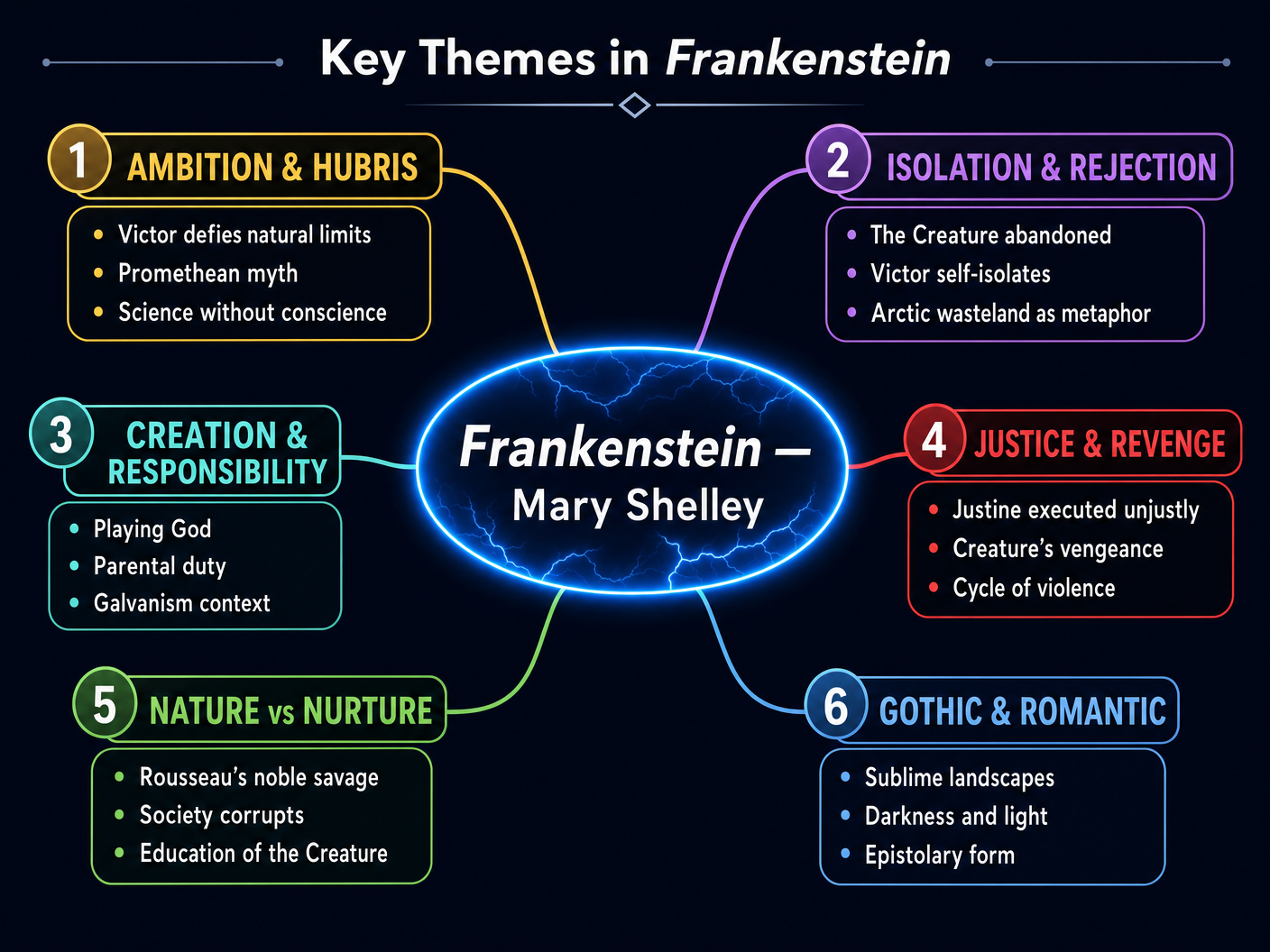
Theme 1: Ambition and Hubris
Victor's ambition is presented as a destructive, obsessive force that blinds him to moral responsibility. Shelley uses the subtitle The Modern Prometheus to explicitly link Victor to the mythological figure who stole fire from the gods. His desire to "pioneer a new way" reflects Enlightenment anxieties about science overreaching natural limits.
Key Quotes:
- "I will pioneer a new way, explore unknown powers, and unfold to the world the deepest mysteries of creation." (Vol 1, Ch 3) - Analysis: The verb "pioneer" and adjective "deepest" highlight Victor's arrogance and desire for god-like status.
- "Learn from me, if not by my precepts, at least by my example, how dangerous is the acquirement of knowledge" (Vol 1, Ch 4) - Analysis: Victor's didactic tone to Walton serves as a warning against unchecked ambition.
Theme 2: Isolation and Rejection
Both creator and creation suffer profound isolation. Victor self-isolates in his "workshop of filthy creation," cutting himself off from the healthy influence of family and nature. The Creature, conversely, is forcibly isolated by society due to his appearance. Shelley uses the sublime, desolate landscapes of the Arctic and the Alps to physically mirror their psychological isolation.
Key Quotes:
- "I, the miserable and the abandoned, am an abortion, to be spurned at, and kicked, and trampled on." (Vol 3, Ch 7) - Analysis: The violent verbs ("spurned", "kicked") emphasize society's cruelty, while "abortion" shows how he has internalized his own unnatural existence.
- "Am I not shunned and hated by all mankind?" (Vol 2, Ch 2) - Analysis: The rhetorical question highlights the universality of his rejection.
Theme 3: Creation and Responsibility
Shelley interrogates the duties a creator owes to their creation. Victor's immediate abandonment of his Creature is presented as a profound moral failure. The Creature repeatedly compares himself to Adam from Paradise Lost, highlighting that unlike Adam, he has no loving creator to guide him.
Key Quotes:
- "I ought to be thy Adam, but I am rather the fallen angel, whom thou drivest from joy for no misdeed." (Vol 2, Ch 2) - Analysis: The biblical allusion emphasizes Victor's failure as a creator and the Creature's unjust punishment.
- "Unable to endure the aspect of the being I had created, I rushed out of the room" (Vol 1, Ch 5) - Analysis: The verb "rushed" highlights Victor's cowardice and immediate abdication of parental duty.
Character Analysis
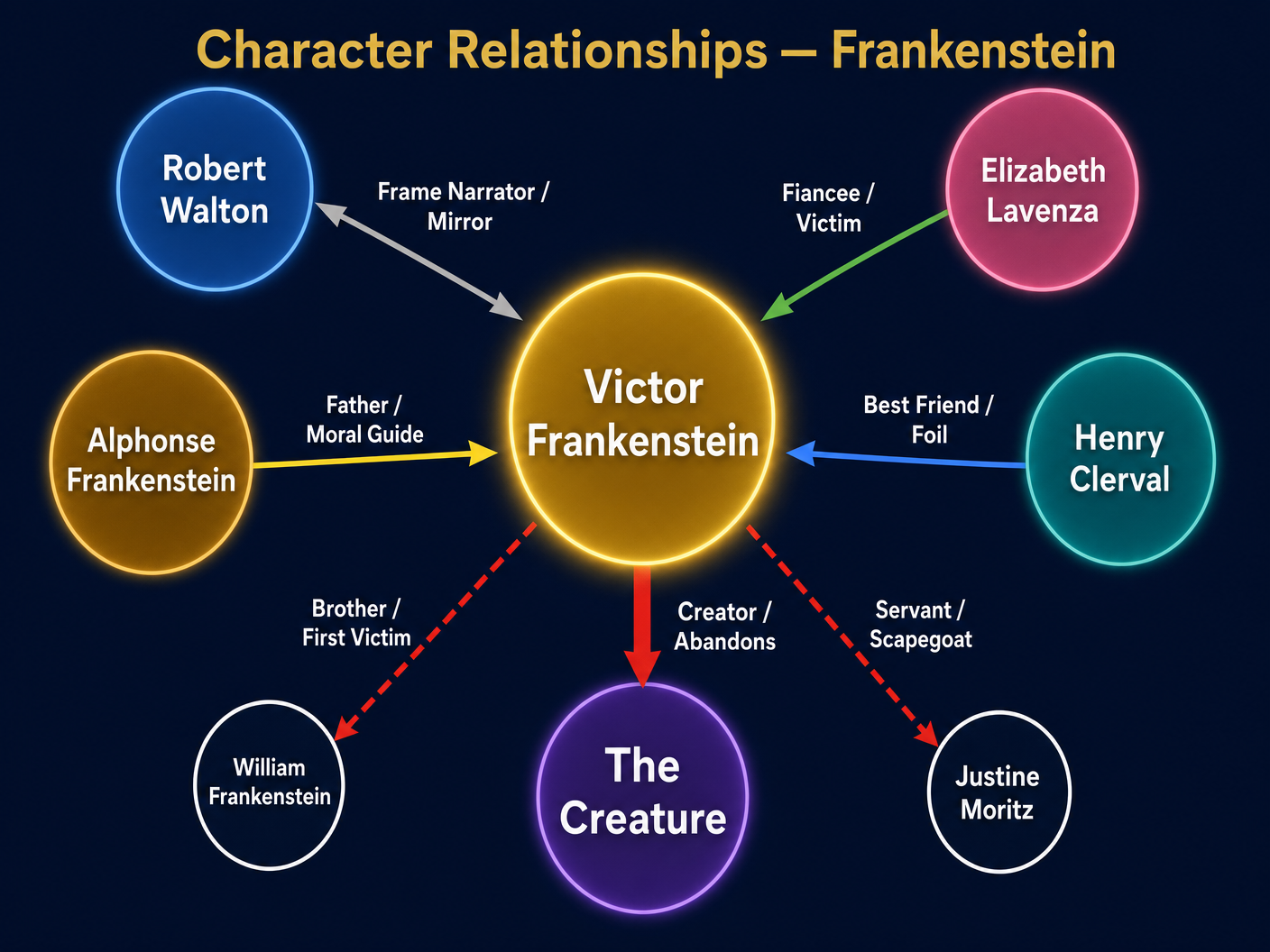
Victor Frankenstein
Role: The primary narrator and flawed creator.
Key Traits: Ambitious, obsessive, arrogant, cowardly, eloquent.
Character Arc: Shifts from a naive, ambitious student to a horrified creator, and finally to an obsessed, vengeful pursuer. He never fully accepts responsibility for his actions, viewing himself as a tragic victim of fate.
Essential Quotes:
- "A new species would bless me as its creator and source"
- "I had selected his features as beautiful. Beautiful! Great God!"
The Creature
Role: The creation, the antagonist, and the most sympathetic voice.
Key Traits: Articulate, sensitive, physically powerful, vengeful, lonely.
Character Arc: Begins as an innocent, benevolent "tabula rasa" (blank slate). Through repeated rejection and violence from humanity, he learns to hate and becomes the monster society assumes him to be.
Essential Quotes:
- "I was benevolent and good; misery made me a fiend."
- "If I cannot inspire love, I will cause fear!"
Writer's Methods
- Epistolary Frame Narrative: The nested structure (Walton -> Victor -> Creature) forces the reader to evaluate the reliability of each narrator. The Creature's narrative is placed at the very centre of the novel, arguably making it the core truth of the text.
- Gothic Setting and Pathetic Fallacy: Shelley uses extreme weather and sublime landscapes (the thunderstorm when the Creature awakens, the desolate Arctic) to reflect the psychological turmoil of the characters.
- Allusion: Frequent references to Milton's Paradise Lost and Coleridge's The Rime of the Ancient Mariner add mythic and moral weight to the narrative.
- Juxtaposition/Foil: Clerval acts as a foil to Victor, representing a balanced, humanities-focused approach to life, contrasting with Victor's obsessive scientific isolation.
Context
- Galvanism: The 18th-century scientific theory that electricity could stimulate muscle movement and perhaps restore life. Shelley mentions "galvanism" in her 1831 introduction as an inspiration.
- Rousseau and the 'Noble Savage': Jean-Jacques Rousseau argued that humans are born inherently good but are corrupted by society. The Creature's development perfectly illustrates this philosophy.
- The Promethean Myth: Prometheus stole fire from the gods to give to humanity and was eternally punished. Victor is the "Modern Prometheus," punished for stealing the divine power of creation.
- Romanticism vs. Enlightenment: The novel critiques the Enlightenment's cold, rational pursuit of scientific progress at the expense of human emotion and nature, aligning with Romantic ideals.
Visual Resources
3 diagrams and illustrations
Interactive Diagrams
1 interactive diagram to visualise key concepts
Conceptual Flow Outline
The Chain of Consequence in Frankenstein
Worked Examples
2 detailed examples with solutions and examiner commentary
Practice Questions
Test your understanding — click to reveal model answers
Explore how Shelley presents the Creature's need for companionship. (30 marks + 4 AO4)
Hint: Consider his time with the De Laceys, his request for a female mate, and his reaction when Victor destroys her.
How does Shelley present the dangers of unchecked scientific ambition? (30 marks + 4 AO4)
Hint: Look at Victor's language in Volume 1, the contrast with Clerval, and Walton's decision at the end of the novel.
Starting with the extract where Justine is condemned, explore how Shelley presents justice and injustice in the novel. (30 marks + 4 AO4)
Hint: Contrast human legal justice (which fails Justine) with the Creature's brutal, retributive justice.
Explore the significance of the settings in Frankenstein. (30 marks + 4 AO4)
Hint: Think about the contrast between the domestic spaces (Geneva) and the extreme, isolated spaces (the Alps, the Arctic).