Study Notes
Overview
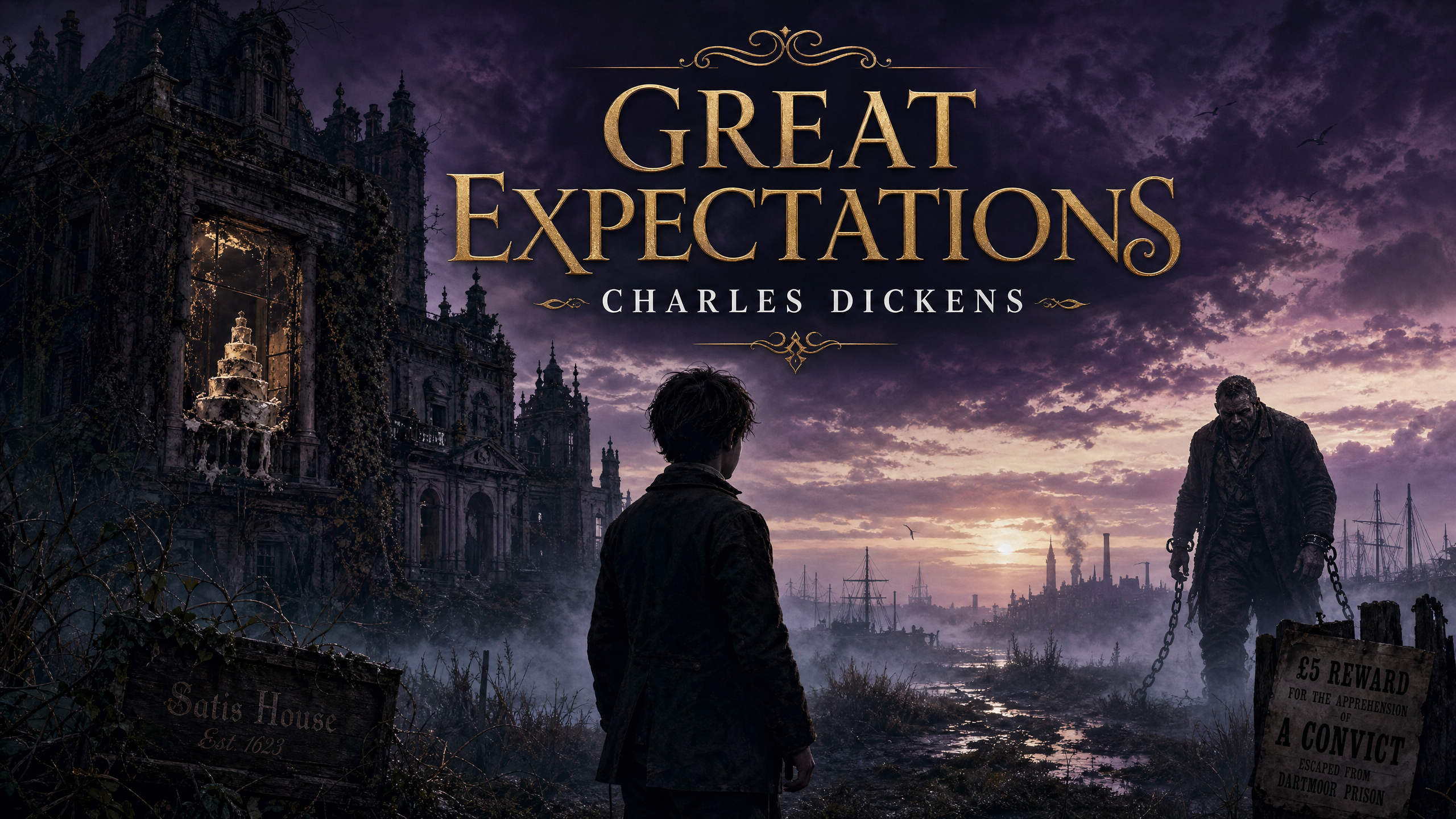
Charles Dickens's Great Expectations (1860-61) is a quintessential Bildungsroman, tracing the moral and psychological development of its protagonist, Pip. Written during a period of intense social mobility and anxiety about class in Victorian England, the novel is both a deeply personal narrative of guilt and redemption and a broad social critique. Examiners look for candidates who can analyse Dickens's retrospective first-person narrative voice, understand the symbolic function of settings like the marshes and Satis House, and evaluate the text's complex exploration of what constitutes a 'true gentleman'.
Plot/Content Overview
**Stage 1: The Marshes (Chapters 1-19)**The novel opens with young Pip's terrifying encounter with the escaped convict Magwitch on the Kent marshes. Soon after, Pip is introduced to the decaying Satis House, the eccentric Miss Havisham, and the beautiful but cruel Estella. Ashamed of his humble origins and his brother-in-law Joe Gargery, Pip longs to become a gentleman. His wish is seemingly granted when a mysterious benefactor provides him with 'great expectations'.
**Stage 2: London (Chapters 20-39)**Pip moves to London, where he adopts the superficial trappings of a gentleman. He becomes idle, snobbish, and increasingly distant from Joe and his past. He pursues Estella, despite Miss Havisham's clear manipulation. This stage ends with a devastating revelation: his benefactor is not Miss Havisham, but Magwitch, the convict he helped years ago.
**Stage 3: Redemption (Chapters 40-59)**Pip's initial revulsion towards Magwitch transforms into genuine care as he tries to help the convict escape. Through suffering, the loss of his fortune, and illness, Pip learns the true value of loyalty and love, ultimately reconciling with Joe and Biddy. The novel concludes with Pip achieving moral maturity, though his final reunion with Estella remains deliberately ambiguous.
Themes
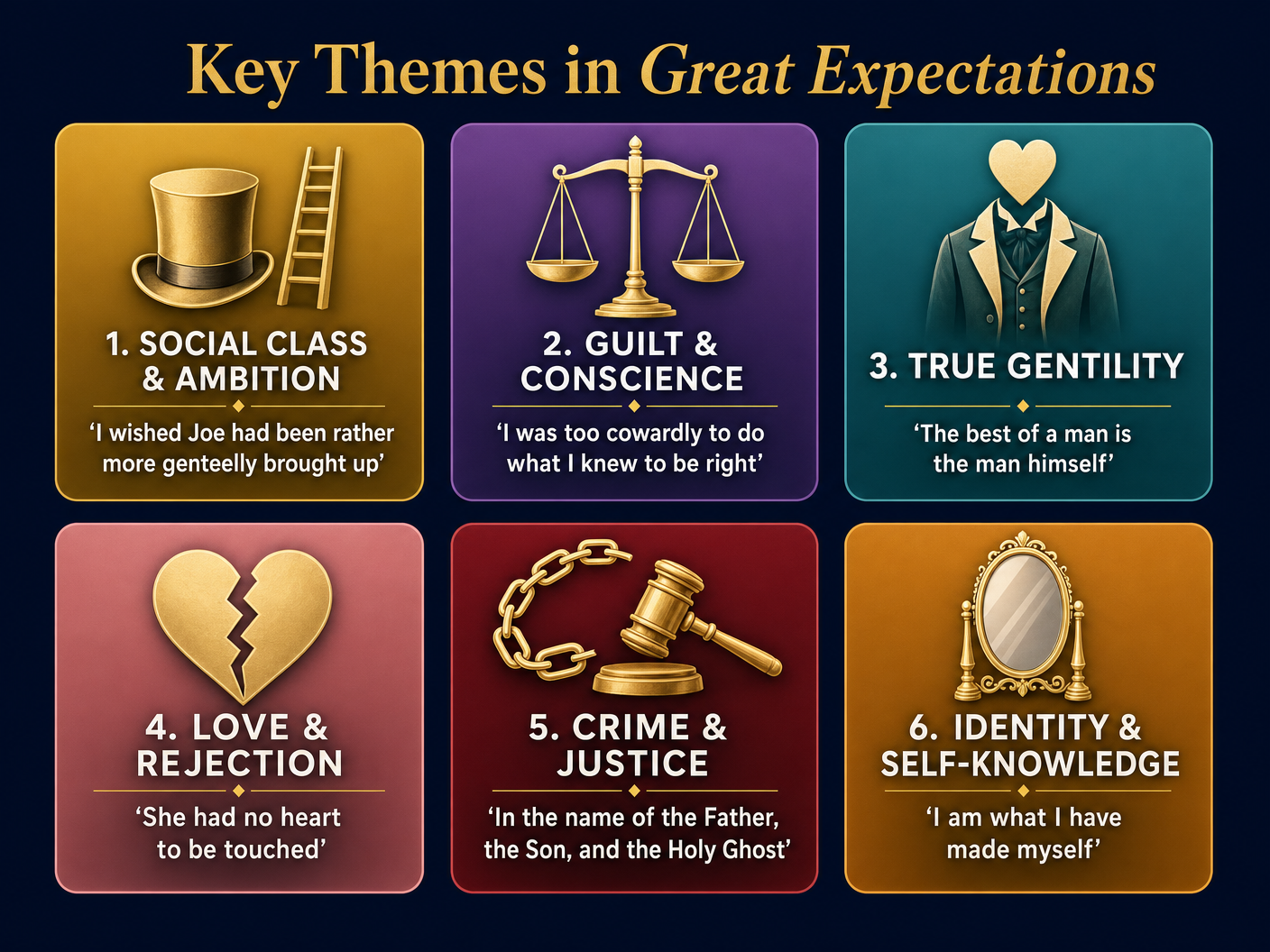
Theme 1: Social Class and Ambition
Dickens critiques the Victorian obsession with social status, arguing that the desire for gentility often corrupts moral character. Pip's ambition makes him ashamed of Joe, the most morally upright character in the novel. The legal system's leniency towards the 'gentlemanly' Compeyson compared to the harsh treatment of Magwitch highlights the hypocrisy of a society that equates appearance with virtue.
Key Quotes:
- "I wished Joe had been rather more genteelly brought up" (Chapter 8) - Reveals Pip's early snobbery and the corrupting influence of Satis House.
- "I was too cowardly to do what I knew to be right, as I had been too cowardly to avoid doing what I knew to be wrong" (Chapter 6) - Highlights the moral paralysis caused by social shame.
Theme 2: Guilt and Conscience
Guilt pervades the novel, symbolised by the oppressive atmosphere of the marshes and the literal chains of the convicts. Pip's guilt is complex: he feels guilty for stealing for Magwitch, but later feels a deeper, more profound guilt for his treatment of Joe and Biddy. The retrospective narrative voice allows the older Pip to judge his younger self's moral failings harshly.
Key Quotes:
- "In the little world in which children have their existence, whosoever brings them up, there is nothing so finely perceived and so finely felt, as injustice" (Chapter 8) - Reflects Dickens's deep empathy for the psychological vulnerability of children.
- "I only saw in him a much better man than I had been to Joe" (Chapter 54) - Marks Pip's moral turning point as he recognises Magwitch's true worth.
Theme 3: True Gentility vs. Superficial Gentility
The novel contrasts the superficial gentility of characters like Bentley Drummle and the adult Pip with the 'true gentility' of Joe Gargery and Herbert Pocket. Dickens argues that a true gentleman is defined by compassion, loyalty, and honest labour, not by wealth or social connections.
Key Quotes:
- "The best of a man is the man himself" (Chapter 59) - A summary of the novel's moral lesson.
- "I lived rough, that you should live smooth; I worked hard that you should be above work" (Chapter 39) - Magwitch's painful sacrifice exposes the parasitic nature of Pip's 'gentlemanly' life.
Character Analysis
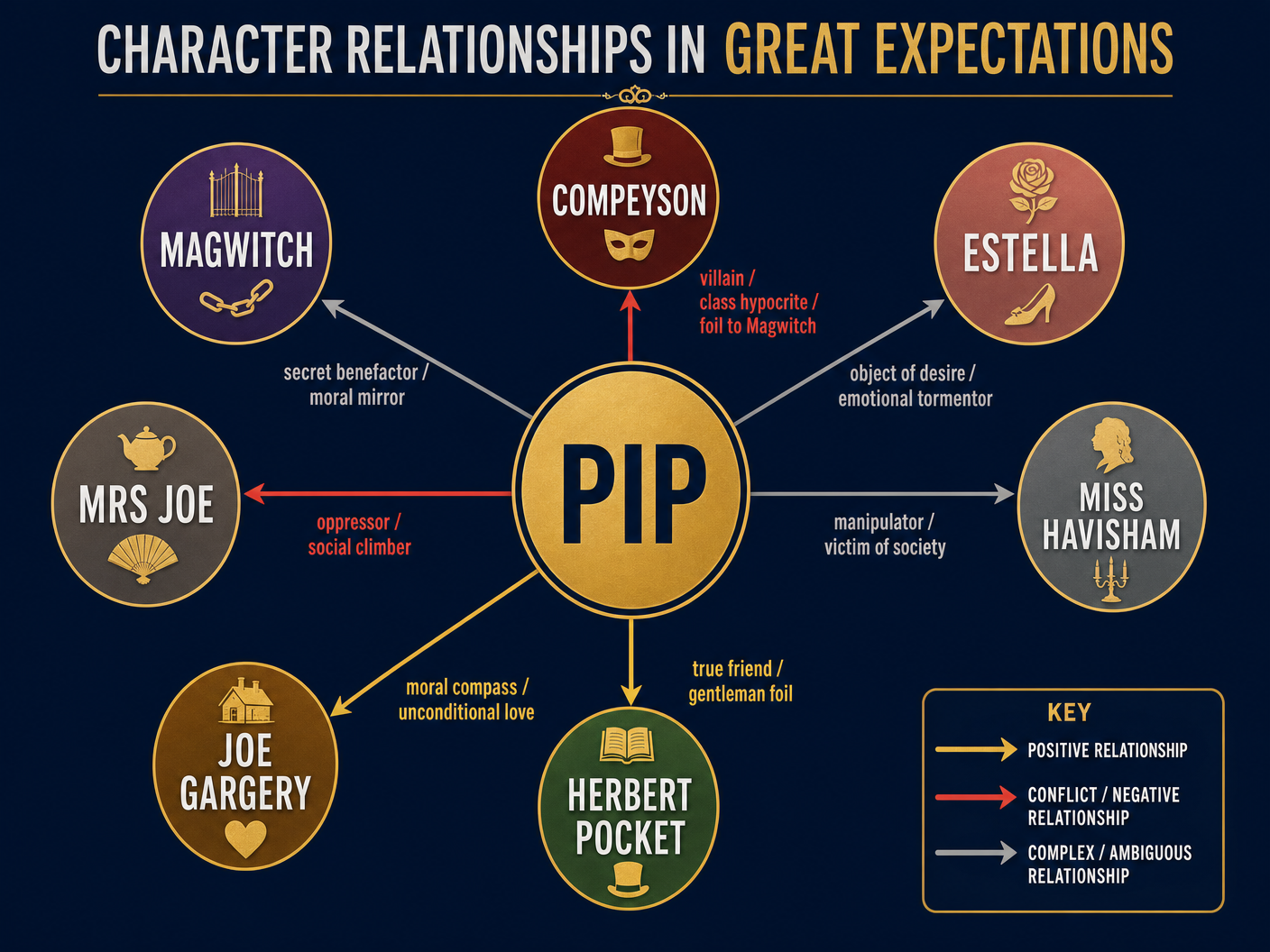
Pip (Philip Pirrip)
Role: Protagonist and first-person retrospective narrator.
Key Traits: Imaginative, sensitive, ambitious, prone to guilt and snobbery.
Character Arc: Pip moves from innocent vulnerability on the marshes, to moral corruption in London, to eventual redemption and self-knowledge through suffering.
Essential Quotes:
- "I am what I have made myself"
- "I was a blacksmith's boy but yesterday; I am - what shall I say I am - today?"
Miss Havisham
Role: Estella's adoptive mother; a symbol of decaying aristocracy and destructive revenge.
Key Traits: Manipulative, bitter, frozen in time, ultimately repentant.
Character Arc: She transitions from a vengeful mastermind who uses Estella to break hearts, to a broken woman who realises she has destroyed the only thing she loved.
Essential Quotes:
- "Break their hearts, my pride and hope, break their hearts and have no mercy!"
- "What have I done! What have I done!"
Joe Gargery
Role: Pip's brother-in-law and moral compass.
Key Traits: Unconditionally loving, forgiving, uneducated but deeply wise.
Character Arc: Joe remains morally static—he is consistently good throughout the novel, serving as the benchmark against which Pip's behaviour is judged.
Essential Quotes:
- "Ever the best of friends, Pip."
- "Life is made of ever so many partings welded together..."
Magwitch
Role: The escaped convict and Pip's secret benefactor.
Key Traits: Fierce, fiercely loyal, a victim of a biased justice system.
Character Arc: Introduced as a terrifying monster, he is gradually revealed as a deeply loving father figure whose sacrifices shame the 'gentlemen' of the novel.
Essential Quotes:
- "I'm your second father. You're my son—more to me nor any son."
Writer's Methods
Narrative Voice: Dickens uses a retrospective first-person narrator. The older, wiser Pip looks back on his younger self with a mixture of sympathy and harsh moral judgment. This creates dramatic irony and allows for deep psychological insight.
Symbolism: The novel is rich in symbols. The mist on the marshes represents moral confusion and guilt. Satis House (meaning 'enough') ironically represents insatiable desire and the decay of the upper classes. The stopped clocks symbolise Miss Havisham's unnatural refusal to let time progress.
Character Foils: Dickens uses foils to highlight moral contrasts. Biddy is a foil to Estella (warmth vs. coldness); Joe is a foil to Pumblechook (genuine goodness vs. hypocritical posturing); Magwitch is a foil to Compeyson (rough loyalty vs. polished villainy).
Context
The Class System: Victorian society was highly stratified. The Industrial Revolution created a new middle class, blurring old lines of aristocracy. Dickens critiques the idea that 'gentility' can be bought or is inherent to the upper classes.
The Justice System: The novel reflects Dickens's anger at the harsh penal system. Magwitch's transportation to Australia and Compeyson's lighter sentence highlight how the law favoured the wealthy and articulate over the poor and uneducated.
Serialisation: The novel was published in weekly instalments in All the Year Round. This dictated its structure, requiring cliffhangers, memorable character quirks, and a tightly woven plot to keep readers engaged.
Audio Revision
Listen to the comprehensive podcast guide for this text:
Visual Resources
2 diagrams and illustrations
Interactive Diagrams
1 interactive diagram to visualise key concepts
Conceptual Flow Outline
Pip's Moral Journey and Structural Arc
Worked Examples
2 detailed examples with solutions and examiner commentary
Practice Questions
Test your understanding — click to reveal model answers
Explore how Dickens presents the relationship between Pip and Magwitch. (30 marks)
Hint: Track the relationship chronologically: from terror on the marshes, to Pip's revulsion in London, to his eventual deep affection and loyalty.
How does Dickens use settings to reflect the psychological states of the characters? (30 marks)
Hint: Focus on three main settings: The Marshes (guilt/exposure), Satis House (decay/obsession), and London/Little Britain (corruption/superficiality).
Explore the significance of guilt in Great Expectations. (30 marks)
Hint: Consider different types of guilt: Pip's criminal guilt (stealing the file), his social guilt (ashamed of Joe), and Miss Havisham's moral guilt.
How does Dickens present the character of Estella? (30 marks)
Hint: Don't just call her cruel. Explore *why* she is cruel (she is a victim of Miss Havisham's abuse) and how she functions as a symbol of upper-class unattainable wealth.