Study Notes
Overview
Shakespeare's Julius Caesar is a tragedy that examines the fatal intersection of personal loyalty and public duty. Set in ancient Rome, it follows the conspiracy to assassinate Caesar, led by Cassius and Brutus, and the chaotic civil war that ensues. Examiners love this text because it demands nuanced character analysis—there are no simple heroes or villains. To achieve top marks, candidates must move beyond plot summary and explore how Shakespeare uses language (especially rhetoric) and structure to reveal the gap between the characters' public personas and their private doubts. A perceptive response will always link these themes to the anxieties of the Elizabethan audience regarding succession, divine right, and civil unrest.
Plot/Content Overview
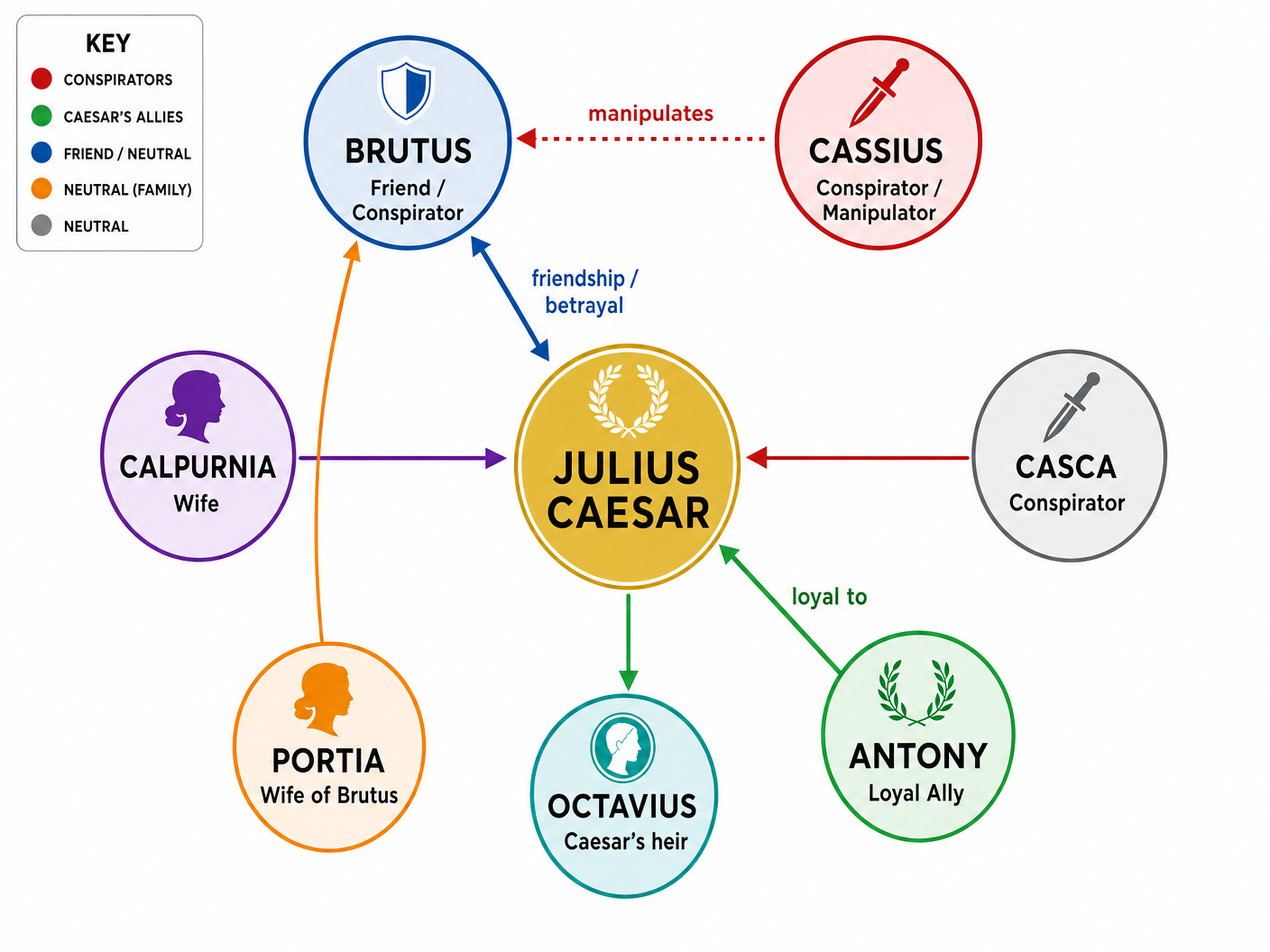
Act 1: Caesar returns to Rome in triumph. Cassius begins manipulating Brutus, arguing that Caesar's growing power threatens the Republic. Strange omens plague the city.
Act 2: Brutus privately decides Caesar must die for the good of Rome. The conspirators meet at his house. Caesar ignores his wife Calpurnia's prophetic nightmares and goes to the Senate.
Act 3: The climax. The conspirators assassinate Caesar in the Senate. Brutus speaks to the plebeians, rationally explaining the murder. However, Mark Antony's masterful, emotional funeral oration turns the crowd against the conspirators, sparking a riot.
Act 4: The conspirators flee Rome. Antony, Octavius, and Lepidus form a ruthless triumvirate. Brutus and Cassius argue bitterly in their camp, revealing the moral decay of their cause. Caesar's ghost appears to Brutus.
Act 5: The battle of Philippi. Facing defeat, both Cassius and Brutus commit suicide. Antony delivers a final eulogy over Brutus's body, calling him "the noblest Roman of them all."
Themes
Theme 1: Rhetoric and Manipulation
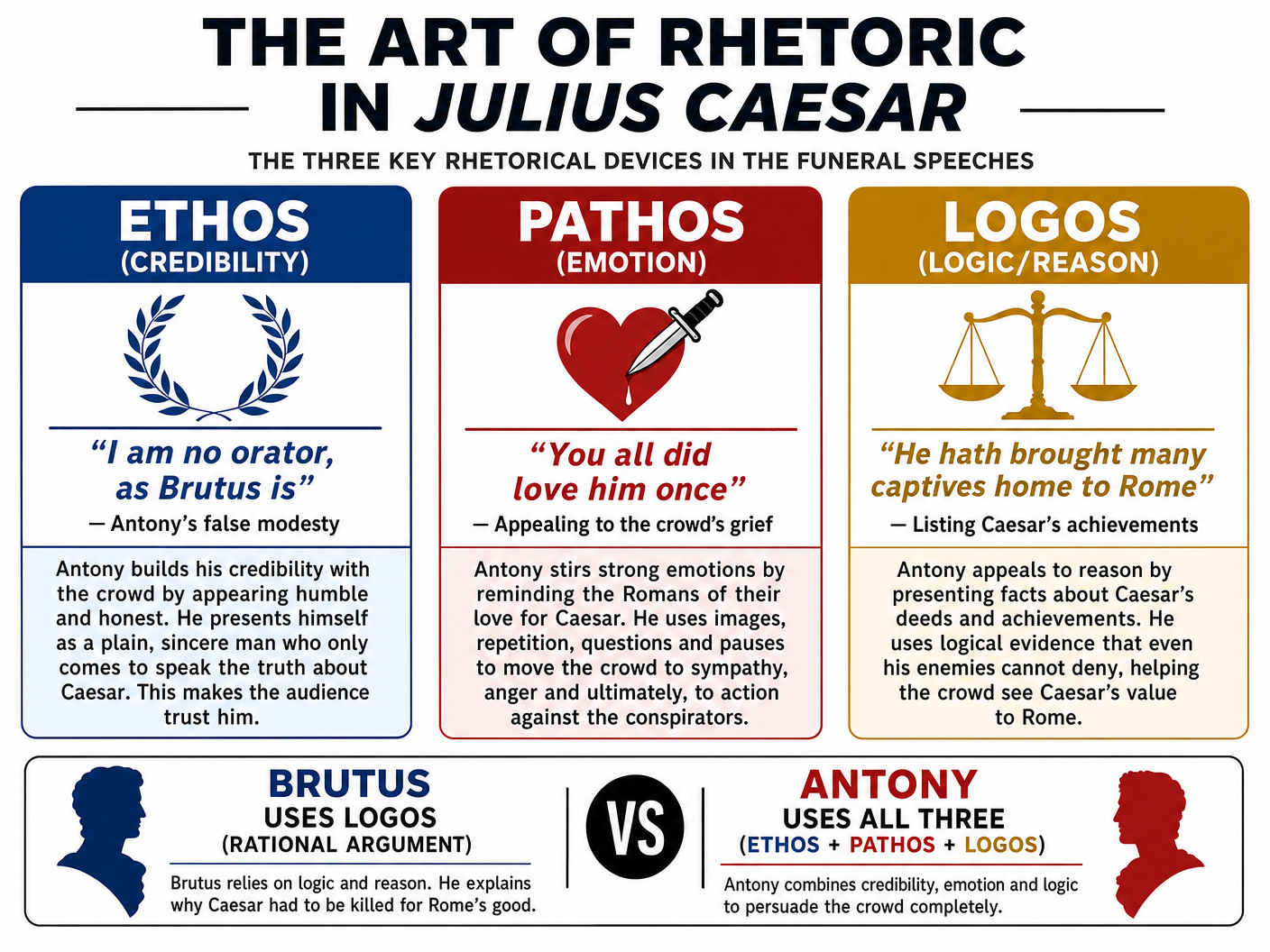
Shakespeare presents language as a weapon more powerful than swords. The play demonstrates how easily the masses can be swayed by skilled orators, highlighting the danger of political manipulation.
Key Quotes:
- "I am no orator, as Brutus is; / But, as you know me all, a plain blunt man" (Act 3, Scene 2) - Antony's false modesty (ethos) masks his calculated manipulation of the crowd.
- "Not that I loved Caesar less, but that I loved Rome more." (Act 3, Scene 2) - Brutus's use of balanced prose and logos appeals to reason, but fails to secure lasting support.
Theme 2: Fate vs. Free Will
The play is saturated with omens and prophecies, raising the question of whether the characters' tragic ends are predestined or the result of their own flawed choices.
Key Quotes:
- "The fault, dear Brutus, is not in our stars, / But in ourselves, that we are underlings." (Act 1, Scene 2) - Cassius argues for free will to persuade Brutus to act.
- "Cowards die many times before their deaths; / The valiant never taste of death but once." (Act 2, Scene 2) - Caesar's fatalistic arrogance leads him to ignore warnings.
Theme 3: Public Face vs. Private Self
Characters constantly struggle to reconcile their personal feelings with their political roles, leading to tragic consequences.
Key Quotes:
- "Let's carve him as a dish fit for the gods, / Not hew him as a carcass fit for hounds." (Act 2, Scene 1) - Brutus attempts to sanitize the brutal reality of murder through elevated language.
- "O constancy, be strong upon my side, / Set a huge mountain 'tween my heart and tongue!" (Act 2, Scene 4) - Portia highlights the painful effort required to maintain a public facade.
Character Analysis
Brutus
Role: The tragic hero; the moral center of the conspiracy.
Key Traits: Idealistic, naive, stoic, honourable but misguided.
Character Arc: Moves from a respected, conflicted senator to a murderer, and finally to a defeated, disillusioned general who chooses suicide over capture.
Essential Quotes:
- "I love / The name of honour more than I fear death." (Act 1, Scene 2)
- "O Julius Caesar, thou art mighty yet! / Thy spirit walks abroad" (Act 5, Scene 3)
Julius Caesar
Role: The catalyst for the action; a looming presence even after death.
Key Traits: Arrogant, physically vulnerable, politically astute, superstitious yet defiant.
Character Arc: Presented initially as a flawed, aging dictator; post-assassination, his spirit becomes an invincible, avenging force.
Essential Quotes:
- "I am constant as the northern star" (Act 3, Scene 1)
- "Et tu, Bruté? Then fall, Caesar." (Act 3, Scene 1)
Mark Antony
Role: Caesar's loyalist and the conspirators' nemesis.
Key Traits: Calculating, persuasive, ruthless, genuinely grieving but politically opportunistic.
Character Arc: Transforms from a seemingly harmless reveler into a masterful orator and a cold-blooded military leader.
Essential Quotes:
- "Cry 'Havoc,' and let slip the dogs of war" (Act 3, Scene 1)
- "Friends, Romans, countrymen, lend me your ears" (Act 3, Scene 2)
Writer's Methods
Shakespeare uses blank verse (unrhymed iambic pentameter) for noble characters to elevate their speech, while commoners often speak in prose. Crucially, Brutus uses prose in his funeral speech, reflecting his appeal to reason, while Antony uses soaring blank verse to manipulate emotion. Dramatic irony is pervasive—the audience knows the assassination is coming, making Caesar's arrogance deeply ironic. The use of soliloquies allows characters like Brutus and Antony to reveal their private thoughts, contrasting sharply with their public declarations.
Context
Written around 1599, the play reflects Elizabethan anxieties. Queen Elizabeth I was aging and had no heir, leading to fears of civil war and succession crises (similar to the chaos following Caesar's death). Furthermore, the Tudor belief in the Divine Right of Kings meant that assassinating a ruler was considered a crime against God, inevitably leading to unnatural chaos (reflected in the storms and omens in the play). Examiners expect candidates to integrate this context to explain why Shakespeare presents rebellion as ultimately destructive.
Listen to our comprehensive podcast guide here:
Visual Resources
2 diagrams and illustrations
Interactive Diagrams
1 interactive diagram to visualise key concepts
Conceptual Flow Outline
The Tragic Arc of Brutus
Worked Examples
2 detailed examples with solutions and examiner commentary
Practice Questions
Test your understanding — click to reveal model answers
Explore how Shakespeare presents the theme of ambition in Julius Caesar. (30 marks)
Hint: Don't just write about Caesar's ambition. Consider Cassius's ambition for power, and how Brutus fears ambition.
How does Shakespeare present the relationship between Brutus and Cassius? (30 marks)
Hint: Look at how the relationship changes from Act 1 (manipulation) to Act 4 (the tent argument).
Starting with this extract (Act 2, Scene 2, Calpurnia's warnings), explore how Shakespeare uses the supernatural in the play. (30 marks)
Hint: Connect the supernatural to the theme of Fate vs Free Will, and the unnaturalness of regicide.
Explore how Shakespeare presents the role of women in Julius Caesar. (30 marks)
Hint: Focus on Portia and Calpurnia. How are they treated by their husbands, and what do they represent?