Letters from Yorkshire
Maura Dooley's 'Letters from Yorkshire' is a quietly powerful poem exploring the contrast between rural and urban existence. It's highly rewarding to study because its emotional complexity and rich sensory imagery offer excellent opportunities for high-level analysis of language and form.
Study Notes
Overview
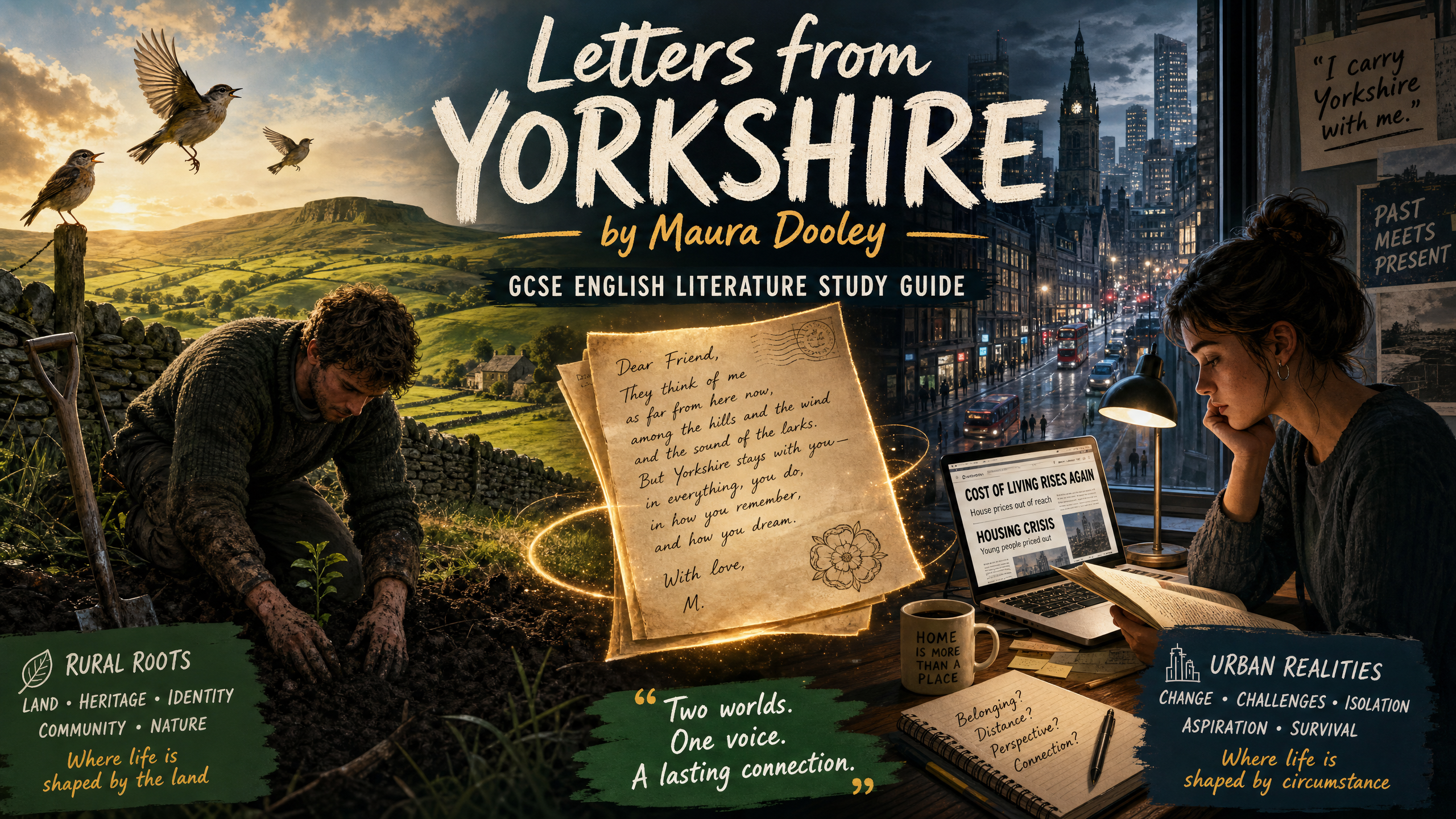
Maura Dooley's 'Letters from Yorkshire' is a poignant exploration of connection, distance, and the contrast between rural and urban lifestyles. The poem is written from the perspective of an urban dweller who receives letters from a friend living a grounded, agricultural life in Yorkshire. Examiners consistently reward candidates who understand that this is a persona poem—do not confuse the speaker with the poet. High marks are awarded to those who can analyse how the epistolary (letter) form bridges the physical distance between the two characters, and how Dooley uses contrasting imagery to explore the complexity of their relationship. The poem resists simple conclusions, instead presenting a nuanced view of modern life where connection is sustained through memory, imagination, and the written word.
Podcast Episode
Listen to our comprehensive audio guide for this poem:
Content Overview
- Stanza 1: The poem opens in February with the letter writer in Yorkshire, digging his garden and planting potatoes. He writes to the speaker to tell her about the first lapwings (birds) returning.
- Stanza 2: The speaker reflects on the letter writer's connection to nature and questions whether his life is 'more real' than hers.
- Stanza 3: The focus shifts to the speaker's urban life. She describes herself as 'feeding words onto a blank screen', contrasting her indoor, sedentary work with his outdoor labour.
- Stanza 4: The letter arrives. The speaker describes the physical act of receiving and opening it, noting how it brings the outside world indoors.
- Stanza 5: The poem concludes with the speaker reflecting on their ongoing connection. Despite the distance and their different lives, their souls remain connected, leaving the speaker 'feeling this, / burning / freezing'.
Themes
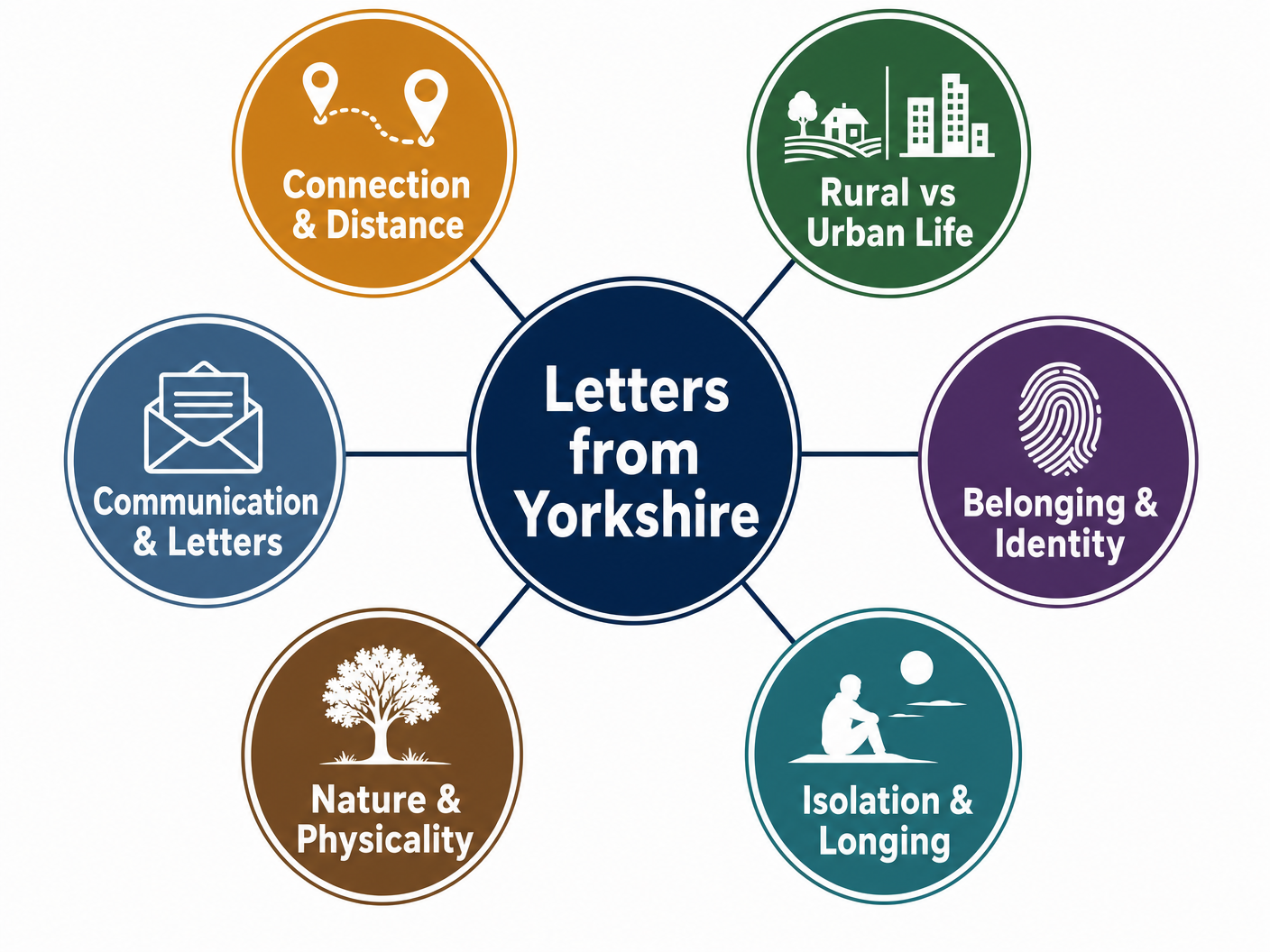
Theme 1: Connection and Distance
The most prominent theme is the tension between physical distance and emotional closeness. The letter serves as a physical bridge between the two distinct worlds. Dooley suggests that while the characters are separated geographically, their bond remains strong, sustained by communication and shared understanding.
Key Quotes:
- "airing the page" (Stanza 4) - The verb 'airing' suggests the letter needs to breathe, bringing the fresh Yorkshire air into the speaker's urban space. It highlights the letter as a physical, sensory object.
- "our souls tap out messages across the icy miles" (Stanza 5) - This metaphor compares their connection to a telegraph or Morse code, suggesting a deep, almost spiritual communication that transcends physical distance.
Theme 2: Rural vs Urban Life
Dooley establishes a clear binary between the rural, agricultural life of the letter writer and the urban, technology-driven life of the speaker. However, she avoids presenting one as inherently superior, instead exploring the value and limitations of both.
Key Quotes:
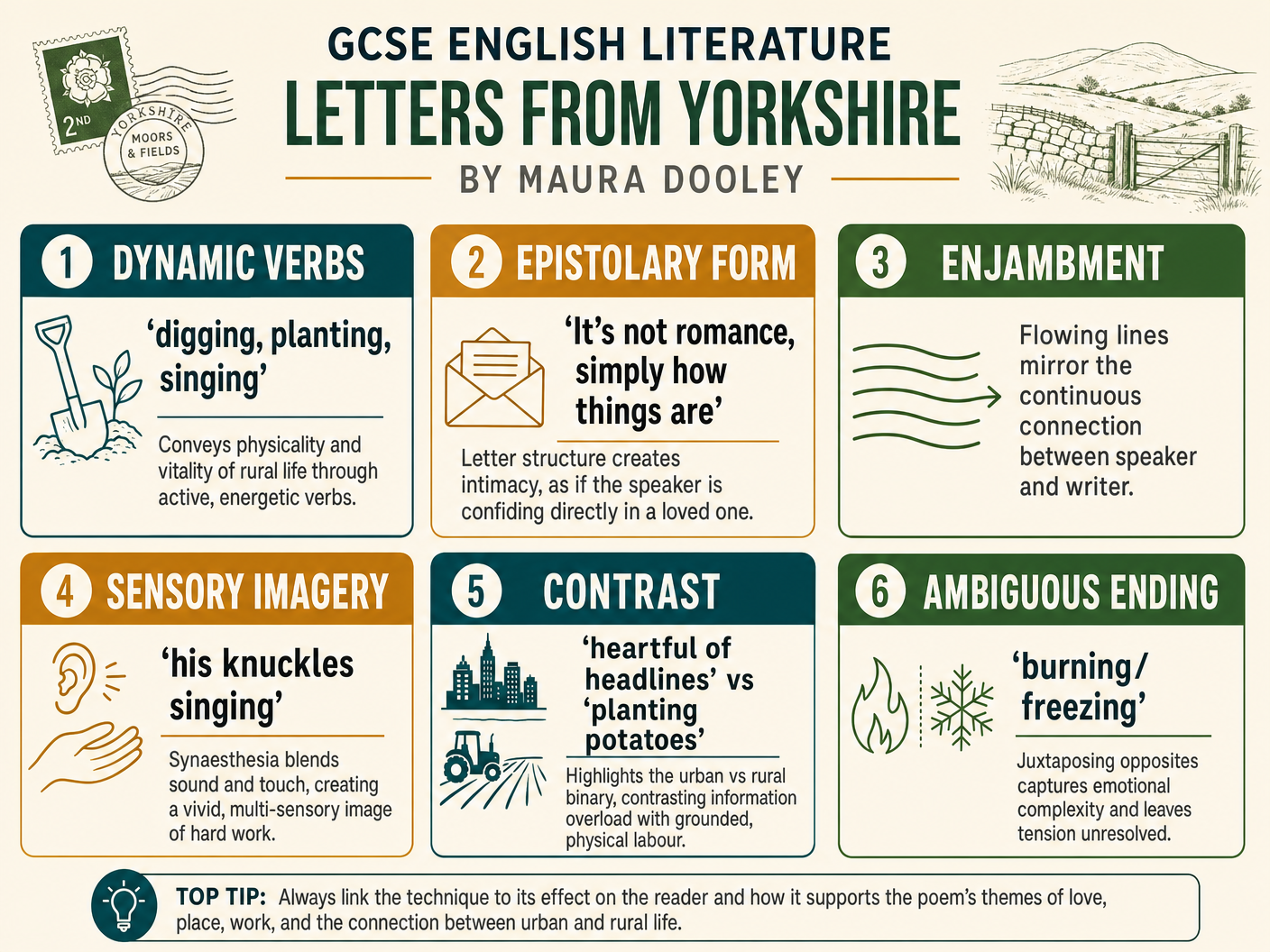
- "his knuckles singing / as they reddened in the warmth" (Stanza 1) - The personification and synaesthesia in 'knuckles singing' conveys the vitality and physical reality of rural labour. It suggests a painful but rewarding connection to the earth.
- "heartful of headlines / feeding words onto a blank screen" (Stanza 3) - The alliteration in 'heartful of headlines' emphasises the overwhelming, artificial nature of the speaker's urban existence, contrasting sharply with the grounded reality of planting potatoes.
Writer's Methods
Form and Structure
- Epistolary Form: The poem is structured around the receipt of a letter. This form creates an intimate, conversational tone, as if the reader is eavesdropping on a private communication.
- Enjambment: Dooley uses enjambment extensively (e.g., "It's not romance, simply how things are. / You out there, in the cold"). The flowing lines mirror the continuous, unbroken connection between the speaker and the writer, visually bridging the gaps between stanzas just as the letter bridges the gap between Yorkshire and the city.
- Free Verse: The lack of a rigid rhyme scheme or meter gives the poem a natural, reflective, and conversational rhythm, suiting the personal nature of a letter.
Language and Imagery
- Dynamic Verbs: The letter writer is associated with active, physical verbs ('digging', 'planting', 'breaking'), which convey energy and purpose. In contrast, the speaker is associated with more passive or abstract verbs ('feeding', 'watching').
- Sensory Language: Dooley appeals to multiple senses to make the contrast vivid. We feel the 'cold', see the 'blank screen', and experience the paradoxical 'burning / freezing' at the end.
- Ambiguous Ending: The final phrase 'burning / freezing' is an oxymoron that captures the speaker's complex emotional state. It could represent the warmth of their connection versus the cold reality of their separation, or the passionate intensity of her feelings contrasting with her physical isolation.
Context
Maura Dooley lived in Yorkshire for several years before moving to London. While candidates should avoid the 'biographical fallacy' (assuming the speaker is definitely the poet), this background informs the poem's authentic depiction of both environments. The poem was published in 2002, a time when digital communication (like the 'blank screen') was becoming dominant, making the physical, handwritten letter an increasingly nostalgic and significant object.
Visual Resources
2 diagrams and illustrations
Interactive Diagrams
1 interactive diagram to visualise key concepts
Conceptual Flow Outline
The flow of connection between the two worlds
Worked Examples
1 detailed example with solutions and examiner commentary
Practice Questions
Test your understanding — click to reveal model answers
Explore how Maura Dooley presents the relationship between people and places in 'Letters from Yorkshire'. (24 marks)
Hint: Consider how the rural place is associated with physical vitality, while the urban place is associated with mental fatigue, and how the letter bridges these spaces.
Compare how poets present complex emotions in 'Letters from Yorkshire' and one other poem from the anthology. (30 marks)
Hint: Focus on the ending of the poem ('burning / freezing') and compare it to another poem with an unresolved or mixed emotional ending (e.g., 'Winter Swans' or 'Porphyria's Lover').
How does the poet use form and structure to convey meaning in 'Letters from Yorkshire'? (15 marks)
Hint: Look at the use of enjambment, free verse, and the epistolary concept.
Explore the significance of the natural world in 'Letters from Yorkshire'. (24 marks)
Hint: Contrast the natural world of Yorkshire with the artificial world of the speaker's city.