AQA · GCSE · English Literature
Course version: 8702 · Version from Sept 2015
Never Let Me Go
Never Let Me Go is a haunting, dystopian novel that uses the premise of human cloning to explore universal themes of mortality, identity, and love. It is a highly rewarding text to study because Ishiguro's masterful use of an unreliable, understated narrator allows candidates to demonstrate sophisticated analysis of narrative methods and psychological depth.
- 8 min read
- 2 worked examples
- 4 practice questions
- 8 key terms
Check what you remember
Read the wording for your board, then hide it and explain Unreliable Narrator in your own words. Rough notes are fine. This is a self-check, with no mark or grade.
Reference: AQA
A narrator whose credibility is compromised. Kathy is unreliable because her memory is subjective and she often withholds information.
Study Notes
Overview
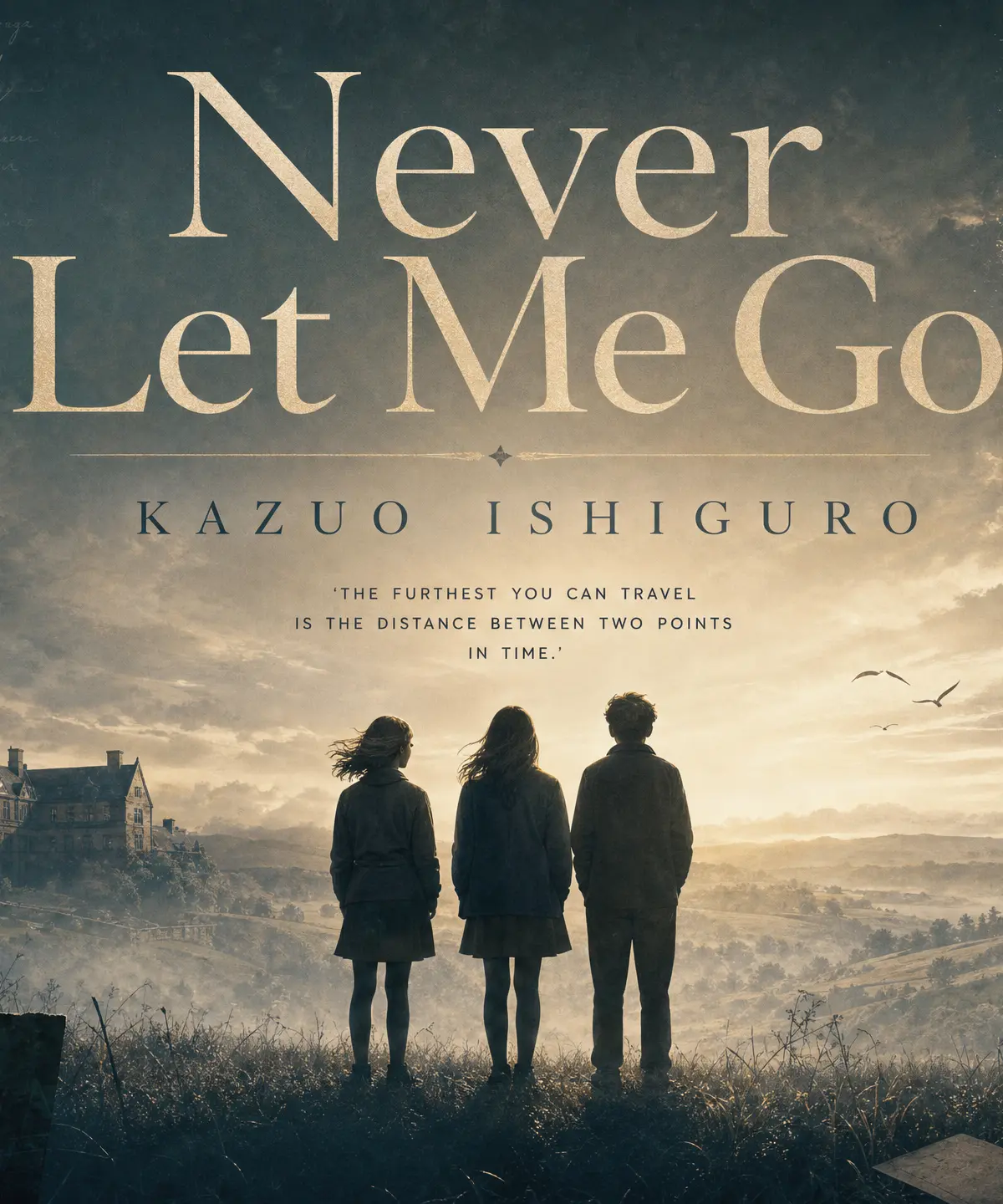
Kazuo Ishiguro's Never Let Me Go (2005) is a profound exploration of what it means to be human, set in a dystopian alternative late-twentieth-century England. The novel follows Kathy H., a 'carer', as she looks back on her life at Hailsham, an idyllic but sinister boarding school, and her relationships with her friends Tommy and Ruth. Examiners highly reward candidates who understand that the novel is less about science fiction and more a powerful metaphor for universal human experiences: the inevitability of death, the desire for connection, and our passive acceptance of societal roles. Strong responses will focus on Ishiguro's narrative methods—specifically Kathy's unreliable, retrospective, and highly understated narrative voice.
Listen to our comprehensive podcast guide here:
Plot/Content Overview
Part One: HailshamKathy, Tommy, and Ruth grow up at Hailsham, a seemingly idyllic boarding school. The students are encouraged to create art, which is taken away by a mysterious woman known as 'Madame'. The students slowly learn the truth about their existence from Miss Lucy: they are clones created solely to donate their vital organs when they reach young adulthood.
Part Two: The CottagesAs teenagers, the trio moves to the Cottages, a transitional living space. Here, they encounter older clones and are exposed to the outside world. Ruth tries desperately to fit in with the older students, causing friction with Kathy. The group takes a trip to Norfolk to find Ruth's 'possible' (the human she was cloned from). Rumours circulate that couples who can prove they are truly in love can get a 'deferral' from their donations.
Part Three: Donors and CarersKathy becomes a 'carer', looking after donors. She eventually reunites with Ruth, who is on her second donation, and Tommy. Before Ruth 'completes' (dies), she apologises for keeping Kathy and Tommy apart and gives them Madame's address so they can apply for a deferral. Kathy and Tommy finally become a couple. They visit Madame and Miss Emily, who reveal that deferrals do not exist; Hailsham was merely an experiment to prove clones had souls. Tommy completes, and the novel ends with Kathy awaiting her own first donation.
Themes
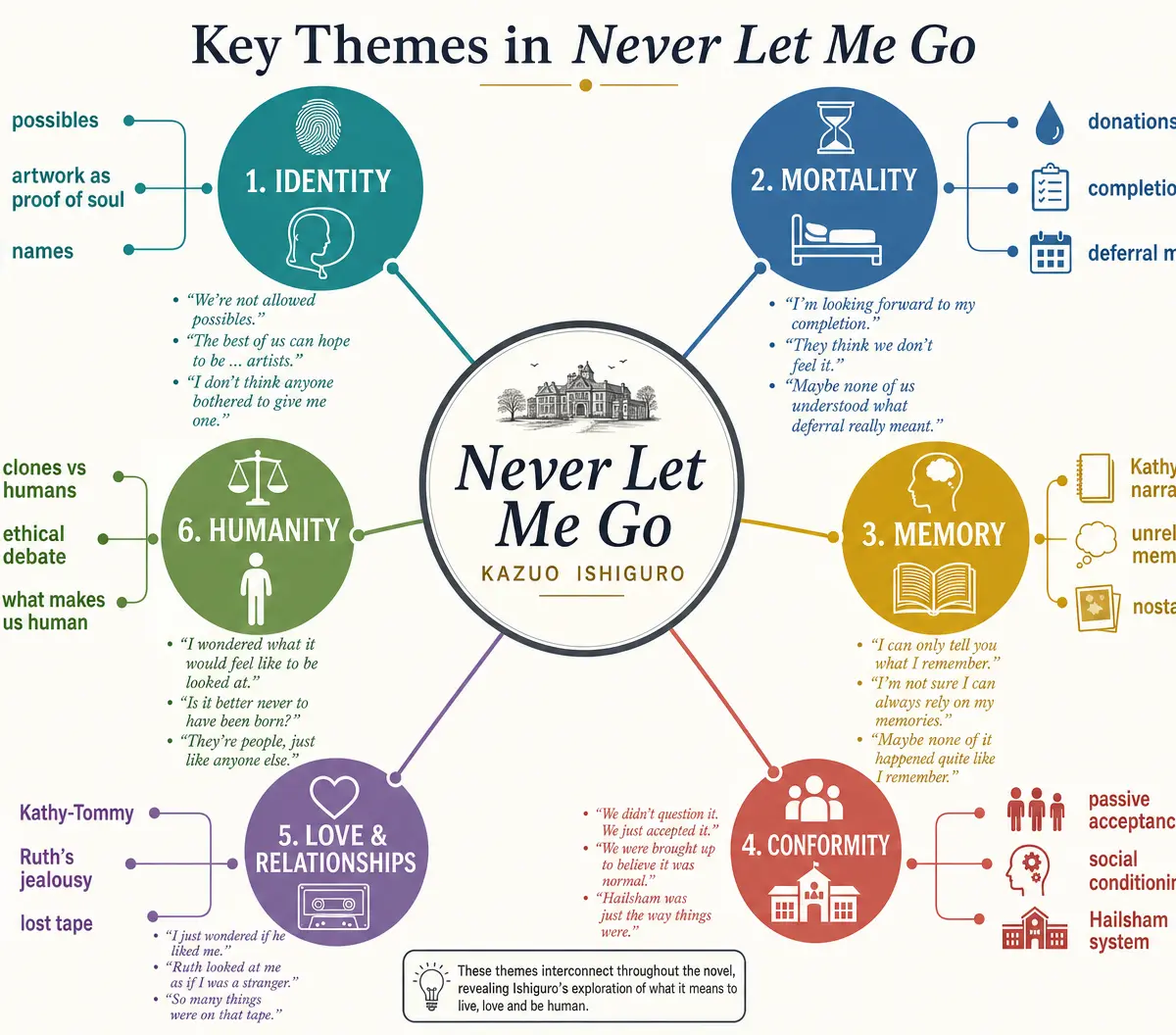
Theme 1: Identity and Humanity
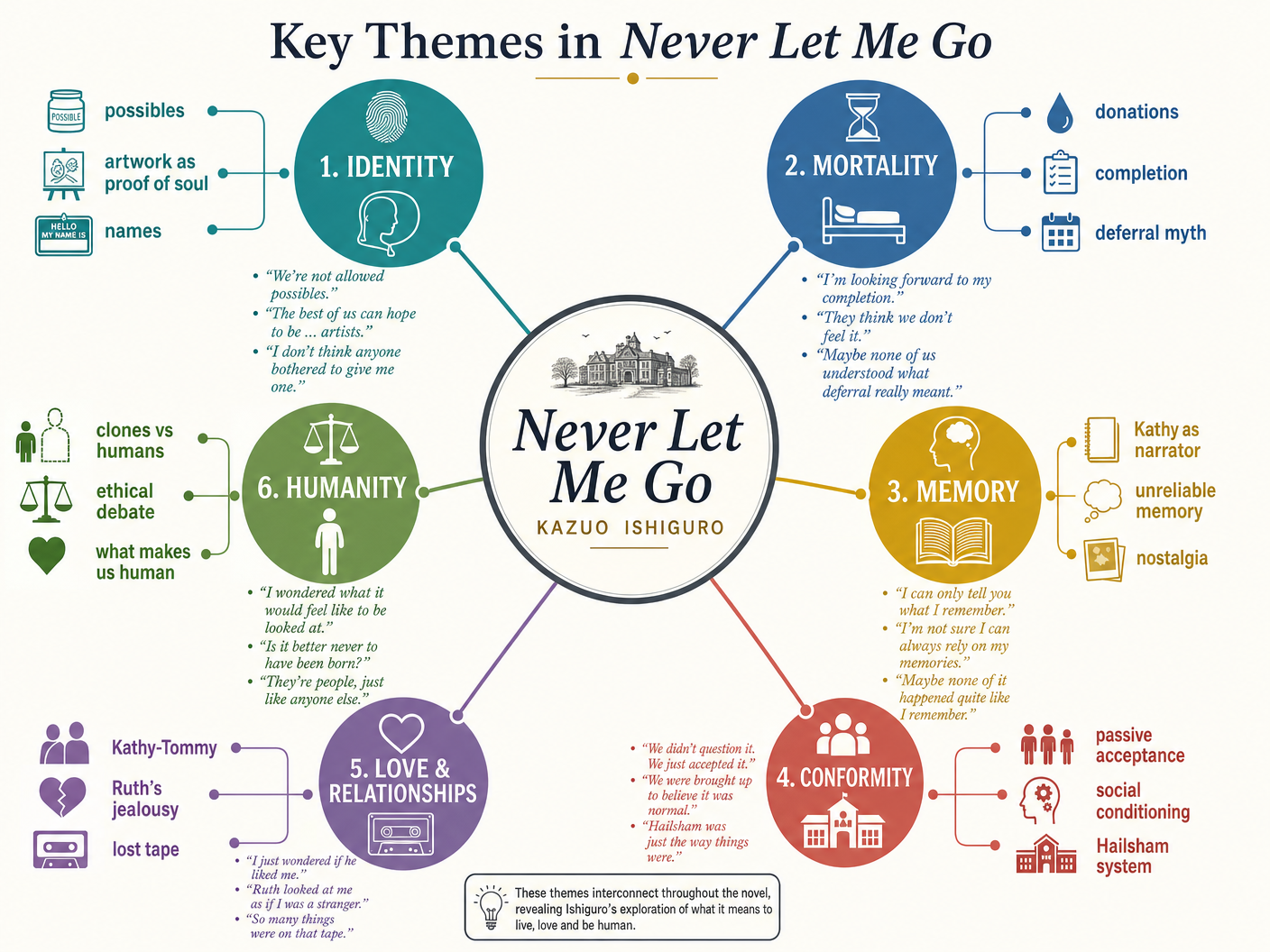
Ishiguro explores how identity is constructed and whether humanity is defined by biology, art, or emotion. The clones are biologically human but socially classified as 'other'. Hailsham uses art to prove the students have souls, highlighting the tension between their rich inner lives and their predetermined fates.
Key Quotes:
- "We were told we were special." (Part One) - Analysis: This creates a deep sense of irony; they are 'special' because they are exploited, yet the guardians use the word to comfort them.
- "I wondered what it would feel like to be looked at like that... like you were a spider or something." (Part One) - Analysis: Kathy's observation of Madame's revulsion underscores the clones' alienation and the societal prejudice against them.
- "We're modelled from trash. Junkies, prostitutes, winos, tramps." (Part Two) - Analysis: Ruth's outburst reveals her deep-seated insecurity and the clones' struggle to find worth when society views them as disposable.
Theme 2: Mortality and Time
The novel is a meditation on the human condition—we are all, like the clones, moving towards an inevitable end. The clones' 'completion' is simply a truncated version of the universal human experience of death. Time is fluid in Kathy's narrative, reflecting how we cling to the past as the future shortens.
Key Quotes:
- "I'm looking forward to my completion." (Part Three) - Analysis: The euphemistic language masks the horror of death, showing how deeply the clones have been conditioned to accept their fate.
- "I keep thinking about this river somewhere, with the water moving really fast. And these two people in the water, trying to hold onto each other..." (Part Three) - Analysis: Tommy's poignant metaphor encapsulates the tragedy of their situation—love cannot stop the inevitable flow of time and mortality.
Theme 3: Conformity and Passive Acceptance
Perhaps the most chilling aspect of the novel is that the clones never attempt to run away or rebel. They accept their horrific fate. Ishiguro uses this to comment on how all humans accept societal norms and structures, even when they are unjust or harmful.
Key Quotes:
- "We didn't question it. We just accepted it." (Part One) - Analysis: Highlights the power of institutional conditioning and the lack of agency the clones possess.
- "You were brought into this world for a purpose, and your futures, all of them, have been decided." (Part One) - Analysis: Miss Lucy's blunt revelation breaks the illusion of Hailsham, emphasizing the deterministic nature of their existence.
Character Analysis
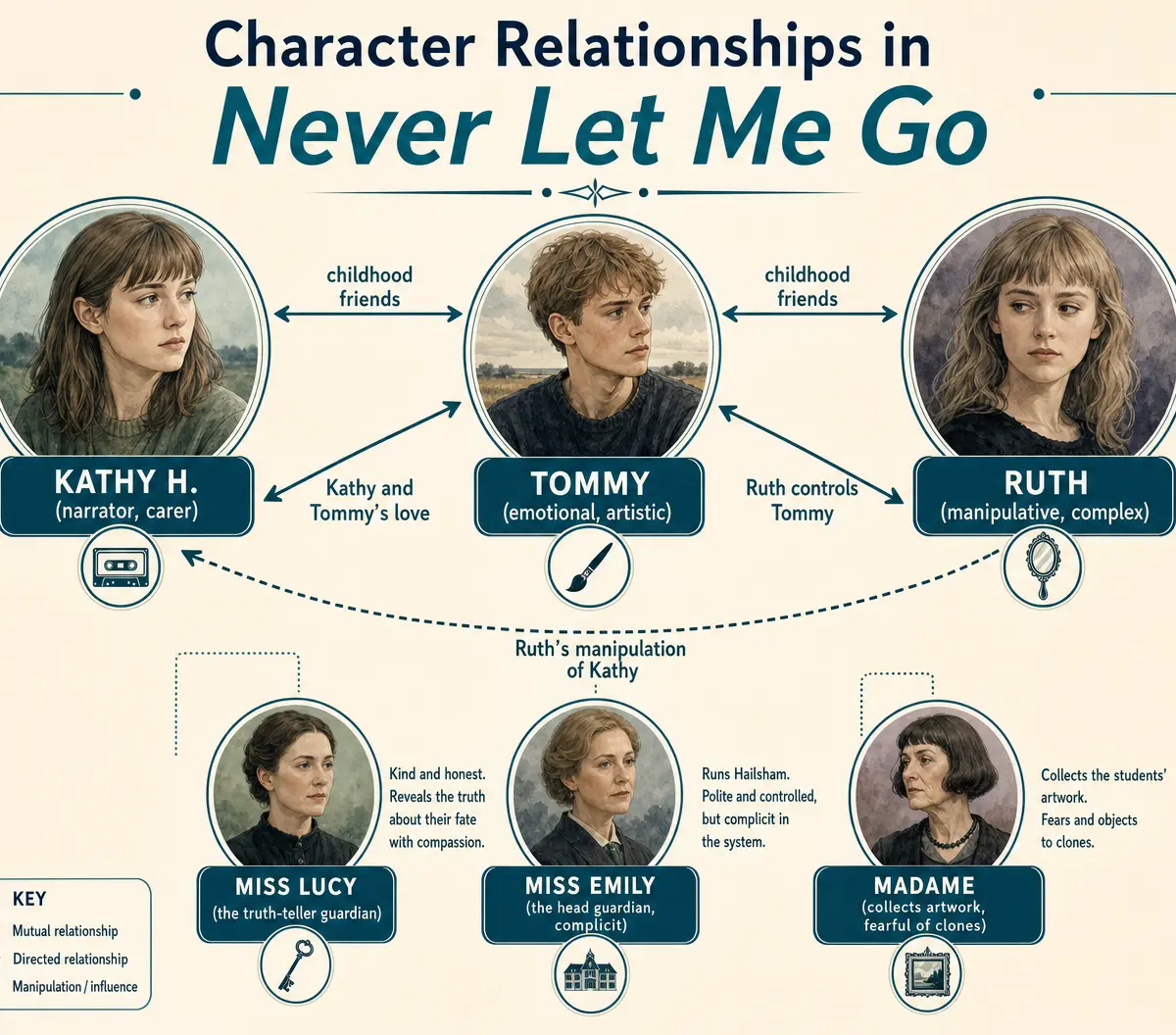
Kathy H.
Role: The narrator and protagonist; a 'carer' who is looking back on her life.
Key Traits: Observant, passive, nostalgic, restrained.
Character Arc: Kathy moves from an innocent child trying to understand the rules of Hailsham, to a frustrated teenager navigating Ruth's manipulations, to a resigned adult who finds brief solace in Tommy's love before accepting her inevitable end.
Essential Quotes:
- "My name is Kathy H. I'm thirty-one years old, and I've been a carer now for over eleven years."
- "I can only tell you what I remember, and maybe none of it happened quite like I remember."
- "I just waited a bit, then turned back to the car, to drive off to wherever it was I was supposed to be."
Tommy
Role: Kathy's childhood friend and eventual lover.
Key Traits: Emotional, earnest, uncreative (initially), prone to tantrums.
Character Arc: Tommy begins as an outcast who cannot create art, leading to emotional outbursts. As he grows older, he tries desperately to create art to prove his soul and secure a deferral, ultimately reaching a tragic acceptance of his fate.
Essential Quotes:
- "Tommy burst into tears, and began to scream and shout..."
- "It's a shame, Kath, because we've loved each other all our lives. But in the end, we can't stay together forever."
Ruth
Role: Kathy's complex friend and Tommy's girlfriend for much of the novel.
Key Traits: Manipulative, insecure, desperate to fit in, ultimately seeking redemption.
Character Arc: Ruth constantly asserts dominance over Kathy and manipulates Tommy to maintain status. However, as she nears 'completion', she shows immense growth by acknowledging her wrongs and trying to give Kathy and Tommy a chance at happiness.
Essential Quotes:
- "Ruth looked at me as if I was a stranger."
- "I kept you and Tommy apart... That was the worst thing I did."
Writer's Methods
Narrative Perspective: The use of a first-person, retrospective narrator is Ishiguro's most powerful tool. Kathy's voice is conversational yet highly controlled. She frequently addresses the reader directly ("I don't know how it was where you were"), creating a false sense of intimacy that masks the horror of her reality.
Deferred Revelation: Ishiguro does not explain the cloning process or the purpose of the donations immediately. Instead, he drops subtle hints and euphemisms, forcing the reader to piece together the grim reality. This mirrors the clones' own gradual awakening to their fate.
Euphemistic Language: The institutional language used—'carer', 'donor', 'completion', 'possible'—serves to sanitize and normalize horrific acts. This demonstrates the power of language as a tool for social control.
Motifs and Symbolism:
- The Cassette Tape (Never Let Me Go): Symbolizes Kathy's desire for love and maternal connection, and later, nostalgia for a lost past.
- The Open-Plan Office: Represents Ruth's impossible dream of a normal, human future.
- Norfolk: Described as the 'lost corner' of England, it symbolizes the hope of retrieving what has been lost.
Context
Scientific Advancements: The novel was published in 2005, shortly after the successful cloning of Dolly the Sheep (1996) and the mapping of the human genome (2003). It taps into late 20th and early 21st-century anxieties about the ethics of genetic engineering, stem cell research, and the commodification of human life.
Literary Context: While it has elements of dystopia (like Orwell's 1984 or Atwood's The Handmaid's Tale), it subverts the genre because the protagonists do not rebel. It is often compared to a 'Bildungsroman' (a coming-of-age story) that has been tragically derailed.
Social Commentary: Ishiguro has stated the novel is about the human condition. The clones' acceptance of their short lives and predetermined roles is a metaphor for how ordinary people accept their mortality and conform to the societal roles assigned to them.
Visual Resources
2 diagrams and illustrations
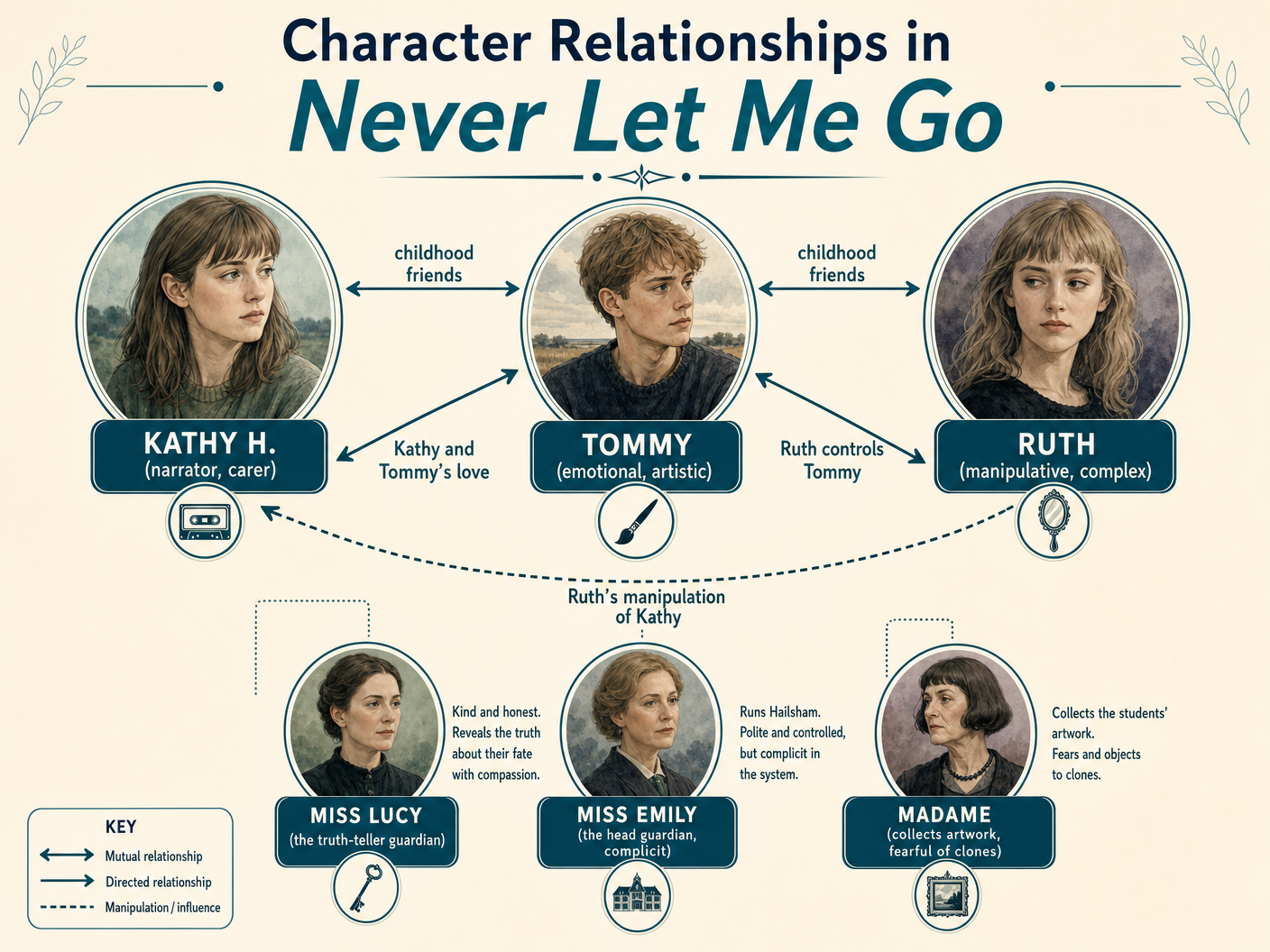
Interactive Diagrams
1 interactive diagram to visualise key concepts
Conceptual Flow Outline
The structural progression of the clones' lives, mirroring the deferred revelation of their fate.
Worked Examples
2 worked examples — open one to explore the question and available guidance.
Practice Questions
Try the question, then reveal an answer plan or example response
Explore how Ishiguro presents the relationship between Kathy and Tommy in Never Let Me Go.
Hint: Consider how their relationship changes from childhood to adulthood, the impact of Ruth's interference, and what their final moments reveal about love and mortality.
How does Ishiguro use the setting of Hailsham to explore ideas about childhood and control?
Hint: Think about the contrast between the idyllic surface of the school and its dark underlying purpose. How does the physical space isolate them?
Explore the significance of the title Never Let Me Go.
Hint: Link the title to the cassette tape, Kathy's desire for a mother, and the overarching themes of memory and holding on to life.
How does Ishiguro present the clones' attitude towards their fate?
Hint: Focus on the lack of rebellion, the use of euphemisms, and how hope (the deferral myth) is used as a coping mechanism.
Exam technique
How to turn what you know into marks
How to approach the question
Deconstruct the prompt: highlight the key theme/character, note the command word. Plan 3-4 paragraphs, ensuring each one connects to a specific technique Ishiguro uses (AO2) and relevant context (AO3).
How to structure your answer
PEAL paragraphs with context woven in: Point → Evidence (embedded quote) → Analysis (zoom in on a word/technique) → Link to context/authorial intent
Timing
For a 30+4 mark question, spend 5 minutes planning, 40-45 minutes writing
Common pitfalls
- Treating the novel purely as sci-fi and ignoring the metaphorical meaning about the human condition.
- Confusing Kathy's voice with Ishiguro's voice—remember Kathy is a construct created by Ishiguro.
- Retelling the plot of what happens at Hailsham instead of analysing *how* Ishiguro reveals information.
What the command words want
- How does Ishiguro present...
- Focus heavily on AO2. Use phrases like 'Ishiguro constructs...', 'Through the use of...', 'The author employs...'
- Starting with this extract...
- Spend roughly 1/3 of your essay on the extract, analysing specific language tightly, then zoom out to the wider text for the remaining 2/3.
- Explore the significance of...
- Look at the topic from multiple angles. How is it significant to the characters? How is it significant to the reader? How does it link to context?
Watch or listen (optional)
Test your understanding of Never Let Me Go
Active recall beats re-reading. Take an instant quiz now to test what you’ve learned and lock it into long-term memory.
7 days Premium · Then the free plan continues · No card, no charge