Study Notes
Overview
'Ozymandias', written by Romantic poet Percy Bysshe Shelley in 1817, is a profound meditation on the transient nature of political power and human legacy. Through the description of a ruined statue in an empty desert, Shelley explores how even the most arrogant and powerful rulers are ultimately erased by time and nature. Examiners look for candidates who can confidently explore the poem's central irony: the contrast between the boastful inscription and the desolate reality. Top-tier responses will also analyze the significance of the poem's narrative structure (the frame narrative) and its disrupted sonnet form, linking these methods to Shelley's radical political views.
Plot/Content Overview
- The Frame Narrative (Lines 1-2): The speaker (narrator) meets a 'traveller from an antique land' who tells him a story.
- The Description of the Statue (Lines 2-8): The traveller describes finding two huge stone legs standing in the desert, with a shattered stone face lying nearby. The face bears an expression of cruel arrogance ('sneer of cold command').
- The Sculptor's Skill (Lines 6-8): The traveller notes that the sculptor perfectly captured the ruler's cruel passions, and that this artistic creation has outlasted the ruler himself.
- The Inscription (Lines 9-11): The traveller reads the words carved on the pedestal, where Ozymandias boasts of his greatness and commands others to despair.
- The Desolation (Lines 12-14): The poem concludes with a stark description of the vast, empty desert surrounding the ruined statue, highlighting the futility of the king's boast.
Themes
Theme 1: Power and Hubris
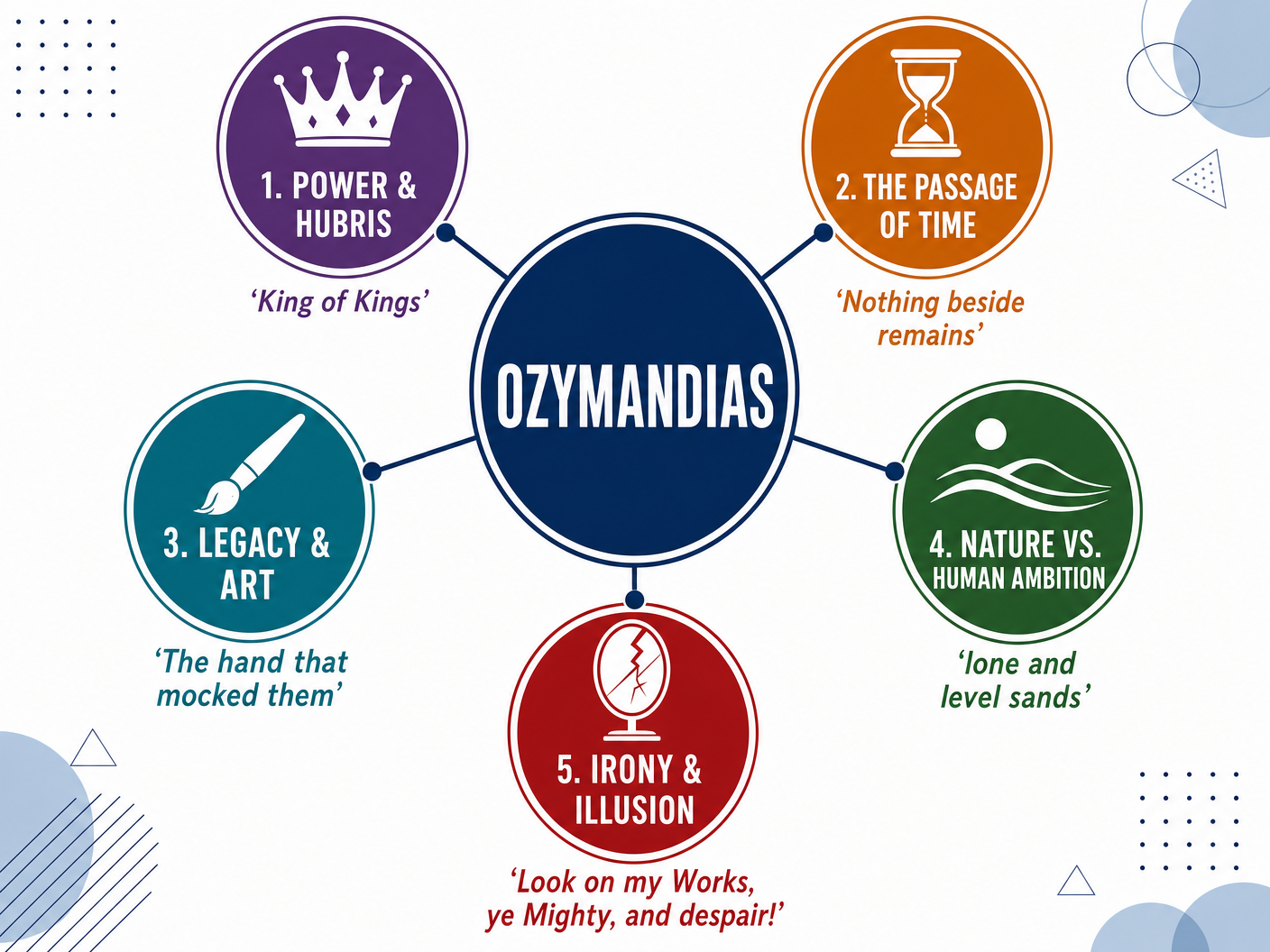
Shelley presents human power as temporary and hubris (excessive pride) as ultimately foolish. Ozymandias believed his power was absolute and immortal, but the poem reveals that his empire has crumbled to dust.
Key Quotes:
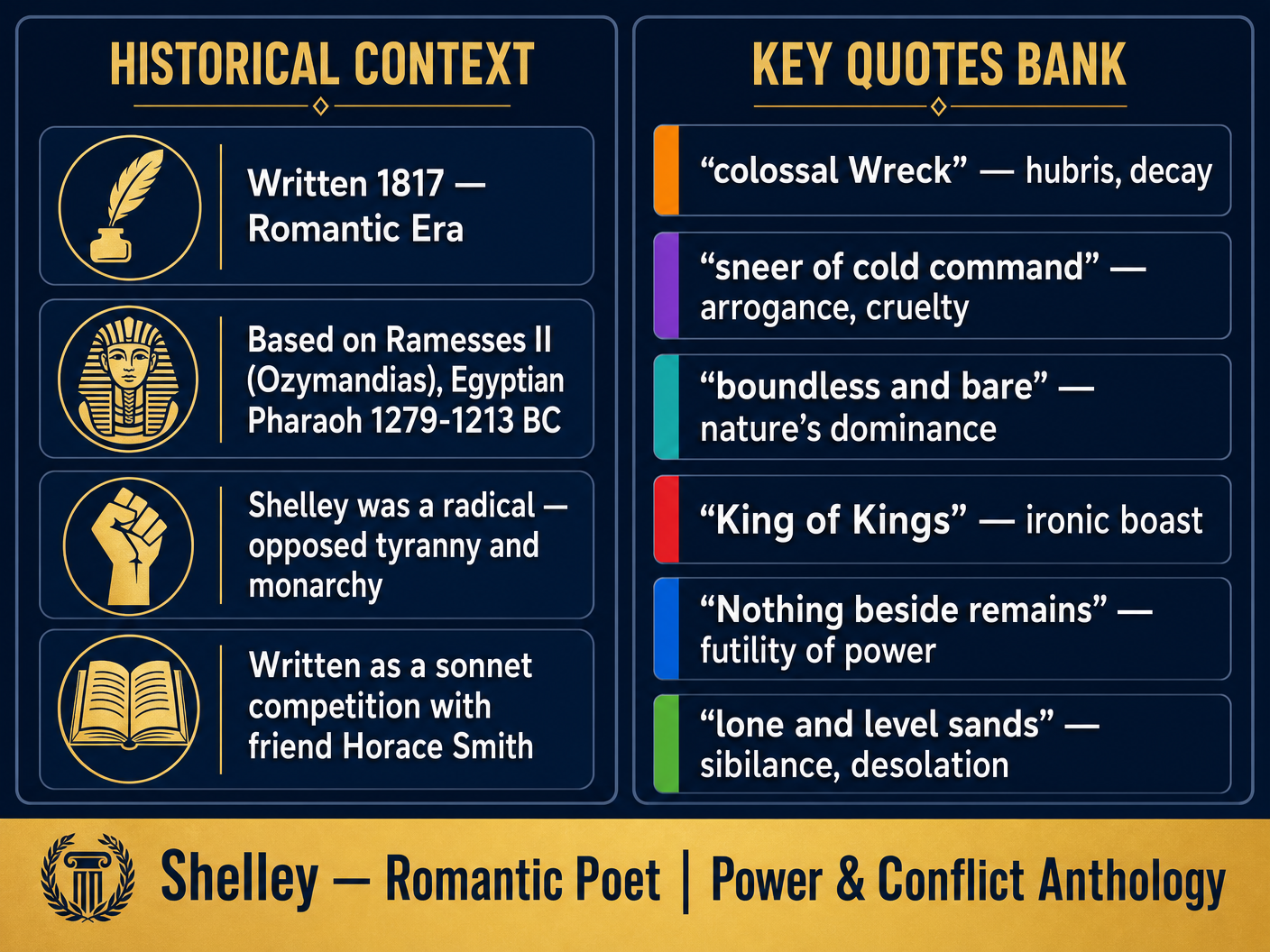
- "sneer of cold command" (Line 5) - The harsh alliteration of the 'c' sound reflects the ruler's cruelty and arrogance. The noun 'sneer' implies a contemptuous superiority over his subjects.
- "King of Kings" (Line 10) - This arrogant title, originally given to God or Jesus, shows Ozymandias's hubris. He believed he was supreme above all other rulers.
- "Look on my Works, ye Mighty, and despair!" (Line 11) - The imperative verb 'Look' shows his commanding nature. The irony is that the 'Mighty' should despair not because of his greatness, but because they too will inevitably end up as dust.
Theme 2: The Power of Time and Nature
In contrast to the fragility of human power, time and nature are presented as unstoppable and eternal forces that consume everything.
Key Quotes:
- "colossal Wreck" (Line 13) - The oxymoron highlights the contrast between former greatness ('colossal') and current ruin ('Wreck'). The capital 'W' emphasizes the magnitude of the destruction.
- "boundless and bare" (Line 13) - The plosive 'b' alliteration emphasizes the vast emptiness of the desert, showing nature's dominance over human creations.
- "lone and level sands stretch far away" (Line 14) - The sibilance ('sands stretch') and long vowel sounds create a sense of vast, unending space and time, dwarfing the ruined statue.
Theme 3: Art vs. Political Power
Shelley suggests that art (represented by the sculptor) outlasts political power. The ruler is dead, but the artist's work survives to tell the truth about him.
Key Quotes:
- "the hand that mocked them" (Line 8) - 'Mocked' has a double meaning: it means 'to copy' (the sculptor copying the king's face) but also 'to ridicule'. The artist had the final word, capturing the king's cruelty for eternity.
Writer's Methods
Form: The Subverted Sonnet
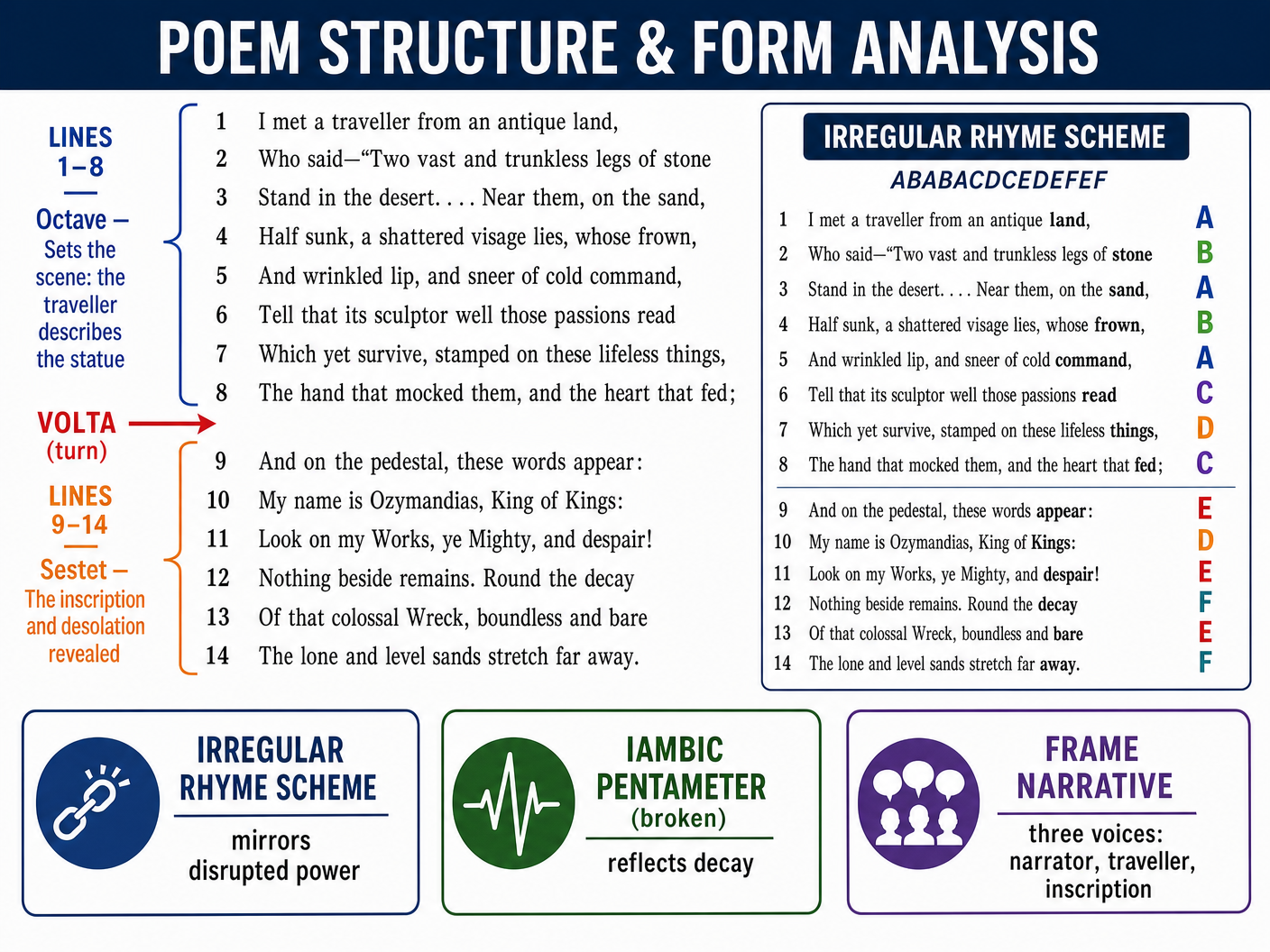
'Ozymandias' is a 14-line sonnet. Traditionally, sonnets are love poems (Petrarchan or Shakespearean). Shelley subverts this form to write about power and decay, perhaps suggesting that Ozymandias was in love with himself.
- Irregular Rhyme Scheme: The rhyme scheme (ABABACDCEDEFEF) does not follow a strict traditional pattern. This broken, irregular rhyme scheme mirrors the broken, shattered nature of the statue and the collapse of Ozymandias's power.
- Volta: The volta (turning point) occurs at line 9 ("And on the pedestal..."). It shifts the focus from the physical description of the ruined statue to the arrogant voice of the king, creating a sharp, ironic contrast.
Structure: The Frame Narrative
Shelley uses a frame narrative (a story within a story). We hear from the narrator, who hears from the traveller, who reads the words of Ozymandias. This distances the reader from Ozymandias, diminishing his power and making him seem like an insignificant historical anecdote rather than a mighty ruler.
Context
- Romanticism: Shelley was a Romantic poet. Romantics believed in the sublime power of nature over human endeavours and hated the oppression of ordinary people by tyrannical rulers.
- Radical Politics: Shelley was an anti-monarchist and a pacifist. He hated King George III of England and the aristocracy. 'Ozymandias' can be read as a veiled attack on the British monarchy, suggesting that their power, too, will eventually fall.
- Ramesses II: 'Ozymandias' is the Greek name for the Egyptian Pharaoh Ramesses II. In 1817, the British Museum acquired a large fragment of a statue of Ramesses II, which inspired Shelley to write the poem.
Visual Resources
3 diagrams and illustrations
Interactive Diagrams
1 interactive diagram to visualise key concepts
Conceptual Flow Outline
The Frame Narrative Structure: Distancing the Reader from Power
Worked Examples
2 detailed examples with solutions and examiner commentary
Practice Questions
Test your understanding — click to reveal model answers
Compare how poets present the theme of human power in 'Ozymandias' and one other poem from the Power and Conflict anthology.
Hint: Consider comparing with 'My Last Duchess' (arrogant power of rulers) or 'London' (the corrupt power of institutions).
How does Shelley use setting to convey his ideas in 'Ozymandias'?
Hint: Focus on the desert imagery: 'antique land', 'sand', 'boundless and bare', 'lone and level'.
Explore the significance of the sculptor in the poem 'Ozymandias'.
Hint: Look closely at lines 6-8. Consider the relationship between art and power, and the double meaning of 'mocked'.
How does Shelley use form and structure to convey meaning in 'Ozymandias'?
Hint: Discuss the frame narrative, the subverted sonnet form, the irregular rhyme scheme, and the volta.