AQA · GCSE · English Literature
Course version: 8702 · Version from Sept 2015
Poetry anthology: Worlds and Lives: A Century Later
The poem argues that the fight for girls' education is a modern form of warfare, transforming the violent imagery of past conflicts, like those described by Wilfred Owen, into a new battle for…
Checked against the AQA 8702 specification (opens in a new tab) on .
- Point 1 of 15
- 4 key terms
Study notes
From the checked teaching notes for this specification point.
The idea
The poem argues that the fight for girls' education is a modern form of warfare, transforming the violent imagery of past conflicts, like those described by Wilfred Owen, into a new battle for knowledge and freedom. It celebrates the resilience and courage of young women, like Malala Yousafzai, who face threats and violence. The poem suggests that this struggle is a collective one, where the act of going to school becomes a heroic, defiant stand. Ultimately, Dharker contends that ideas, represented by books and education, are indestructible and will triumph over oppression, leading to a future where girls can claim their rightful place in the world.
What earns the marks
- AO1: Select precise references, such as the re-framing of the 'school bell' as a 'call to battle', to support an argument about the poem's presentation of conflict.
- AO1: Develop a comparative argument by linking the theme of defiance in 'A Century Later' with the theme of political protest in another poem, such as 'England in 1819'.
- AO1: Show understanding of the poem's central idea: that the fight for education is a modern form of warfare requiring immense courage.
- AO2: Analyse how Dharker's use of military metaphors, such as 'front line', transforms the act of attending school into a heroic, collective struggle.
- AO2: Explain the effects of the poem's free verse form and irregular stanzas, linking them to the idea of resisting restrictive patriarchal control.
- AO2: Explore the impact of the simple, declarative statement 'You cannot kill a book', considering how it functions as the poem's core assertion about the power of ideas.
- AO3: Link the poem's imagery of violence, such as 'takes the bullet in the head', to the specific context of the 2012 attack on Malala Yousafzai.
- AO3: Explain how the poem's title and its imagery of conflict create a dialogue with the war poetry of writers like Wilfred Owen, written a century earlier.
- AO3: Discuss how the poem reflects wider contemporary concerns about girls' access to education globally and the violence they can face for seeking it.
Common mistakes and how to put them right
The poem is only about Malala Yousafzai.
Put it right: While the attack on Malala is a key inspiration, the poem deliberately uses general terms like 'One girl' and plural pronouns ('their') to represent the struggle of all girls who face violence for seeking an education.
The poem is pessimistic because it focuses on violence and bullets.
Put it right: The poem acknowledges the reality of violence but its overall message is one of hope and resilience. It transforms images of war into symbols of empowerment, culminating in the powerful, unified image of girls on the 'front line'.
The title 'A Century Later' just means the poem was written 100 years after World War I.
Put it right: The title does more than mark time. It invites a direct comparison between the trench warfare described by poets like Wilfred Owen and the 'battle' for education today, suggesting the nature of conflict has changed but the need for courage remains.
Exam tips
- Compare with England in 1819: Both poems critique oppressive power structures and imagine a future of positive change rising from a violent present. Difference: Dharker's poem focuses on a contemporary, global struggle for education fought by young girls, ending with a hopeful image of collective action. Shelley's sonnet critiques the specific corruption of the English state in 1819, with its hope for a "glorious Phantom" being more abstract and revolutionary. Useful when: How poets present hope in the face of oppression.
- Compare with Thirteen: Both poems explore the vulnerability of young people when confronted by threatening and powerful forces. Difference: "A Century Later" moves from an act of violence against an individual to a vision of collective empowerment and defiance. In contrast, "Thirteen" focuses entirely on the isolating and "powerless" experience of an individual boy subjected to racial profiling, ending on an image of entrapment ("black holes"). Useful when: How poets explore experiences of power and powerlessness.
- Compare with A Portable Paradise: Both poems present a means of finding resilience and strength in the face of external pressures and difficulties. Difference: In "A Century Later", resilience is found in collective action and defiant public acts like going to school. In "A Portable Paradise", resilience is an internal, personal act of carrying a concealed "paradise" of memory and heritage to endure "sustained and daily" stresses. Useful when: How poets present ways of coping with adversity.
- Compare with Homing: Both poems are concerned with giving voice to those who have been silenced or oppressed by restrictive forces. Difference: Dharker's poem is about a present and future struggle, celebrating the living girls who "take their places on the front line" for education. Berry's poem is about recovering a past, suppressed voice, addressing a relative whose accent was "kept... in a box" and seeking to "forge" it anew. Useful when: How poets explore ideas about voice and silence.
Try the lesson
The start of the Poetry anthology: Worlds and Lives: A Century Later lesson, made from checked teaching notes for this specification point.
Have a go first
In Imtiaz Dharker's 'A Century Later', what does the metaphor 'the school-bell is a call to battle' suggest about the girls' education?
Listen
The poem argues that the fight for girls' education is a modern form of warfare, transforming the violent imagery of past conflicts, like those described by Wilfred Owen, into a new battle for knowledge and freedom. It celebrates the resilience and courage of young women, like Malala Yousafzai, who face threats and violence. The poem suggests that this struggle is a collective one, where the act of going to school becomes a heroic, defiant stand. Ultimately, Dharker contends that ideas, represented by books and education, are indestructible and will triumph over oppression, leading to a future where girls can claim their rightful place in the world. A strong answer earns marks for these points. Select precise references, such as the re-framing of the 'school bell' as a 'call to battle', to support an argument about the poem's presentation of conflict. Develop a comparative argument by linking the theme of defiance in 'A Century Later' with the theme of political protest in another poem, such as 'England in 1819'. Show understanding of the poem's central idea: that the fight for education is a modern form of warfare requiring immense courage. Analyse how Dharker's use of military metaphors, such as 'front line', transforms the act of attending school into a heroic, collective struggle. A common slip: The poem is only about Malala Yousafzai. Instead, While the attack on Malala is a key inspiration, the poem deliberately uses general terms like 'One girl' and plural pronouns ('their') to represent the struggle of all girls who face violence for seeking an education. Exam tip: Compare with England in 1819: Both poems critique oppressive power structures and imagine a future of positive change rising from a violent present. Difference: Dharker's poem focuses on a contemporary, global struggle for education fought by young girls, ending with a hopeful image of collective action. Shelley's sonnet critiques the specific corruption of the English state in 1819, with its hope for a "glorious Phantom" being more abstract and revolutionary. Useful when: How poets present hope in the face of oppression.
See it
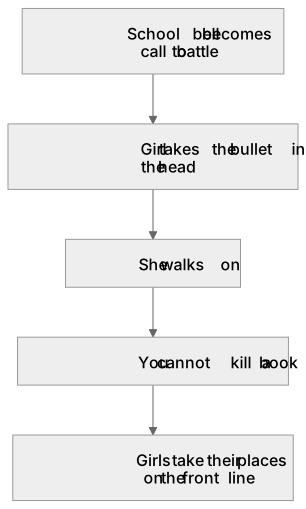
Put it in order
Put these steps in the order they happen.
- 1. Girl takes the bullet in the head
- 2. She walks on
- 3. School bell becomes a call to battle
- 4. Girls take their places on the front line
- 5. You cannot kill a book
Watch it explained
What is the one idea the video explains? Say it in a sentence.
Read the described scene instead
Imtiaz Dharker’s ‘A Century Later’ argues that the fight for girls’ education is a modern form of warfare. It transforms violent imagery from past conflicts, like those described by Wilfred Owen, into a new battle for knowledge and freedom. Dharker re-frames the ordinary school bell: the school-bell is a call to battle. Attending school becomes a dangerous, heroic act. The poem celebrates resilience: despite violence, the girl walks on. Images like take their places on the front line turn a school assembly into a unified formation, showing collective strength and hope. First, connect the poem to context: the 2012 attack on Malala Yousafzai. Pause here and ask how Dharker turns a school bell into warfare. Now look at the language. The phrase the school-bell is a call to battle is a metaphor that makes education a dangerous act of war. The phrase takes the bullet in the head is brutal imagery alluding to that attack. Finally, You cannot kill a book is a declarative statement using a book as a metonym for indestructible ideas. For a comparative argument, link defiance here with political protest in ‘England in 1819’. Both poems critique oppressive power and imagine positive change rising from a violent present. Dharker focuses on a contemporary, global struggle for girls’ education, ending with collective action. Shelley critiques the corruption of the English state in 1819, and his hope for a glorious Phantom is more abstract and revolutionary. Three corrections matter. First, the poem is not only about Malala: it uses One girl and plural pronouns to represent all girls facing violence for education. Second, it is not pessimistic: it acknowledges violence but ends with resilience and collective empowerment. Third, the title does more than mark time: it invites comparison with Owen’s trench warfare, suggesting conflict has changed but courage remains. Remember the central idea: the fight for education is modern warfare requiring immense courage. Dharker uses military metaphors to make school heroic and collective. The free verse and irregular stanzas resist restrictive control, while the final image of girls on the front line offers hope. Books and ideas cannot be killed, so the movement walks on.
Key words
Say what each word means before you turn the card.
Education and Empowerment
Try answering aloud or in your head before turning the card.
Conflict and Violence
Try answering aloud or in your head before turning the card.
Courage and Resilience
Try answering aloud or in your head before turning the card.
Collective Action
Try answering aloud or in your head before turning the card.
See every definition
- Education and Empowerment
- The poem argues that the fight for girls' education is a modern form of warfare, transforming violent imagery into a new battle for knowledge and freedom.
- Conflict and Violence
- The poem re-frames the ordinary sound of a school bell as a military signal, establishing that seeking education is a dangerous act of war against oppressive forces.
- Courage and Resilience
- The simple, active verb placed at the end of a line emphasises the girl's relentless determination and resilience despite the violence she faces.
- Collective Action
- The concluding metaphor transforms the image of a school assembly into a military formation, showing the girls as a powerful, unified army ready to fight for their future.
Label the diagram
Some boxes have lost their names. Pick the right name for each number.
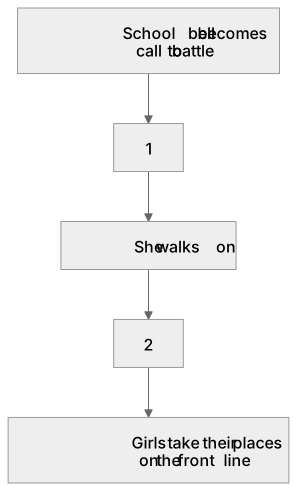
1Box 1
2Box 2
There is more to this lesson
The full lesson goes on to check your understanding and help you earn the marks. Create a free account to carry on, with your progress saved.
A week of Premium from your first lesson · Then the free plan continues · No card, no charge
Test your understanding of Poetry anthology: Worlds and Lives: A Century Later
Active recall beats re-reading. Take an instant quiz now to test what you’ve learned and lock it into long-term memory.
A week of Premium from your first lesson · Then the free plan continues · No card, no charge