AQA · GCSE · English Literature
Course version: 8702 · Version from Sept 2015
Poetry anthology: Worlds and Lives: A Portable Paradise
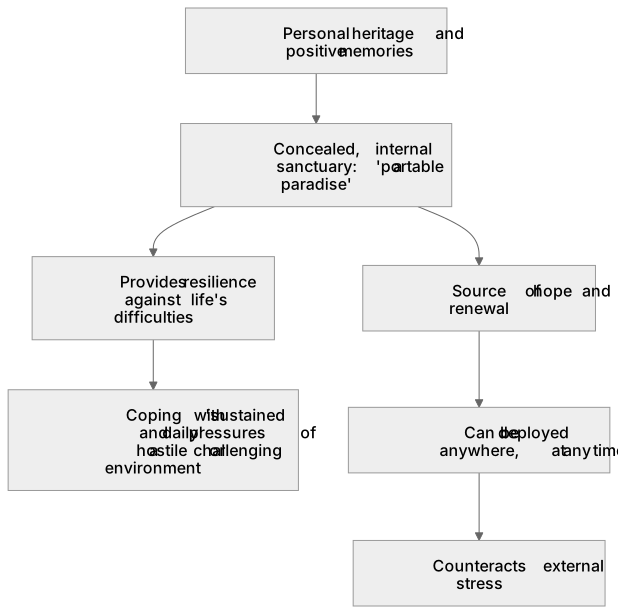
Roger Robinson’s poem argues that personal heritage and positive memories can function as a concealed, internal sanctuary—a “portable paradise”—that provides resilience against life’s difficulties.
Checked against the AQA 8702 specification (opens in a new tab) on .
- Point 2 of 15
- 4 key terms
Study notes
From the checked teaching notes for this specification point.
The idea
Roger Robinson’s poem argues that personal heritage and positive memories can function as a concealed, internal sanctuary—a “portable paradise”—that provides resilience against life’s difficulties. Drawing on Trinidadian sensory memory, the speaker adopts an intimate, advisory tone, using imperatives to instruct the reader on how to consciously access this inner resource. This act of self-preservation is presented as a vital strategy for coping with the “sustained and daily” pressures of a hostile or challenging environment. The poem suggests that this internalised heritage is not just a comfort but a source of hope and renewal that can be deployed anywhere, at any time, to counteract external stress.
What earns the marks
- AO1: Develop a comparative argument about how Robinson and another poet present the importance of memory.
- AO1: Use precise references, such as the imperative 'carry it always', to support the idea that heritage is presented as a vital tool for survival.
- AO1: Show understanding that the poem is a piece of direct advice from the speaker to the reader or another listener.
- AO2: Analyse how the extended metaphor of the 'portable paradise' represents internal resilience built from cultural heritage.
- AO2: Explain the effect of the free verse and conversational opening ('And'), which create a sense of intimacy and immediacy.
- AO2: Explore how sensory language connected to the paradise contrasts with the abstract 'stresses' of the speaker's environment.
- AO3: Link the idea of a 'portable paradise' to the context of migration and the diaspora experience, where people carry their culture with them to a new country.
- AO3: Discuss how the poem reflects the need for psychological resilience for people facing daily pressures or racism in Britain.
- AO3: Consider the poem as the title piece of Robinson's T.S. Eliot Prize-winning collection, which explores themes of race, identity and community.
Common mistakes and how to put them right
The speaker is physically in paradise or is planning a holiday.
Put it right: The 'paradise' is an extended metaphor for the speaker's memories and cultural heritage, specifically of Trinidad. It is a mental and emotional sanctuary, not a physical location the speaker currently occupies.
The poem is only for people who have migrated from the Caribbean.
Put it right: While the poem draws on specific Trinidadian heritage, its central message is universal. It advises that anyone can create a 'portable paradise' from their own positive memories and heritage to cope with difficult circumstances.
The poem suggests that ignoring problems is the best way to deal with them.
Put it right: The poem does not advocate for escapism. Instead, it presents the 'portable paradise' as a source of strength and resilience, a tool to help a person endure and survive 'sustained and daily' stresses, not to pretend they do not exist.
Exam tips
- Compare with In a London Drawingroom: The negative pressures of urban life. Difference: Robinson's speaker offers a personal, internal solution ('portable paradise') to cope with daily stress, whereas Eliot's speaker presents a relentlessly bleak and inescapable vision of London as a 'huge prison-house' with no obvious source of relief. Useful when: How poets present responses to difficult environments.
- Compare with Homing: The importance of carrying personal and cultural heritage. Difference: Robinson's speaker advises actively using a 'portable paradise' of memory for resilience. In contrast, Berry's speaker focuses on recovering a relative's heritage (a 'locked-box' accent) that was suppressed, making it an act of reclamation rather than ongoing use. Useful when: How poets explore the connection between identity and heritage.
- Compare with Lines Written in Early Spring: Finding solace and meaning in nature. Difference: Robinson's speaker internalises nature as a portable, personal memory of a specific place to combat daily stress. Wordsworth's speaker observes nature in the present and finds its harmony a source of sadness, lamenting what 'man has made of man'. Useful when: How poets present the relationship between humanity and the natural world.
- Compare with Thirteen: Experiences of hostility and the need for resilience. Difference: Robinson's poem is a guide for survival, offering a proactive strategy (the 'portable paradise') to cope with sustained pressure. Femi's poem depicts a specific, traumatic moment of racial profiling where the subject is 'powerless,' showing an overwhelming external threat. Useful when: How poets explore responses to threatening experiences.
Try the lesson
The start of the Poetry anthology: Worlds and Lives: A Portable Paradise lesson, made from checked teaching notes for this specification point.
Have a go first
In 'A Portable Paradise', what does the 'paradise' that the speaker tells the reader to carry represent?
Listen
Roger Robinson’s poem argues that personal heritage and positive memories can function as a concealed, internal sanctuary—a “portable paradise”—that provides resilience against life’s difficulties. Drawing on Trinidadian sensory memory, the speaker adopts an intimate, advisory tone, using imperatives to instruct the reader on how to consciously access this inner resource. This act of self-preservation is presented as a vital strategy for coping with the “sustained and daily” pressures of a hostile or challenging environment. The poem suggests that this internalised heritage is not just a comfort but a source of hope and renewal that can be deployed anywhere, at any time, to counteract external stress. A strong answer earns marks for these points. Develop a comparative argument about how Robinson and another poet present the importance of memory. Use precise references, such as the imperative 'carry it always', to support the idea that heritage is presented as a vital tool for survival. Show understanding that the poem is a piece of direct advice from the speaker to the reader or another listener. Analyse how the extended metaphor of the 'portable paradise' represents internal resilience built from cultural heritage. A common slip: The speaker is physically in paradise or is planning a holiday. Instead, The 'paradise' is an extended metaphor for the speaker's memories and cultural heritage, specifically of Trinidad. It is a mental and emotional sanctuary, not a physical location the speaker currently occupies. Exam tip: Compare with In a London Drawingroom: The negative pressures of urban life. Difference: Robinson's speaker offers a personal, internal solution ('portable paradise') to cope with daily stress, whereas Eliot's speaker presents a relentlessly bleak and inescapable vision of London as a 'huge prison-house' with no obvious source of relief. Useful when: How poets present responses to difficult environments.
See it
Watch it explained
What is the one idea the video explains? Say it in a sentence.
Read the described scene instead
Roger Robinson’s poem ‘A Portable Paradise’ argues that personal heritage and positive memories can work as a concealed, internal sanctuary. This is not a physical holiday destination. It is a portable paradise carried inside the speaker, offering resilience against life’s difficulties. The title phrase is an extended metaphor. The speaker draws on Trinidadian sensory memory, so the paradise is built from cultural heritage. It is presented as a vital resource for coping with pressures that are ‘sustained and daily’. The poem’s free verse and conversational opening ‘And’ create intimacy and immediacy. The imperative ‘carry it always’ establishes an advisory tone. It stresses that holding onto inner heritage is constant and essential. The phrase ‘under pressure’ frames the paradise as a necessary counterforce. Robinson then instructs: ‘empty your paradise onto a desk’, turning memory into a tangible act. The simile ‘like the fresh hope of morning’ closes with renewal and optimism. Here is a question: how does Robinson present accessing memory? Pause briefly to think. The imperative ‘empty your paradise onto a desk’ makes an abstract heritage physical. The verb ‘empty’ suggests pouring out a resource, while ‘onto a desk’ places it in a mundane setting. This shows the speaker can consciously choose to access inner comfort anywhere. First, the speaker is not physically in paradise or planning a holiday. The paradise is a mental and emotional sanctuary. Second, although the poem draws on Trinidadian heritage, its advice is universal: anyone can build a portable paradise from positive memories. Third, the poem does not advocate escapism. It offers resilience to endure daily stresses, not to pretend they do not exist. Remember: Robinson presents heritage as an internal, portable resource for resilience. Analyse the extended metaphor, imperatives, sensory language and the contrast between paradise and abstract stresses. For comparison, link the poem to migration and diaspora experience. Contrast it with texts where external pressures are inescapable, or where heritage is reclaimed rather than actively used.
Key words
Say what each word means before you turn the card.
Identity and Heritage
Try answering aloud or in your head before turning the card.
Resilience and Hope
Try answering aloud or in your head before turning the card.
The Power of Memory
Try answering aloud or in your head before turning the card.
Belonging and Displacement
Try answering aloud or in your head before turning the card.
See every definition
- Identity and Heritage
- Personal heritage and positive memories can function as a concealed, internal sanctuary that provides resilience against life's difficulties.
- Resilience and Hope
- This internalised heritage is not just a comfort but a source of hope and renewal that can be deployed anywhere, at any time, to counteract external stress.
- The Power of Memory
- Drawing on Trinidadian sensory memory, the speaker uses imperatives to instruct the reader on how to consciously access this inner resource.
- Belonging and Displacement
- The idea of a 'portable paradise' links to the context of migration and the diaspora experience, where people carry their culture with them to a new country.
Label the diagram
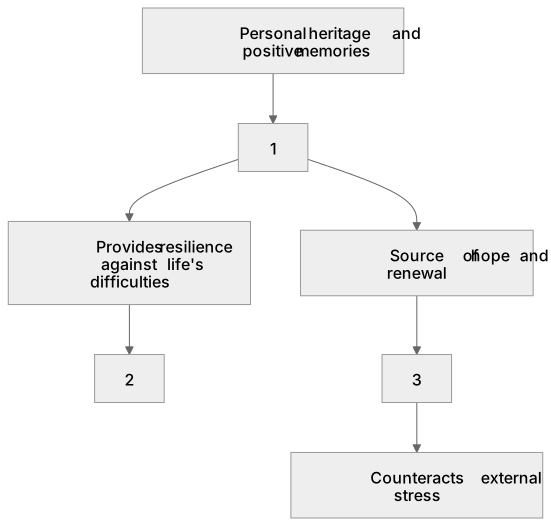
Some boxes have lost their names. Pick the right name for each number.
1Box 1
2Box 2
3Box 3
There is more to this lesson
The full lesson goes on to check your understanding and help you earn the marks. Create a free account to carry on, with your progress saved.
A week of Premium from your first lesson · Then the free plan continues · No card, no charge
Test your understanding of Poetry anthology: Worlds and Lives: A Portable Paradise
Active recall beats re-reading. Take an instant quiz now to test what you’ve learned and lock it into long-term memory.
A week of Premium from your first lesson · Then the free plan continues · No card, no charge