AQA · GCSE · English Literature
Course version: 8702 · Version from Sept 2015
Poetry anthology: Worlds and Lives: pot
Shamshad Khan’s poem uses a direct address to a Nigerian pot in a British museum to explore the lasting trauma of colonialism, cultural theft and diaspora.
Checked against the AQA 8702 specification (opens in a new tab) on .
- Point 11 of 15
- 4 key terms
Study notes
From the checked teaching notes for this specification point.
The idea
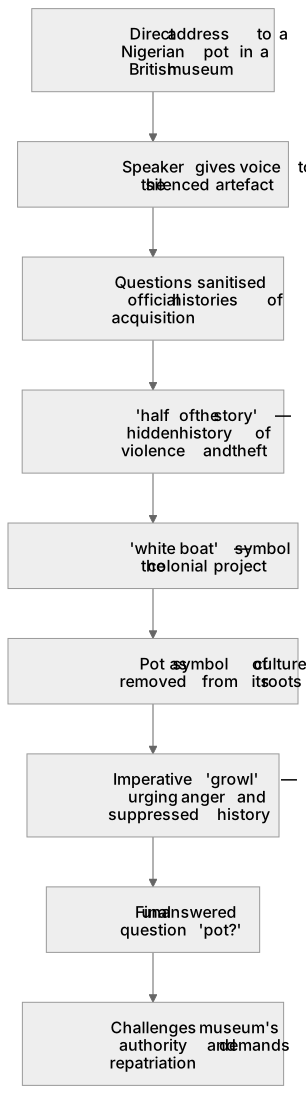
Shamshad Khan’s poem uses a direct address to a Nigerian pot in a British museum to explore the lasting trauma of colonialism, cultural theft and diaspora. The speaker acts as a voice for the displaced artefact, questioning the sanitised official histories of how it was acquired and exposing the violent reality of colonial appropriation. The pot becomes a powerful symbol of a culture removed from its roots, silenced and imprisoned behind glass. By demanding the pot “growl” and by ending with an unresolved question, the poem challenges the authority of the museum and makes an urgent political demand for the repatriation of stolen cultural heritage, highlighting the pain of communities separated from their history.
What earns the marks
- AO1: Develop an interpretation of the speaker's relationship with the pot, considering how it represents a connection to a displaced heritage.
- AO1: Use precise references, such as the 'white boat' or the idea of 'half of the story', to support the argument that the poem critiques colonial narratives.
- AO1: When comparing, focus on the shared theme of displaced identity but contrast the specific causes: colonial theft in 'pot' versus linguistic pressure in 'Name Journeys', for example.
- AO2: Analyse how the poem's use of free verse, irregular stanzas and short lines creates a fragmented tone that mirrors the themes of displacement and a broken history.
- AO2: Explain the effect of the direct address to the pot, including the imperative 'growl', in giving voice to a silenced object and expressing the speaker's anger.
- AO2: Explore the significance of the final unanswered question ('pot?'), considering how it challenges the reader and the institution to confront the issues of ownership and identity.
- AO3: Link the poem's themes to the context of its commission for Manchester Museum, showing how it directly engages with and critiques the role of such institutions.
- AO3: Discuss how the poem contributes to contemporary debates about the repatriation of colonial artefacts, such as those taken from Nigeria.
- AO3: Consider how the poem reflects the experiences of diaspora communities and their relationship with cultural heritage displayed in Western museums.
Common mistakes and how to put them right
The speaker is talking about a pot from their own family that they used for cooking.
Put it right: The poem was commissioned by Manchester Museum and the speaker is addressing a specific Nigerian pot that is a museum artefact. The poem is about cultural heritage and colonial appropriation, not a personal family heirloom.
The poem is a simple description of an object in a museum.
Put it right: The poem is a dramatic monologue addressed to the pot, using it as a symbol to explore complex themes of colonialism, cultural theft, diaspora and the demand for repatriation. It is a political and emotional critique, not a neutral description.
The speaker knows the full history of how the pot came to be in the museum.
Put it right: The speaker highlights the uncertainty and competing narratives surrounding the pot's acquisition, referring to 'half of the story'. This uncertainty is key to the poem's argument that official museum accounts often conceal a violent or unjust history.
Exam tips
- Compare with Homing: Recovering a suppressed part of cultural heritage. Difference: In 'pot', the focus is on the physical repatriation of a cultural artefact stolen by colonial powers, demanding its return to its place of origin. In 'Homing', the focus is on the internal, personal recovery of a suppressed regional dialect and voice belonging to a dead relative. Useful when: How poets explore the connection between identity and heritage.
- Compare with Name Journeys: The experience of migration and the dislocation of cultural identity. Difference: 'pot' explores dislocation through a physical object in a museum, representing a culture forcibly removed from its home. 'Name Journeys' explores it through the personal and linguistic challenges of a name being displaced and mispronounced in a new country. Useful when: How poets present the challenges of maintaining cultural identity.
- Compare with Thirteen: The experience of being powerless against a dominant authority. Difference: In 'pot', the power imbalance is historical and institutional, embodied by the museum's colonial legacy. In 'Thirteen', the power imbalance is immediate and personal, enacted through the state-sanctioned authority of the police conducting a racially-motivated search on a young boy. Useful when: How poets explore themes of power and powerlessness.
- Compare with In a London Drawingroom: A critical perspective on a place and its oppressive atmosphere. Difference: 'pot' critiques the museum as a site of colonial appropriation and cultural silencing. 'In a London Drawingroom' critiques industrial London as a monotonous, polluted and socially isolating 'prison-house' that stifles its inhabitants. Useful when: How poets present places as restrictive or oppressive.
Try the lesson
The start of the Poetry anthology: Worlds and Lives: pot lesson, made from checked teaching notes for this specification point.
Have a go first
In 'pot', who is the speaker addressing throughout the poem?
Listen
Shamshad Khan’s poem uses a direct address to a Nigerian pot in a British museum to explore the lasting trauma of colonialism, cultural theft and diaspora. The speaker acts as a voice for the displaced artefact, questioning the sanitised official histories of how it was acquired and exposing the violent reality of colonial appropriation. The pot becomes a powerful symbol of a culture removed from its roots, silenced and imprisoned behind glass. By demanding the pot “growl” and by ending with an unresolved question, the poem challenges the authority of the museum and makes an urgent political demand for the repatriation of stolen cultural heritage, highlighting the pain of communities separated from their history. A strong answer earns marks for these points. Develop an interpretation of the speaker's relationship with the pot, considering how it represents a connection to a displaced heritage. Use precise references, such as the 'white boat' or the idea of 'half of the story', to support the argument that the poem critiques colonial narratives. When comparing, focus on the shared theme of displaced identity but contrast the specific causes: colonial theft in 'pot' versus linguistic pressure in 'Name Journeys', for example. Analyse how the poem's use of free verse, irregular stanzas and short lines creates a fragmented tone that mirrors the themes of displacement and a broken history. A common slip: The speaker is talking about a pot from their own family that they used for cooking. Instead, The poem was commissioned by Manchester Museum and the speaker is addressing a specific Nigerian pot that is a museum artefact. The poem is about cultural heritage and colonial appropriation, not a personal family heirloom. Exam tip: Compare with Homing: Recovering a suppressed part of cultural heritage. Difference: In 'pot', the focus is on the physical repatriation of a cultural artefact stolen by colonial powers, demanding its return to its place of origin. In 'Homing', the focus is on the internal, personal recovery of a suppressed regional dialect and voice belonging to a dead relative. Useful when: How poets explore the connection between identity and heritage.
See it
Watch it explained
What is the one idea the video explains? Say it in a sentence.
Read the described scene instead
Shamshad Khan's 'pot' is a direct address to a Nigerian pot held in a British museum. The poem was commissioned by Manchester Museum, and it explores the lasting trauma of colonialism, cultural theft and diaspora. The speaker becomes a voice for the displaced artefact, questioning sanitised official histories. This is not a neutral description of an object; it is a political and emotional critique. The pot becomes a symbol of a culture removed from its roots, silenced and imprisoned behind glass. The poem sets the official museum story against the violent reality of colonial appropriation. The phrase 'half of the story' suggests that acquisition narratives are incomplete and conceal theft. The 'white boat' symbolises the European colonial project that forcibly removed the pot from its home. Khan describes the pot as 'so fragile', an adjective that marks its physical vulnerability. It also symbolises the precariousness of cultural identity when forcibly removed from context. The phrase 'half of the story' critiques the museum's sanitised narrative. It implies a hidden history of violence and theft that official records omit. These precise references support an interpretation that the poem challenges colonial narratives. The poem uses direct address to give voice to a silenced object. Pause to consider what the imperative 'growl if you hear me' does. It personifies the pot and urges it to express anger. 'Growl' suggests a primal, non-verbal rage, an anger that cannot be fully spoken. This command turns the artefact from a passive exhibit into a presence that might answer back. The poem's free verse, irregular stanzas and short lines create a fragmented tone. That form mirrors displacement and a broken history. The final single-word question, 'pot?', is directed at the pot, the reader and the institution. It questions the object's identity, its current state and its future. Because the poem ends unresolved, it demands a response about ownership and repatriation. Avoid reading the pot as a family cooking pot; it is a specific Nigerian museum artefact. Avoid treating the poem as a simple description; it is a dramatic monologue and a political critique. Also, the speaker does not know the full history of how the pot came to the museum. The uncertainty around 'half of the story' is central to the poem's argument about concealed violence. In 'pot', Khan connects colonial theft, diaspora and the demand for repatriation. The pot stands for communities separated from their history and for the pain of that separation. The poem challenges museum authority and asks who owns cultural heritage. When comparing, link displaced identity in 'pot' to linguistic pressure in 'Name Journeys', but contrast colonial theft with a name mispronounced in a new country. The final question remains open.
Key words
Say what each word means before you turn the card.
Colonialism and Cultural Theft
Try answering aloud or in your head before turning the card.
Identity and Diaspora
Try answering aloud or in your head before turning the card.
Power and Repatriation
Try answering aloud or in your head before turning the card.
Voice and Silence
Try answering aloud or in your head before turning the card.
See every definition
- Colonialism and Cultural Theft
- The lasting trauma explored through a direct address to a Nigerian pot in a British museum, exposing the violent reality of colonial appropriation.
- Identity and Diaspora
- The pain of communities separated from their history, with the pot symbolising a culture removed from its roots, silenced and imprisoned behind glass.
- Power and Repatriation
- An urgent political demand for the return of stolen cultural heritage, challenging the authority of the museum through an unresolved final question.
- Voice and Silence
- The speaker acts as a voice for the displaced artefact, demanding the pot 'growl' to give expression to a silenced object.
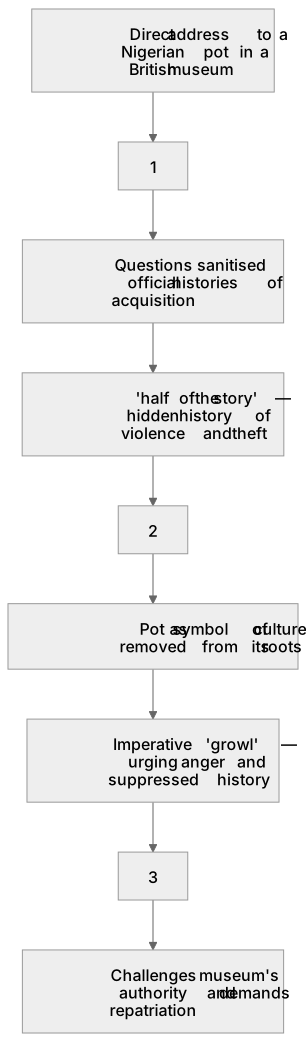
Label the diagram
Some boxes have lost their names. Pick the right name for each number.
1Box 1
2Box 2
3Box 3
There is more to this lesson
The full lesson goes on to check your understanding and help you earn the marks. Create a free account to carry on, with your progress saved.
A week of Premium from your first lesson · Then the free plan continues · No card, no charge
Test your understanding of Poetry anthology: Worlds and Lives: pot
Active recall beats re-reading. Take an instant quiz now to test what you’ve learned and lock it into long-term memory.
A week of Premium from your first lesson · Then the free plan continues · No card, no charge