AQA · GCSE · English Literature
Course version: 8702 · Version from Sept 2015
Poetry: Love and Relationships
Love and Relationships is one of three clusters in the AQA poetry anthology, alongside Power and Conflict and Worlds and Lives.
Checked against the AQA 8702 specification (opens in a new tab) on .
- Point 3 of 5
- 3 key terms
Study notes
From the checked teaching notes for this specification point.
The idea
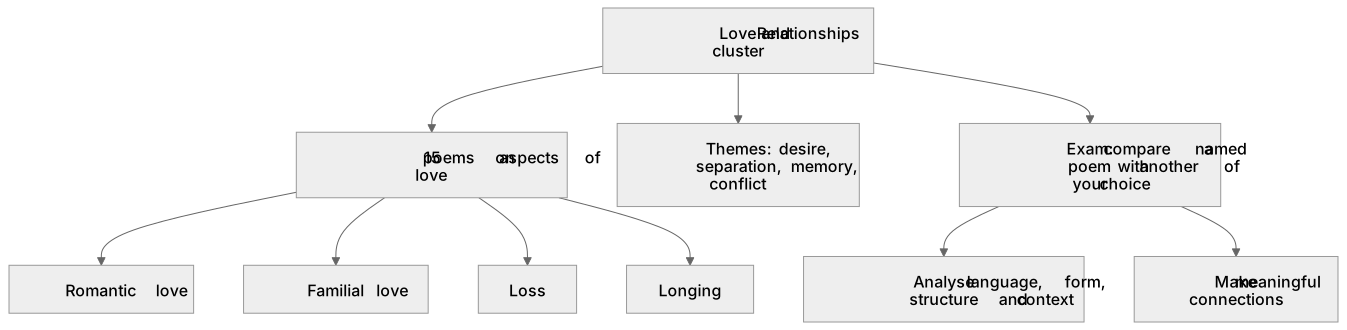
Love and Relationships is one of three clusters in the AQA poetry anthology, alongside Power and Conflict and Worlds and Lives. It contains 15 poems exploring aspects of love, from romantic and familial to loss and longing, spanning the early 19th century to the present, including Byron, Shelley, Hardy and Duffy. You study how poets present themes such as desire, separation, memory and conflict. The exam requires you to compare a named poem with another of your choice from the cluster, analysing language, form, structure and context, and making meaningful connections. For example, you might compare how 'Sonnet 29' and 'Walking Away' present different types of love. Effective preparation involves learning quotations, understanding poetic techniques, and practising comparative essays.
What earns the marks
- Show detailed knowledge of the 15 poems in the Love and Relationships cluster, including their themes, poetic devices and contexts.
- Analyse how poets use language, form and structure to convey ideas about love and relationships, using precise quotations and poetic terminology.
- Compare poems thoughtfully, identifying similarities and differences in theme, technique and context, using comparative connectives.
- Integrate contextual understanding of love and relationships across different eras into your interpretations, distinguishing between the poet's context and the poem's ideas.
- Respond to the specific focus of the question, selecting relevant material rather than retelling the poems.
Common mistakes and how to put them right
Treating all poems as having the same view of love.
Put it right: Recognise the diversity of perspectives, from idealistic to cynical, and compare them.
Neglecting to compare the poems, instead analysing them separately.
Put it right: Make explicit comparisons throughout your response, using comparative language.
Overlooking form and structure, focusing only on language.
Put it right: Discuss how sonnet form, line breaks, rhyme and rhythm contribute to meaning.
Assuming there are only two clusters.
Put it right: AQA 8702 v1.3 lists three clusters: Love and Relationships, Power and Conflict, and Worlds and Lives.
Exam tips
- Create a revision grid linking each poem to themes, key quotations, context and possible comparison partners.
- Practise writing comparative topic sentences that clearly signal similarities or differences.
- Memorise short, versatile quotations that can be used flexibly across different themes and comparisons.
Try the lesson
The start of the Poetry: Love and Relationships lesson, made from checked teaching notes for this specification point.
Have a go first
In Elizabeth Barrett Browning's 'Sonnet 29 – I think of thee!', what central metaphor does the speaker use to describe her obsessive thoughts about her absent lover?
Listen
Love and Relationships is one of three clusters in the AQA poetry anthology, alongside Power and Conflict and Worlds and Lives. It contains 15 poems exploring aspects of love, from romantic and familial to loss and longing, spanning the early 19th century to the present, including Byron, Shelley, Hardy and Duffy. You study how poets present themes such as desire, separation, memory and conflict. The exam requires you to compare a named poem with another of your choice from the cluster, analysing language, form, structure and context, and making meaningful connections. For example, you might compare how 'Sonnet 29' and 'Walking Away' present different types of love. Effective preparation involves learning quotations, understanding poetic techniques, and practising comparative essays. A strong answer earns marks for these points. Show detailed knowledge of the 15 poems in the Love and Relationships cluster, including their themes, poetic devices and contexts. Analyse how poets use language, form and structure to convey ideas about love and relationships, using precise quotations and poetic terminology. Compare poems thoughtfully, identifying similarities and differences in theme, technique and context, using comparative connectives. Integrate contextual understanding of love and relationships across different eras into your interpretations, distinguishing between the poet's context and the poem's ideas. A common slip: Treating all poems as having the same view of love. Instead, Recognise the diversity of perspectives, from idealistic to cynical, and compare them. Exam tip: Create a revision grid linking each poem to themes, key quotations, context and possible comparison partners.
See it
Watch it explained
Compare how 'Sonnet 29' and 'Walking Away' present different types of love.
Read the described scene instead
Welcome to this interactive study breakdown for AQA GCSE English Literature. Our focus is the Poetry anthology cluster Love and Relationships. This cluster is one of three in the AQA poetry anthology, alongside Power and Conflict and Worlds and Lives. It contains fifteen poems exploring aspects of love, from romantic and familial love to loss and longing. The poems span the early nineteenth century to the present and include poets such as Byron, Shelley, Hardy and Duffy. In this video, we will map the cluster, review what the exam asks, practise comparison, and highlight common mistakes to avoid. By the end, you should have a clear method for analysing language, form, structure and context, and for making meaningful connections between poems. Let's start with a concept map of the cluster. The Love and Relationships cluster contains fifteen poems. The key themes you need to track are romantic love, loss and separation, family relationships, and conflict in relationships. You also study how poets present desire, separation, memory and conflict. The poems range from the early nineteenth century to the present, so context matters: you need to understand each poem's ideas and the poet's context without confusing the two. Use the map to link every poem to themes, poetic devices, key quotations, context and possible comparison partners. That grid will help you choose relevant material quickly in the exam and compare thoughtfully rather than analysing poems in isolation. Now look at the core study notes. For this cluster, you need detailed knowledge of all fifteen poems, including their themes, poetic devices and contexts. When analysing, explain how poets use language, form and structure to convey ideas about love and relationships. Use precise quotations and poetic terminology. The exam requires you to compare a named poem with another poem of your choice from the cluster. Your comparison should analyse language, form, structure and context, and make meaningful connections. Effective preparation means learning quotations, understanding poetic techniques, and practising comparative essays. It is not enough to retell the poem; you must respond to the specific focus of the question and select only relevant material. Here is a process for building a comparative response. First, create a revision grid linking each poem to themes, key quotations, context and possible comparison partners. Second, practise writing comparative topic sentences that clearly signal similarities or differences. Use comparative connectives to keep the comparison explicit throughout. Third, memorise short, versatile quotations that can be used flexibly across different themes and comparisons. Fourth, integrate contextual understanding of love and relationships across different eras into your interpretations. Distinguish between the poet's context and the poem's ideas. Finally, respond to the specific focus of the question: choose relevant evidence and analyse how language, form and structure create meaning, rather than simply retelling the poems. Let's apply this to a worked example. The guide suggests comparing how 'Sonnet 29' and 'Walking Away' present different types of love. Start by identifying the named poem and your chosen comparison poem. Then select short, precise quotations that show how each poem presents love. Analyse the language choices, and also discuss form and structure: for example, sonnet form, line breaks, rhyme and rhythm, where relevant. Integrate context carefully, keeping the poet's context distinct from the poem's ideas. Make explicit comparisons between similarities and differences, using comparative connectives. A strong answer will not just describe each poem separately; it will compare how each presents different types of love and make meaningful connections between them. Watch out for these common pitfalls. First, do not treat all poems as having the same view of love. Recognise the diversity of perspectives, from idealistic to cynical, and compare them. Second, do not neglect to compare: analysing poems separately is not enough. Make explicit comparisons throughout your response, using comparative language. Third, do not overlook form and structure by focusing only on language. Discuss how sonnet form, line breaks, rhyme and rhythm contribute to meaning. Fourth, do not assume there are only two clusters. AQA 8702 version 1.3 lists three clusters: Love and Relationships, Power and Conflict, and Worlds and Lives. Avoiding these errors will help you write a focused, comparative, and accurate exam response. To recap: know the fifteen poems in the Love and Relationships cluster, including their themes, poetic devices and contexts. Analyse how poets use language, form and structure to convey ideas about love and relationships, using precise quotations and poetic terminology. Compare your named poem with another poem of your choice, making meaningful connections and using comparative connectives. Integrate contextual understanding across different eras, distinguishing between the poet's context and the poem's ideas. Respond to the specific focus of the question and select relevant material rather than retelling the poems. Build a revision grid, practise comparative topic sentences, and memorise short, versatile quotations. With that method, you can approach the AQA exam with confidence.
Key words
Say what each word means before you turn the card.
Romantic love
Try answering aloud or in your head before turning the card.
Family relationships
Try answering aloud or in your head before turning the card.
Conflict in relationships
Try answering aloud or in your head before turning the card.
See every definition
- Romantic love
- One aspect of love explored in the cluster's poems, alongside familial love and loss and longing.
- Family relationships
- One aspect of love explored in the cluster, alongside romantic love and loss and longing.
- Conflict in relationships
- A theme poets present in the cluster, alongside desire, separation and memory.
Label the diagram
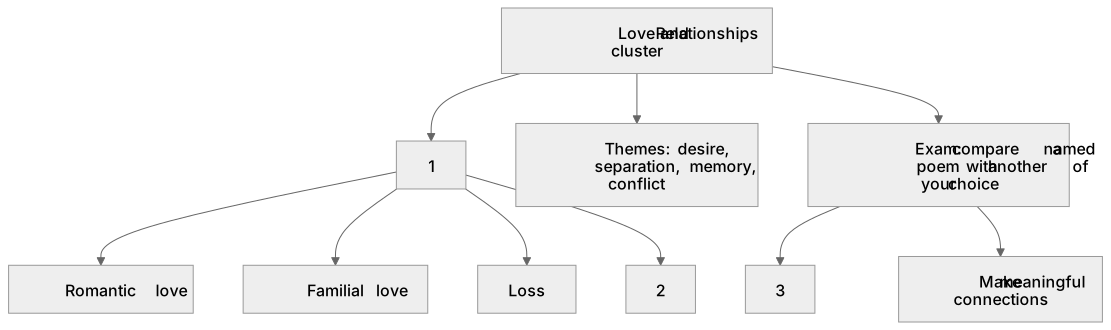
Some boxes have lost their names. Pick the right name for each number.
1Box 1
2Box 2
3Box 3
There is more to this lesson
The full lesson goes on to check your understanding and help you earn the marks. Create a free account to carry on, with your progress saved.
A week of Premium from your first lesson · Then the free plan continues · No card, no charge
Test your understanding of Poetry: Love and Relationships
Active recall beats re-reading. Take an instant quiz now to test what you’ve learned and lock it into long-term memory.
A week of Premium from your first lesson · Then the free plan continues · No card, no charge