Study Notes
Overview
Jane Weir's 'Poppies' offers a profoundly moving, civilian perspective on the impact of conflict. Written in 2009 for the 'Exit Wounds' anthology, the poem subverts traditional war poetry by focusing not on the battlefield, but on the domestic space left behind. The speaker is a mother reflecting on the morning her son left for war, and her subsequent mourning at a war memorial. Examiners highly reward candidates who can confidently navigate the poem's shifting time frames and analyse how Weir uses the language of domesticity alongside the language of violence to convey the enduring agony of grief.
Listen to the 'Poppies' Deep Dive Podcast
Plot/Content Overview
The poem does not follow a linear narrative, but rather mirrors the fragmented nature of memory.
- Stanza 1-2 (The Past): The mother remembers pinning a poppy to her son's blazer before he leaves. She recalls smoothing his collar and suppressing her own emotions so she wouldn't upset him.
- Stanza 3 (The Departure): The son leaves, excited for the world ahead, while the mother feels a profound sense of release and loss.
- Stanza 4 (The Present): The poem shifts to the present day. The mother walks to the local war memorial, tracing the inscriptions on the stone, desperately listening for her son's voice on the wind.
Themes
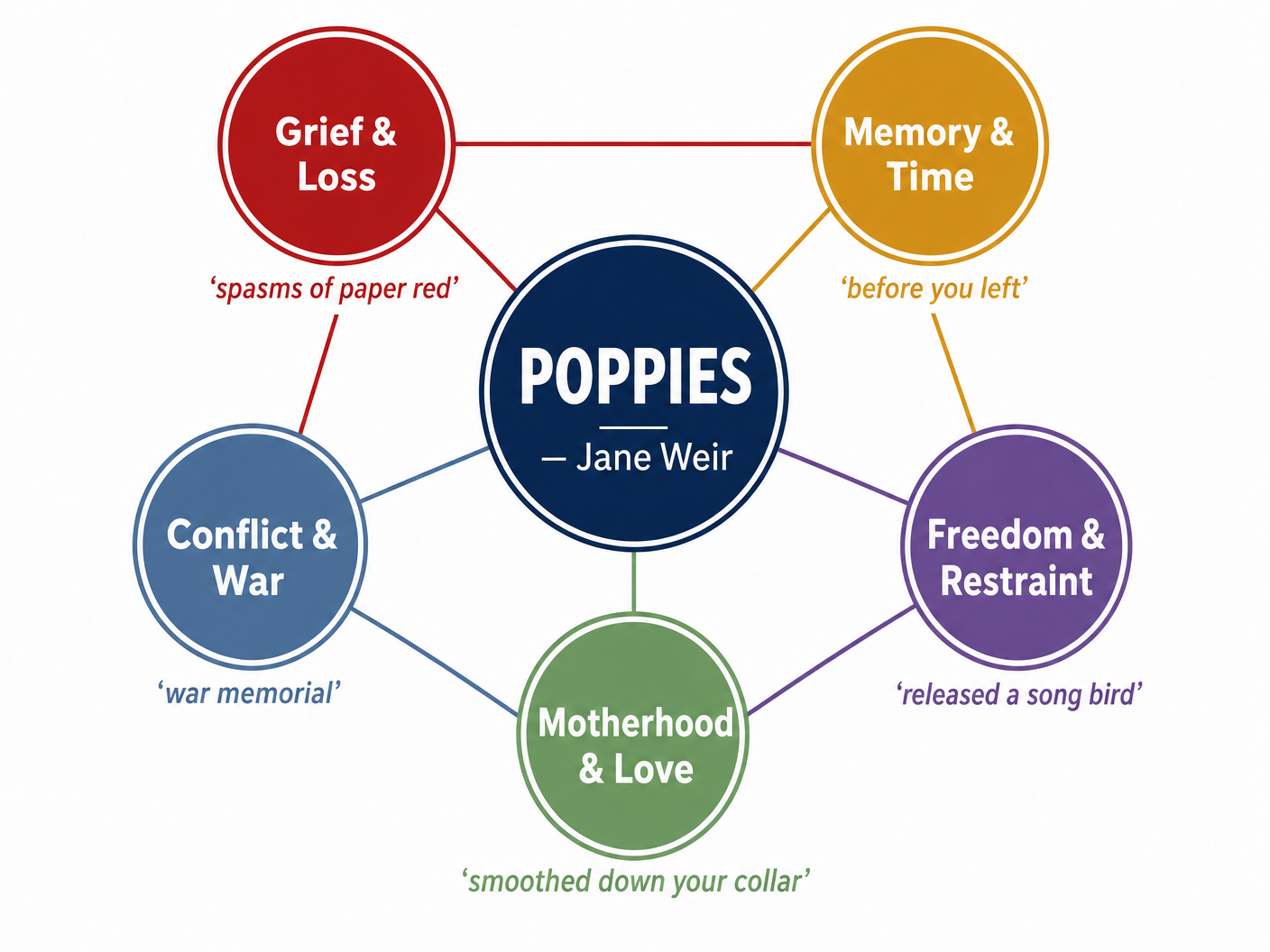
Theme 1: The Domestic Impact of War
Weir powerfully contrasts the vast, public scale of war with the intimate, private scale of motherhood. The poem is saturated with domestic imagery, showing that the true cost of conflict is felt in the home.
Key Quotes:
- "smoothed down your shirt's upturned collar" - The tenderness of a mother's touch highlights the vulnerability of the son, contrasting sharply with the violence of his destination.
- "sellotape bandaged around my hand" - A domestic object (sellotape) is paired with a medical, war-related verb ("bandaged"), showing how the reality of war has infected her everyday life.
Theme 2: Grief and Memory
The poem explores how grief disrupts time. The mother is trapped in her memories, unable to move forward. Her grief is presented as something physical and difficult to contain.
Key Quotes:
- "spasms of paper red" - The word "spasms" suggests uncontrollable pain and injury, undermining the neat, artificial nature of the paper poppy. Grief cannot be neatly packaged.
- "released a song bird from its cage" - A metaphor for her crying, or perhaps for letting her son go. It conveys a sense of sudden, overwhelming emotion breaking free.
Theme 3: Conflict and Violence
Even though the poem is set in a domestic environment, the language of violence and conflict permeates the mother's descriptions, showing how her son's departure has altered her perception of the world.
Key Quotes:
- "steeled the softening of my face" - The mother has to armour herself ("steeled") against her own emotions, preparing herself for the battle of saying goodbye.
- "gelled blackthorns of your hair" - The son's hair is compared to sharp, dangerous thorns, suggesting he is already transforming into something harder and more dangerous as he prepares for war.
Character Analysis
The Mother (The Speaker)
Role: The narrator and focal point of the poem. Her perspective filters the entire experience of the war.
Key Traits: Suppressed emotion, deep tenderness, physical manifestation of grief.
Character Arc: Moves from attempting to control her emotions on the morning of departure to a state of desperate longing at the war memorial.
Essential Quotes:
- "I wanted to graze my nose across the tip of your nose"
- "leaned against it like a wishbone"
The Son
Role: The absent subject of the poem. He never speaks and is only seen through the mother's memories.
Key Traits: Youthful, eager, vulnerable yet hardened.
Character Arc: Transitions from a child needing care to an independent young man heading into danger.
Essential Quotes:
- "intoxicated" (by the prospect of leaving)
- "the world overflowing like a treasure chest"
Writer's Methods
Structure and Form
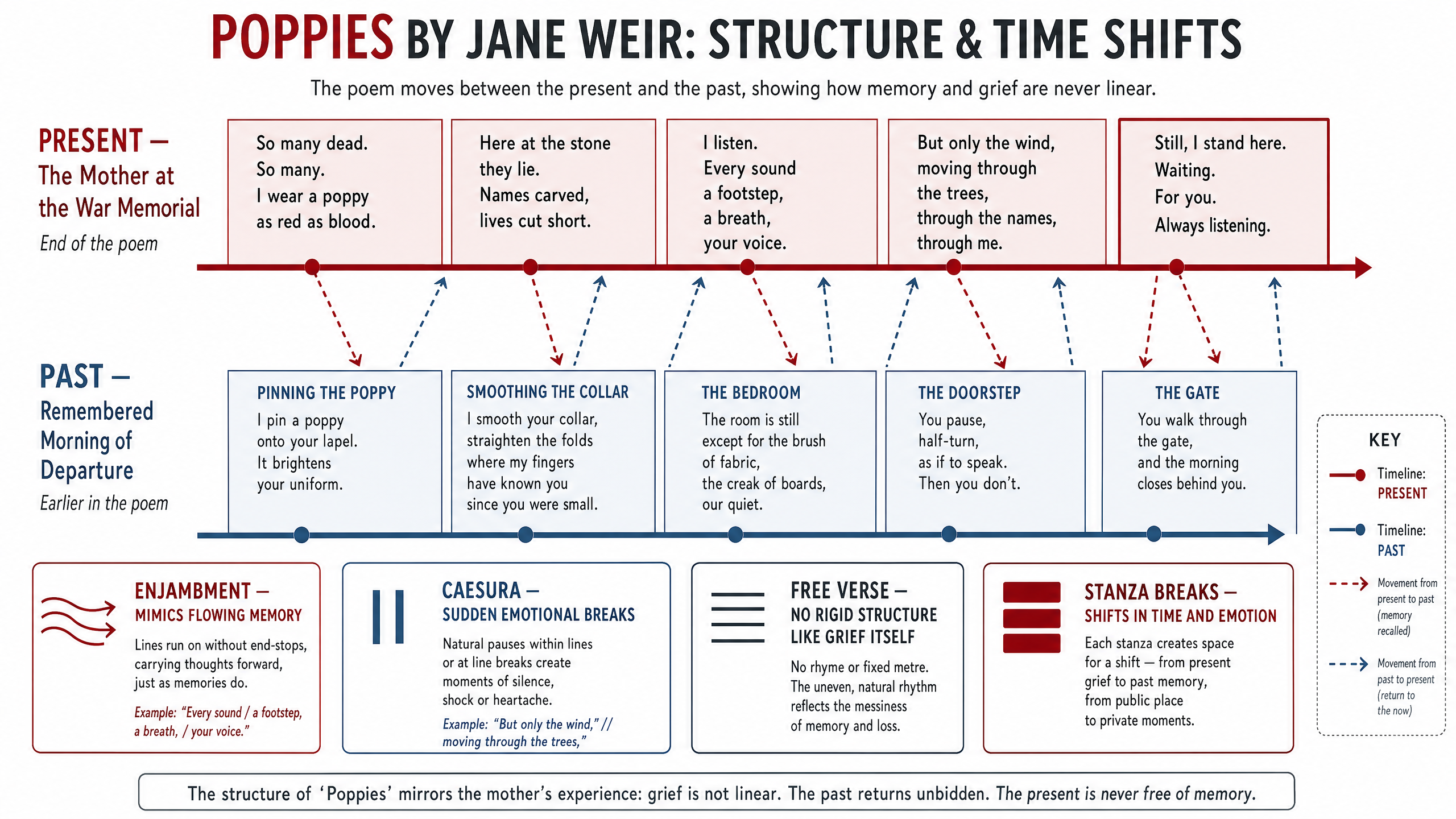
- Free Verse: The lack of a rigid rhyme scheme or regular metre reflects the unpredictable, messy nature of grief and the free-flowing nature of memory.
- Enjambment and Caesura: Weir uses enjambment (lines running on) to mimic the uncontrollable flow of memories, and caesura (pauses within lines) to represent moments where the mother chokes on her grief or pauses in pain.
- Time Shifts: The poem's non-linear structure—moving from the past (the departure) to the present (the memorial)—demonstrates how trauma traps the speaker in a loop of memory.
Language
- Sensory Imagery: The poem relies heavily on touch and sound (smoothing collars, grazing noses, listening to the wind) to emphasize the physical absence of the son.
- Textile Metaphors: Weir, a textile designer by trade, uses fabric imagery ("felt", "pleats", "tucks", "darts") to weave the narrative together, grounding the poem in women's domestic work.
Context
Jane Weir was commissioned by Carol Ann Duffy to write a poem for the Exit Wounds anthology (2009), which responded to the ongoing conflicts in Iraq and Afghanistan. Weir, a mother of two teenage boys, chose to write from the perspective of a mother to explore the universal, timeless nature of parental grief. While the poem uses the symbol of the poppy (connecting it to WWI and Remembrance Day), the ambiguity of the setting makes the poem's message applicable to any conflict. Examiners reward candidates who use this context to illuminate the poem's focus on the civilian experience of war.
Worked Examples
2 detailed examples with solutions and examiner commentary
Practice Questions
Test your understanding — click to reveal model answers
Compare how poets present the theme of memory in 'Poppies' and one other poem from your anthology.
Hint: Consider 'Kamikaze' or 'Remains' where memory is a source of trauma, or 'The Emigree' where memory is a source of both comfort and pain.
How does Weir use structure and form to convey the speaker's feelings in 'Poppies'?
Hint: Focus purely on AO2. Look at free verse, enjambment, caesura, and the shift from the past to the present.
Compare how poets present the effects of war on civilians in 'Poppies' and one other poem.
Hint: Kamikaze is an excellent comparison here, as it also deals with the family left behind and the social/emotional consequences of a soldier's choices.
Explore the significance of the title 'Poppies' in the context of the whole poem.
Hint: Think about the multiple meanings of a poppy: remembrance, blood, fragility (paper), and sleep/opium.