Porphyria's Lover
Dive into the dark, twisted psychology of Robert Browning's 'Porphyria's Lover'. This chilling dramatic monologue explores obsession, power, and Victorian gender dynamics, offering rich opportunities for high-level analysis of form, structure, and dramatic irony.
Study Notes
Overview
'Porphyria's Lover' is a masterclass in psychological horror and dramatic irony. Written by Robert Browning in 1836, this dramatic monologue invites the reader into the mind of a murderer who believes he has committed the ultimate act of love. For GCSE English Literature, this poem is a goldmine for AO2 analysis, particularly regarding form (the dramatic monologue) and structure (the unsettlingly regular rhyme scheme). Examiners consistently reward candidates who can look beyond the shocking plot to analyse how Browning constructs the speaker's delusion and critiques Victorian patriarchal attitudes towards female independence.
Plot/Content Overview
The poem unfolds in a single, unbroken stanza:
- The Storm: The speaker sits alone in a cold cottage during a violent storm.
- Porphyria's Arrival: Porphyria enters, shuts out the storm, lights the fire, and takes control of the scene, embracing the passive speaker.
- The Revelation: The speaker realises that Porphyria 'worshipped' him, despite her 'vainer ties' (social obligations).
- The Murder: To preserve this perfect moment of devotion, he strangles her with her own hair.
- The Aftermath: He props her dead body against him, convinced she felt no pain, and waits through the night, noting chillingly that 'God has not said a word!'
Themes
Theme 1: Obsession and Control
The poem explores how romantic love can warp into a dangerous desire for total possession. The speaker cannot tolerate Porphyria's independence; his only way to secure her devotion is to objectify her entirely through death.
Key Quotes:
- "That moment she was mine, mine, fair, / Perfectly pure and good" - The repetition of 'mine' highlights his possessive nature; he values her purity only when she is entirely under his control.
- "I wound / Three times her little throat around, / And strangled her." - The enjambment physically mimics the winding of the hair, emphasising his active, deliberate control over her life.
Theme 2: Power and Gender Dynamics
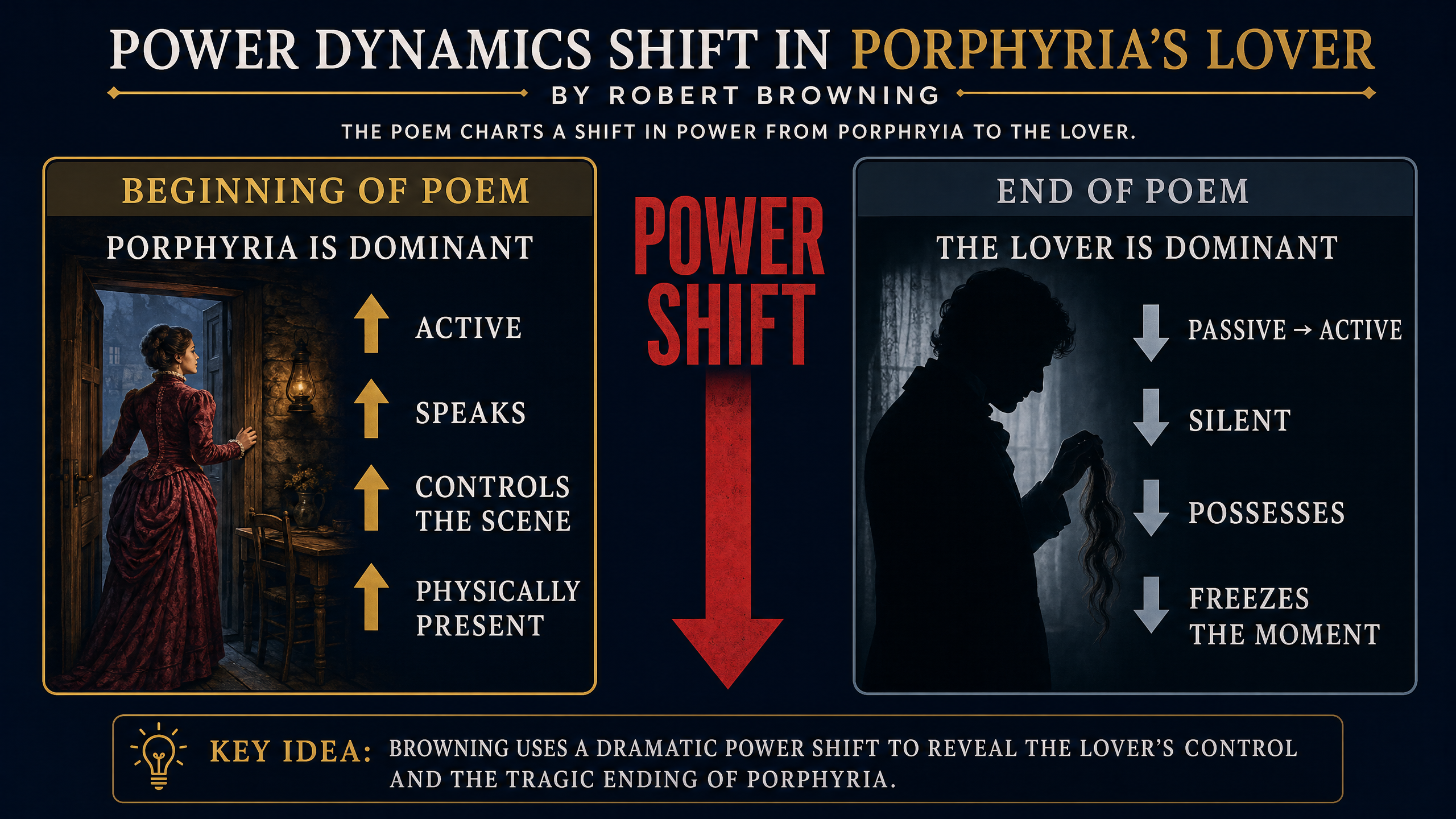
Browning subverts and then violently reasserts Victorian gender expectations. Initially, Porphyria is the active, dominant figure, which threatens the speaker's masculinity. The murder is an extreme reassertion of patriarchal power.
Key Quotes:
- "she shut the cold out and the storm" - Porphyria is active and capable, contrasting with the speaker's initial sullen passivity.
- "I propped her head up as before, / Only, this time my shoulder bore / Her head" - The shift in physical positioning mirrors the shift in power; he has forced her into a posture of permanent, passive dependency.
Theme 3: Madness and Delusion
The speaker is the ultimate unreliable narrator. He rationalises a horrific murder as an act of preservation, projecting his own desires onto Porphyria's dead body.
Key Quotes:
- "No pain felt she; / I am quite sure she felt no pain." - The repetition and assertion of certainty ironically highlight his profound delusion; he cannot possibly know what she felt.
- "And yet God has not said a word!" - The chilling final line shows his belief that his actions are divinely sanctioned, revealing the terrifying depth of his psychological detachment from reality.
Character Analysis
The Speaker (The Lover)
Role: The unreliable narrator and protagonist of the dramatic monologue.
Key Traits: Deluded, possessive, passive-aggressive, controlling.
Character Arc: Shifts from sullen passivity to violent, decisive action, ending in a state of calm delusion.
Essential Quotes:
- "heart fit to break"
- "That moment she was mine, mine"
- "And yet God has not said a word!"
Porphyria
Role: The victim and object of the speaker's obsession.
Key Traits: Active, loving, socially constrained, ultimately objectified.
Character Arc: Begins as an active, dominant force bringing warmth; is reduced to a passive, silent object by the end.
Essential Quotes:
- "glided in Porphyria"
- "made her smooth white shoulder bare"
- "The smiling rosy little head"
Writer's Methods
Form: The dramatic monologue form is crucial. By giving the speaker uninterrupted control of the narrative, Browning forces the reader into the uncomfortable position of confidant to a murderer. The gap between what the speaker believes (that he acted out of love) and what the reader understands (that he is a deluded killer) creates powerful dramatic irony.
Structure: The poem is written in iambic tetrameter with an ABABB rhyme scheme. This tight, regular, almost musical structure contrasts sickeningly with the violent, chaotic nature of the murder. The unbroken single stanza reflects the speaker's continuous, obsessive train of thought.
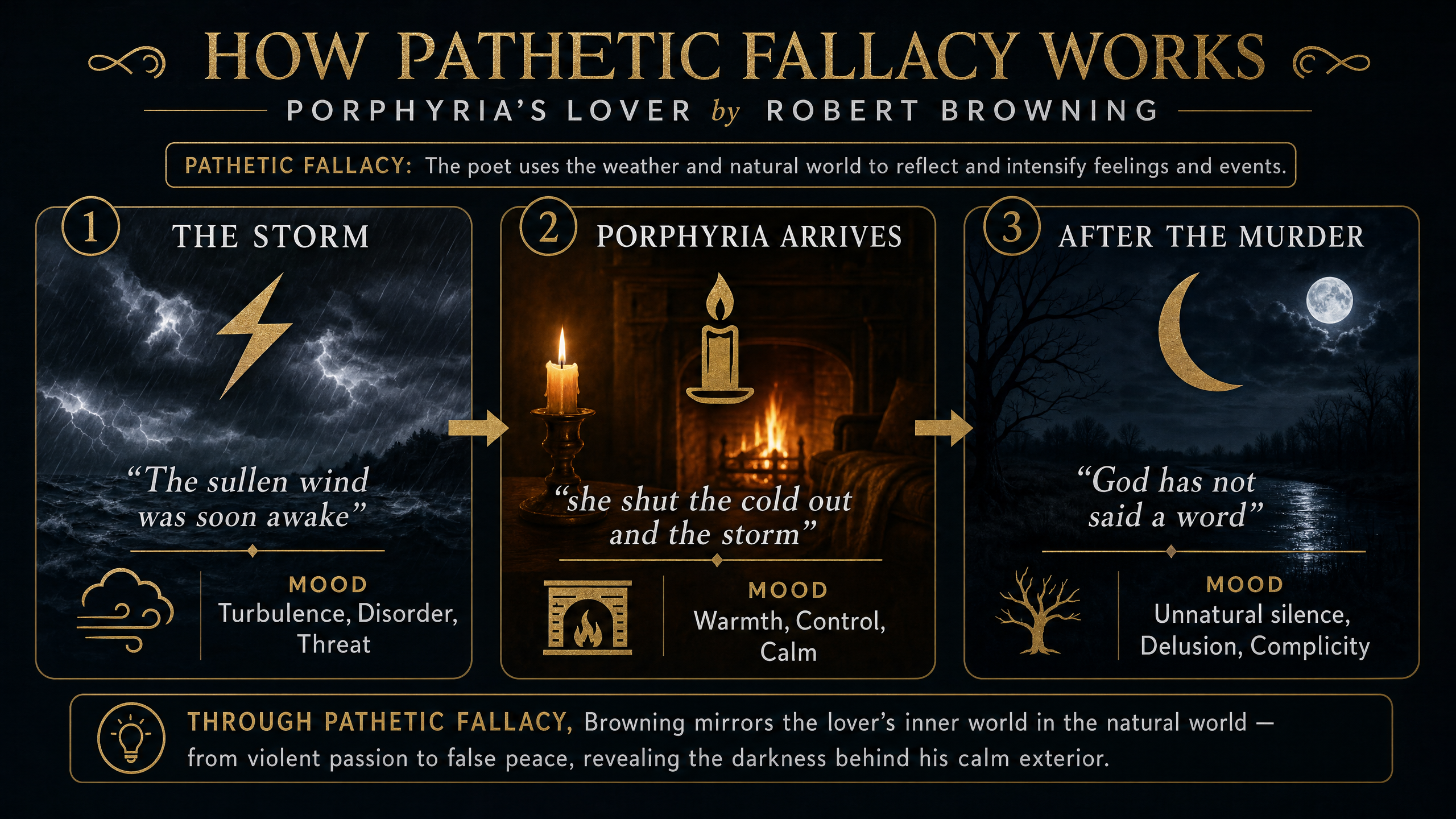
Language: Browning uses pathetic fallacy initially to reflect the speaker's inner turmoil ("The sullen wind"). Later, he employs the language of fragmentation and objectification to describe Porphyria ("her smooth white shoulder", "rosy little head"), demonstrating how the speaker reduces her from a person to a collection of parts he can possess.
Context
Victorian Gender Roles: Victorian society expected women to be the 'Angel in the House'—passive, domestic, and subservient to men. Porphyria's independence (arriving alone at night) challenges these norms. The speaker's violent reaction can be read as an extreme manifestation of the patriarchal need to control women.
Psychological Exploration: The 19th century saw a growing interest in psychology and the inner workings of the criminal mind (often termed 'moral insanity'). Browning was fascinated by aberrant psychology, using the dramatic monologue to explore the logic of a disturbed mind from the inside out.
Interactive Diagrams
1 interactive diagram to visualise key concepts
Conceptual Flow Outline
Narrative structure and emotional progression in Porphyria's Lover
Worked Examples
1 detailed example with solutions and examiner commentary
Practice Questions
Test your understanding — click to reveal model answers
Compare how poets present obsessive love in 'Porphyria's Lover' and one other poem from your anthology.
Hint: Ensure you balance your essay 50/50 between the two poems. Look for differences in how the obsession is manifested (e.g., violence vs. emotional longing).
How does Browning use the setting to reflect the speaker's state of mind in 'Porphyria's Lover'?
Hint: Focus on the opening lines and the concept of pathetic fallacy, then contrast it with the eerie silence at the end.
Explore the presentation of female characters in 'Porphyria's Lover'.
Hint: Track Porphyria's transition from an active agent at the start to a passive object at the end.
How does Browning create a sense of unease in 'Porphyria's Lover'?
Hint: Look at the contrast between the calm, regular structure and the horrific events described.