Pride and Prejudice
Pride and Prejudice is Jane Austen's sparkling critique of Regency society, wrapped in a compelling marriage plot. Studying this text rewards students who can look beyond the romance to analyse Austen's sharp irony, structural brilliance, and exploration of class, gender, and moral growth.
Study Notes
Overview
Jane Austen's Pride and Prejudice (1813) is far more than a simple romance; it is a sharp, satirical examination of early 19th-century English society. Examiners are looking for candidates who understand that Austen uses the marriage plot to interrogate issues of class, economic dependency, and gender roles. Top-tier responses will focus on Austen's narrative techniques—particularly her use of irony and free indirect discourse—and how she structuralises the novel to highlight the moral growth of Elizabeth Bennet and Mr Darcy. Always remember to link characters' personal choices to the wider social constraints of the Regency era, such as primogeniture and the rigid class hierarchy.
Listen to our comprehensive revision podcast for an in-depth discussion of key themes and exam strategies:
Plot/Content Overview
Volume 1: The wealthy Mr Bingley and his proud friend Mr Darcy arrive in Hertfordshire. Bingley is drawn to Jane Bennet, while Darcy insults Elizabeth, sparking her prejudice against him. Elizabeth meets Mr Wickham, who falsely claims Darcy ruined his life. Mr Collins, the heir to the Bennet estate, proposes to Elizabeth; when she refuses, he marries her pragmatic friend, Charlotte Lucas.
Volume 2: Jane is heartbroken when Bingley suddenly leaves for London. Elizabeth visits Charlotte and encounters Darcy, who unexpectedly proposes to her in a highly insulting manner. Elizabeth angrily rejects him, citing his interference with Jane and his treatment of Wickham. Darcy writes a pivotal letter explaining his actions and exposing Wickham's true, mercenary character. Elizabeth begins to realise her own blindness and prejudice.
Volume 3: Elizabeth visits Darcy's estate, Pemberley, and sees a different, more gracious side of him. The plot crisis occurs when Lydia elopes with Wickham, threatening the entire family's reputation. Darcy secretly intervenes, paying Wickham to marry Lydia and saving the Bennets from ruin. Bingley returns and proposes to Jane. Lady Catherine de Bourgh attempts to forbid Elizabeth from marrying Darcy, but her interference only gives Darcy hope. He proposes again, Elizabeth accepts, and the novel concludes with their marriage of equals.
Themes
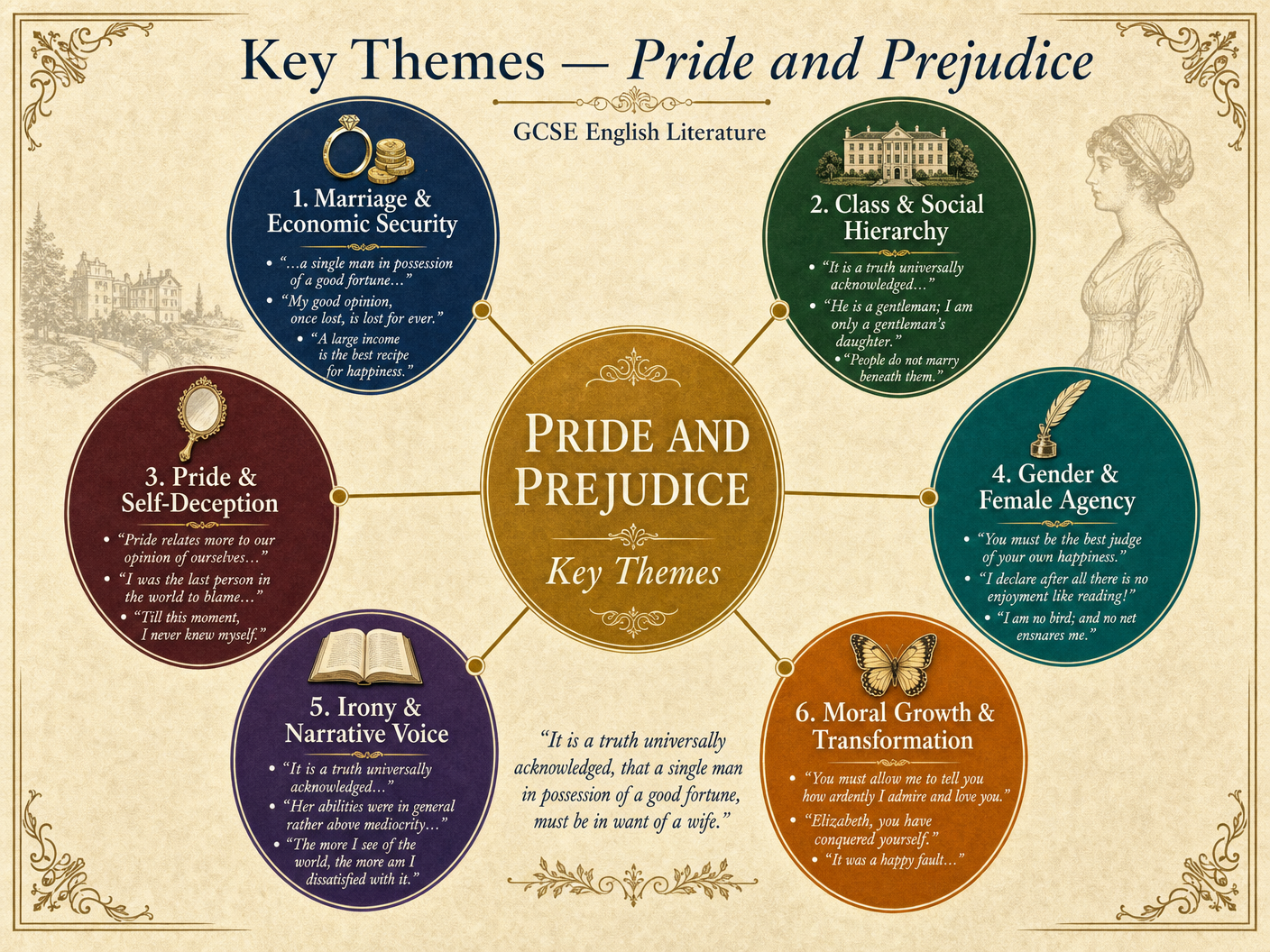
Theme 1: Marriage and Economic Security
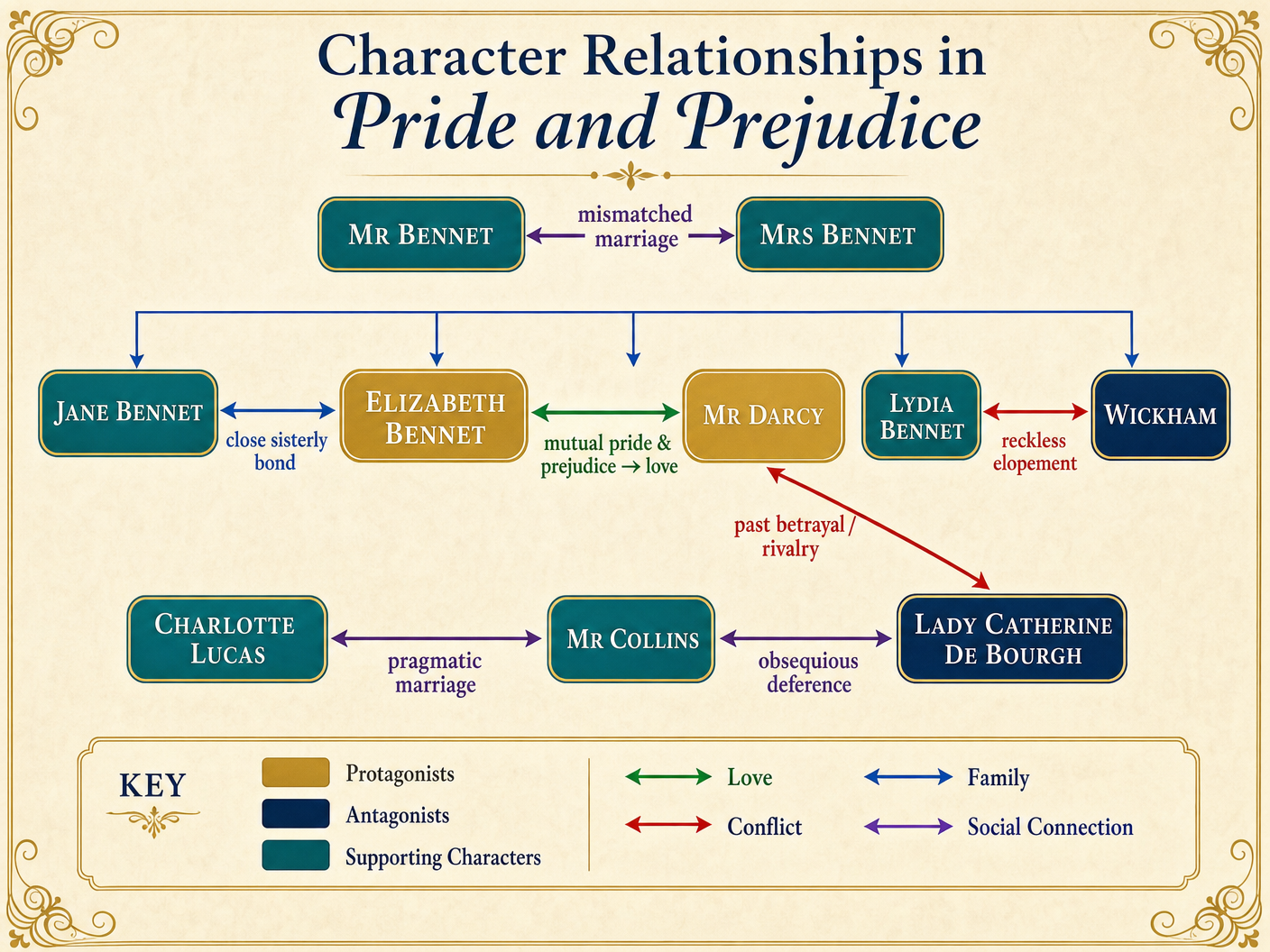
Austen uses marriage as the central structural device to explore the limited options available to women in Regency society. Because of the entailment (primogeniture), the Bennet sisters must marry to secure their futures. Austen presents a spectrum of marriages: the pragmatic (Charlotte and Collins), the reckless (Lydia and Wickham), the mismatched (Mr and Mrs Bennet), and the ideal union of equals (Elizabeth and Darcy).
Key Quotes:
- "It is a truth universally acknowledged, that a single man in possession of a good fortune, must be in want of a wife." (Vol 1, Ch 1) - Austen's famous opening line uses irony to establish the mercenary reality of the marriage market.
- "I am not romantic, you know. I never was. I ask only a comfortable home." (Vol 1, Ch 22) - Charlotte Lucas's pragmatic view highlights the economic necessity of marriage for women without independent wealth.
Theme 2: Pride and Prejudice (Self-Deception and Moral Growth)
The titular themes are not confined to single characters; both Elizabeth and Darcy exhibit pride and prejudice. Darcy's pride in his social standing leads to his prejudice against Elizabeth's family, while Elizabeth's pride in her own discernment leads to her prejudice against Darcy. The novel's emotional arc traces their journey toward self-awareness and mutual understanding.
Key Quotes:
- "She is tolerable; but not handsome enough to tempt me." (Vol 1, Ch 3) - Darcy's initial pride and social snobbery.
- "How despicably have I acted! I, who have prided myself on my discernment!" (Vol 2, Ch 13) - Elizabeth's moment of anagnorisis (realisation) after reading Darcy's letter.
- "Till this moment, I never knew myself." (Vol 2, Ch 13) - The culmination of Elizabeth's moral growth.
Theme 3: Class and Social Hierarchy
Austen sharply critiques the rigid class structures of her time. While she does not advocate for overthrowing the system, she satirises those who mistake high social rank for moral superiority (like Lady Catherine and Caroline Bingley) and rewards characters who judge others based on merit rather than wealth.
Key Quotes:
- "He is a gentleman; I am a gentleman's daughter; so far we are equal." (Vol 3, Ch 14) - Elizabeth's assertion of equality to Lady Catherine challenges strict class divisions.
- "My good opinion once lost is lost for ever." (Vol 1, Ch 11) - Darcy's early rigidity reflects the inflexible nature of high society.
Character Analysis
Elizabeth Bennet
Role: The protagonist and the lens through which we view the society.
Key Traits: Intelligent, witty, independent, but flawed by her quick judgements.
Character Arc: Moves from misplaced confidence in her own perceptions to a humbled self-awareness and, ultimately, a mature union with Darcy.
Essential Quotes:
- "I could easily forgive his pride, if he had not mortified mine."
- "There is a stubbornness about me that never can bear to be frightened at the will of others."
Mr Darcy
Role: The wealthy aristocratic foil and eventual match for Elizabeth.
Key Traits: Proud, reserved, socially awkward, but fundamentally honourable and generous.
Character Arc: Learns to temper his class prejudice and aristocratic pride, becoming a more gracious and open individual.
Essential Quotes:
- "In vain have I struggled. It will not do. My feelings will not be repressed. You must allow me to tell you how ardently I admire and love you."
- "By you, I was properly humbled."
Mr Collins
Role: Comic relief and a satirical representation of sycophancy and the absurdities of the entailment system.
Key Traits: Pompous, obsequious, materialistic, and completely lacking in self-awareness.
Essential Quotes:
- "A clergyman like you must marry. Choose properly, choose a gentlewoman for my sake; and for your own, let her be an active, useful sort of person."
Writer's Methods
Irony: Austen's primary tool for social critique. She frequently states the opposite of what she means (as in the opening line) to expose the hypocrisy and mercenary nature of her society.
Free Indirect Discourse: Austen blends the third-person narrator's voice with a character's internal thoughts (usually Elizabeth's). This creates intimacy with Elizabeth but also allows Austen to ironically expose Elizabeth's blind spots to the reader.
Dialogue: Austen reveals character entirely through speech. Mr Collins's long, convoluted sentences expose his pomposity; Elizabeth's sharp, balanced syntax reveals her wit; Darcy's formal, stilted early dialogue reflects his pride.
Structure: The novel's three-volume structure perfectly mirrors the protagonists' journey: misunderstanding (Vol 1), crisis and revelation (Vol 2), and resolution (Vol 3). Austen also uses contrasting pairs (foils) structurally, such as Jane/Elizabeth and Wickham/Darcy.
Context
Primogeniture and Entailment: The legal system whereby estates were passed intact to the nearest male relative, leaving female dependents vulnerable. This is the driving economic force of the plot.
The Marriage Market: In the Regency era, middle- and upper-class women could not work. Marriage was the only socially acceptable route to financial security.
Accomplishments: Women were expected to possess superficial skills (playing the piano, drawing, speaking French) to attract a husband, rather than receiving a rigorous intellectual education. Austen critiques this through Caroline Bingley's absurd list of requirements for an "accomplished woman."
Visual Resources
2 diagrams and illustrations
Interactive Diagrams
1 interactive diagram to visualise key concepts
Conceptual Flow Outline
Elizabeth Bennet's Arc of Moral Growth
Worked Examples
2 detailed examples with solutions and examiner commentary
Practice Questions
Test your understanding — click to reveal model answers
Starting with this extract (Mr Collins's proposal, Vol 1, Ch 19), explore how Austen presents attitudes towards marriage. (30 marks + 4 AO4)
Hint: Consider how Mr Collins views marriage as a transaction, and contrast this with Elizabeth's view. Then look at Charlotte Lucas.
Explore how Austen presents the character of Lady Catherine de Bourgh and what she represents in society. (30 marks + 4 AO4)
Hint: Focus on Lady Catherine as a symbol of the rigid, aristocratic class system. Look at her final confrontation with Elizabeth.
How does Austen use the setting of Pemberley to reveal changes in Mr Darcy's character? (30 marks + 4 AO4)
Hint: Think about how the physical description of the estate mirrors Darcy's true nature, free from the artificiality of London society.
Explore the significance of letters in Pride and Prejudice. (30 marks + 4 AO4)
Hint: Letters are structural turning points. Focus heavily on Darcy's letter to Elizabeth, but also mention Mr Collins's letters or Jane's letters.