Study Notes
Overview
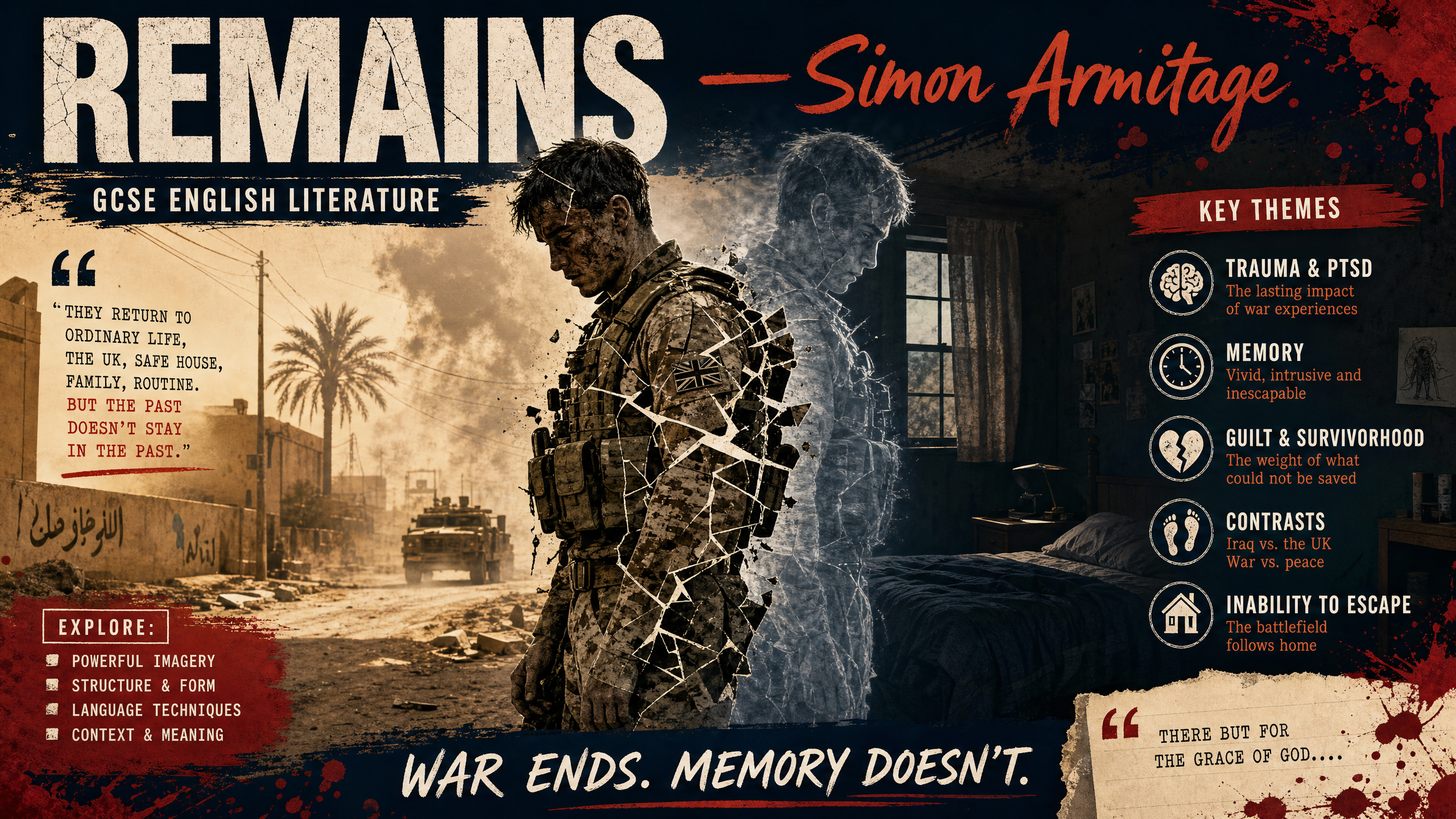
Simon Armitage's 'Remains' is a standout poem in the AQA Power and Conflict anthology. Adapted from the real-life testimony of Iraq War veteran Eddie Cochrane (featured in the Channel 4 documentary The Not Dead), the poem explores the debilitating psychological effects of conflict. Examiners look for candidates who can move beyond a simple narrative retelling to analyse how Armitage constructs the speaker's fragmented mental state. Strong responses will explore the poem's structural irregularities, the dual meaning of its language, and the shift from physical action to psychological haunting.
Listen to the Revision Podcast
Plot/Content Overview
The poem begins in media res (in the middle of the action) with a group of soldiers on patrol. They encounter a looter running from a bank and, acting on instinct and training, open fire. The man is killed instantly, his body brutally described as being 'tossed up' and 'carted off'.
However, the narrative quickly shifts. The soldier returns home, expecting the incident to be left behind on the battlefield. Instead, the memory of the shooting relentlessly intrudes upon his everyday life. He attempts to self-medicate with drink and drugs, but the traumatic memory is inescapable, leading to a powerful conclusion where the speaker acknowledges the enduring burden of guilt.
Themes
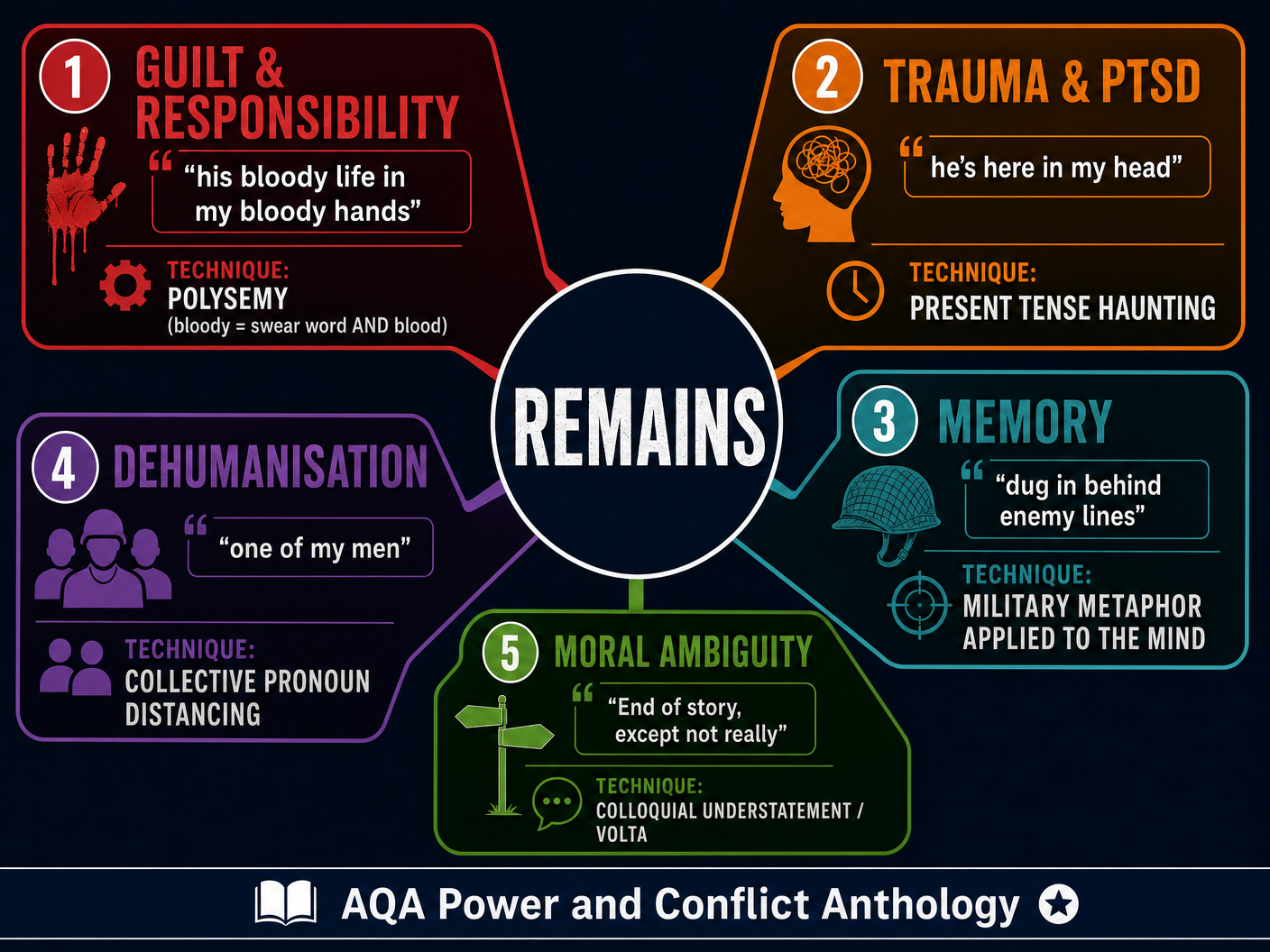
Theme 1: Guilt and Moral Responsibility
The most pervasive theme in the poem is the speaker's overwhelming sense of guilt. Armitage presents a soldier who cannot reconcile his actions with his conscience. The poem raises complex questions about accountability in modern warfare—when a soldier is trained to kill, who bears the moral weight of that action?
Key Quotes:
- "his bloody life in my bloody hands" - This is the poem's devastating final line. The polysemy of "bloody" acts as both a colloquial swear word (expressing frustration and despair) and a literal description of the physical reality of the killing. The repetition hammers home the inescapability of the guilt.
- "probably armed, possibly not" - This phrase is repeated twice in the poem. The uncertainty is the root of the speaker's trauma; he will never know if the killing was justified, creating a moral ambiguity that torments him.
Theme 2: Trauma and PTSD
Armitage meticulously details the symptoms of Post-Traumatic Stress Disorder. The poem illustrates how the mind can become a battlefield long after the physical conflict has ended. The trauma is presented not as a memory, but as an active, ongoing haunting.
Key Quotes:
- "he's here in my head when I close my eyes" - The use of the present tense ("he's here") is crucial. It demonstrates that for the PTSD sufferer, the traumatic event is not consigned to the past; it is continually relived in the present.
- "Sleep, and he's probably armed, possibly not. / Dream, and he's torn apart by a dozen rounds." - The disruption of sleep is a classic symptom of PTSD. The anaphora of the verbs "Sleep" and "Dream" highlights how even the subconscious offers no refuge.
Theme 3: The Inescapability of Memory
The poem suggests that physical distance from a conflict zone does not equate to psychological distance. The memory of the event is deeply entrenched and resistant to any attempts to erase it.
Key Quotes:
- "dug in behind enemy lines" - This is a profound use of a military metaphor applied to the mind. The memory is entrenched, fortified, and hostile. The irony is palpable: the enemy is no longer external, but internal.
- "the drink and the drugs won't flush him out" - The colloquial phrasing highlights the desperate, futile attempts at self-medication. The verb "flush" suggests trying to purge a sickness or an enemy combatant, further extending the military metaphor.
Writer's Methods
Structure and Form
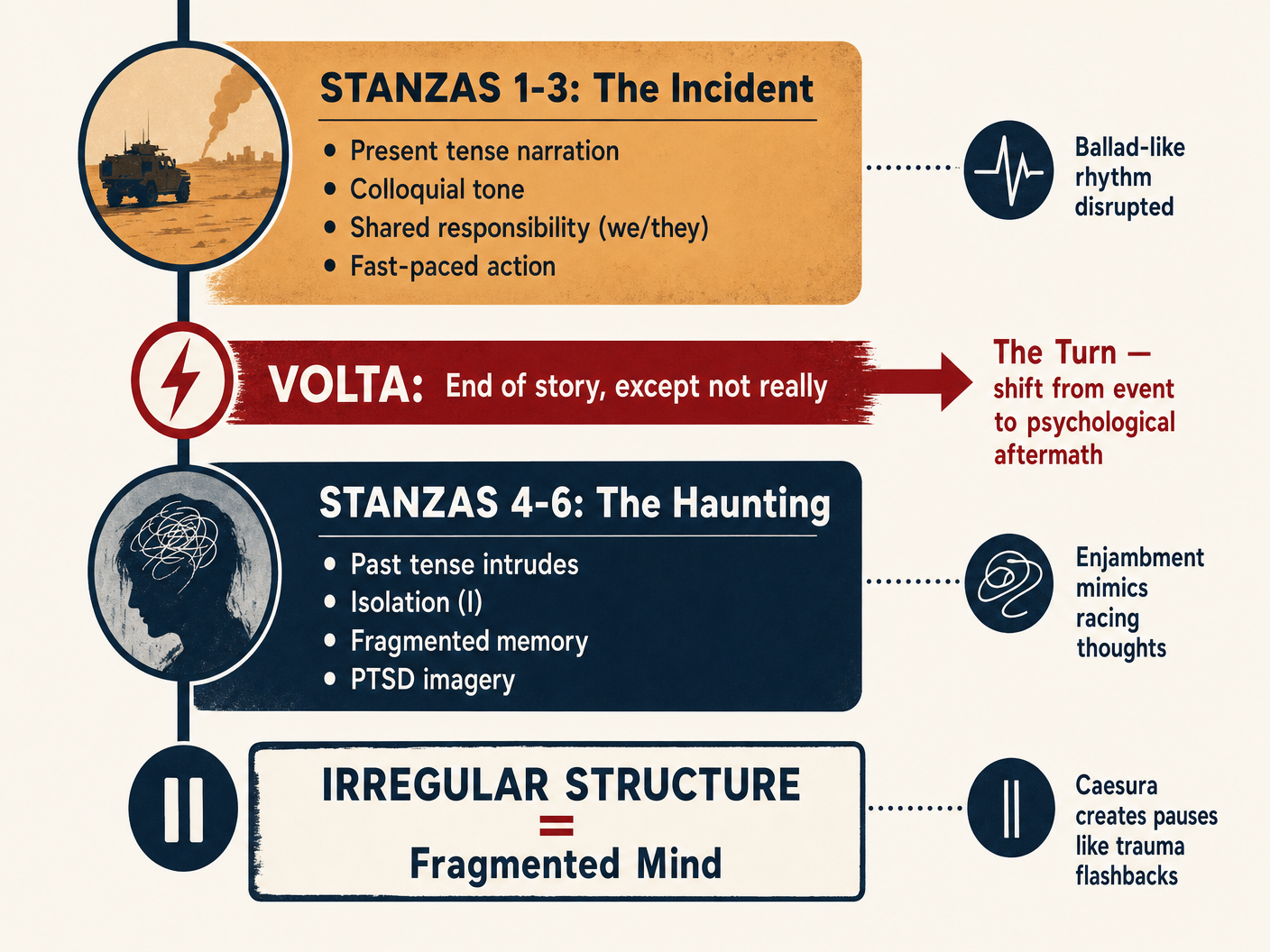
The poem is written in a monologue form, adopting a highly conversational, anecdotal tone. However, the structure is deliberately irregular. The stanzas are mostly quatrains, but the line lengths vary significantly, and there is no consistent rhyme scheme. This irregularity is not accidental; it mirrors the speaker's fragmented, chaotic mental state. The lack of structural control reflects the speaker's lack of psychological control over his memories.
The Volta
The most critical structural feature is the volta (the turning point), which occurs in the fifth stanza: "End of story, except not really." This colloquial, almost dismissive phrase is immediately undercut. It marks the transition from the physical event (the shooting) to the psychological aftermath (the haunting). Candidates must analyse this shift to achieve high marks.
Language and Register
Armitage deliberately employs a colloquial, everyday register ("legs it", "tosses his guts", "mate"). This achieves two things: firstly, it lends authenticity to the soldier's voice, grounding the poem in a gritty realism. Secondly, it creates a jarring juxtaposition with the horrific violence being described. The casual language makes the brutality seem even more shocking and underscores the dehumanising nature of conflict.
Context
'Remains' was published in 2008 as part of Armitage's collection The Not Dead, which coincided with a Channel 4 documentary of the same name. The collection focused on the testimonies of ex-soldiers whose lives had been shattered by their experiences in various conflicts, including the Gulf War, Bosnia, and the Iraq War.
Examiners expect candidates to integrate this context seamlessly. Do not write a separate paragraph on the Iraq War. Instead, weave it into your analysis: "Writing in the context of the Iraq War, Armitage explores the psychological reality of modern combat, where the lack of clear front lines and the ambiguity of threats ('probably armed, possibly not') contribute directly to the devastating PTSD experienced by returning veterans."
Visual Resources
2 diagrams and illustrations
Interactive Diagrams
1 interactive diagram to visualise key concepts
Conceptual Flow Outline
The narrative and psychological progression in 'Remains'
Worked Examples
2 detailed examples with solutions and examiner commentary
Practice Questions
Test your understanding — click to reveal model answers
Compare how poets present the psychological impact of war in 'Remains' and one other poem from the 'Power and Conflict' anthology.
Hint: Consider 'War Photographer' or 'Kamikaze'. Focus on how memory and trauma are depicted using structure and metaphor.
How does Armitage use language and structure to convey the speaker's sense of guilt in 'Remains'?
Hint: Look closely at the repetition of 'probably armed, possibly not' and the final stanza.