The Emigrée
'The Emigrée' by Carol Rumens is a deeply moving exploration of memory, identity, and exile. It offers students a rich opportunity to analyse how the indestructible power of the imagination can serve as a form of resistance against political tyranny.
Study Notes
Overview
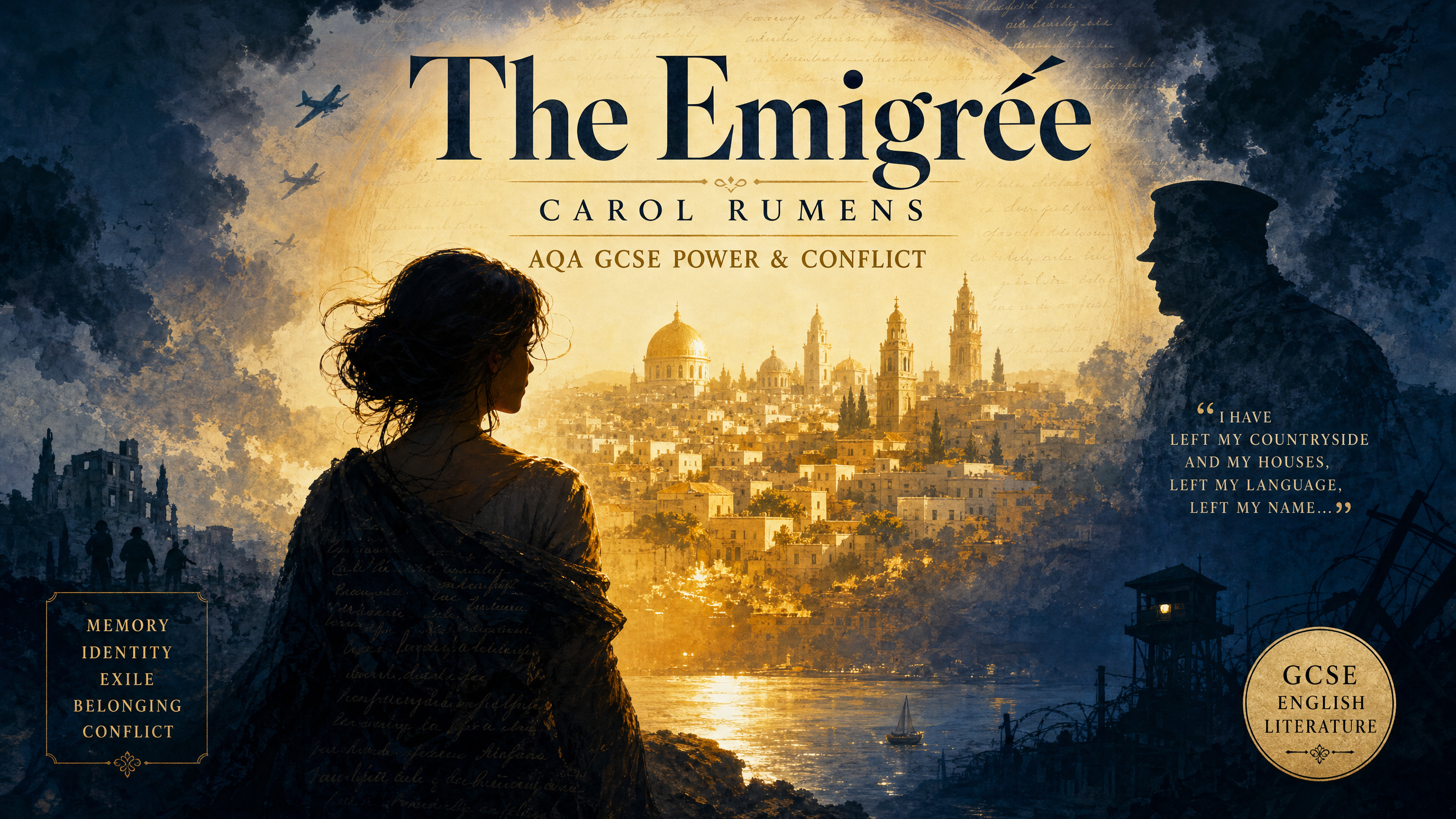
'The Emigrée' is a poignant dramatic monologue that explores the experience of a female exile who was forced to leave her homeland as a child. Despite the intrusion of a "tyrant" and the reality of conflict, her memory of her city remains "sunlight-clear." Examiners reward candidates who can perceptively analyse how Rumens uses imagery of light and dark, structural enjambment, and the personification of the city to explore themes of identity, memory, and the power of the imagination. A key differentiator for higher-tier responses is recognising the poem's ambiguity—the unnamed city ensures the poem speaks universally to the refugee experience.
Podcast Episode
Listen to our comprehensive 10-minute revision podcast covering the poem's core ideas, structural analysis, and exam tips:
Content Overview
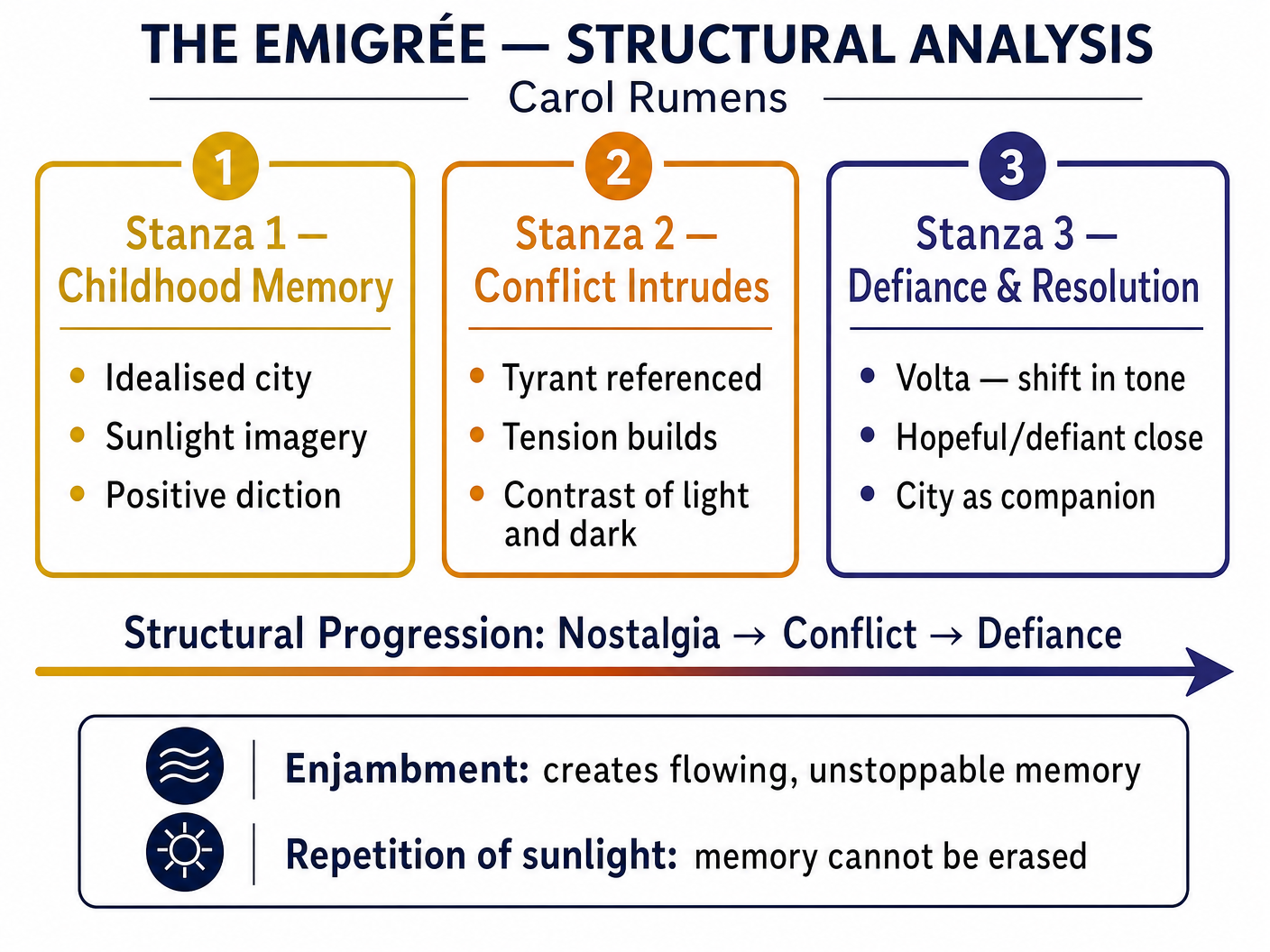
Stanza 1: The Idealised MemoryThe speaker recalls leaving her city as a child. She acknowledges she has not returned, but her memory of it remains vivid, positive, and luminous, untainted by the reality of what it has become.
Stanza 2: The Intrusion of ConflictThe tone darkens as the speaker acknowledges that her former home is now ruled by a "tyrant" and consumed by conflict. However, she refuses to let this dark reality overwrite her glowing childhood memories.
Stanza 3: Defiance and CompanionThe poem shifts to a defiant tone. The city is personified as a loyal companion that "comes to me in its own white plane." Despite having "no passport" and facing hostility in her new environment, her inner connection to her homeland remains indestructible.
Themes
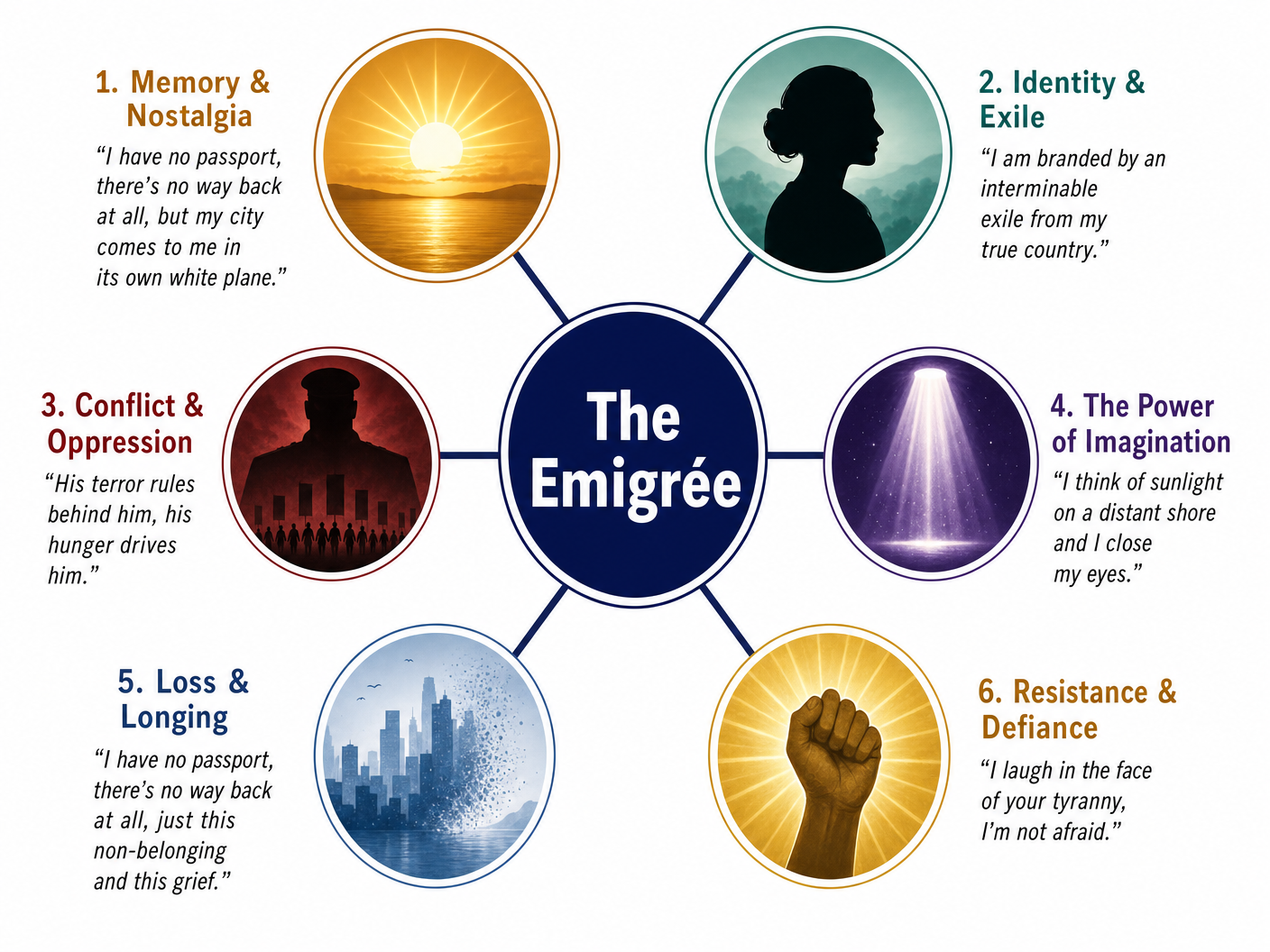
Theme 1: Memory and Nostalgia
Rumens presents memory as something powerful, permanent, and protective. The speaker's childhood memories are idealised, acting as a shield against the harsh reality of her exile.
Key Quotes:
- "I am branded by an impression of sunlight." (Stanza 1) - The verb "branded" suggests permanence and ownership. The memory is burned into her identity; it is inescapable and intense.
- "the bright, filled paperweight." (Stanza 1) - A metaphor suggesting her memory is solid, colourful, and heavy with significance, holding down her identity just as a paperweight holds down paper in a storm.
Theme 2: Identity and Exile
The poem explores the displacement felt by refugees. The speaker is physically separated from her homeland but remains emotionally anchored to it, creating a fractured sense of identity.
Key Quotes:
- "I have no passport, there's no way back at all" (Stanza 3) - The blunt, monosyllabic phrasing highlights the stark, bureaucratic reality of her exile and the finality of her physical displacement.
- "my city comes to me in its own white plane." (Stanza 3) - Personification. The city is an active agent in her mind, crossing borders that she physically cannot.
Theme 3: Conflict and Oppression
While the poem is predominantly about memory, the shadow of conflict is ever-present, threatening to consume the speaker's past.
Key Quotes:
- "It may be at war, it may be sick with tyrants" (Stanza 1) - The repetition of "it may be" shows her detachment from the current reality of the city; she knows it is suffering, but chooses to focus on the "sunlight."
- "That child's vocabulary I carried here / like a hollow doll" (Stanza 2) - A simile conveying fragility and loss. Her native language is precious but perhaps empty or useless in her new, oppressive environment.
Writer's Methods
Form and Structure
The poem is written as a dramatic monologue in three stanzas of roughly equal length. This regular structure contrasts with the chaotic reality of exile, suggesting the speaker is trying to impose order on her fractured memories.
Enjambment is used extensively (e.g., "I carried here / like a hollow doll"). This structural choice creates a flowing, unstoppable rhythm, mimicking the way memories continuously spill into the speaker's consciousness.
Language and Imagery
Light vs. Dark Imagery: Rumens uses an extended motif of sunlight to represent the speaker's idealised memory ("sunlight-clear," "tastes of sunlight"). This is juxtaposed against the darkness of the "tyrant" and the "dark" of her current reality.
Personification: In the final stanza, the city is heavily personified ("It lies down in front of me," "It takes me dancing"). This transforms the city from a physical place into a living, breathing companion, emphasizing the speaker's deep emotional bond.
Context
Carol Rumens is a British poet, and this poem is written from an imagined perspective. The deliberate ambiguity—never naming the city or the tyrant—allows the poem to serve as a universal reflection on the refugee experience, applicable to any number of modern conflicts. Examiners expect candidates to integrate this context seamlessly, noting how the poem speaks to the broader human condition of displacement rather than bolting on specific historical facts.
Visual Resources
2 diagrams and illustrations
Interactive Diagrams
1 interactive diagram to visualise key concepts
Conceptual Flow Outline
The structural and emotional progression in 'The Emigrée'
Worked Examples
1 detailed example with solutions and examiner commentary
Practice Questions
Test your understanding — click to reveal model answers
Compare how poets present the power of memory in 'The Emigrée' and one other poem from 'Power and Conflict'.
Hint: Consider comparing with 'Poppies' or 'Kamikaze'. Focus on whether memory is a source of comfort and resistance, or a source of pain and regret.
Explore how Rumens presents the speaker's relationship with her city in 'The Emigrée'.
Hint: This is a single-poem question (often found in other exam boards or as a part-question). Focus heavily on the personification in Stanza 3.
Compare how poets present ideas about identity in 'The Emigrée' and one other poem from 'Power and Conflict'.
Hint: Consider 'Checking Out Me History' for a comparison on how cultural identity is suppressed but ultimately reclaimed.
How does Rumens use structure to convey the speaker's feelings in 'The Emigrée'?
Hint: Focus purely on structural elements: stanza length, enjambment, the volta, and repetition.