Walking Away
Walking Away by Cecil Day-Lewis is a deeply moving exploration of parental love and the painful necessity of letting a child grow up. It offers excellent opportunities for exploring extended metaphor and tracking emotional shifts, making it a highly rewarding text for the AQA Love and Relationships anthology.
Study Notes
Overview
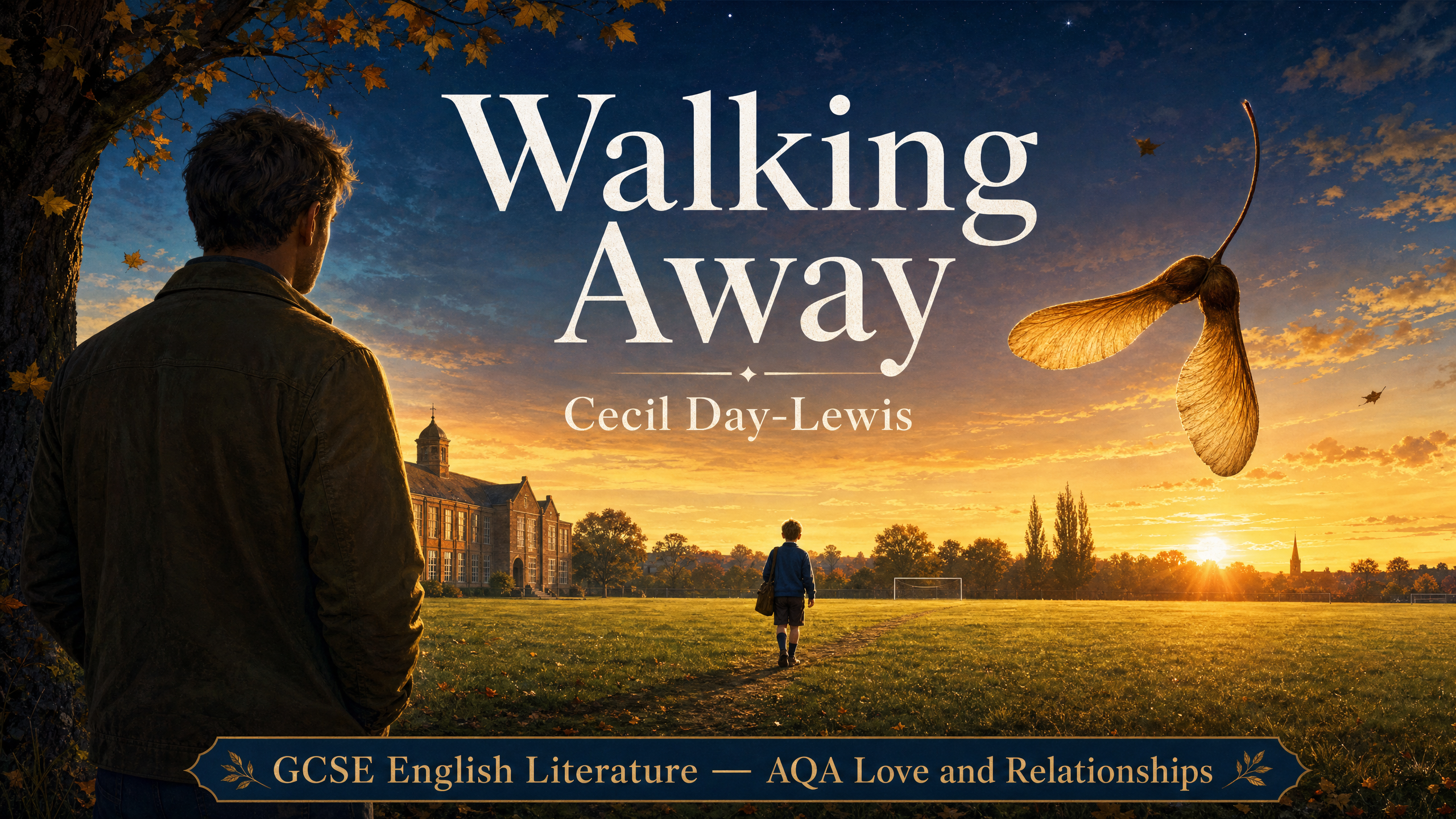
'Walking Away', written by Cecil Day-Lewis in 1962, is a poignant autobiographical poem dedicated to his eldest son, Sean. It recalls a memory from eighteen years prior, when the poet watched his young son walk across a school playing field at the start of term. This everyday moment of separation becomes a profound meditation on the nature of parental love, vulnerability, and the inevitable process of growing up. Examiners highly reward responses that recognise the universal themes beneath this personal memory. Strong candidates will trace the speaker's emotional journey from anxious observation to philosophical acceptance, paying close attention to the extended natural metaphors and the controlled, reflective structure.
Listen to our revision podcast for an in-depth breakdown:
Plot/Content Overview
- Stanza 1: The speaker recalls a specific memory from 'eighteen years ago'—watching his son play in a football match and then walk away across the pitch.
- Stanza 2: The speaker uses the modern metaphor of a 'satellite wrenched from its orbit' to describe the sudden, painful separation of the child from the parent's protective sphere.
- Stanza 3: The imagery shifts to nature, comparing the boy to a 'half-fledged' bird and a 'winged seed', emphasising his vulnerability as he seeks independence.
- Stanza 4: The poem concludes with a philosophical reflection. The speaker admits the memory still 'gnaws' at him, but accepts that 'love is proved in the letting go'.
Themes
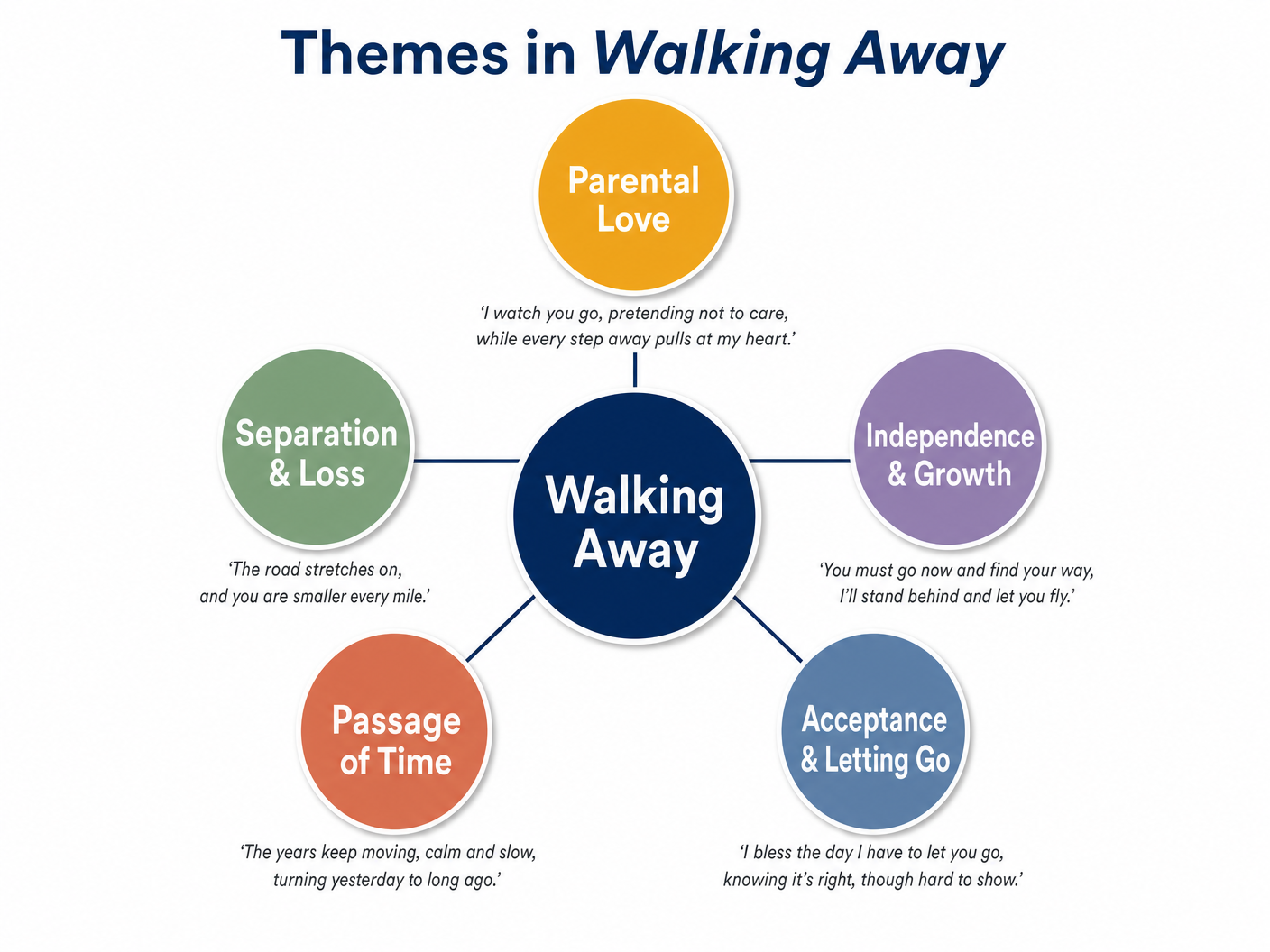
Theme 1: Parental Love and Letting Go
Day-Lewis presents parental love not as holding on, but as the painful act of releasing the child. The poem suggests that true love requires sacrifice—the parent must endure the pain of separation to allow the child to achieve 'selfhood'.
Key Quotes:
- "love is proved in the letting go" (Stanza 4) - This is the volta and central thesis of the poem. The verb 'proved' suggests love is a test that is passed through sacrifice.
- "gnaws at my mind still" (Stanza 4) - The animalistic verb 'gnaws' reveals the enduring, physical pain of this separation, highlighting the depth of the father's love.
Theme 2: Independence and Vulnerability
The child's journey toward independence is depicted as unsteady and fraught with danger. The speaker feels a protective anxiety, seeing his son as fragile in the face of the wider world.
Key Quotes:
- "Like a winged seed loosened from its parent stem" (Stanza 3) - The sycamore seed simile shows that leaving is natural and necessary for growth, but also leaves the child at the mercy of the elements.
- "find no path where the path should be" (Stanza 3) - The repetition of 'path' emphasises the lack of clear direction in growing up, highlighting the child's vulnerability.
Theme 3: The Passage of Time
Time is presented as an unstoppable force. The memory has survived for eighteen years, showing how a single moment of realisation can crystallise in the mind forever.
Key Quotes:
- "It is eighteen years ago, almost to the day" (Stanza 1) - The precision of this opening line demonstrates how deeply etched this memory is, while also emphasising the long span of time that has passed.
Writer's Methods
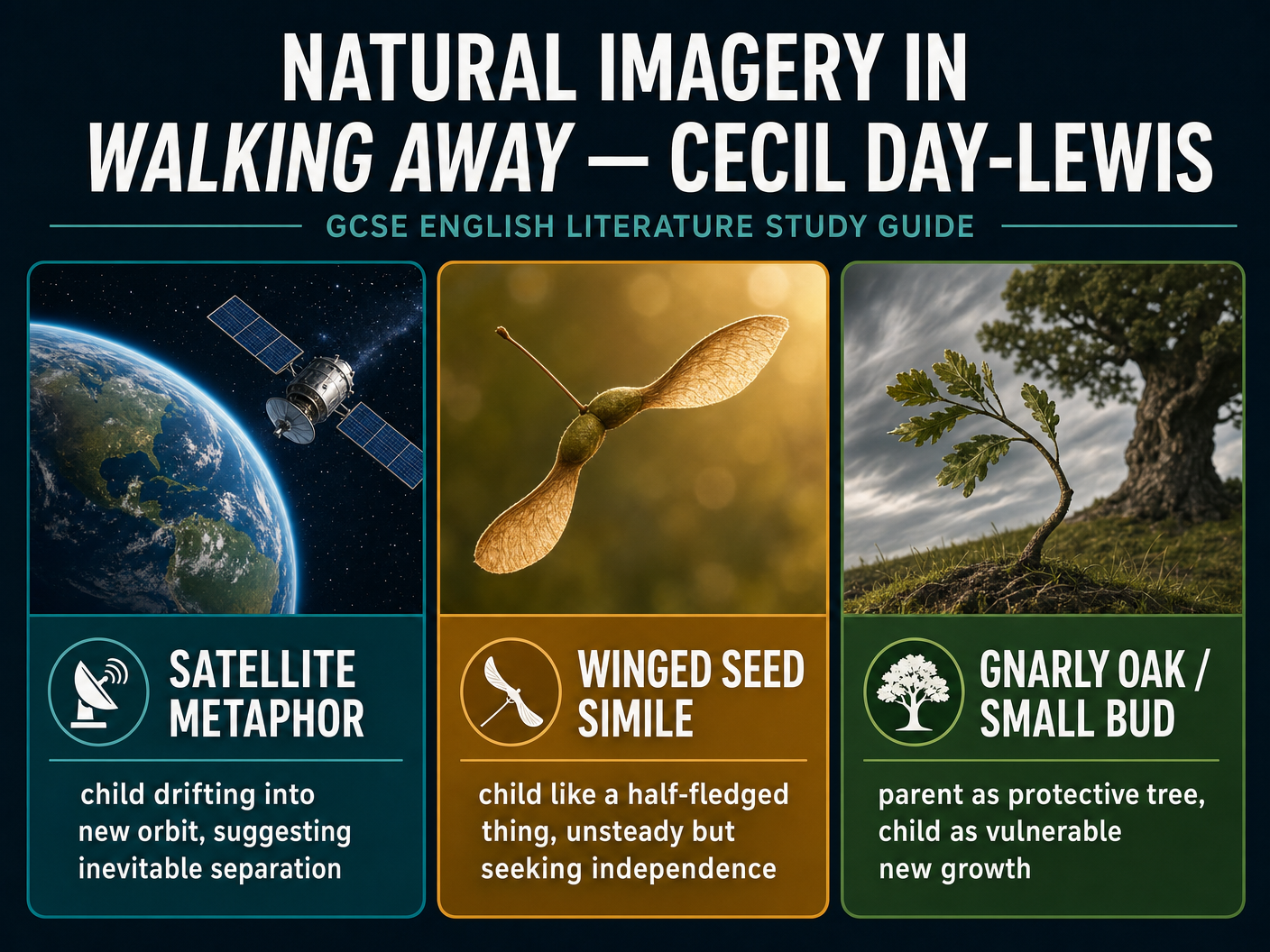
Imagery and Metaphor
Day-Lewis juxtaposes modern and natural imagery to convey the complexity of separation. The 'satellite / Wrenched from its orbit' (AO2) is a violent, modern image suggesting an unnatural break in gravity. This contrasts with the 'winged seed' and 'half-fledged thing' (AO2), which frame the separation as a natural, biological imperative. Examiners reward analysis of this contrast: the separation feels violently unnatural to the father (the satellite), but is entirely natural for the child (the seed).
Structure and Form
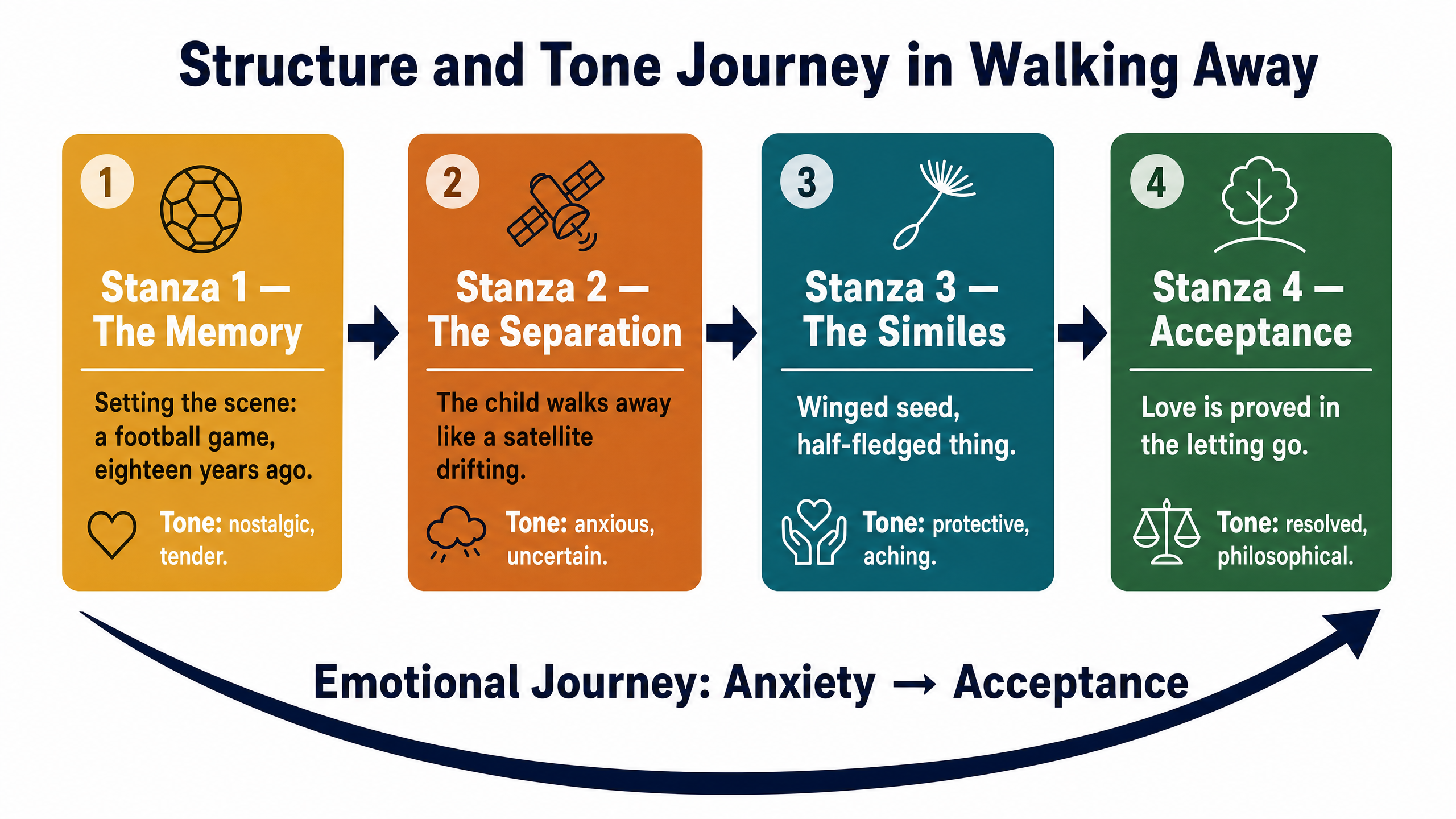
The poem consists of four steady, five-line stanzas with an ABACA rhyme scheme. This highly controlled structure reflects the father's attempt to impose order on his difficult emotions. The consistent rhythm mirrors the steady, inevitable passage of time and the child's footsteps walking away. However, the heavy use of enjambment (lines running into one another) subverts this control, reflecting the unstoppable flow of time and the lingering, unresolved nature of the father's anxiety.
Context
Cecil Day-Lewis was Poet Laureate of the UK from 1968 until his death. Writing 'Walking Away' in the early 1960s, he drew upon contemporary events—such as the space race—to inform his imagery ('satellite'). However, the core of the poem is deeply personal and autobiographical, addressed to his firstborn son, Sean. For AO3 (Context), examiners do not want bolted-on biographical facts. Instead, they want you to recognise how this personal, autobiographical context enhances the emotional authenticity of the poem, elevating a specific 1960s memory into a universal truth about parenthood.
Visual Resources
3 diagrams and illustrations
Interactive Diagrams
1 interactive diagram to visualise key concepts
Conceptual Flow Outline
The emotional trajectory of the speaker in Walking Away
Worked Examples
1 detailed example with solutions and examiner commentary
Practice Questions
Test your understanding — click to reveal model answers
Compare how poets present family relationships in 'Walking Away' and one other poem from 'Love and Relationships'.
Hint: Consider using 'Eden Rock' (idealised, peaceful family relationship vs painful separation) or 'Mother, Any Distance' (similar theme of letting go but from the child's perspective).
How does Cecil Day-Lewis use natural imagery to explore feelings of separation in 'Walking Away'?
Hint: Focus on the 'winged seed', the 'half-fledged thing', and the 'wilderness'.