War Photographer
Carol Ann Duffy's 'War Photographer' offers a profound exploration of the ethics of witnessing conflict. This poem rewards detailed study because it brilliantly contrasts the unimaginable trauma of war with the comfortable indifference of the Western public, making it a perfect text for exploring themes of suffering, duty, and media desensitisation.
Study Notes
Overview
'War Photographer' by Carol Ann Duffy is a devastating critique of how modern society consumes images of conflict. Published in 1985 in the collection Standing Female Nude, the poem adopts the persona of a photojournalist returning to rural England to develop images of war. Examiners highly reward candidates who recognise the tension between the photographer's professional detachment and his underlying moral distress. Top-band responses consistently explore how Duffy uses the structured form of the poem to mirror the photographer's attempt to impose order on the chaos of human suffering.
Listen to our comprehensive 10-minute podcast guide for an in-depth walkthrough of the poem:
Plot/Content Overview
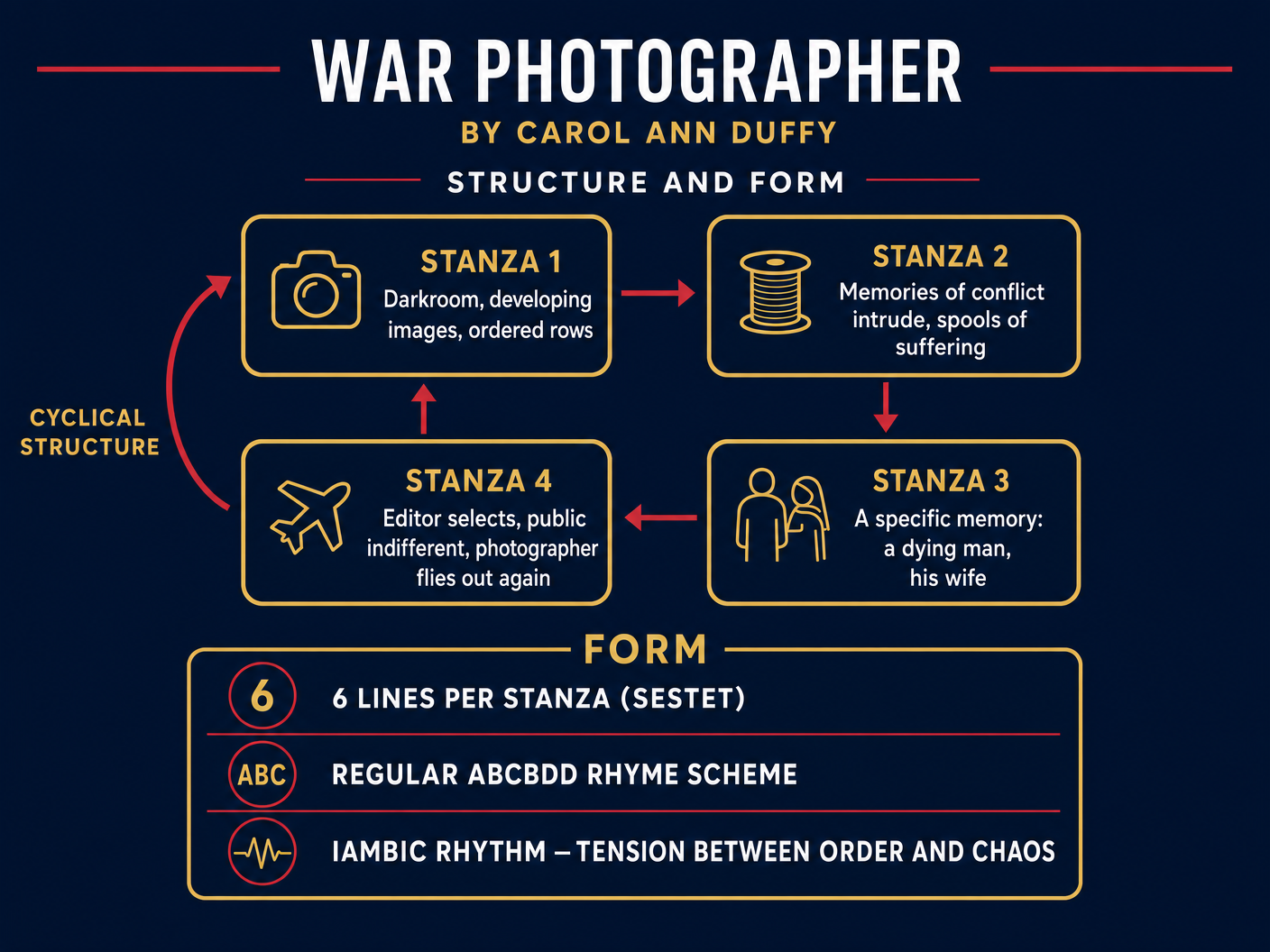
- Stanza 1: The photographer is alone in his darkroom, beginning the ritualistic process of developing his film. He is compared to a priest, elevating his work to a solemn duty.
- Stanza 2: The process triggers traumatic memories. The contrast between the horrors of the conflict zones and the safety of "Rural England" is starkly drawn.
- Stanza 3: A specific memory materialises as a photograph develops: a dying man and the cries of his wife. The photographer's suppressed emotions surface as his hands begin to tremble.
- Stanza 4: The photographs are sent to an editor who selects a few for the Sunday supplement. The public reacts with momentary, shallow emotion before returning to their comfortable lives. The photographer departs for his next assignment, isolated and resigned.
Themes
Theme 1: Conflict and Human Suffering
Duffy does not shy away from the brutal reality of war. The suffering is both physical and psychological, and it is presented as inescapable and overwhelming.
Key Quotes:
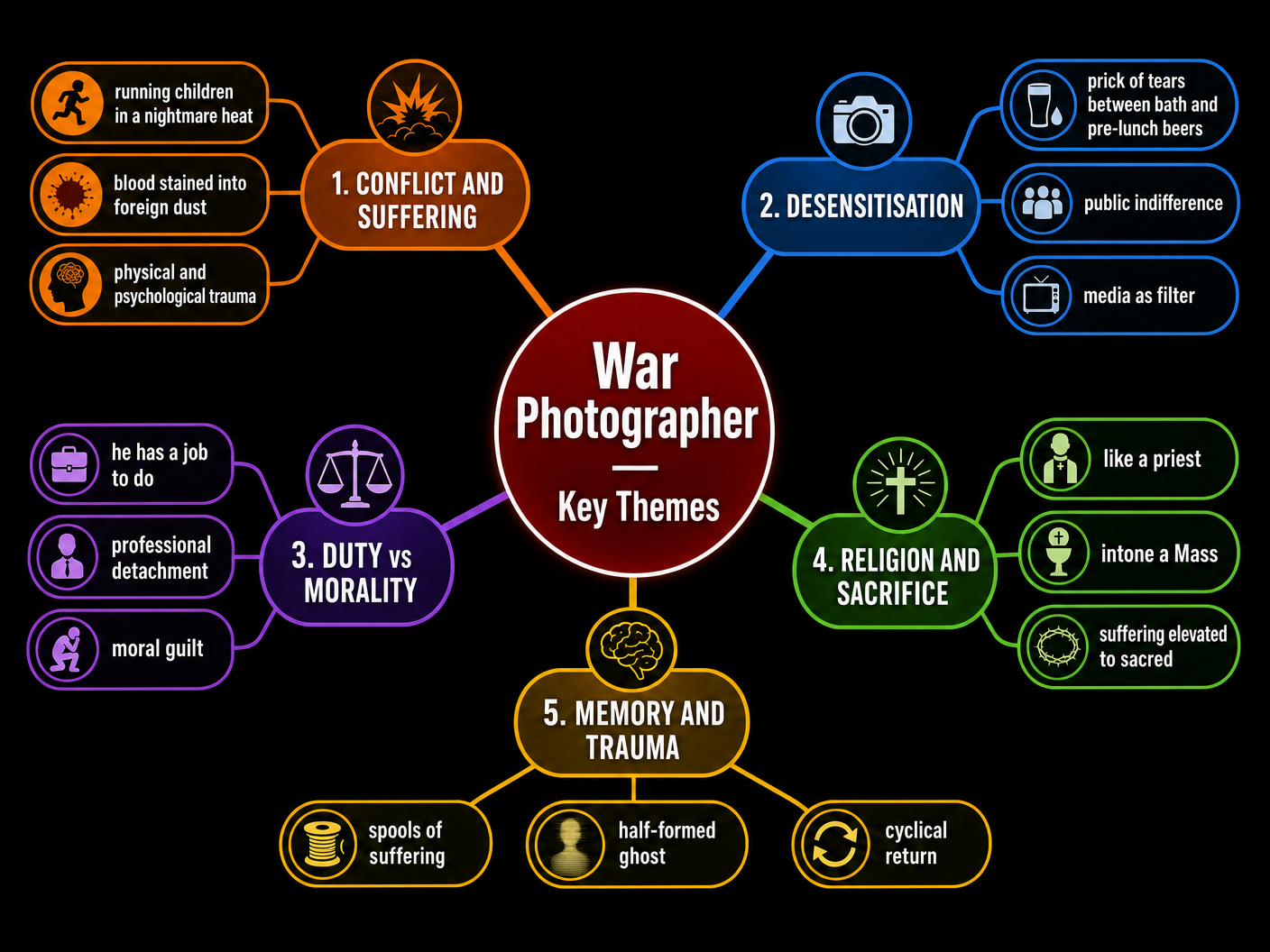
- "spools of suffering set out in ordered rows" (Stanza 1) - The metaphor suggests trauma has been commodified and mechanically processed. The sibilance creates a harsh, hissing sound.
- "running children in a nightmare heat" (Stanza 2) - A direct allusion to Nick Ut's famous 'Napalm Girl' photograph from the Vietnam War, grounding the poem in real historical trauma.
- "blood stained into foreign dust" (Stanza 3) - A bleak image of permanence and loss; the suffering is absorbed into the earth and forgotten.
Theme 2: Public Indifference and Desensitisation
The poem fiercely critiques the Western public's inability to truly engage with the suffering of others. The media acts as a filter, reducing complex human tragedy to weekend entertainment.
Key Quotes:
- "Rural England. Home again / to ordinary pain" (Stanza 2) - The deliberate bathos contrasts the minor inconveniences of English life with the agony of war.
- "The reader's eyeballs prick / with tears between the bath and pre-lunch beers" (Stanza 4) - The internal rhyme of 'tears' and 'beers' trivialises the emotional response. The word "prick" suggests a tiny, momentary discomfort rather than genuine empathy.
Theme 3: Duty, Morality, and the Role of the Observer
The photographer exists in a liminal space: he is a witness to horror but cannot intervene. He is burdened by guilt but bound by professional duty.
Key Quotes:
- "as though this were a church and he / a priest preparing to intone a Mass" (Stanza 1) - The simile elevates his role to a sacred duty; he is a mediator between the suffering and the safe.
- "his hands, which did not tremble then / though seem to now" (Stanza 3) - The physical manifestation of suppressed trauma. His professional detachment is breaking down in the safety of the darkroom.
- "he has a job to do" (Stanza 1) - A simple, declarative statement that highlights the tension between moral responsibility and professional obligation.
Writer's Methods
Form and Structure: The poem is written in four six-line stanzas (sestets) with a regular ABCBDD rhyme scheme. This rigid, ordered structure mirrors the photographer's attempt to maintain professional composure and impose order on the chaos of war. However, the use of enjambment and caesura throughout creates a disjointed rhythm, reflecting his internal emotional turmoil breaking through the facade.
Language and Imagery: Duffy relies heavily on religious imagery ("priest", "Mass", "Belfast. Beirut. Phnom Penh.") to suggest the solemnity of the photographer's task. The language shifts between the clinical terminology of photography ("solutions slop in trays") and visceral descriptions of violence ("half-formed ghost").
Context
Written in the mid-1980s, the poem responds to an era of highly visible photojournalism covering conflicts like the Vietnam War, the Troubles in Northern Ireland, and the Lebanese Civil War. Duffy was a friend of Don McCullin, a famous war photographer, which informed her understanding of the psychological toll of the profession. Examiners expect candidates to use this context to explore the ethics of capturing suffering on film.
Interactive Diagrams
1 interactive diagram to visualise key concepts
Conceptual Flow Outline
The Cyclical Structure of War Photographer
Worked Examples
1 detailed example with solutions and examiner commentary
Practice Questions
Test your understanding — click to reveal model answers
Compare how poets present the reality of conflict in 'War Photographer' and one other poem from your anthology.
Hint: Consider comparing with 'Remains' (for psychological impact) or 'Charge of the Light Brigade' (for contrasting views of duty and reality). Focus heavily on AO2 (methods).
How does Duffy use language and structure to present the photographer's sense of isolation?
Hint: Look at the first and last stanzas. How does his physical isolation in the darkroom reflect his emotional isolation from the public?