Study Notes
Overview
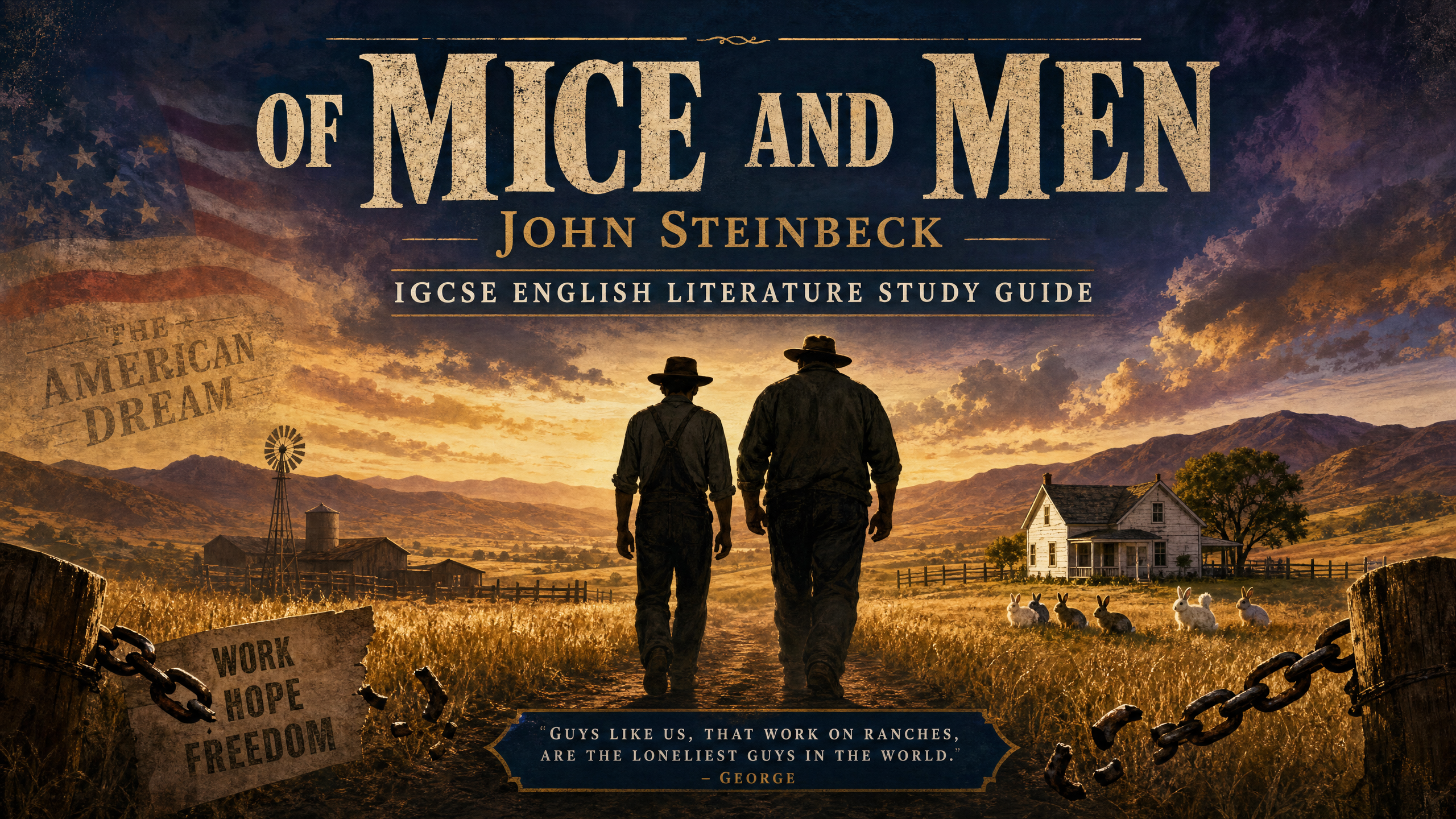
'Of Mice and Men' is a seminal 1937 novella by John Steinbeck, set against the unforgiving backdrop of the Great Depression in California. The narrative follows two displaced migrant workers, George Milton and Lennie Small, as they navigate a hostile world in pursuit of their shared dream: owning a small piece of land. For Cambridge IGCSE, examiners are looking for a sophisticated understanding of how Steinbeck constructs this tragic narrative. Candidates must demonstrate perceptive engagement with the text's pervasive themes of loneliness, the futility of the American Dream, and the vulnerability of the marginalised. High-level responses will seamlessly integrate contextual knowledge (AO3) with close analysis of Steinbeck's linguistic choices and structural framing (AO2).
Plot/Content Overview
Section 1: George and Lennie camp by a pool near the Salinas River. We learn of their dream to own a farm and Lennie's obsession with petting soft things, which caused trouble in Weed.
Section 2: They arrive at the ranch. We meet the other characters: Candy (the old swamper), the Boss, Curley (the aggressive son), Curley's Wife, Slim (the respected jerkline skinner), and Carlson.
Section 3: George confides in Slim about Weed. Carlson shoots Candy's old dog. Candy overhears George and Lennie's dream and offers his life savings to join them, making the dream seem suddenly achievable. Lennie crushes Curley's hand in a fight.
Section 4: Lennie visits Crooks, the isolated Black stable buck, in his room. Candy joins them. Curley's Wife enters and threatens Crooks, shattering the brief moment of shared hope among the outcasts.
Section 5: In the barn, Lennie accidentally kills his puppy. Curley's Wife offers him her soft hair to stroke; when he panics, he accidentally breaks her neck. Lennie flees to the brush.
Section 6: Back at the pool, George finds Lennie before the lynch mob arrives. George distracts Lennie with the story of their dream farm and shoots him in the back of the head, an act of tragic mercy.
Themes
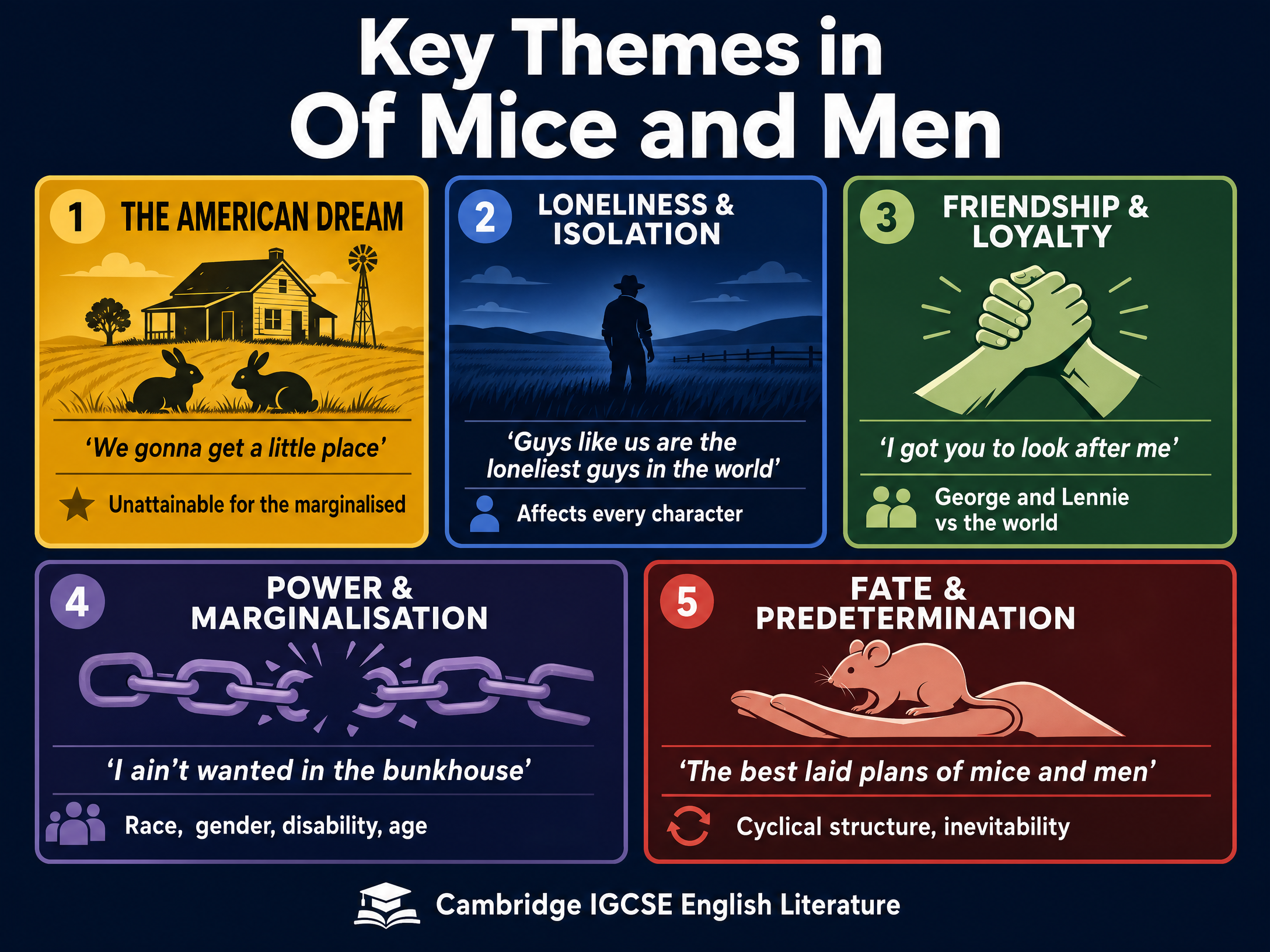
Theme 1: The American Dream
The American Dream is presented not as a realistic goal, but as a necessary illusion that sustains the characters through unbearable hardship. Steinbeck suggests that for the working class and marginalised, the dream is inherently unattainable. The dream farm acts as a motif of hope, but the cyclical structure of the novella predetermines its failure.
Key Quotes:
- "We gonna have a little house and a couple of acres an' a cow and some pigs" (Section 1) - The repetition of this vision gives it the quality of a ritualistic chant rather than a practical plan.
- "Nobody never gets to heaven, and nobody gets no land." (Section 4) - Crooks acts as the cynical voice of reality, exposing the futility of their aspirations.
Theme 2: Loneliness and Isolation
Steinbeck portrays loneliness as a systemic condition of the 1930s migrant worker lifestyle, exacerbated by societal prejudices. Almost every character suffers from profound isolation, seeking connection but finding it impossible to sustain in a competitive, harsh environment.
Key Quotes:
- "Guys like us, that work on ranches, are the loneliest guys in the world." (Section 1) - George explicitly states the central thesis of the text; migrant workers are dispossessed and alienated.
- "I never get to talk to nobody. I get awful lonely." (Section 5) - Curley's Wife's tragic confession highlights how gender isolation is just as destructive as physical isolation.
Theme 3: Power and Marginalisation
The ranch operates as a microcosm of 1930s American society, strictly stratified by power. Characters are marginalised based on intelligence (Lennie), age/disability (Candy), race (Crooks), and gender (Curley's Wife). The tragedy stems from how the powerless turn on each other rather than uniting against the system.
Key Quotes:
- "They left all the weak ones here" (Section 4) - Curley's Wife accurately assesses the hierarchy, yet uses her racial privilege to assert power over Crooks, demonstrating the toxic nature of the hierarchy.
Character Analysis
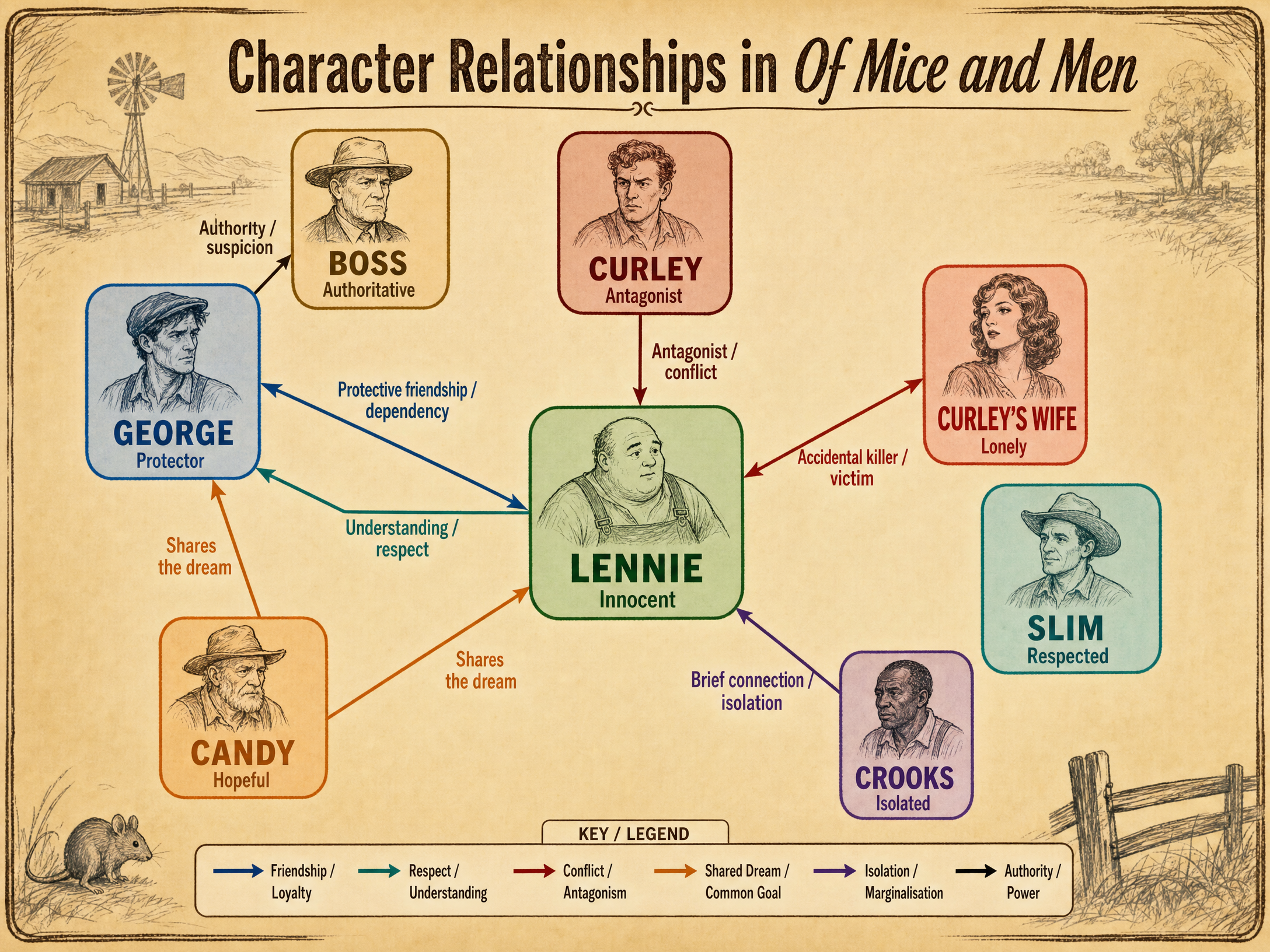
George Milton
Role: The pragmatic protector and the voice of reason.
Key Traits: Cautious, protective, burdened, realistic but susceptible to hope.
Character Arc: George moves from a burdened caretaker who believes the dream might be possible, to a tragic figure who must destroy his only companion, ultimately accepting his fate as just another lonely ranch worker.
Essential Quotes:
- "I could get along so easy and so nice if I didn't have you on my tail."
- "He's dumb as hell, but he ain't crazy."
Lennie Small
Role: The innocent catalyst for tragedy; the embodiment of physical power without intellectual control.
Key Traits: Childlike, physically immense, instinctively loyal, unable to comprehend social rules.
Character Arc: Lennie is static; he does not learn or develop, which is the root of his tragedy. His inability to control his strength inevitably leads to disaster.
Essential Quotes:
- "Make 'um stop, George."
- "I didn't wanta hurt him."
Curley's Wife
Role: The victim of gender marginalisation; a catalyst for the climax.
Key Traits: Lonely, naive, attention-seeking, trapped.
Character Arc: Initially presented as a "tart" through the men's biased perspective, Steinbeck gradually reveals her vulnerability and crushed dreams of Hollywood, making her death a dual tragedy.
Essential Quotes:
- "I tell you I ain't used to livin' like this. I coulda made somethin' of myself."
- "Think I don't like to talk to somebody ever' once in a while?"
Writer's Methods
Structural Circularity: The novella begins and ends in the exact same location (the pool by the Salinas River). This cyclical structure reinforces the theme of predetermination and the inescapable trap of the migrant worker's life.
Foreshadowing: Steinbeck heavily foreshadows the tragic climax. The death of Candy's dog mirrors Lennie's death (both shot in the back of the head by Carlson's Luger to end suffering). Lennie's accidental killing of mice and the puppy foreshadows the death of Curley's Wife.
Animal Imagery: Lennie is frequently described using animalistic metaphors ("like a bear drags his paws", "snorting into the water like a horse"). This highlights his reliance on instinct over intellect and his vulnerability in a human world.
Dialogue: Steinbeck uses authentic, ungrammatical vernacular to ground the characters in their social reality. The dialogue is sparse but loaded with subtext, revealing the men's emotional repression.
Context
The Great Depression & Dust Bowl: Following the 1929 Wall Street Crash, millions faced unemployment. Ecological disaster in the Midwest (the Dust Bowl) forced thousands of farmers to migrate to California seeking work. George and Lennie represent these dispossessed masses.
Social Darwinism: The 1930s saw a rise in 'survival of the fittest' ideologies. The ranch reflects this brutal reality, where weakness (Candy's age, Lennie's disability) is punished or discarded.
Jim Crow Era: Racial segregation was legally enforced in many states and socially enforced everywhere. Crooks' isolation in the harness room is a direct reflection of systemic racism.
Visual Resources
2 diagrams and illustrations
Interactive Diagrams
1 interactive diagram to visualise key concepts
Conceptual Flow Outline
The Cyclical Setting Structure of Of Mice and Men
Worked Examples
2 detailed examples with solutions and examiner commentary
Practice Questions
Test your understanding — click to reveal model answers
How does Steinbeck present the character of Candy and his importance in the novella? (30 marks)
Hint: Consider Candy's physical state, his relationship with his dog, his reaction to the dream, and what he represents about aging in 1930s society.
Explore how Steinbeck uses the setting of the ranch to highlight the harshness of 1930s society. (30 marks)
Hint: Look at the bunkhouse (lack of privacy), the harness room (segregation), and the contrast with the natural world outside.
How does Steinbeck present Curley as an antagonist? (30 marks)
Hint: Focus on his physical description, his body language, his insecurities about his wife, and his abuse of power.
Explore the significance of the ending of the novella. (30 marks)
Hint: Consider the cyclical setting, George's moral dilemma, the death of the dream, and Carlson's final comment.