
Pride and Prejudice
Click to watch full video explainer
Study Notes
Overview
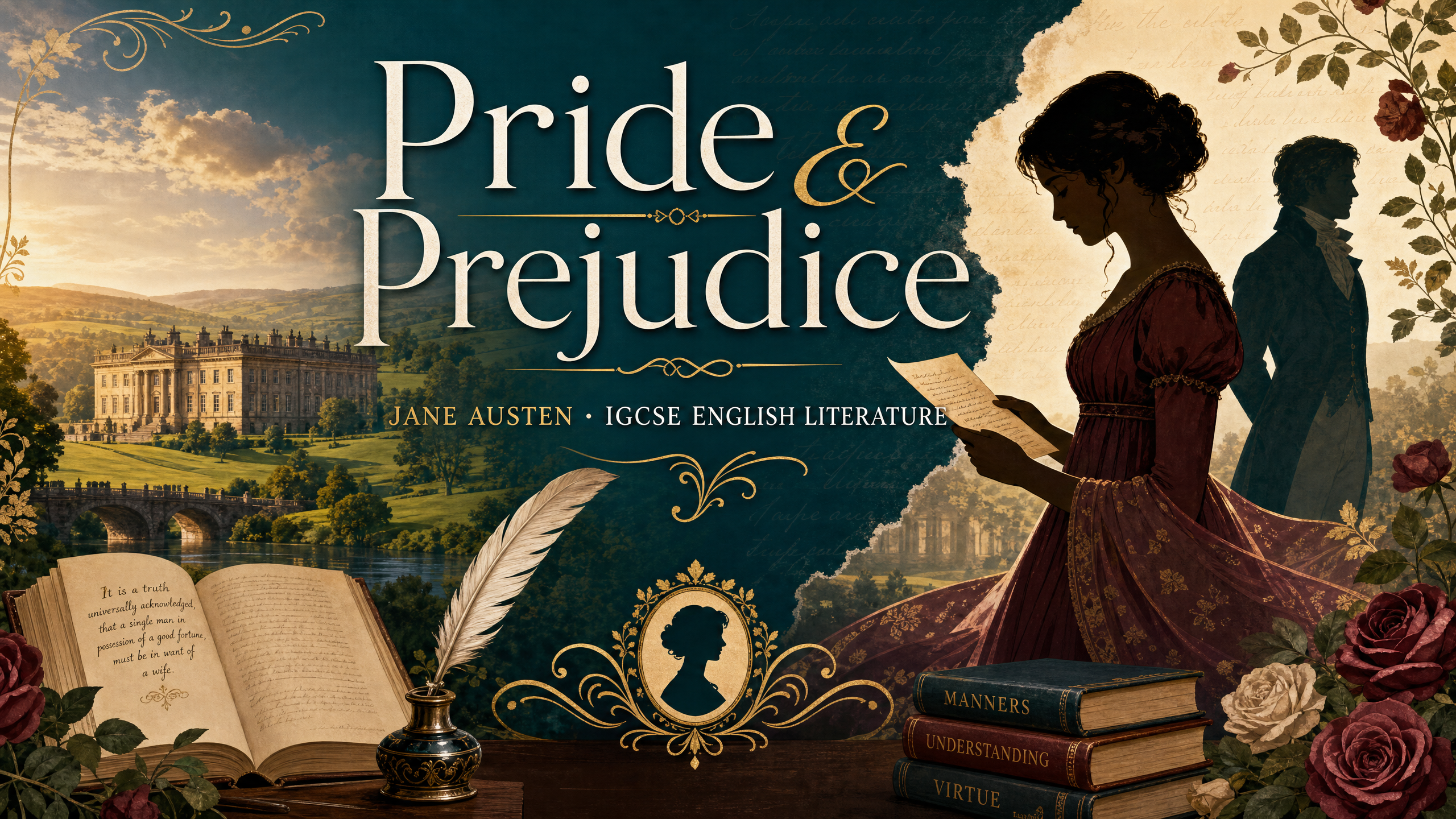
Pride and Prejudice (1813) is a masterclass in social satire and narrative technique. For Cambridge IGCSE, examiners expect you to move beyond the central romance and analyse how Austen uses the marriage plot to critique the economic and social realities of Regency England. You will be rewarded for exploring Austen's sophisticated narrative methods, particularly her use of irony and free indirect discourse, and for showing how historical context—specifically the legal and financial vulnerability of women—drives the characters' actions.
Listen to the revision podcast below for a comprehensive overview of the text:
Plot/Content Overview
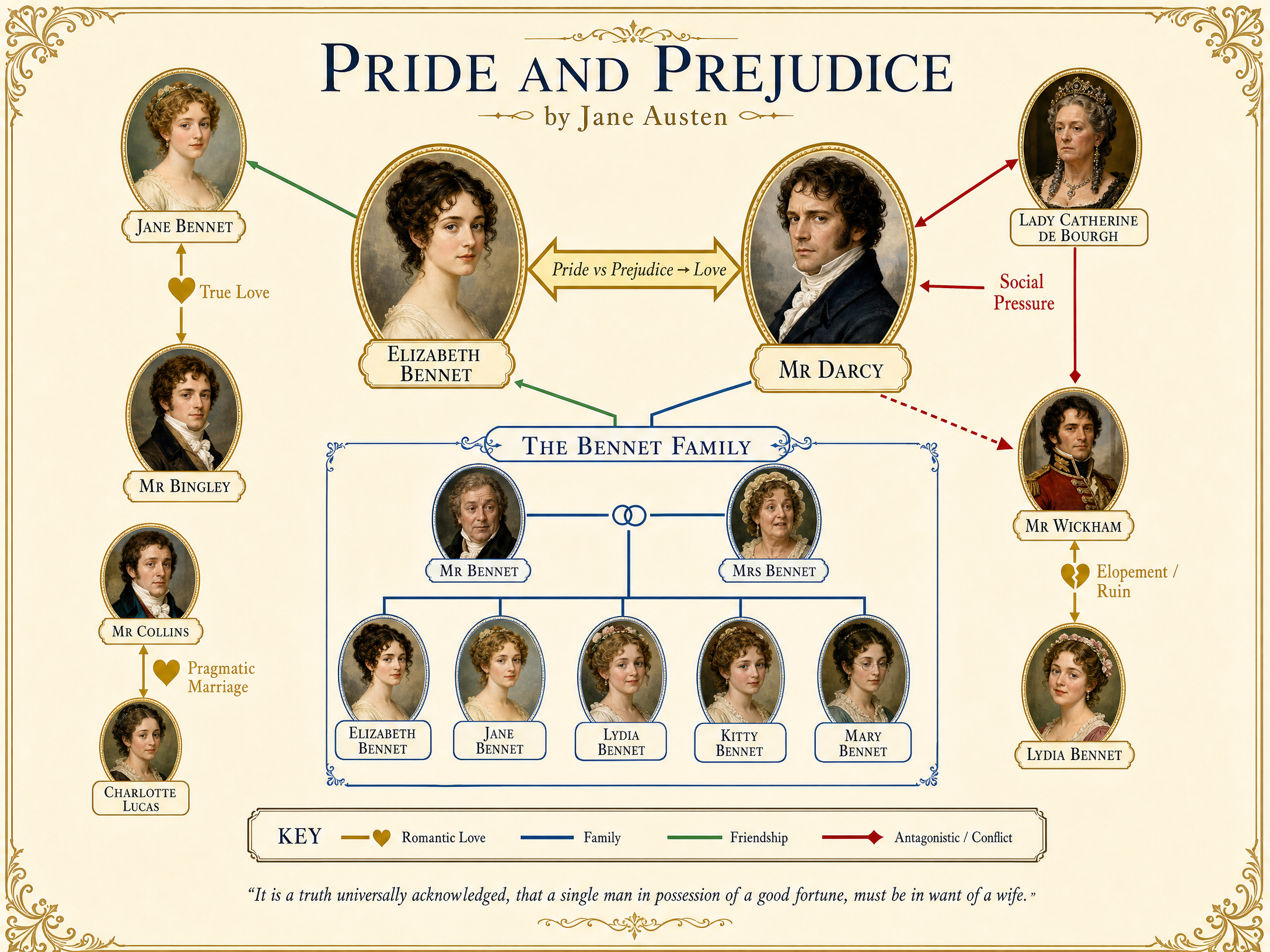
- Chapters 1-12: The novel opens at Longbourn. Mr Bingley arrives at Netherfield, bringing his proud friend Mr Darcy. Bingley is drawn to Jane Bennet, while Darcy insults Elizabeth, establishing the titular prejudice.
- Chapters 13-23: Mr Collins, the heir to the Bennet estate, arrives and proposes to Elizabeth. She refuses, but her pragmatic friend Charlotte Lucas accepts him.
- Chapters 24-38: Jane's heart is broken when Bingley leaves abruptly. Elizabeth visits Charlotte and encounters Darcy, who disastrously proposes. His explanatory letter forces Elizabeth to re-evaluate her judgements.
- Chapters 39-45: Elizabeth tours Derbyshire and visits Pemberley, Darcy's estate. She sees a softer side to him, and her feelings begin to change.
- Chapters 46-61: Lydia elopes with Wickham, threatening the family with ruin. Darcy secretly intervenes, paying Wickham to marry her. Bingley returns to Jane, and Lady Catherine's attempt to intimidate Elizabeth ironically gives Darcy the hope to propose again. Both couples marry.
Themes
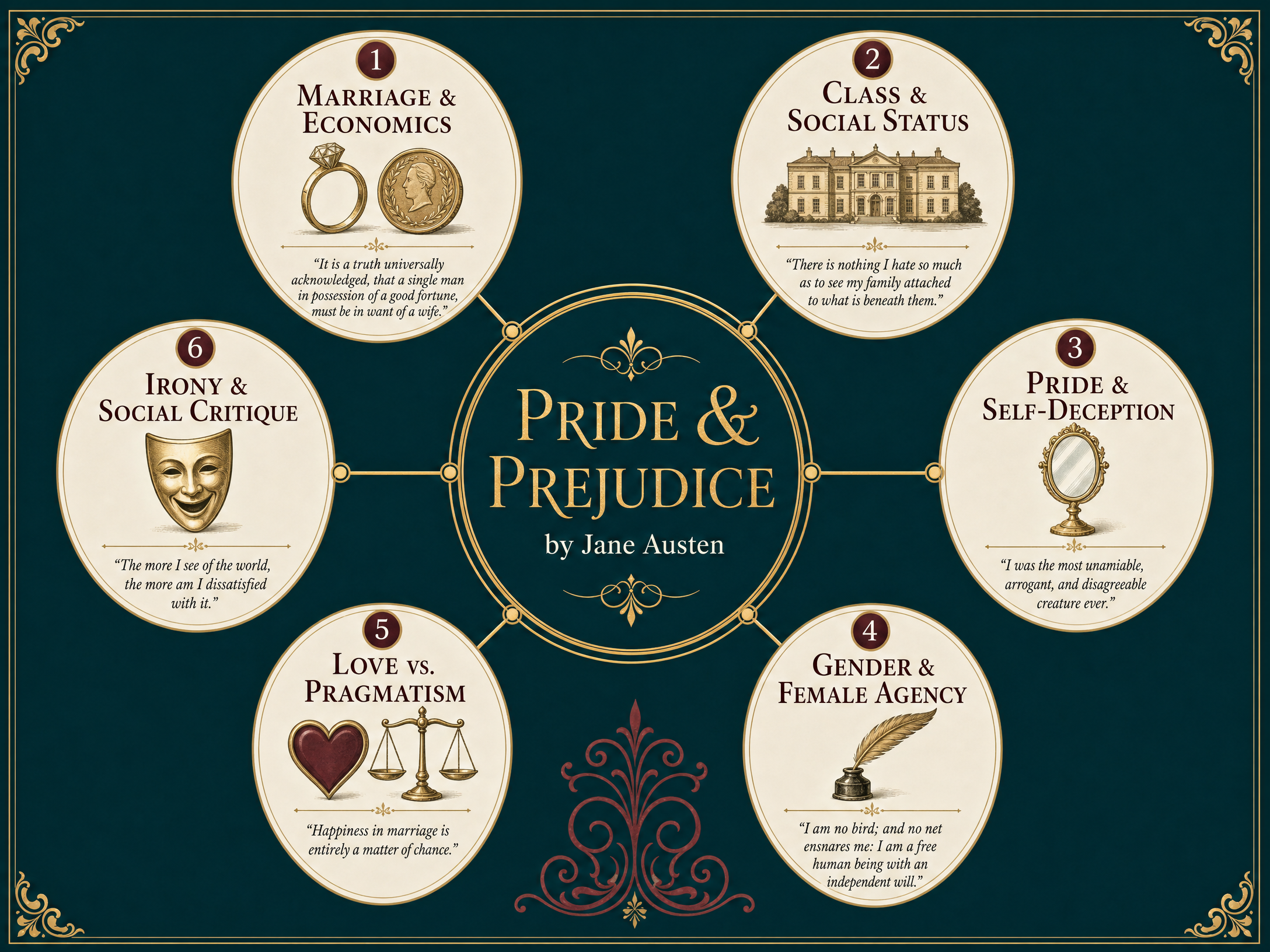
Theme 1: Marriage and Economics
Austen presents marriage not merely as a romantic ideal, but as an economic necessity for women in a society where they cannot inherit property. The spectrum of marriages in the novel—from Charlotte's pragmatism to Lydia's recklessness—serves as a critique of a system that reduces women to commodities.
Key Quotes:
- "It is a truth universally acknowledged, that a single man in possession of a good fortune, must be in want of a wife." (Chapter 1) - Austen's opening irony exposes the mercenary nature of the marriage market.
- "I am not romantic, you know. I never was. I ask only a comfortable home." (Chapter 22) - Charlotte Lucas articulates the grim reality of female economic dependence.
Theme 2: Pride and Self-Deception
The novel explores how pride blinds characters to the truth about themselves and others. Both Darcy and Elizabeth must overcome their respective flaws—his aristocratic arrogance and her intellectual vanity—before they can unite.
Key Quotes:
- "I could easily forgive his pride, if he had not mortified mine." (Chapter 5) - Elizabeth acknowledges the personal nature of her prejudice.
- "How despicably I have acted! I, who have prided myself on my discernment!" (Chapter 36) - Elizabeth's moment of self-recognition highlights the danger of intellectual pride.
Theme 3: Class and Social Status
Austen critiques the rigid class hierarchy of Regency England, exposing the vulgarity of the supposedly superior upper classes (like Lady Catherine) and defending the dignity of the middle class.
Key Quotes:
- "He is a gentleman; I am a gentleman's daughter; so far we are equal." (Chapter 56) - Elizabeth asserts her fundamental equality with Darcy against Lady Catherine's snobbery.
Character Analysis
Elizabeth Bennet
Role: The protagonist; the moral and intellectual centre of the novel.
Key Traits: Witty, independent, observant, but prone to hasty judgements.
Character Arc: Elizabeth moves from intellectual arrogance and prejudice to profound self-awareness and humility.
Essential Quotes:
- "There is a stubbornness about me that never can bear to be frightened at the will of others."
- "Till this moment I never knew myself."
Fitzwilliam Darcy
Role: The aristocratic male lead; Elizabeth's foil and eventual husband.
Key Traits: Proud, reserved, fiercely loyal, socially awkward.
Character Arc: Darcy learns to temper his aristocratic pride and value individual merit over social rank.
Essential Quotes:
- "My good opinion once lost is lost forever."
- "You taught me a lesson, hard indeed at first, but most advantageous. By you, I was properly humbled."
Mr Collins
Role: The comic antagonist; a vehicle for Austen's satire of sycophancy and the clergy.
Key Traits: Pompous, obsequious, materialistic, utterly lacking in self-awareness.
Essential Quotes:
- "I consider the clerical office as equal in point of dignity with the highest rank in the kingdom."
Writer's Methods
Austen's primary tool is irony. She uses verbal irony (saying the opposite of what is meant) and situational irony to expose the hypocrisy of her society. Her use of free indirect discourse allows her to blend the narrator's voice with the characters' thoughts, creating a tone that is simultaneously sympathetic and satirical. The novel's epistolary elements (letters) serve as crucial structural devices, allowing characters to reveal their true selves without the constraints of social conversation.
Context
Examiners expect you to integrate context into your analysis. The most crucial context is the legal and economic status of women. The entailment of the Bennet estate means the daughters cannot inherit; their only path to financial security is marriage. Austen is writing during the Regency period, a time of rigid social hierarchy but also emerging social mobility. Her focus on the minor gentry (the Bennets) interacting with the upper aristocracy (Darcy) reflects these shifting dynamics.
Visual Resources
2 diagrams and illustrations
Interactive Diagrams
1 interactive diagram to visualise key concepts
Conceptual Flow Outline
The parallel character arcs of Elizabeth and Darcy
Worked Examples
2 detailed examples with solutions and examiner commentary
Practice Questions
Test your understanding — click to reveal model answers
Explore how Austen presents the theme of social class in Pride and Prejudice. (30 marks + 4 AO4)
Hint: Consider how different characters (Lady Catherine, Mr Collins, Darcy, Elizabeth) view class, and how Austen uses satire to mock class snobbery.
How does Austen present the relationship between Jane and Bingley? (30 marks + 4 AO4)
Hint: Contrast their relationship with Elizabeth and Darcy's. Think about how their passive natures make them vulnerable to the interference of others.
Explore the significance of the setting of Pemberley in the novel. (30 marks + 4 AO4)
Hint: Pemberley is not just a house; it is a physical manifestation of Darcy's true character.
Starting with this extract (Mr Collins's proposal, Chapter 19), explore how Austen presents attitudes to marriage. (30 marks + 4 AO4)
Hint: Use the extract to show marriage as a transaction, then contrast this with Elizabeth's views elsewhere in the novel.