A Midsummer Night's Dream
A Midsummer Night's Dream is Shakespeare's most enchanting comedy, intertwining the strict rules of Athens with the magical chaos of the fairy forest. Studying this play rewards candidates who can unpick the irrationality of love, the blur between illusion and reality, and the sophisticated use of dramatic irony.
Study Notes
Overview
A Midsummer Night's Dream offers a vibrant exploration of love's complexities, examining its irrationality, transformative power, and susceptibility to illusion. Shakespeare masterfully intertwines the human and supernatural realms, using the magical forest as a catalyst for comedic chaos and profound self-discovery. Cambridge IGCSE examiners reward candidates who demonstrate a clear understanding of Shakespeare's dramatic methods—such as dramatic irony, juxtaposition, and structural contrast—rather than merely recounting plot points. Strong responses will explore how Shakespeare creates meaning through language and form, and how the play reflects and challenges Elizabethan social norms.
Plot/Content Overview
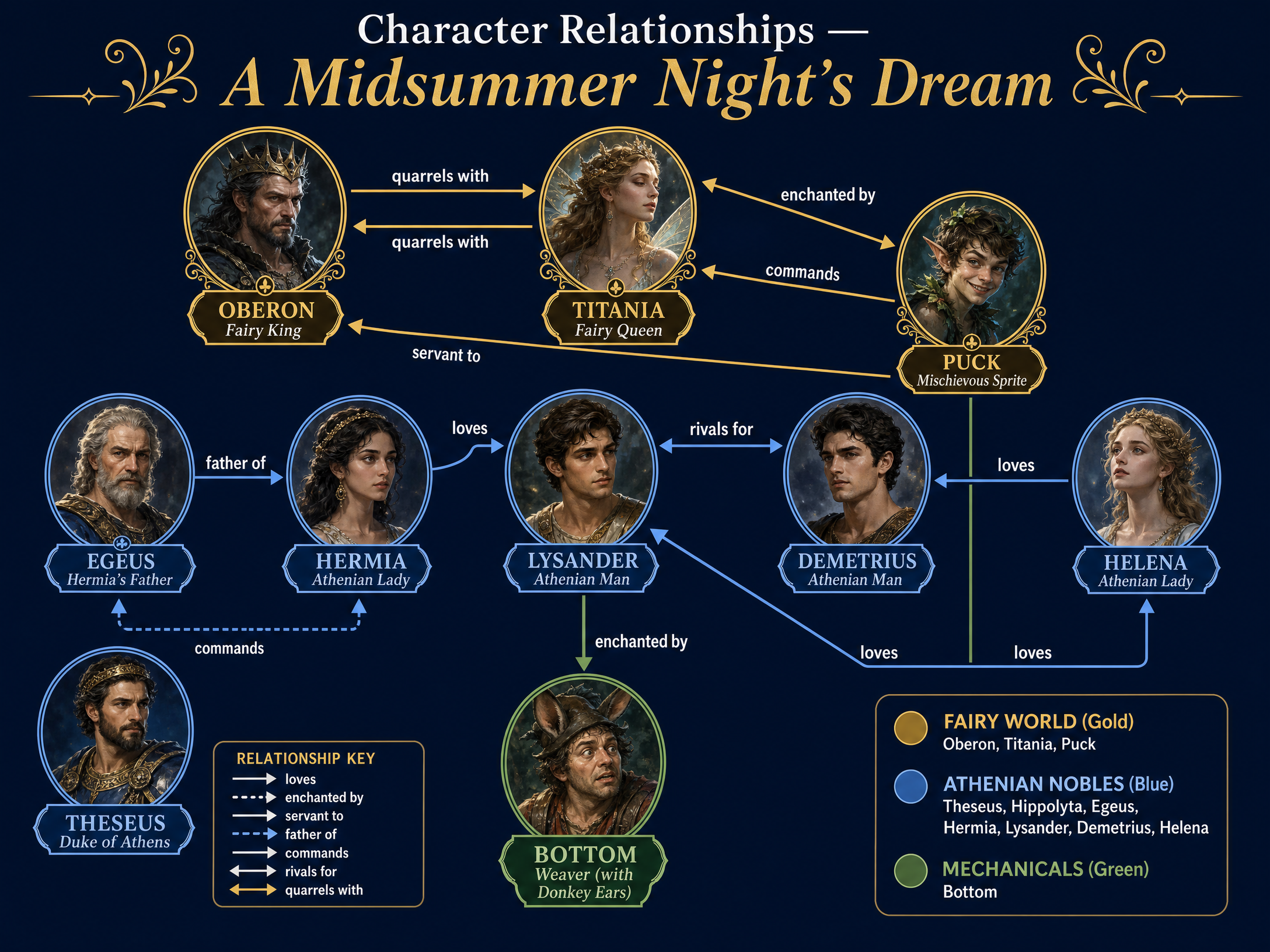
Act 1: The Athenian LawTheseus, Duke of Athens, prepares to marry Hippolyta. Egeus complains that his daughter, Hermia, refuses to marry Demetrius, loving Lysander instead. Theseus gives Hermia a stark choice: marry Demetrius, face death, or become a nun. Hermia and Lysander plan to elope through the forest. They tell Helena, who loves Demetrius; she decides to tell Demetrius to win his favour. Meanwhile, a group of tradesmen (the Mechanicals), led by Peter Quince and featuring Bottom, plan to rehearse a play for the Duke's wedding.
Act 2: The Fairy ForestIn the forest, Oberon (Fairy King) and Titania (Fairy Queen) are quarrelling over a changeling boy. Oberon orders his servant, Puck, to fetch a magical flower; its juice, placed on sleeping eyelids, makes the victim fall in love with the first living thing they see. Oberon plans to enchant Titania. Seeing Demetrius reject Helena, Oberon tells Puck to enchant Demetrius too. Puck mistakenly enchants Lysander, who wakes, sees Helena, and falls madly in love with her, abandoning Hermia.
Act 3: Chaos and TransformationThe Mechanicals rehearse in the forest. Puck magically gives Bottom a donkey's head. The others flee in terror. Titania wakes, sees Bottom, and falls in love with him. Meanwhile, Oberon realises Puck's mistake with the Athenians and enchants Demetrius to love Helena. Now both men pursue Helena, who thinks they are mocking her. Hermia feels betrayed. Puck leads the four exhausted lovers astray until they fall asleep, then applies the antidote to Lysander's eyes.
Act 4: ResolutionOberon, having obtained the changeling boy, removes the spell from Titania. They are reconciled. Puck removes Bottom's donkey head. Theseus, Hippolyta, and Egeus discover the sleeping lovers. Lysander now loves Hermia, and Demetrius loves Helena. Theseus overrules Egeus and declares they will all be married alongside him. Bottom wakes, believing his transformation was a bizarre dream.
Act 5: The Play and BlessingAt the wedding feast, the Mechanicals perform their hilariously inept play, Pyramus and Thisbe. After the mortals go to bed, the fairies arrive to bless the house and the marriages. Puck delivers the epilogue, suggesting the entire play was merely a dream.
Themes
Theme 1: Love and Irrationality
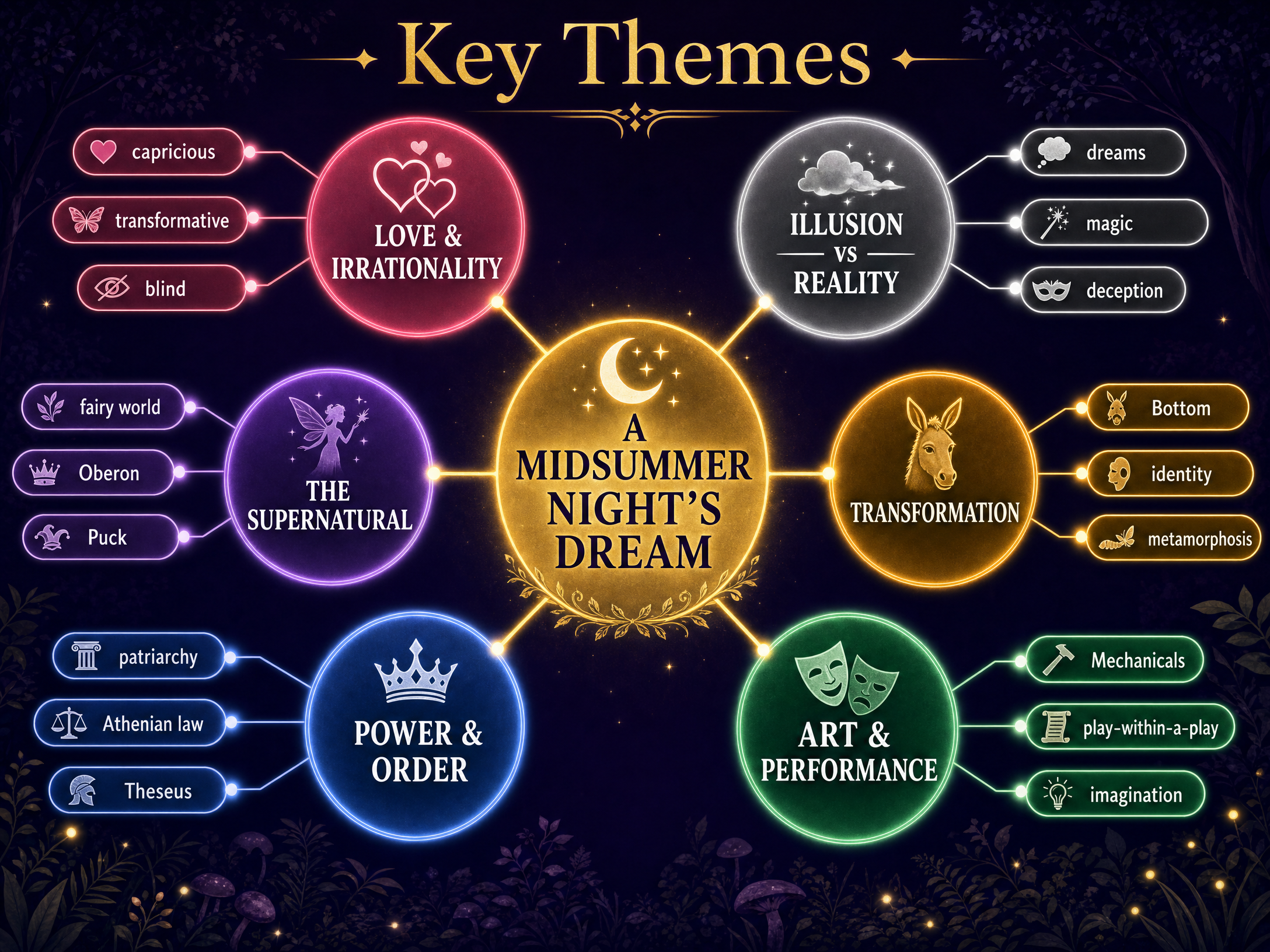
Shakespeare presents love not as a noble, rational choice, but as a capricious and irrational force that overrides reason. The love potion is the central dramatic device illustrating this: it literalises the way love can instantly and arbitrarily alter human behaviour. The shifting affections of the four lovers demonstrate that romantic attraction is often based on illusion rather than genuine substance.
Key Quotes:
- "Love looks not with the eyes, but with the mind, / And therefore is winged Cupid painted blind." (Helena, 1.1) - Analysis: Helena identifies that love is subjective and based on imagination (the "mind") rather than objective reality (the "eyes"). The personification of "blind" Cupid emphasises love's lack of judgement.
- "Reason and love keep little company together nowadays." (Bottom, 3.1) - Analysis: Ironically spoken by Bottom while wearing a donkey's head to the enchanted Titania, this encapsulates the play's central thematic truth: logic and romantic feeling are fundamentally opposed.
Theme 2: Illusion vs. Reality
The play constantly blurs the boundary between what is real and what is imagined. The forest setting functions as a liminal space where the rigid realities of Athenian law dissolve into magic and dreams. The frequent references to dreams suggest that the theatrical experience itself is an illusion, requiring the audience's willing suspension of disbelief.
Key Quotes:
- "I have had a most rare vision. I have had a dream, past the wit of man to say what dream it was." (Bottom, 4.1) - Analysis: Bottom's inability to articulate his experience highlights the limits of human reason when confronted with the supernatural. His "vision" transcends ordinary reality.
- "If we shadows have offended, / Think but this, and all is mended: / That you have but slumbered here / While these visions did appear." (Puck, 5.1) - Analysis: Puck's epilogue breaks the fourth wall, directly equating the play itself with a dream, challenging the audience to question the nature of reality and art.
Theme 3: Power, Order, and Patriarchy
The play contrasts the rigid, patriarchal order of Athens with the wild, fluid power dynamics of the forest. In Athens, Egeus views his daughter as property, a view upheld by the law. The forest provides a space where these oppressive social structures can be temporarily subverted, allowing for a more harmonious resolution.
Key Quotes:
- "As she is mine, I may dispose of her; / Which shall be either to this gentleman / Or to her death, according to our law." (Egeus, 1.1) - Analysis: Egeus's harsh, transactional language ("dispose") highlights the absolute power of the patriarchy in the Athenian setting. Hermia is treated as an object.
- "To you your father should be as a god." (Theseus, 1.1) - Analysis: Theseus reinforces the patriarchal hierarchy, equating paternal authority with divine right, setting up the conflict that drives the lovers into the forest.
Character Analysis
Puck (Robin Goodfellow)
Role: Oberon's jester and lieutenant; the catalyst for the play's comedic chaos.
Key Traits: Mischievous, amoral, energetic, observant.
Character Arc: Puck does not change; rather, he drives the changes in others. He observes human folly with detached amusement, serving as a bridge between the fairy world and the audience.
Essential Quotes:
- "Lord, what fools these mortals be!" (3.2) - Highlights his detached, mocking perspective on human irrationality.
- "I am that merry wanderer of the night." (2.1) - Establishes his identity as a chaotic, trickster figure associated with darkness and unpredictability.
Bottom
Role: A weaver and amateur actor; the comic focal point of the Mechanicals.
Key Traits: Arrogant, literal-minded, enthusiastic, surprisingly adaptable.
Character Arc: Bottom undergoes a literal physical transformation (gaining a donkey's head) and becomes the object of a fairy queen's desire, yet his fundamental personality remains entirely unchanged—he accepts the magical situation with supreme, comic confidence.
Essential Quotes:
- "Let me play the lion too. I will roar, that I will do any man's heart good to hear me." (1.2) - Demonstrates his comic overconfidence and desire to dominate the performance.
- "Methinks, mistress, you should have little reason for that. And yet, to say the truth, reason and love keep little company together nowadays." (3.1) - Provides profound thematic insight despite his ridiculous appearance.
Helena
Role: One of the four Athenian lovers; initially rejected by Demetrius.
Key Traits: Insecure, desperate, loyal, self-pitying.
Character Arc: Helena begins the play debasing herself for Demetrius's love. When magically pursued by both men, she believes it is a cruel joke, highlighting her deep-seated insecurity, before finally achieving the marriage she desired.
Essential Quotes:
- "I am your spaniel; and, Demetrius, / The more you beat me, I will fawn on you." (2.1) - Shows the degrading, desperate nature of her unrequited love.
- "O, when she's angry, she is keen and shrewd! / She was a vixen when she went to school." (3.2) - Reveals the breakdown of female friendship under the pressure of romantic rivalry.
Writer's Methods
Dramatic Irony: Shakespeare extensively uses dramatic irony to generate comedy and thematic depth. The audience knows the love potion is the cause of the lovers' erratic behaviour, while the characters believe their feelings are genuine. We also know Bottom has a donkey's head while he remains oblivious. This technique positions the audience alongside Puck, observing human folly from a position of superior knowledge.
Structural Contrast: The play is built on deliberate juxtapositions: the rigid daylight world of Athens vs. the fluid, magical night-time world of the forest; the formal blank verse of the nobles vs. the lyrical rhyming couplets of the fairies and the prose of the Mechanicals. These structural contrasts highlight the thematic conflict between order and chaos, reason and imagination.
The Play-Within-a-Play: The Mechanicals' performance of Pyramus and Thisbe is a meta-theatrical device. By presenting a tragically inept performance, Shakespeare satirises theatrical conventions and forces the audience to consider the nature of illusion. The tragedy of Pyramus and Thisbe mirrors what could have happened to Hermia and Lysander, highlighting the thin line between comedy and tragedy.
Imagery of Eyes and Sight: Shakespeare repeatedly uses imagery related to vision to explore the theme of illusion. Love is "blind"; the potion is applied to "eyes"; characters constantly misperceive reality. This motif reinforces the idea that human perception is flawed and easily manipulated.
Context
Elizabethan Patriarchy: The play reflects the strict patriarchal structure of Shakespeare's society, where fathers had significant legal and social control over their daughters' marriages. However, the play's comedic resolution subverts this, allowing the young lovers to marry for love, perhaps reflecting a tension between societal rules and individual desires in the period.
Belief in the Supernatural: While the fairy world is presented playfully, Elizabethan audiences had a much stronger cultural belief in folklore, magic, and the supernatural. Robin Goodfellow (Puck) was a well-known figure in English folklore. Shakespeare blends classical mythology (Theseus) with English country folklore (the fairies) to create a unique, magical atmosphere.
The Role of the Monarch: Theseus functions as an idealized ruler—ultimately merciful and capable of restoring order. This would have resonated with an Elizabethan audience, serving as a subtle compliment to Queen Elizabeth I, who maintained order and stability in England.
Visual Resources
2 diagrams and illustrations
Interactive Diagrams
1 interactive diagram to visualise key concepts
Conceptual Flow Outline
The Structural Arc of the Play
Worked Examples
2 detailed examples with solutions and examiner commentary
Practice Questions
Test your understanding — click to reveal model answers
How does Shakespeare present the power of magic in A Midsummer Night's Dream? (30 marks + 4 AO4)
Hint: Consider magic not just as a plot device, but as a metaphor for the unpredictability of love and the power of theatrical illusion.
Starting with Act 1 Scene 1 (lines 22-45, Egeus confronting Theseus), explore how Shakespeare presents the conflict between parents and children. (30 marks + 4 AO4)
Hint: Focus on the harsh, possessive language Egeus uses, and contrast this with Hermia's defiance. Link to the wider context of Elizabethan patriarchy.
How does Shakespeare present the differences between the Athenian court and the forest? (30 marks + 4 AO4)
Hint: Think about structure, rules, lighting (day vs night), and the type of language used by the characters in each setting.
Explore the significance of the play-within-a-play (Pyramus and Thisbe) in A Midsummer Night's Dream. (30 marks + 4 AO4)
Hint: Look beyond the comedy. How does the tragic story of Pyramus and Thisbe reflect the main plot? What is Shakespeare saying about theatre?